

Key Takeaways:
- Predictive Analytics in Real Estate helps businesses make informed decisions by analyzing historical data, market trends, and AI-driven insights instead of relying on assumptions.
- AI-powered solutions such as chatbots, predictive analytics, robo-advisors, and automated workflows help financial institutions deliver faster, smarter, and more personalized services.
- Commercial property owners can use predictive models to forecast foot traffic, lease renewals, and occupancy rates, enabling smarter portfolio management.
- A successful implementation starts with clean, well-organized data and a focused use case before expanding to more advanced applications.
- Custom AI Integration Services and Real Estate Software Development Services allow businesses to build predictive models tailored to their own properties, markets, and operational goals.
- Companies that adopt predictive analytics early can respond faster to market changes, reduce operational risks, and gain a long-term competitive advantage.
Buying, selling, or managing property once relied heavily on experience and intuition. Today, however, the real estate market moves too quickly for guesswork alone. The growing adoption of AI and data analytics is transforming how real estate professionals make decisions.
Reflecting this shift, the global predictive analytics market is projected to grow from USD 27.56 billion in 2026 to USD 116.65 billion by 2034, expanding at a CAGR of 19.80%. This rapid growth highlights how businesses across industries are investing in predictive technologies to improve forecasting and decision-making.
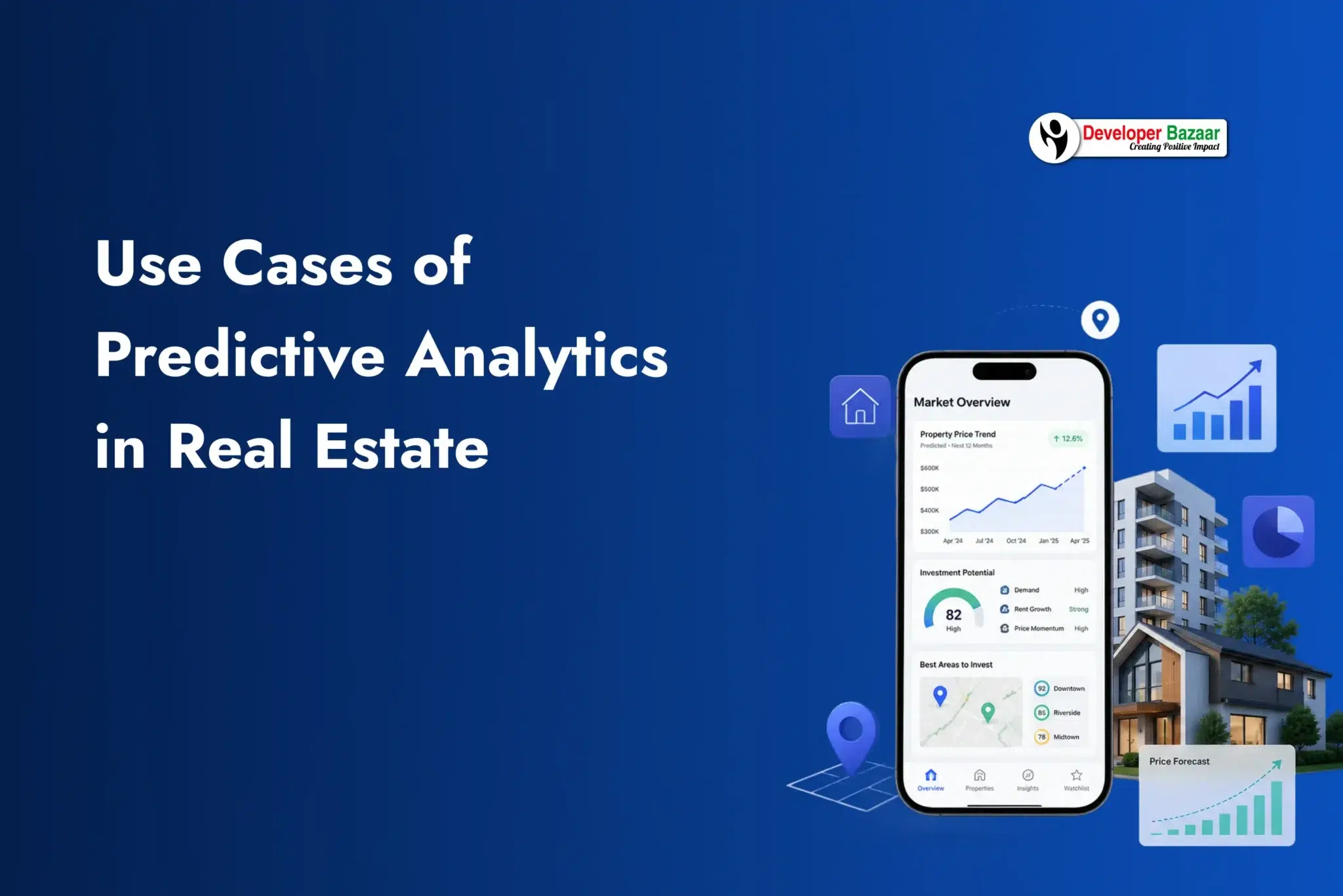
This is where predictive analytics in real estate works. It uses computers to study old data, market trends, and buyer behavior. Then it predicts what may happen next. It can predict future home prices, identify which tenant might miss a rent payment, or warn a property manager before an elevator breaks down.
In this blog, we will explain what predictive analytics in real estate tools do, walk through their biggest use cases, and show how AI predictive analytics in real estate is changing the way agents, investors, and property managers work.
We will also look at predictive analytics in commercial real estate, since offices, malls, and warehouses use this technology in their own special ways.
What Is Predictive Analytics in Real Estate?
Real Estate Predictive Analytics is the use of historical data, statistics, and machine learning to forecast future outcomes in the property market. It studies things like:
- Past sale prices
- Rent history
- Local job growth
- School ratings and crime rates
- Interest rates
- Online property searches
Then it finds patterns in this data. For example, it might notice that home prices in a certain area always go up when a new tech company opens an office nearby. Once the pattern is found, the software can predict future prices, rental demand, or investment risk with strong accuracy.
Unlike old-style spreadsheets, predictive analytics in real estate tools keep learning. The more data they get, the smarter and more accurate their guesses become.
How Predictive Analytics Works?
Before we learn about use cases, we need to understand the basic steps behind any predictive analytics real estate system.
| Step | What Happens | Simple Example |
| Collect Data | The system gathers data from listings, public records, and sensors | Sales prices from the last 10 years in a city |
| Clean Data | Removes errors, duplicates, and missing values | Fixing wrong zip codes in property records |
| Find Patterns | Machine learning studies the clean data for trends | Homes near parks sell 8% faster |
| Predict | The system makes a forecast based on the pattern | Predicts next year’s rent in a neighborhood |
| Act | Agents, investors, or managers use the forecast to decide | Setting the right listing price |
Top Use Cases of Predictive Analytics in Real Estate
Making the right real estate decision requires more than experience alone. AI Demand forecasting tools use historical data and market patterns to forecast future outcomes, helping real estate professionals optimize pricing, investments, marketing, and property operations.
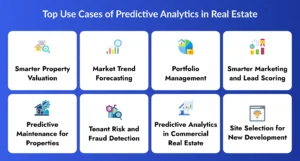
1. Smarter Property Valuation
Setting the right price is one of the biggest challenges in real estate. Price a home too high, and it sits unsold for months. Price it too low, and the seller loses money.
Predictive Analytics in real estate solves this with Automated Valuation Models (AVMs). These tools study thousands of past sales along with property features like size, age, number of rooms, and location. They also study things a human agent might miss, such as noise levels, walkability, or the crime rate on a specific street.
Tools like Zillow’s Zestimate are a well-known example. They pull data from public records and past listings to guess a home’s value within a few percentage points of its real selling price.
2. Market Trend Forecasting
Real estate prices do not move alone. They rise and fall with jobs, interest rates, population growth, and even remote work trends. Predictive Analytics real estate platforms track these signals together to forecast where the market is heading.
For example, a system might notice that a city is seeing strong tech job growth. It could then predict that rents will rise in the short term. But it might also warn that, over time, more people will choose to buy homes instead of renting, which could slow rent growth later. This kind of forward-looking insight helps agents and investors plan months or years, not just react to what has already happened.
3. Investment and Portfolio Management
Investors who own many properties need to know which ones are worth keeping, improving, or selling. Predictive Analytics for real estate helps by scoring each property based on its expected future value, rental income, and risk level.
It can also suggest smart upgrades. For instance, the system might predict that adding solar panels or a new kitchen will boost a property’s resale value more than a cosmetic paint job. Investors can also use this data to balance their portfolio across different property types and locations, so a downturn in one area does not hurt their entire investment.
4. Smarter Marketing and Lead Scoring
Not every website visitor turns into a buyer. Real estate teams often waste time chasing leads who were never serious. AI Predictive Analytics in Real Estate fixes this with predictive lead scoring.
The system studies a lead’s browsing history, past searches, and personal details to guess how likely they are to buy or rent soon. Agents can then spend their time on the leads most likely to close a deal. Marketing teams also use this data to build targeted ad campaigns, showing the right property to the right buyer at the right time.
5. Predictive Maintenance for Properties
Buildings have machines too: elevators, HVAC systems, water pumps, and electrical panels. When these break down without warning, repairs cost more, and tenants get upset.
With sensors placed around a building, real estate predictive analytics tools track machine performance in real time. If an elevator motor starts vibrating oddly or using more power than usual, the system flags it before it fails. This is called predictive maintenance, and it saves property managers both money and stress.
6. Tenant Risk and Fraud Detection
Landlords and property managers face real risk when choosing tenants. A tenant who cannot pay rent on time can create months of financial trouble. Predictive Analytics for Real Estate studies a tenant’s income stability, payment history, and other financial signals to score their risk level before signing a lease.
The same technology also helps spot fraud. It can flag mismatched documents, fake pay stubs, or unusual patterns in a rental application, helping companies avoid dealing with dishonest applicants.
7. Predictive Analytics in Commercial Real Estate
Offices, retail stores, warehouses, and shopping malls face different challenges than homes. Predictive Analytics in commercial real estate focuses on things like foot traffic, lease renewal chances, and business tenant stability.
For example, a mall owner can use Predictive Analytics tools for commercial real estate to study visitor traffic patterns and guess which store locations will perform best. An office building owner can predict which corporate tenants are at risk of not renewing their lease, based on their company’s financial health and hiring trends. This helps commercial landlords fill empty spaces faster and avoid sudden drops in rental income.
8. Site Selection for New Development
Before building anything new, developers need to know if a location will succeed. AI Predictive Analytics in Real Estate studies population growth, nearby competition, road access, and future zoning plans to score a location’s potential.
This reduces the risk of building in the wrong place. A developer can compare several sites side by side and choose the one with the strongest predicted demand, rather than relying only on instinct.
Real-World Tools Using Predictive Analytics
Many real estate platforms already use Predictive Analytics in Real Estate to improve decision-making, optimize pricing, and identify new business opportunities. Here are a few well-known examples:
- Zillow’s Zestimate – It uses machine learning and millions of property records to estimate home values. It analyzes factors such as property size, location, past sales, nearby listings, and current market trends to provide an estimated selling price.
- AirDNA – It helps short-term rental owners maximize revenue by analyzing booking patterns, occupancy rates, seasonal demand, and local competition. Its predictive insights help hosts set competitive nightly rates and identify high-performing vacation rental markets.
- Placer.ai – It supports commercial real estate decisions by analyzing foot traffic and visitor behavior. Retailers, shopping centers, and property developers use these insights to evaluate locations, understand customer movement, and select sites with strong business potential.
- SmartZip – It helps real estate agents identify homeowners who are most likely to sell in the near future. By analyzing behavioral patterns, demographic information, and property data, it enables agents to focus on high-potential leads instead of relying on broad outreach campaigns.
These tools show that predictive analytics for real estate is not a future idea. It is already changing how deals get made today. But off-the-shelf tools only go so far. Many businesses eventually need a system trained on their own market and their own customers, which is why custom development matters.
Getting Started with Predictive Analytics in Real Estate
Adopting Predictive Analytics in real estate does not have to be complicated. Instead of trying to solve every challenge at once, businesses should start with one high-impact use case and expand gradually as they see results.
Here’s a practical roadmap to get started:
- Identify a specific business challenge, such as improving property valuation, reducing tenant risk, or forecasting market trends.
- Collect relevant data from sources like past property sales, rental records, CRM systems, maintenance logs, and market reports.
- Clean and organize the data by removing duplicate, incomplete, or outdated records to improve prediction accuracy.
- Select the right predictive model based on your business goal. Simple forecasting tasks may only require regression models, while complex scenarios may benefit from machine learning algorithms.
- Validate the results by comparing predictions with actual outcomes before using them to support major business decisions.
- Scale gradually by introducing predictive analytics to other areas such as lead scoring, investment planning, marketing, or predictive maintenance, after the initial implementation proves successful.
Taking a phased approach helps businesses control implementation costs, improve model accuracy, and build confidence before expanding predictive analytics across the entire real estate operation.
Benefits of Using Predictive Analytics in Real Estate
The benefits of predictive analytics in real estate go far beyond forecasting future trends. It helps real estate businesses make smarter decisions, reduce operational risks, improve efficiency, and increase profitability. Find how it creates value across different areas of the business:
| Benefit | What It Means for Your Business |
| Better Pricing | Sets prices based on real data, not guesswork |
| Lower Risk | Flags risky tenants and unstable markets early |
| Time Savings | Automates hours of manual research and reports |
| Higher Profit | Finds the best investment and upgrade opportunities |
| Stronger Marketing | Targets buyers who are most likely to convert |
| Fewer Breakdowns | Predicts equipment failure before it happens |
Common Challenges and How to Solve Them
Every technology comes with its own challenges, and Predictive Analytics in Real Estate is no exception. The good news is that most implementation issues can be addressed with the right strategy, reliable data, and a phased adoption approach.
| Challenge | Simple Fix |
| Messy or scattered data | Clean and connect all data sources into one system |
| Bias in old data | Use fair, tested AI models and review results with humans |
| Data privacy concerns | Use encryption and follow data protection laws |
| High setup cost | Start with one use case, then expand step by step |
How AI Integration Services Make This Possible
Building a successful predictive analytics in real estate solution requires more than just AI models. It involves integrating data, developing custom solutions, and ensuring predictions fit into everyday business workflows. Here’s how different AI services make it possible:
1. AI Integration Services
- Connect existing property management software, CRM platforms, MLS databases, and other business systems with AI-powered predictive models.
- Deliver real-time predictions directly within the tools your team already uses, improving adoption and decision-making.
2. AI Software Development Services
- Build custom predictive models trained on your company’s historical data instead of relying on generic market datasets.
- Generate more accurate forecasts tailored to your properties, locations, customers, and business goals.
3. Real Estate Software Development Services
- Develop custom dashboards, web platforms, and mobile applications that present predictive insights in an easy-to-understand format.
- Provide real-time reports, alerts, and visual analytics for sales teams, property managers, investors, and finance departments.
4. AI Development Services
- Create a long-term AI roadmap based on your business objectives and available data.
- Help select the right data sources, machine learning models, and infrastructure while continuously improving prediction accuracy as market conditions change.
By combining these services, real estate businesses can successfully implement predictive analytics, automate decision-making, and turn complex data into actionable business insights.
The Future of Real Estate Is Predictive
Real estate has always been about location, timing, and trust. Predictive Analytics in real estate does not remove the human side of the business. It simply gives agents, investors, and property managers better information to work with. Instead of guessing what the market will do, they can see it coming and plan.
As more companies adopt AI Predictive Analytics, the businesses that act early will have a real edge. Whether it is pricing a home correctly, spotting a risky tenant, or fixing an elevator before it breaks, predictive analytics turns raw data into smart, timely action.
FAQs
1. How accurate are AI-powered property valuation models compared to traditional appraisals?
AI-powered valuation models analyze thousands of data points, including comparable sales, neighborhood trends, property features, and market conditions. While they may not replace certified appraisals for legal purposes, they provide highly accurate estimates that help agents and investors price properties more confidently.
2. What types of data produce the best predictive analytics results in real estate?
The most reliable predictions come from combining multiple data sources such as historical sales records, rental history, CRM data, local economic indicators, demographic trends, property characteristics, maintenance records, and public datasets. Better-quality data generally leads to more accurate forecasts.
3. Can predictive analytics help identify the best time to sell a property?
Yes. Predictive models monitor market demand, pricing trends, mortgage rates, seasonal buying patterns, and local economic conditions to estimate when a property is likely to achieve the highest market value. This helps sellers make better timing decisions.
4. How does predictive analytics improve investment decisions for multi-property portfolios?
Instead of evaluating each property manually, predictive analytics scores assets based on expected appreciation, rental income, maintenance costs, occupancy trends, and investment risk. This allows investors to prioritize upgrades, rebalance portfolios, and identify underperforming assets before they impact returns.
5. How often should predictive models be updated in a changing real estate market?
Predictive models should be updated regularly as new transaction data, market conditions, interest rates, and customer behavior change. Continuous model retraining ensures forecasts remain accurate and relevant, especially in fast-moving or highly competitive markets.
6. What is the biggest mistake companies make when implementing predictive analytics in real estate?
One of the most common mistakes is trying to solve multiple business problems at once. Organizations typically achieve better results by starting with a single use case, such as property valuation or tenant risk analysis, validating the outcomes, and then expanding predictive analytics across other business functions.
7. When should a real estate business choose a custom predictive analytics solution instead of an off-the-shelf platform?
Off-the-shelf platforms work well for standard market insights, but businesses with unique workflows, specialized property portfolios, or region-specific requirements often benefit from custom AI solutions. A tailored platform can integrate with existing systems, use proprietary business data, and generate predictions that are more relevant to the organization’s goals.