




Projects Completed
Happy Clients
Delivery Rate
Communication
Apps Downloads
Years of Growth
 By
Developer Bazaar Technologies
By
Developer Bazaar Technologies
Demand forecasting is predicting how much of a product or service people will buy in the future. It is the same as guessing tomorrow’s weather, but instead of rain or sunshine, you’re predicting sales numbers.
Traditionally, companies relied only on past sales data. But today’s market is unpredictable. Customer preferences change quickly, trends go viral overnight, and external factors like inflation, weather, or even a tweet can change demand instantly. That’s where AI in Demand Forecasting comes in.
By combining all this, AI demand forecasting software creates smarter, faster, and more reliable predictions. This helps businesses avoid mistakes like overstocking (having too much inventory that doesn’t sell) or understocking (running out of popular items).
In short, Artificial Intelligence in Demand Forecasting makes businesses more prepared, more efficient, and more customer-friendly.
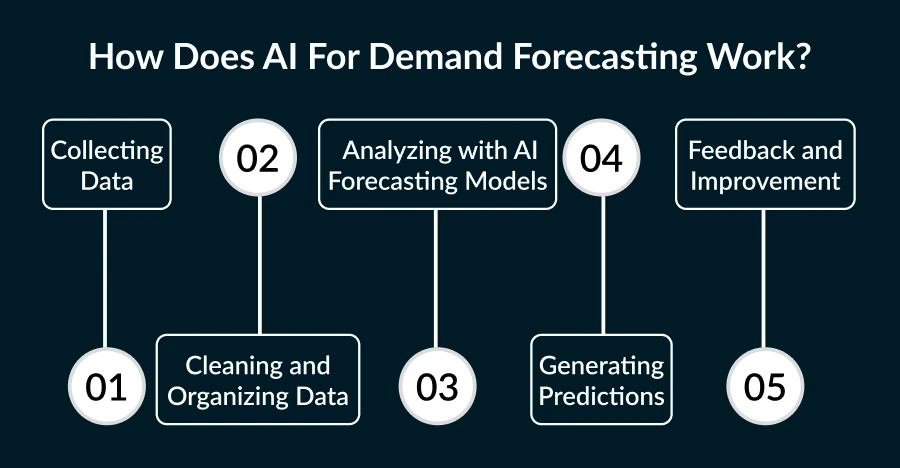
Many of you are thinking: “How exactly does AI do this?” We have mentioned the step-by-step process so you can get a better understanding.
AI in demand forecasting starts by gathering information from different sources, such as past sales, customer behavior, market trends, competitor activity, and even weather. More data means better predictions.
Raw data is often complicated. AI pipelines clean errors, remove duplicates, and arrange everything. This makes the information ready for accurate forecasting.
Clean data is fed into ML in demand forecasting models like regression, decision trees, or deep learning networks. These models spot patterns and signals that are often missed by humans.
The system then creates forecasts: how much stock is needed, which products will trend, or how sales will change during promotions. These insights guide planning and decision-making.
When real results come, AI compares them to its forecasts. It learns from mistakes and adjusts, becoming more accurate and reliable over time.
AI doesn’t rely on a single method. It uses a mix of advanced techniques to handle different data types and prediction challenges. Below are the core methods that make AI forecasting accurate and reliable:
Algorithms like regression, decision trees, and random forests form the backbone of many AI forecasting models. They analyze structured data, detect non-linear patterns, and highlight key factors like pricing, seasonality, or promotions.
For example, they can predict how a 10% price drop will impact product sales.
Deep learning is powerful for time-series forecasting. RNNs are good at spotting short-term patterns such as daily or weekly sales trends. LSTMs capture longer-term patterns like holiday or seasonal cycles.
NLP allows artificial intelligence in demand forecasting to use unstructured data such as reviews, news articles, and social media posts. It identifies consumer sentiment, detects new preferences, and picks up on early signals.
For example, if customers start posting about a new flavor of chips, the system can anticipate a rise in demand.
Hybrid models combine traditional statistical methods, such as ARIMA or exponential smoothing, with AI forecasting models. This mix balances interpretability with accuracy, making forecasts more reliable. Many businesses prefer hybrid models because they blend the strengths of old and new methods for better results.
AI-based forecasting is changing industries by predicting future trends, automating repetitive tasks, reducing costs, and boosting efficiency. By adopting AI in demand planning, organizations gain real-time insights, minimize risks, and make smarter business decisions.
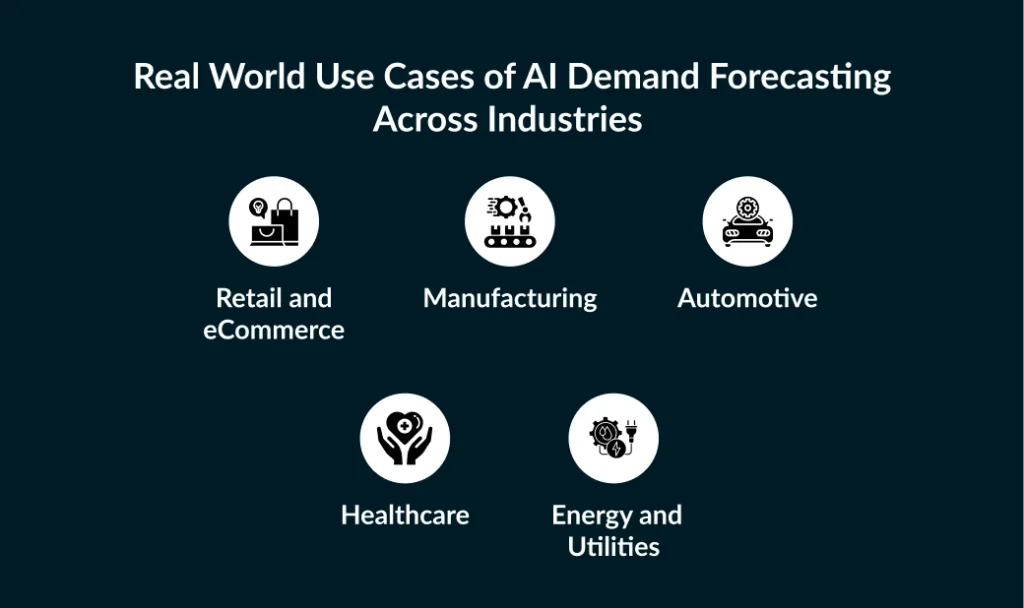
AI in retail and e-commerce is a game-changer, helping businesses optimize stock, prevent shortages, and create personalized customer experiences. It improves efficiency and makes customers get what they need, when they need it.
Real Example: Amazon
Amazon utilizes AI to track competitor pricing, market trends, and customer behavior in real-time. This enables the company to optimize pricing strategies, maintain inventory availability, and respond to shifting consumer demand, ultimately driving increased sales and customer satisfaction.
In manufacturing, AI demand forecasting boosts productivity by aligning production schedules with real demand. It reduces waste, prevents supply chain bottlenecks, and ensures timely product availability.
Real Example: Siemens
Siemens utilizes AI forecasting to analyze market trends, supplier performance, and sales data. This allows the company to adjust production in real time, minimize lead times, and increase operational efficiency.
The automotive sector benefits from AI demand forecasting by improving sales planning, inventory management, and aftermarket services. It helps companies adapt to fluctuating demand while maintaining efficiency.
Real Example: Tesla
Tesla uses AI-powered demand forecasting to optimize production planning and scheduling. This ensures it produces the right number of cars and parts, reducing bottlenecks and delivering vehicles to customers on time.
In healthcare, AI demand forecasting improves patient care by checking that resources, staff, and supplies are always available. It allows hospitals to manage patient inflow and supply chain challenges more effectively.
Real Example: Mayo Clinic
Mayo Clinic integrates AI-powered forecasting to predict patient visits, optimal staffing levels and timely medical supply availability. This enables the clinic to maintain high-quality patient care consistently.
AI forecasting in energy helps manage supply and demand, improve grid reliability, and integrate renewable energy sources. It supports a stable, cost-efficient, and sustainable energy system.
Real Example: National Grid
National Grid uses AI to forecast energy demand and supply by analyzing historical and real-time data. This allows smarter grid management, efficient resource allocation, and a stable energy distribution network.
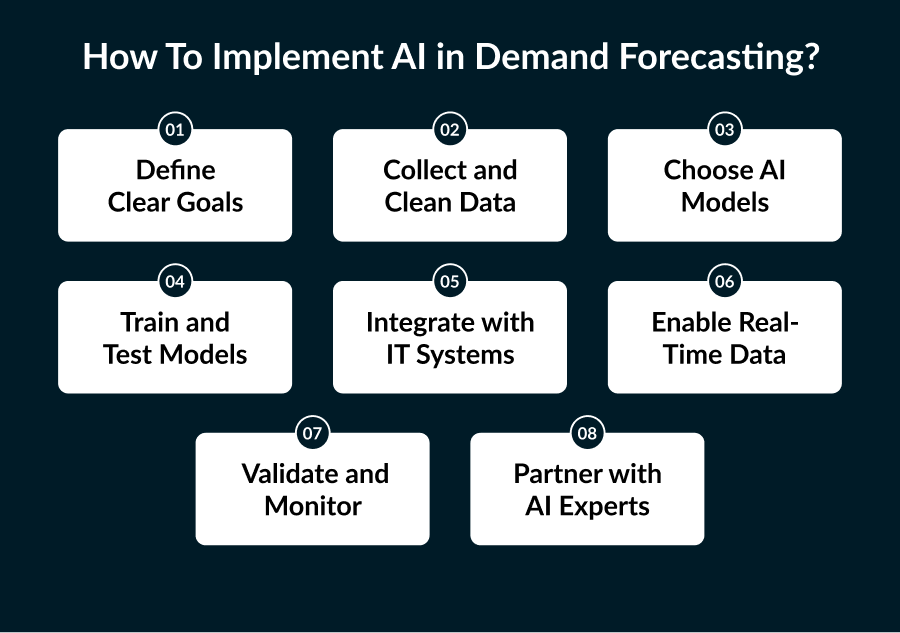
Bringing AI into demand forecasting isn’t just about installing software, it’s a step-by-step process that combines data, technology, and business goals. Here’s a breakdown of how companies can successfully implement AI forecasting solutions:
Start by asking: What exactly do we want to achieve with AI? Some businesses want to avoid frequent stockouts, while others want to optimize production schedules or reduce logistics costs. Having a clear objective helps you choose the right tools and models, instead of applying AI everywhere without focus.
AI is only as good as the data it uses. Gather information such as past sales numbers, customer preferences, competitor strategies, and market trends. Once collected, the data must be cleaned, removing duplicates, fixing errors, and organizing it into a format that AI can process easily. Clean, high-quality data is the foundation of accurate forecasts.
Not all AI models work the same way. Simple problems can be solved with regression models or decision trees, while complex forecasting requires deep learning models like LSTMs or Transformers that can handle large, time-based data. The right choice depends on the complexity of your business and the type of demand you’re forecasting.
Once the data and features are ready, split them into two sets: one for training and one for testing. The AI learns from the training data, then is tested on new data to see how well it performs.
AI forecasting should not sit in isolation. To be useful, it must connect with your ERP, CRM, or supply chain systems. For example, if AI predicts low inventory, the ERP should trigger reorders automatically. This integration turns AI insights into real business actions.
Markets change daily, sometimes hourly. Feeding AI with live updates—like new sales transactions, promotions, or sudden changes in customer behavior—makes the forecasts dynamic and responsive. Real-time data ensures you’re not planning based on outdated information.
Even the best AI models can drift over time. That’s why businesses must constantly validate the forecasts against real outcomes. Monitoring performance helps identify when predictions are slipping, so the model can be recalibrated. This keeps the system reliable and business-ready.
For many businesses, building AI systems from scratch can be overwhelming. Partnering with experienced AI development company makes sure access to proven frameworks, scalable solutions, and faster implementation. This reduces risks and accelerates the benefits of AI forecasting.
Businesses face rapid changes in the markets, and AI in demand forecasting helps them stay ahead. By combining real-time data, advanced algorithms, and automation, AI makes predictions faster, more accurate, and actionable.
Here are the key benefits:
AI demand forecasting software can analyze huge volumes of data, including historical sales, promotions, weather, and market trends. This helps spot patterns that humans or traditional methods might miss, reducing costly mistakes like overproduction or stockouts.
AI combines data from social media, IoT sensors, point-of-sale systems, weather reports, and supply chain performance. This multi-source approach makes sure forecasts are more realistic and responsive to sudden market changes.
Manual forecasting can consume more time, but AI automation does most of the work in minimal time. Machine learning in demand forecasting continuously updates predictions in weeks to hours or even minutes.
Accurate AI predictions help align inventory with actual demand. This minimizes excess stock, reduces spoilage, lowers storage costs, and prevents lost sales due to stockouts.
AI in demand planning doesn’t just provide numbers, it offers insights. Executives can make smarter decisions about marketing campaigns, new product launches, and supply chain adjustments.
While AI demand forecasting software offers many advantages, businesses need to be aware of some challenges:
While AI demand forecasting software brings immense benefits, businesses must be aware of certain challenges. Understanding these challenges, their impact, and possible solutions helps in successfully implementing AI-driven demand planning.
Solution: Regularly clean and standardize data. Use validation tools to remove errors and ensure the dataset is complete and structured before feeding it to AI models.
Solution: Supplement limited data with external sources, like market trends, competitor information, or similar product performance. This helps the AI make informed predictions even with minimal historical data.
Solution: Treat AI as a decision-support tool rather than a replacement for human expertise. Combine AI insights with expert opinions for balanced and informed decision-making.
Solution: Use real-time data feeds and update AI models frequently. Continuous learning allows AI forecasting models to adapt to changing consumer behavior.
Solution: Use explainable AI tools that show how predictions are made. Visualizations and clear reasoning help teams understand and trust AI forecasts.
Solution: Follow strict data protection laws, anonymize sensitive information, and use secure platforms to ensure data privacy while still enabling accurate forecasting.
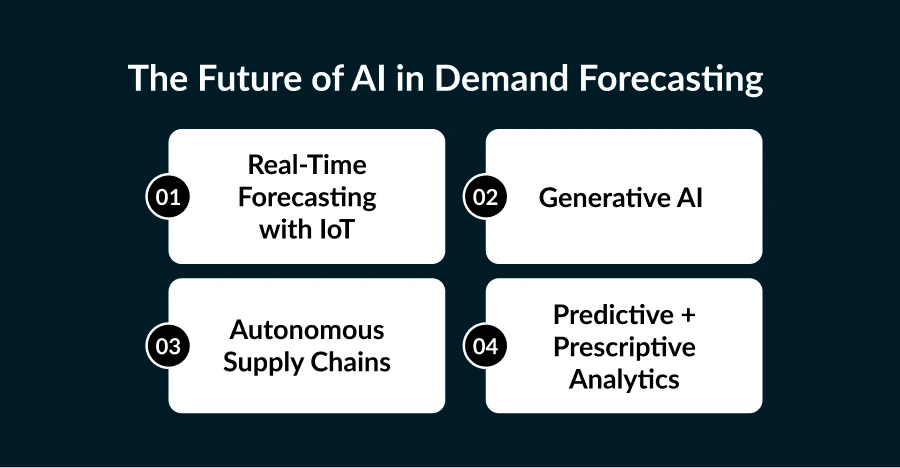
The future of AI in demand forecasting is full of exciting possibilities that can transform how businesses plan and operate.
AI will increasingly use live data from smart devices, sensors, and connected systems. This means forecasts can adjust instantly as conditions change, such as sudden shifts in customer demand or supply chain disruptions. Businesses will be able to respond faster and make smarter decisions in real-time.
Generative AI can create different “what-if” situations, such as supply shortages, sudden increases in demand, or new promotions. This helps companies get ready for unexpected changes, make smarter decisions in advance, lower risks, and improve their planning.
Smart AI systems will soon handle procurement, logistics, and inventory almost on their own. These AI-driven supply chains will reduce waste, make operations faster, and allow people to focus on more important strategic work.
The future of AI won’t just predict what will happen; it will also recommend the best actions to achieve desired outcomes. Businesses will get actionable insights that guide decisions, like adjusting production, pricing, or promotions, to maximize efficiency and profitability.
Developer Bazaar Technologies provides expert AI development services that help businesses use AI in demand forecasting to run smarter and faster. Their solutions make operations easier and more accurate by offering:
By integrating these AI solutions with existing systems, businesses can reduce costs, save time, improve efficiency, and make smarter decisions, giving them a strong competitive advantage.
The integration of AI in demand forecasting is changing industries worldwide. By highlighting patterns, adapting to market changes, and providing actionable insights. With the rapid adoption of AI-powered forecasting tools, this technology is quickly becoming the industry standard. Future advancements will bring smarter algorithms, real-time data integration, and enhanced predictive analytics, further influencing market trends.
For businesses, staying updated with AI trends in demand forecasting is no longer optional, but it’s necessary. AI brings strategic advantage, improved efficiency, and sustained growth in the competitive market.
Traditional methods are mainly based on past sales. AI also considers weather, promotions, IoT, social media, and other data sources, making predictions more accurate.
Retail, manufacturing, supply chain, food & beverage, energy, and healthcare benefit the most due to high reliance on accurate demand planning.
Popular tools include AWS Forecast, Google Vertex AI, Microsoft Azure ML, SAP IBP, DataRobot, o9 Solutions, and Anaplan.
AI models can analyze historical trends, weather patterns, holidays, promotions, and social media sentiment to accurately predict seasonal spikes and dips, ensuring businesses are well-prepared for fluctuations in demand.
Yes. Developer Bazaar Technologies offers tailored AI demand forecasting solutions designed to fit your business size, industry, product type, and operational requirements. Custom models ensure maximum accuracy and efficiency.
Absolutely. Developer Bazaar Technologies can easily integrate an AI Solution with ERP, CRM, supply chain systems, and other business software, making a smooth workflow and real-time data updates for accurate demand predictions.
You can contact the AI expert team through our website or consultation channels. We begin with a detailed assessment of your business needs and then design a customized AI forecasting solution to help you optimize operations and improve decision-making.
Co-Founder
Developer Bazaar technologies

Key Takeaways: Building an LLM agent is easier when you start with one well-defined task instead of trying to automate everything at once. Most businesses can build powerful AI agents using pre-trained LLMs without training a...
Key Takeaways: Building an LLM agent is easier when you start with one well-defined task instead of trying to automate everything at once. Most ...
Key Takeaways: AI predictive maintenance prevents equipment failures before they happen by analyzing real-time sensor data and identifying early warning signs. Predictive maintenance with AI is more efficient than reactive or preventive maintenance, helping businesses reduce...
Key Takeaways: AI predictive maintenance prevents equipment failures before they happen by analyzing real-time sensor data and identifying early warning signs. Predictive maintenance with ...
Key Takeaways: AI software delivers long-term business value by improving decision-making, automation, customer experiences, and operational efficiency. Successful AI projects require more than coding, they depend on quality data, the right AI model, seamless integration, and...
Key Takeaways: AI software delivers long-term business value by improving decision-making, automation, customer experiences, and operational efficiency. Successful AI projects require more than coding, ...
Key Takeaways: AI agents go beyond traditional automation by reasoning, planning, and executing multi-step healthcare workflows with minimal human intervention. Agentic AI delivers value across the healthcare ecosystem, from clinical documentation and medical imaging to patient...
Key Takeaways: AI agents go beyond traditional automation by reasoning, planning, and executing multi-step healthcare workflows with minimal human intervention. Agentic AI delivers value ...
Key Takeaways: AI integration helps mobile apps deliver personalized experiences, automate repetitive tasks, improve customer support, and strengthen security. Businesses can start with pre-built AI APIs like OpenAI, Google AI, or AWS AI, making AI adoption...
Key Takeaways: AI integration helps mobile apps deliver personalized experiences, automate repetitive tasks, improve customer support, and strengthen security. Businesses can start with pre-built ...
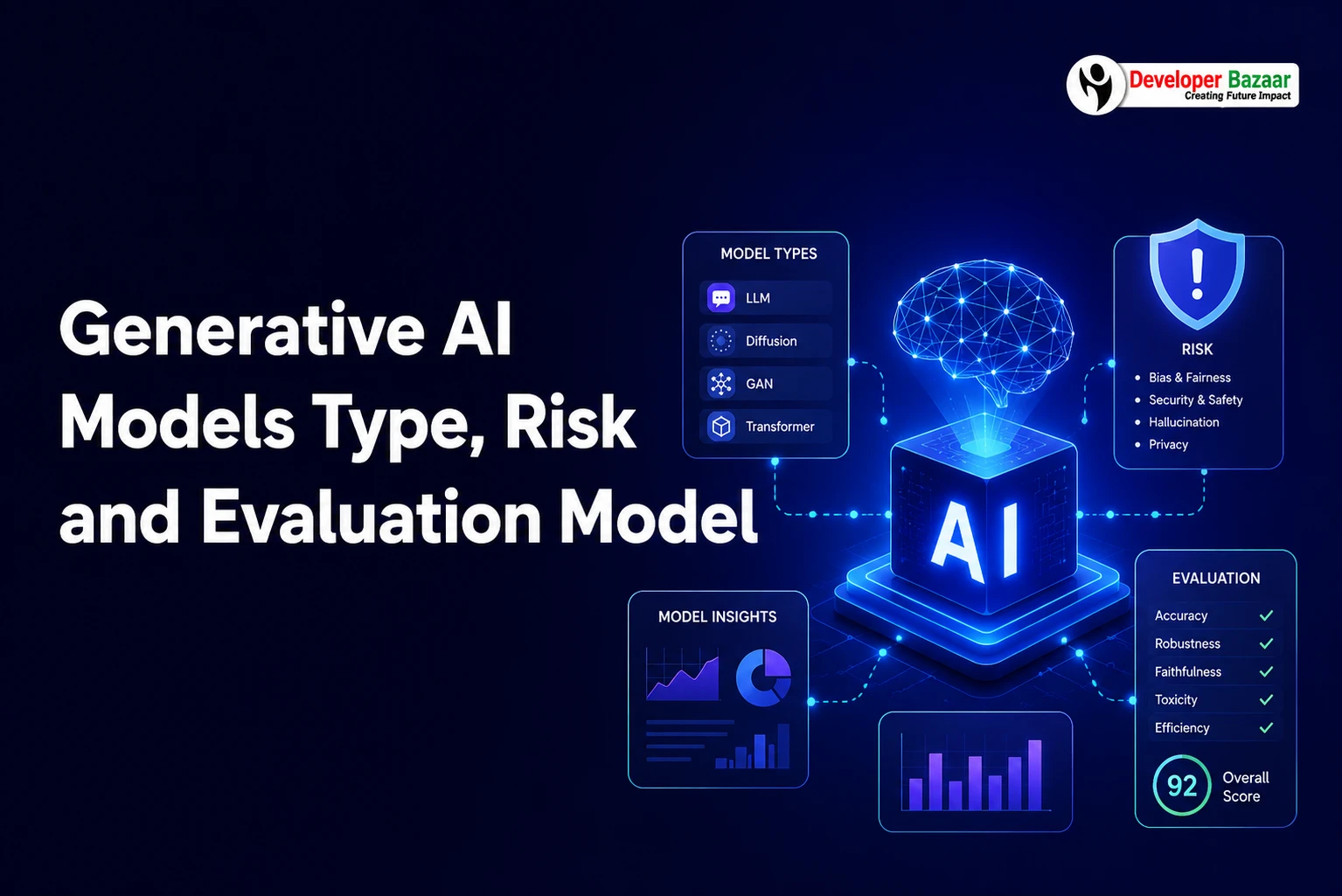
Key Takeaways: Generative AI Models create original text, images, code, audio, and video by learning patterns from massive datasets rather than copying existing content. Different model architectures, including GANs, VAEs, Transformers, Diffusion Models, Autoregressive Models, and...
Key Takeaways: Generative AI Models create original text, images, code, audio, and video by learning patterns from massive datasets rather than copying existing content. ...
Is your business still depending on old software systems that slow down growth and innovation? Many companies struggle with outdated applications that are costly, hard to maintain, and unable to meet modern customer expectations. The growing...
Is your business still depending on old software systems that slow down growth and innovation? Many companies struggle with outdated applications that are costly, ...

Businesses today collect huge amounts of data every second. Finding unusual activities or errors in this massive data is difficult for humans. This is where AI Anomaly Detection becomes helpful. AI-powered systems can quickly scan data,...
Businesses today collect huge amounts of data every second. Finding unusual activities or errors in this massive data is difficult for humans. This is ...
AI agents are becoming part of everyday business systems. According to Gartner, 40% of enterprise applications will include AI agents by the end of 2026, up from less than 5% in 2025. But there is a...
AI agents are becoming part of everyday business systems. According to Gartner, 40% of enterprise applications will include AI agents by the end of ...
Many businesses want to use Artificial Intelligence (AI). But approaching a full AI project directly can be risky and expensive. In this situation, an AI Proof of Concept (PoC) helps. An AI PoC is a small...
Many businesses want to use Artificial Intelligence (AI). But approaching a full AI project directly can be risky and expensive. In this situation, an ...

Complete the form below and validate your idea now.
✔ Your idea is 100% protected by our Non Disclosure Agreement.
