

Key Takeaways:
- Route optimization software is becoming essential for modern logistics businesses. It helps reduce fuel costs, shorten delivery times, improve fleet utilization, and increase customer satisfaction through smarter route planning.
- Successful development starts with careful planning. Defining business goals, prioritizing MVP features, and choosing the right technology stack lay the foundation for a scalable and cost-effective solution.
- AI integration takes route planning to the next level. Features such as predictive traffic analysis, dynamic rerouting, demand forecasting, and intelligent driver assignment improve operational efficiency and lower long-term costs.
- Development costs vary based on business requirements. Factors such as the number of features, supported platforms, AI capabilities, third-party integrations, UI/UX complexity, and the development team’s location all influence the overall budget.
- Choosing an experienced development partner is critical. A company with expertise in logistics software development services, mapping APIs, and AI can help you build a secure, scalable, and future-ready solution while minimizing development risks.
Imagine a delivery driver with 30 packages to drop off in one day. Without a plan, the driver may drive in circles, waste fuel, and arrive late. This is a problem for thousands of logistics companies every single day. That is where route optimization software steps in.
Logistics route optimization software uses maps, live traffic data, and smart algorithms to find the best, shortest, and cheapest path for every delivery. It is like giving your driver a super-smart assistant who always knows the fastest way to go.
In this guide, we will explain how to develop logistics route optimization software from the first idea to the final launch. We will also cover the real cost to develop logistics route optimization software, the best tech stack, AI integration, and how to pick the right software development company for the job.
What Is Logistics Route Optimization Software?
Logistics route optimization software is a computer program that plans the best routes for trucks, vans, or bikes that deliver goods. It looks at many things at once, such as:
- Delivery locations: Where every package needs to go.
- Traffic and road conditions: Which roads are busy or blocked right now?
- Vehicle capacity: How much weight or space each vehicle has left.
- Driver working hours: So drivers do not work too many hours in a row.
- Delivery time windows: Some customers want their package only between 2 PM and 4 PM.
The software then creates the shortest and smartest route for each driver. This is why more and more companies want to build logistics route optimization software instead of depending on manual planning or simple map apps.
Why the Demand to Build Logistics Route Optimization Software Is Growing Fast
Online shopping has grown massively across the world, and this has put huge pressure on delivery companies to move packages faster and more cheaply. Because of this, more businesses are investing in smart routing tools every year.
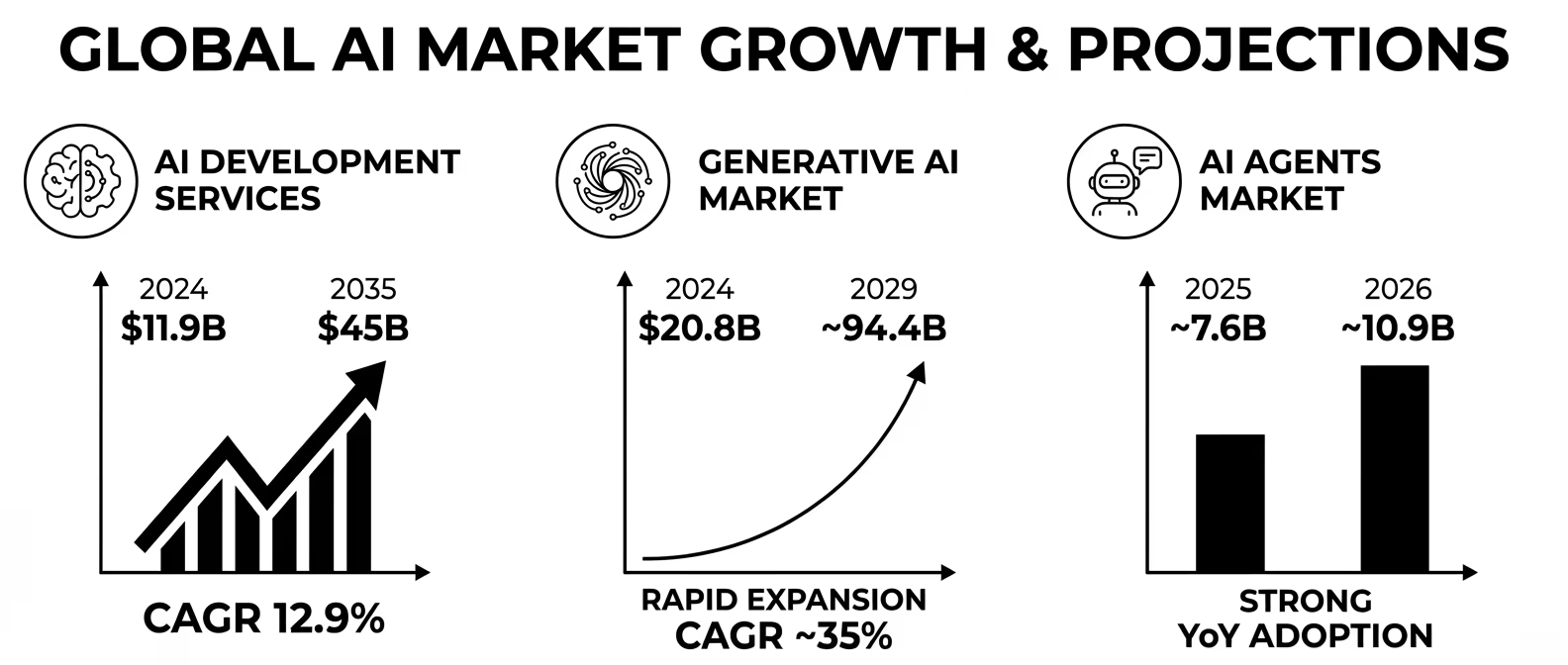
According to Fortune Business Insights, the report shows that the global route optimization software market was worth close to $8 to $10 billion in 2025 and 2026, and it is expected to grow past $17 billion, and by some estimates even $40 billion, within the next decade, growing at around 13% to 15% every year.
This fast growth shows that route optimization software development is not a small trend. It is becoming a must-have tool for logistics, e-commerce, food delivery, and field service businesses everywhere.
Simply put, if you run or plan to build a logistics business, investing in route optimization software today can give you a strong advantage tomorrow.
Key Features to Include When You Build Logistics Route Optimization Software
Before writing a single line of code, you must decide what your software should do.
Here are the features that almost every good logistics route optimization software needs.
| Feature | What It Does |
| Route Planning & Optimization | Automatically finds the shortest and fastest route for every vehicle and driver. |
| Real-Time GPS Tracking | Shows exactly where each vehicle is on a live map, at any moment. |
| Traffic & Weather Integration | Reroutes drivers automatically during traffic jams, accidents, or storms. |
| Multi-Stop Route Planning | Plan one route with many delivery stops in the smartest order possible. |
| Driver Mobile App | Gives drivers turn-by-turn directions, delivery details, and proof-of-delivery tools. |
| Dispatcher Dashboard | Allow managers to assign, track, and update routes from a single central screen. |
| Automated Notifications | Sends SMS or app alerts to customers about delivery time and delays. |
| Analytics & Reporting | Shows fuel usage, on-time rates, and driver performance in simple charts. |
| Fleet Management | Tracks vehicle health, fuel levels, and maintenance schedules. |
| AI-Based Predictions | Uses past data to predict delays, demand spikes, and the best delivery windows. |
Step-by-Step Guide to Develop Logistics Route Optimization Software
Here is a clear, easy-to-follow process to develop logistics route optimization software from scratch.
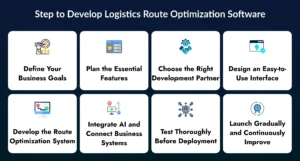
Step 1: Define Your Business Goals and Requirements
Start by identifying the exact challenges your business wants to solve. This could include reducing fuel costs, improving delivery times, handling more orders, or increasing driver productivity. Clear business goals help you decide which features to build and make it easier to measure the success of your logistics route optimization software after launch.
Step 2: Plan the Essential Features
Create a list of the features your business needs most. Focus on core capabilities such as route optimization, GPS tracking, delivery scheduling, driver management, and real-time notifications. Building a Minimum Viable Product (MVP) first allows you to launch faster, reduce development costs, and add advanced features later based on user feedback.
Step 3: Choose the Right Development Partner
Developing route optimization software requires expertise in mapping technologies, cloud infrastructure, APIs, and logistics workflows. Partner with a company that has experience delivering logistics software development services. The right development team can recommend the best technology stack, estimate realistic timelines, and help you avoid expensive development mistakes.
Step 4: Design an Easy-to-Use Interface
Your software should be simple for everyone who uses it, including dispatchers, drivers, fleet managers, and customers. Create clean dashboards, clear navigation, and mobile-friendly screens so users can complete tasks quickly without extensive training. A good user experience improves adoption and reduces operational errors.
Step 5: Develop the Route Optimization System
The route optimization engine is the foundation of the entire platform. It uses mapping services, live GPS data, traffic information, and optimization algorithms to calculate the fastest and most cost-effective routes. A well-built routing engine helps businesses reduce travel time, fuel consumption, and unnecessary vehicle mileage.
Step 6: Integrate AI and Connect Business Systems
Once the core routing system is ready, integrate AI to make route planning smarter. AI can predict traffic patterns, estimate delivery delays, recommend the best driver for each job, and improve future route planning using historical data. At the same time, connect the software with existing systems such as ERP, CRM, warehouse management, and inventory platforms through secure APIs for smooth data sharing.
Step 7: Test Thoroughly Before Deployment
Before launching, perform extensive testing using real delivery scenarios, different traffic conditions, and multiple device types. Verify that routes are accurate, notifications work properly, GPS tracking remains reliable, and integrations perform as expected. Careful testing helps prevent costly delivery errors and ensures a stable user experience.
Step 8: Launch Gradually and Continuously Improve
Instead of deploying the software across your entire fleet immediately, begin with a pilot program involving a small group of drivers or a single location. Monitor performance, collect feedback from dispatchers and drivers, and fix any issues that arise. Continue releasing updates, adding new features, and refining AI models to keep the software effective as your business grows.
Recommended Tech Stack for Route Optimization Software Development
Choosing the right tools matters a lot. Below is a tech stack table that most companies use for logistics route optimization software development.
| Layer | Common Tools |
| Frontend (Web) | React.js, Angular, or Vue.js |
| Mobile App (Driver App) | React Native, Flutter, or Kotlin/Swift |
| Backend | Node.js, Python (Django), or Java (Spring Boot) |
| Database | PostgreSQL, MongoDB, or MySQL |
| Maps & Routing APIs | Google Maps Platform, Mapbox, HERE Maps, OSRM |
| AI & Machine Learning | TensorFlow, PyTorch, or cloud AI services (AWS, Azure, Google Cloud) |
| Real-Time Tracking | WebSockets, MQTT, Firebase |
| Cloud Hosting | AWS, Microsoft Azure, or Google Cloud Platform |
Cost to Develop Logistics Route Optimization Software
This is usually the first question every business owner asks. The honest answer is: it depends. The Logistics Route Optimization Software Development cost changes based on the number of features, the platforms you need (web, Android, iOS), how much AI you use, and which country your development team is based in.
| Software Type | Typical Features | Estimated Cost (USD) |
| Basic Route Planner (MVP) | Simple route planning, GPS tracking, basic dashboard | $15,000 – $35,000 |
| Mid-Level Solution | Multi-stop routing, driver app, notifications, analytics | $35,000 – $80,000 |
| Advanced / AI-Powered Platform | AI Integration, predictive routing, fleet management, full API integrations | $80,000 – $150,000+ |
Factors That Affect the Cost to Develop Logistics Route Optimization Software
- Number of Features: The more features you include, the more time, effort, and resources are required for development. Starting with essential features and adding advanced functionality later can help reduce the initial development cost.
- Platforms to Support: Developing software for multiple platforms, such as web, Android, and iOS, requires additional development and testing. Building for a single platform first is generally more cost-effective than launching on all platforms at once.
- AI and Machine Learning Capabilities: Integrating AI-powered features such as predictive route planning, traffic forecasting, or demand analysis increases development complexity. However, these features also improve operational efficiency and provide greater long-term business value.
- Third-Party Integrations: Connecting the software with external services such as mapping APIs, GPS providers, ERP systems, warehouse management software, or payment gateways requires additional development work and may involve ongoing licensing or subscription costs.
- Development Team Location: Development costs vary significantly depending on where your software development partner is located. Software development Outsourcing companies in regions such as India or Southeast Asia often provide high-quality logistics software development services at more competitive rates than companies in the US or Western Europe.
- UI/UX Design Complexity: A fully customized interface with advanced animations, branding, and interactive elements requires more design and development time than a simple, template-based design. The level of design sophistication directly affects the overall project cost.
The best way to know your exact logistics route optimization software development cost is to share your requirements with a trusted logistics software development services partner and ask for a detailed quote.
The Role of AI Integration in Modern Route Optimization Software
AI Integration is what turns a basic route planner into a truly smart system. Instead of just following fixed rules, AI-powered software learns from data and gets better over time.
- Predictive traffic analysis: AI studies traffic patterns from past weeks or months and predicts busy roads before they even get busy.
- Demand forecasting: AI can guess which areas will have more delivery orders on certain days, like festivals or sale seasons.
- Dynamic rerouting: If a road suddenly closes, AI instantly finds a new best route without any human help.
- Driver matching: AI studies driver history and matches the right driver to the right route for faster, safer delivery.
- Fuel and cost savings: By choosing smarter routes, AI can cut fuel use and vehicle wear, saving real money every month.
Many businesses now prefer working with a team that offers full AI software development services, so the route optimization software does not just plan routes, but keeps learning and improving on its own.
How to Choose the Right Software Development Company
Since building this software requires a mix of mapping, AI, and logistics knowledge, picking the right software development company matters a lot. Look for a partner who can show you:
- Past projects: Ask for real examples of logistics or route planning software they have built before.
- Technical skill: Check if the team has real experience with maps APIs, AI models, and large-scale backend systems.
- Clear communication: Choose a team that explains technical ideas in simple words, not just jargon.
- Support after launch: Software always needs updates and bug fixes, so ask about post-launch support plans.
- Transparent pricing: A trustworthy logistics software development services company will always give you a clear cost breakdown, not a vague number.
Developer Bazaar Technologies is one such logistics software development services provider, helping businesses develop logistics route optimization software with strong AI Integration, clean design, and dependable long-term support.
Common Challenges When You Build Logistics Route Optimization Software
| Challenge | Simple Solution |
| Handling live traffic data | Use trusted map APIs that update traffic every few seconds. |
| Managing hundreds of stops at once | Use strong optimization algorithms built for large, complex routes. |
| Keeping the driver app simple | Test the app with real drivers and remove any confusing steps. |
| Connecting to old company systems | Build flexible APIs that can talk to older software smoothly. |
| Keeping customer data safe | Use encryption and follow data protection laws in every region you operate. |
Conclusion
Logistics route optimization software is no longer a luxury. It is quickly becoming a basic need for any business that delivers goods or manages a fleet. Whether you want to develop logistics route optimization software from scratch or upgrade an old system with AI Integration, the steps in this guide will help you plan the journey with confidence.
The right approach, the right tech stack, and the right software development company can turn a simple idea into a powerful tool that saves your business time, fuel, and money for years to come.
FAQs
1. How does route optimization software handle last-minute delivery changes?
Modern route optimization software can automatically recalculate routes when new delivery requests, cancellations, vehicle breakdowns, or traffic incidents occur. This helps dispatchers adjust schedules in real time without disrupting the rest of the delivery operations.
2. Can logistics route optimization software manage different types of vehicles?
Yes. The software can assign deliveries based on vehicle type, carrying capacity, fuel efficiency, refrigeration requirements, or other operational constraints. This ensures each order is assigned to the most suitable vehicle while maximizing fleet utilization.
3. What business systems should be integrated with route optimization software?
For the best results, businesses often integrate route optimization software with ERP systems, warehouse management software (WMS), CRM platforms, inventory management tools, GPS providers, and payment systems. These integrations eliminate manual work and keep data synchronized across departments.
4. How can AI improve delivery performance beyond finding the shortest route?
AI does much more than optimize routes. It can forecast delivery demand, predict traffic congestion, recommend the best driver for specific deliveries, estimate arrival times more accurately, and continuously improve routing decisions by learning from historical delivery data.
5. How can businesses scale their route optimization software as delivery volumes grow?
Scalability depends on using cloud infrastructure, modular software architecture, and flexible APIs. This allows businesses to add more drivers, vehicles, delivery locations, and advanced features without rebuilding the entire platform as operations expand.
6. What should businesses evaluate before choosing a logistics software development company?
Beyond pricing, businesses should review the company’s experience with logistics projects, expertise in mapping APIs and AI technologies, ability to build scalable cloud-based solutions, post-launch maintenance services, and its track record of delivering similar software successfully.