

What will logistics look like by 2030?
Will robots deliver packages? Will warehouses run without people? Will goods move faster and safer across the world?
The logistics industry is changing very fast. New tools like Artificial Intelligence, smart sensors, automation and drones are making supply chains smarter and more connected. By 2030, companies that adopt these logistics technology trends early will move goods faster, reduce costs and serve customers better. Companies that ignore them may struggle to compete.
In this blog, we will explore the top logistics trends, the challenges businesses face and how technology partners can help them prepare for the future.
High-Tech Logistics Market Summary
The high-tech logistics market is growing rapidly as industries increasingly depend on safe, fast and smart delivery systems. The global high-tech logistics market was valued at USD 45.70 billion in 2023 and is expected to grow at a strong CAGR of 12.4% from 2024 to 2030. By 2030, the market is projected to reach around USD 100.24 billion. This growth is driven by companies’ need for specialized logistics solutions to transport sensitive and high-value products safely across the world.
Many industries rely heavily on advanced logistics services. Sectors such as semiconductors, consumer electronics, telecommunications and medical devices require careful handling and timely delivery.
These products are often fragile and expensive, so logistics providers are using advanced tools like real-time tracking, temperature-controlled transportation and specialized handling systems. These technologies help to products reach their destination safely and on time.
Key market insights include:
- North America dominated the global high-tech logistics market in 2023 with a revenue share of 38.1%.
- By service, the transportation segment held the largest share at 38.2% in 2023.
- By industry, the semiconductor sector accounted for the largest revenue share of 32.1%.
- The consumer electronics segment is expected to grow the fastest, with a CAGR of 12.9% from 2024 to 2030.
As global trade expands and technology products become more advanced, logistics companies must adapt to complex supply chains.
They are investing in smart systems, logistics automation and real-time monitoring tools to improve efficiency and safety. These advancements are helping logistics providers meet the strict requirements of high-tech industries and continue driving market growth toward 2030.
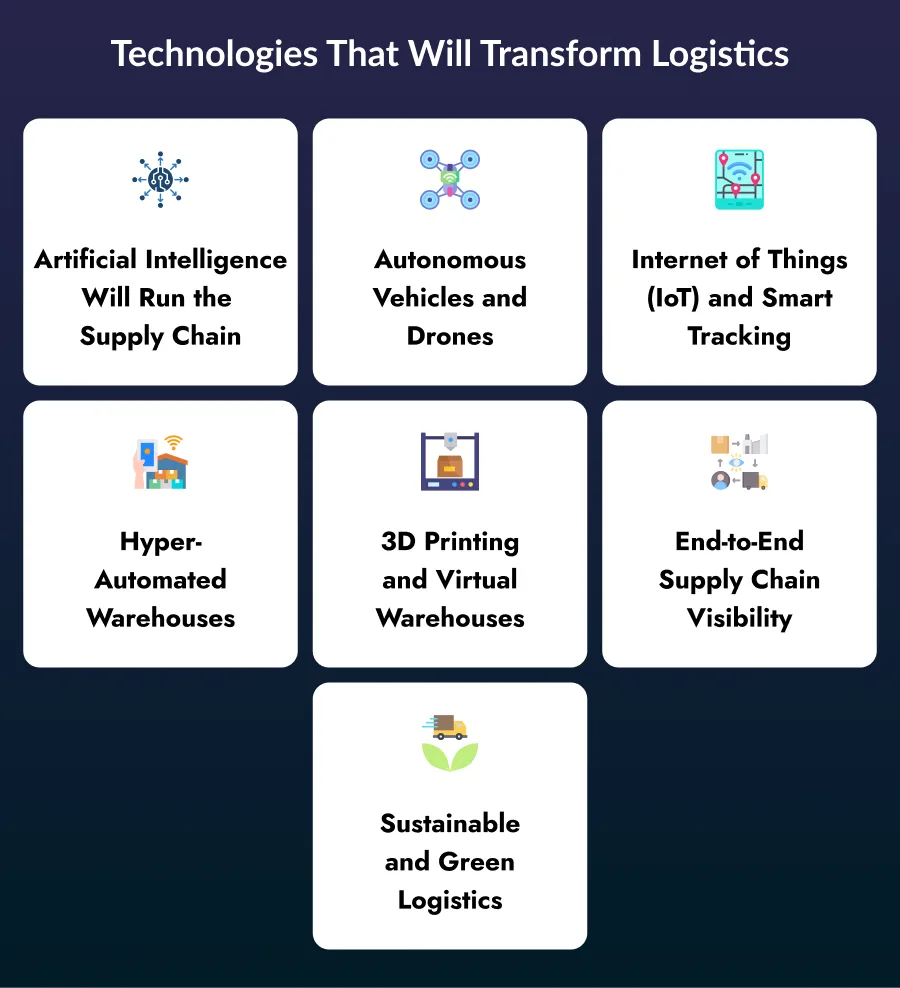
Technologies That Will Transform Logistics by 2030
What will logistics look like by 2030 as new technologies continue to grow? From Artificial intelligence in logistics to drones, smart tracking and automated warehouses, the industry is moving toward faster, safer and more efficient supply chains.
These Logistics Technology Trends will help businesses reduce costs, improve delivery speed and build smarter operations for the future.
1. Artificial Intelligence Will Run the Supply Chain
Artificial intelligence in logistics is already improving operations by 2030, it will become standard across the industry.
AI helps companies work faster, make better decisions and reduce costs. It studies data from traffic, weather, inventory, vehicles and customer demand. Then it makes smart decisions in real time without waiting for human input.
- Predict demand and stock levels
- Optimize delivery routes
- Reduce fuel use and costs
- Detect risks in supply chains
- Automate warehouse tasks
For example, AI can change delivery routes instantly if traffic increases or a storm is coming. This saves time, fuel and money. AI may boost logistics productivity by up to 20% in the coming years. It will also help reduce carbon emissions and improve safety.
Why this is one of the best Logistics Technology Trends:
AI helps companies make faster decisions, reduce delays and improve customer service across the supply chain.
2. Autonomous Vehicles and Drones
Self-driving trucks and delivery drones are becoming more common. By 2030, they may be used widely in daily logistics operations. These technologies will change how goods move from warehouses to customers.
Autonomous trucks will:
- Drive long highway routes
- Reduce driver fatigue
- Lower fuel costs
- Improve safety
Human drivers may focus more on city areas and supervision, while autonomous trucks handle long-distance travel.
Drones and robots will:
- Deliver packages in cities
- Reach remote villages
- Reduce traffic on roads
- Speed up last-mile delivery
For example, a drone can deliver medicines quickly to a remote village where roads are difficult. Experts believe drones could handle a large portion of deliveries in the future, especially for urgent goods.
This is one of the most important logistics technology trends because it changes how goods reach customers and improves delivery speed.
3. Internet of Things (IoT) and Smart Tracking
IoT uses smart sensors to track goods, vehicles and warehouses in real time. These sensors collect and send data so companies always know what is happening in their supply chain.
With IoT, companies can:
- Track shipments live
- Monitor the temperature of goods
- Prevent theft
- Check warehouse conditions
- Monitor vehicle health
For example, if a truck carrying medicines gets too hot, sensors can send an alert immediately. The company can then fix the issue before the medicines get damaged.
This improves safety, reduces losses and builds trust with customers.
Why it matters:
Real-time tracking helps companies make better decisions, avoid delays and keep goods safe during transport.
4. Hyper-Automated Warehouses
Warehouses are becoming smarter every year. By 2030, many warehouses will be fully automated and run with very little human help. Robots and AI will work together to manage daily tasks like picking, packing and sorting goods. This will help companies process orders faster and with fewer errors.
Robots will:
- Pick items from shelves
- Pack orders
- Sort goods
- Load trucks
AI will manage these tasks 24/7 and make sure everything runs smoothly. Digital twin technology will create virtual warehouse models. This means companies can test layout changes or process improvements in a digital version before applying them in the real warehouse.
For example, an online shopping company can use robots to pick and pack thousands of orders every day without delays. This helps deliver products faster to customers.
Benefits include:
- Faster order processing
- Fewer mistakes
- Lower labor costs
- Better efficiency
This is one of the top logistics technology trends for e-commerce and global supply chains because it improves speed, accuracy and overall productivity.
5. 3D Printing and Virtual Warehouses
3D printing will change how products are stored and shipped. Instead of storing large amounts of inventory in warehouses, companies can store digital product designs and print items when needed. This reduces storage and transportation costs.
Companies can:
- Store digital product designs
- Print parts near customers
- Reduce shipping time
- Lower storage costs
For example, if a machine part is needed urgently in another country, the company does not need to ship it from far away. Instead, they can print the part at a nearby center within hours. This saves time and reduces shipping expenses.
This process is called decentralized production. It reduces long-distance transportation and helps deliver products faster. It is one of the most important logistics technology trends because it changes how goods are produced and delivered.
6. End-to-End Supply Chain Visibility
By 2030, companies will track goods from the factory to the customer in real time. AI and IoT will work together to provide full visibility across the entire supply chain. Businesses will always know where their shipments are and what is happening at each stage.
AI and IoT will help to:
- Predict delays
- Suggest alternative routes
- Monitor global risks
- Improve planning
For example, if a shipment is delayed at a port due to bad weather, AI can suggest a new route immediately. This helps avoid long delays and keeps deliveries on schedule.
This level of visibility helps businesses handle disruptions, improve planning and provide better customer service. Companies with strong tracking systems will gain a big competitive advantage in the future.
7. Sustainable and Green Logistics
Sustainability is becoming a top priority in logistics. Governments and customers want eco-friendly delivery systems that reduce pollution and protect the environment. By 2030, green logistics will be necessary for all businesses.
AI and technology will help companies:
- Reduce fuel use
- Optimize delivery routes
- Combine shipments
- Maintain vehicles better
For example, AI can plan routes that avoid traffic and use less fuel. This reduces pollution and saves money. Predictive maintenance also keeps vehicles in good condition, which improves fuel efficiency.
These improvements will reduce carbon emissions and protect the environment. Sustainable logistics is one of the top logistics trends that will shape the future of the industry and help companies meet environmental goals.
Challenges to the Adoption of New Technologies
Even though these Trends in logistics technology are exciting and useful, many companies still face challenges when adopting them. New systems require money, skills and proper planning. Without preparation, businesses may struggle to use modern tools effectively. Below are the main barriers companies face.
1. Lack of Skilled Workers
Many logistics companies do not have enough tech experts to handle modern systems. They need professionals who understand AI, automation, software and data systems. Without skilled workers, it becomes difficult to manage and maintain new technologies. Companies must invest in hiring and training employees so they can use these tools properly.
2. High Costs
Adopting new technology requires a big investment. Businesses need to spend money on software, hardware, employee training and infrastructure upgrades. These costs can be challenging, especially for small and mid-sized companies. Even though technology saves money in the long run, the initial investment can slow down adoption.
3. Legacy Systems
Many logistics companies still use old systems that do not work well with modern technology. These legacy systems may not support AI, IoT, or automation tools. Upgrading or replacing them takes time, effort and money. Companies must carefully plan system upgrades to avoid disruptions in daily operations.
4. Company Culture
Some employees and teams resist change when new technology is introduced. They may worry about job security or feel uncomfortable learning new tools. This resistance can slow down digital transformation. Proper training, communication and support are needed to help employees adapt to new systems and understand their benefits.
5. Data Security Concerns
With more digital tools and connected systems, data security becomes very important. Logistics companies handle sensitive data like shipment details, customer information and business records. They must protect this data from cyber threats and breaches. Strong security systems and regular monitoring are necessary to keep data safe.
Because of these barriers, many logistics companies choose to partner with technology providers. Studies show that over 60% of logistics operators plan to work with external tech partners to adopt new technologies more easily and efficiently.
Developer Bazaar Technologies Assists Your Business with the Latest Logistics Technology
Adopting new logistics tools and systems can feel confusing for many businesses. This is where a trusted logistics software development company can make the process easier. With the right guidance, companies can adopt modern solutions without delays or risks.
Developer Bazaar Technologies offers modern Software development services for logistics businesses. Their team helps companies build smart, scalable and future-ready systems that improve operations and customer experience.
How They Help
1. Custom Logistics Software
They develop logistics software based on the unique needs of your business. Every logistics company works differently, so they create solutions that match your workflow and goals.
Their custom solutions include:
- Fleet management systems
- Warehouse management software
- Delivery tracking apps
- Supply chain platforms
These tools help businesses manage operations smoothly, reduce manual work and improve efficiency across the supply chain
2. AI-Powered Solutions
They use Artificial intelligence in logistics to build smart and automated systems. AI helps companies make better decisions and improve daily operations.
Their AI-based solutions include:
- Smart route optimization
- Demand forecasting tools
- Predictive maintenance systems
- Automated warehouse solutions
These tools help reduce costs, save time and improve delivery speed while increasing overall productivity.
3. Real-Time Tracking Systems
They create advanced tracking systems using IoT and GPS technology. These systems allow businesses to monitor shipments, vehicles and deliveries in real time.
With live tracking, companies can quickly detect delays, improve safety and keep customers informed. This leads to better transparency and trust.
4. Scalable Technology
Their solutions are designed to grow with your business. As your company expands, the software can handle more users, data and operations without performance issues.
This makes it easier for businesses to scale operations locally and globally while maintaining efficiency.
5. Expert Support
From planning to launch, their team provides full support at every step. They help businesses choose the right technology, build systems and maintain them after launch.
With expert guidance, companies can adopt the best Logistics Technology Trends smoothly and without stress.
Conclusion
The logistics industry is moving toward a smarter and more connected future. By 2030, technologies like AI, automation, IoT, drones and smart tracking will change how goods move across the world. Companies that adopt these Logistics Technology Trends early will deliver faster, reduce costs and improve customer satisfaction. Those who delay may struggle to compete in a fast-changing market.
However, adopting new technology also comes with challenges such as high costs, lack of skilled workers and outdated systems. Businesses must plan carefully and choose the right tools to succeed. Working with a trusted logistics software development company can make this process easier and more effective.
With the right strategy and technology partner, companies can build strong, future-ready supply chains. The future of logistics is smart, automated and data-driven. Now is the best time to prepare for it.
FAQs
1. What are the top logistics technology trends for 2030?
Some of the top logistics technology trends include Artificial intelligence in logistics, autonomous vehicles, drones, IoT tracking, automated warehouses, 3D printing and sustainable logistics solutions. These technologies will improve speed, safety and efficiency.
2. How will Artificial intelligence in logistics help businesses?
Artificial intelligence in logistics helps companies predict demand, optimize routes, reduce fuel costs and automate warehouse tasks. It also improves decision-making by analyzing real-time data from the supply chain.
3. Why is real-time tracking important in logistics?
Real-time tracking helps companies monitor shipments, detect delays and improve delivery accuracy. It also builds customer trust because businesses can provide live updates on orders.
4. What challenges do companies face when adopting logistics technology?
Common challenges include high costs, lack of skilled workers, outdated systems, resistance to change and data security concerns. Many companies overcome these challenges by partnering with technology providers.
5. Why should businesses work with a logistics software development company?
A professional logistics software development company can help businesses build custom systems, integrate new technologies and scale operations smoothly. They also provide support and guidance during the digital transformation process.

RM Mishra
Co-Founder
Developer Bazaar technologies