
Key Takeaways:
- AI development costs can range from $8,000 to $500,000+, depending on solution complexity, industry requirements, and deployment scale.
- Your biggest cost drivers include AI model type, data quality, integration complexity, accuracy requirements, and infrastructure needs.
- Businesses should account for both initial development costs and ongoing operational expenses such as cloud usage, model retraining, monitoring, and compliance.
- Starting with an MVP, leveraging open-source models, improving data quality, and reusing AI components can significantly reduce development costs.
- Calculating ROI before development helps ensure your AI investment delivers measurable business value and long-term returns.
- SQL remains a must-have skill for developers, analysts, and data professionals because virtually every application relies on databases.
- The most successful AI projects focus on solving a specific business problem first and scaling only after proving real-world impact.
Artificial Intelligence (AI) is now a future investment plan. It is already influencing the business’s work today. From automating daily tasks to helping companies make smarter decisions, AI is becoming an essential part of modern business growth.
Many organizations now want to develop an AI solution, but the first question they ask is: How much does AI development cost? The answer depends on many factors like app complexity, data quality, features, and technology choices.
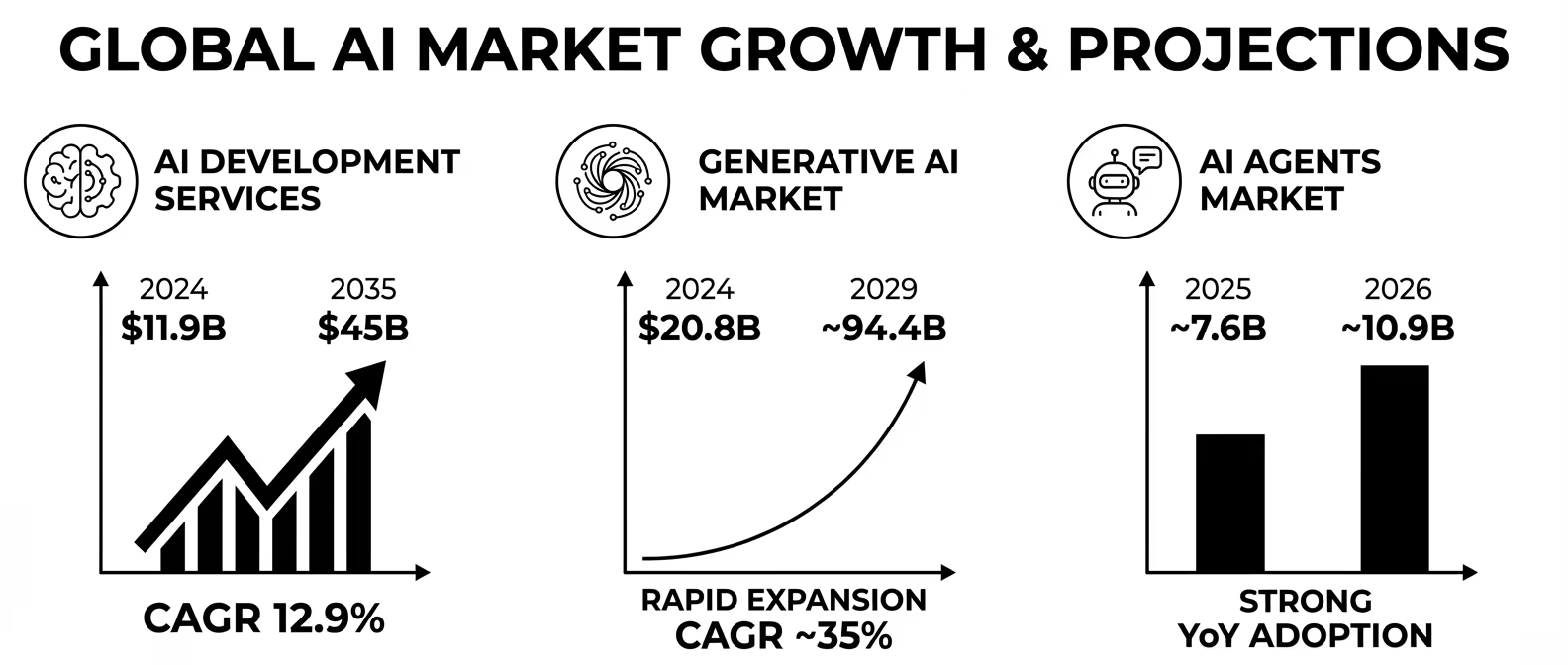
The AI industry is experiencing unprecedented growth. According to ABI Research, the global AI software market is projected to grow from $174 billion in 2025 to $467 billion by 2030, at a CAGR of around 22%. As businesses increasingly invest in AI-powered solutions, understanding the AI development cost breakdown becomes crucial for planning a successful implementation.
This guide gives you the real answer: the complete cost breakdown that covers initial build cost, ongoing operations, team composition, technology choices, and the ROI math you need to make the case internally.
Why Should You Invest in AI?
Investing in AI is not an optional choice but a business necessity.
Earlier, companies used AI only for experiments. Now, businesses use AI to improve customer service, predict demand, reduce costs, and increase productivity. AI helps companies work faster and smarter.
McKinsey estimates that AI can create $2.6 to $4.4 trillion in economic value every year. AI can improve more than 63 core business processes, including marketing, logistics, finance, and research.
Big companies like Google show how AI creates real value. Google uses AI across Search, Cloud, and Workspace, which helps increase revenue and user engagement. This proves one important thing, AI gives results only when businesses fully implement it, not when they just test it.
When companies build an AI solution with clear goals, strong data, and skilled developers, AI becomes a long-term asset. It keeps improving over time and delivers higher returns.
This is the reason why many businesses first focus on choosing the right AI development company and skilled developers before starting a project.
AI Development Cost Breakdown: A Complete Overview
The artificial intelligence development cost depends on what kind of AI solution you want to build. A simple AI automation solution costs much less than an AI-driven recommendation solution or an AI-powered demand forecasting solution.
AI development includes many parts such as planning, design, data preparation, model training, testing and maintenance. Each stage adds to the total cost.
Below is an AI development cost breakdown to help you understand where your money is spent.
At-a-Glance: AI Solution Cost
| AI Solution Type | Estimated Cost (USD) |
| API Integration / Chatbot | $8,000 – $40,000 |
| Basic ML Solution | $40,000 – $75,000 |
| Mid-Level AI Solution | $75,000 – $150,000 |
| Custom LLM / GenAI Application | $150,000 – $300,000 |
| Enterprise AI Platform | $300,000 – $500,000+ |
Build, Buy, or Integrate? The First Decision That Sets Your Budget for AI Development
Before estimating any figure, you need to answer the questions that mostly blog skips.
Should you build from scratch, buy an off-the-shelf AI product, or integrate an existing AI API into your stack?
This single choice can swing your budget by 10x.
| Approach | Cost | Timeline | Customisation | Lock-in Risk | Best For |
| Integrate AI API (OpenAI, Gemini, Claude) | $8K – $50K | 4 – 12 wks | Low – Med | Vendor-dependent; pricing can change | Fast MVPs, chatbots, content tools |
| Buy Off-the-Shelf SaaS AI | $5K – $120K/yr | 2 – 8 wks | Low | High lock-in; data stays on vendor | HR, support, standard analytics |
| Fine-Tune Open-Source Model (Llama, Mistral) | $50K – $200K | 3 – 6 mo | High | Full ownership; self-hosted | Domain-specific; data-sensitive industries |
| Build Custom from Scratch | $200K – $500K+ | 6 – 18 mo | Maximum | Full IP ownership | Unique competitive advantage; regulated industries |
For most businesses in 2026, the smartest path is API integration with a fine-tuning layer. Ship fast, validate the use case, and migrate to a self-hosted model only when monthly API costs exceed $10,000 – $15,000.
Complete AI Development Cost Breakdown
1. Team Composition & Hourly Rates by Region
Labour is usually 60 – 70% of total project cost. Your team structure and geography are the biggest levers you can pull.
| Role | US / Canada | Western Europe | Eastern Europe | India |
| AI / ML Engineer | $120 – $200/hr | $80 – $140/hr | $50 – $90/hr | $25 – $55/hr |
| Data Scientist | $110 – $180/hr | $75 – $130/hr | $45 – $80/hr | $20 – $45/hr |
| LLM / Prompt Engineer | $100 – $160/hr | $70 – $120/hr | $40 – $75/hr | $18 – $40/hr |
| Backend Developer | $90 – $150/hr | $60 – $110/hr | $35 – $65/hr | $15 – $35/hr |
| UI/UX Designer | $80 – $130/hr | $55 – $100/hr | $30 – $60/hr | $12 – $30/hr |
| DevOps / MLOps | $100 – $160/hr | $70 – $120/hr | $40 – $70/hr | $20 – $40/hr |
2. Technology Stack Cost Comparison
Your choice of AI model is a recurring monthly cost. Here’s how leading options compare for a mid-scale production system processing ~1M tokens/day:
| Model / Platform | Licensing | Monthly Cost (1M tok/day) | Fine-tuning Cost | Data Privacy |
| GPT-4o (OpenAI) | Usage-based API | $3,000 – $9,000/mo | $5K – $30K | Data sent to OpenAI |
| Gemini 1.5 Pro (Google) | Usage-based API | $2,500 – $8,000/mo | $4K – $25K | Data sent to Google |
| Claude 3.5 (Anthropic) | Usage-based API | $2,800 – $8,500/mo | N/A (API only) | Data sent to Anthropic |
| Llama 3.1 (Meta, OSS) | Free / self-host | $800 – $3,500/mo (GPU) | $10K – $60K | Full control – self-hosted |
| Mistral (OSS) | Free / self-host | $600 – $2,500/mo (GPU) | $8K – $40K | Full control – self-hosted |
3. Industry-Specific AI Development Costs
General cost estimates can be misleading. For example, an AI solution for healthcare requires additional compliance, security, and audit measures such as HIPAA regulations and explainable AI features.
In contrast, a retail recommendation system has different requirements and costs. That’s why AI development budgets vary significantly across industries.
| Industry | Type | Cost Notes |
| Healthcare | Diagnostic NLP, patient flow | Add $30K – $80K for HIPAA compliance, audit trails, and FDA SaMD explainability requirements. |
| Fintech / Banking | Fraud detection, credit scoring | Add $40K–$100K for SOC 2, PCI-DSS, and mandatory model bias auditing. |
| E-commerce / Retail | Recommendations, visual search | Lower compliance overhead, total $60K – $200K depending on catalogue and traffic volume. |
| Logistics | Route optimization, ETA prediction | Real-time inference adds 20 – 30% to infrastructure costs versus batch-only systems. |
| EdTech | Adaptive learning, assessment AI | FERPA compliance ($15K – $40K) and content moderation layers required for student-facing tools. |
| Manufacturing | Quality inspection, predictive maintenance | Edge deployment on factory hardware adds $20K – $60K in device integration and latency optimization. |
4. The Hidden Costs Nobody Quotes You
Every AI proposal looks clean until it hits production. Add 25 – 35% to any AI project quote to account for these costs or 40 – 50% for compliance-heavy industries.
| Hidden Cost | Why It Happens | Typical Range |
| GPU Reservation & Burst Costs | Peak traffic triggers on-demand GPU pricing (3–5× reserved rate) | $2K – $20K/mo |
| Failed Experiment Write-offs | Models that miss accuracy thresholds, common in early R&D phases | $15K – $60K |
| Data Acquisition & Licensing | When internal data is insufficient and external datasets must be purchased | $5K – $50K |
| EU AI Act / GDPR Compliance | Required for high-risk AI systems in the EU since August 2024 | $20K – $80K |
| Vendor Lock-in Exit Costs | Migrating between cloud AI platforms – model retraining, API rewrites | $30K – $120K |
| Model Monitoring Tools | Drift detection and explainability dashboards (Arize, Evidently, Whylogs) | $500 – $8K/mo |
| Change Management & Training | Staff upskilling, adoption programmes, and workflow redesign | $10K – $40K |

Calculate Your AI ROI Before You Commit
Costs mean nothing without returns. Use this framework to estimate your 2-year ROI. A typical well-scoped AI project sees positive ROI in 9 – 18 months, with a 3 – 5x return at the 2-year mark.
| ROI Input | Formula | Example ($150K build) |
| Annual labour hours saved | Hours × avg. hourly cost | 5,000 hrs × $60 = $300K/yr |
| Annual revenue uplift | New revenue enabled by AI | $100K/yr (e.g., higher conversion) |
| Annual operational cost | Cloud + maintenance + monitoring | $40K/yr |
| Net annual benefit | (Labour + Revenue) – Ops Cost | ($300K + $100K) – $40K = $360K |
| 2-Year net ROI | (Net Benefit × 2) – Build Cost | ($360K × 2) – $150K = +$570K |
| Return multiple | Net ROI / Build Cost | 3.8× return |
| Payback period | Build Cost / Monthly Net Benefit | ~5 months |
What Drives AI Development Cost? The Five Major Factors
Below are major factors that drive the AI development cost and increase your budget:
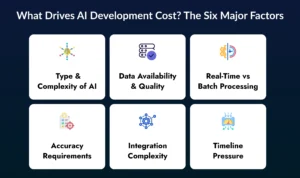
1. Type & Complexity of AI
Rule-based automation is cheap. Computer vision or multi-modal models are expensive. The AI type you choose sets your floor price.
2. Data Availability & Quality
Clean, labeled, domain-specific data cuts 30 – 40% off training costs. Poor data means expensive cleaning cycles and poor model accuracy, the most common cause of AI project overruns.
3. Real-Time vs Batch Processing
Real-time inference (fraud detection, voice AI) costs 3 – 5x more in infrastructure than batch processing (nightly reports, weekly forecasts). Not everything needs sub-100ms response.
4. Accuracy Requirements
Going from 85% to 99% accuracy can double training time and compute cost. Regulated industries (healthcare, finance) often require 99%+, adding significant budget.
5. Integration Complexity
Connecting AI to legacy ERP/CRM systems is often harder than building the AI itself. Each additional integration adds 2–6 weeks of development time.
6. Timeline Pressure
Cutting a 9 – month timeline to 5 months by adding developers typically increases cost by
Ongoing Operational Costs in AI Systems
Deploying an AI System is only the beginning. Once an AI system is live, it requires continuous investment to remain accurate, secure and aligned with business requirements. Unlike traditional software, AI solutions depend heavily on data infrastructure and ongoing optimization.
Below are the key ongoing operational cost factors:
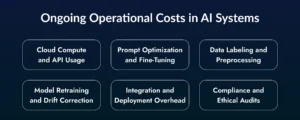
1. Cloud Compute and API Usage
AI systems rely on cloud infrastructure for data processing, model inference, and real-time decision-making. As usage scales, compute power, storage, API calls, and always-on availability significantly increase operational costs.
2. Prompt Optimization and Fine-Tuning
To maintain accuracy and relevance, AI models powered by large language models require continuous prompt optimization and fine-tuning to maintain accuracy and relevance. This ongoing process involves testing, refinement, and AI expertise, adding to long-term operational expenses.
3. Data Labeling and Preprocessing
Preparing high-quality data involves labeling, cleaning, normalization, and formatting for model training. As data volumes grow, continuous preprocessing becomes essential to maintain model performance and reliability.
4. Model Retraining and Drift Correction
AI models can lose accuracy over time as user behavior, market conditions, and data patterns change. Regular retraining, drift detection, and performance monitoring are necessary to ensure reliable results.
5. Integration and Deployment Overhead
Integrating AI into existing workflows, platforms, and legacy systems requires custom development, APIs, and testing. Ongoing maintenance and compatibility updates further contribute to operational costs.
6. Compliance and Ethical Audits
Regular audits help ensure data privacy, security, and compliance with industry regulations. Continuous monitoring, bias testing, and governance efforts are essential for maintaining trustworthy and regulation-ready AI systems.

6 Proven Strategies to Reduce AI Development Cost
Developing an AI solution can be expensive, but the right approach can significantly reduce costs without compromising quality. These proven strategies help businesses optimize custom AI development costs while maximizing ROI.
1. Validate with an MVP First
Start with a Minimum Viable Product (MVP) and focus on the narrowest useful version of your solution. This helps validate real demand, uncover challenges early, and avoid investing heavily before proving business value.
2. Use Open-Source Models Where Possible
When data privacy requirements allow, leverage open-source models such as Llama and Mistral. These models can deliver strong performance for many business use cases while significantly reducing recurring AI costs.
3. Invest in Data Quality Before Model Training
Clean, structured, and well-labeled data improves model accuracy from the beginning. Investing in data quality upfront reduces future debugging, retraining efforts, and overall development expenses.
4. Separate Real-Time from Batch Workloads
Not all AI workloads need real-time processing. Moving non-critical tasks to batch processing can dramatically reduce compute costs while maintaining operational efficiency.
5. Build Reusable AI Components
Reuse APIs, prompt templates, data pipelines, and evaluation frameworks across projects. Reusable assets accelerate development and help reduce costs for future AI initiatives.
6. Negotiate Cloud Credits and Reserved Capacity
Take advantage of cloud credits, committed-use discounts, and reserved capacity programs offered by major cloud providers. These incentives can substantially lower infrastructure costs, especially for growing AI workloads.
What Determines the Cost of AI Development?
Before starting an Artificial Intelligence project, it is important to know why AI development costs can be different for every business. Many people think building AI is like buying a ready-made software product.
Choose a plan → Pay a fixed price → Start using it
But AI development does not work like this. The total cost depends on what is the complexity of the AI System, what technology is used, how much data is needed, and how smart the AI solution you are looking for.
Below are the main factors that decide how much AI software development will cost.
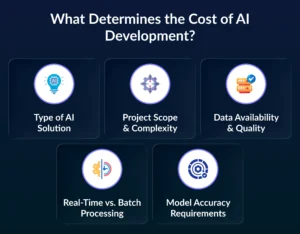
1. Type of AI Solution
The type of AI solution you want to build decides the starting cost. A simple chatbot that follows rules costs much less than an advanced AI system that can understand text, images, or voice together.
Different AI solutions need different work behind the scenes, such as data preparation, model training, testing, and performance checks. More advanced AI needs more time and expert skills, which increases the cost.
2. Project Scope & Complexity
Project scope means how big and detailed the AI system is. The more features you add, the more it costs.
Things like automation level, accuracy goals, system integrations, security rules, device support, and language support all increase the work. Even small changes in features can take extra weeks of development and raise the total cost.
3. Data Availability & Quality
Data is the most important part of AI. If a business already has clean and labeled data, development is faster and cheaper.
But if data is unorganized or not labeled, teams must clean and tag it first. This takes time and money and increases the AI development cost.
4. Real-Time vs. Batch Processing
AI systems can work in two ways: real-time or batch processing.
Real-time AI gives instant results, like fraud detection or voice assistants. These systems need fast servers, special models, constant monitoring, and more computing power. That is why they cost more.
Batch processing AI works on data later, not instantly. These systems use simpler setups and less power, making them cheaper to build.
5. Model Accuracy Requirements
Higher accuracy means more work. Reaching basic accuracy may take a few training rounds, but reaching very high accuracy takes much more time and effort.
This includes more training, better data, more testing, and higher computing use. All of these steps increase the total AI development cost.
Businesses in regulated industries like healthcare or finance need very high accuracy. This helps build trust and meet legal rules, but it also increases costs.
Get Scalable AI Solutions With Developer Bazaar Technologies
Understanding the AI development cost is the first step toward building a successful AI product. At Developer Bazaar Technologies, we handle everything from idea to launch, helping businesses create an AI solution tailored to their needs.
As a trusted AI development company, we use advanced technologies like machine learning, natural language processing, and predictive analytics to turn complex tasks into smart, automated systems. Our AI integration services help businesses scale faster and work smarter.
We focus on building AI apps, AI agents, or whatever AI solutions you require. It delivers real business results, whether it’s AI in travel, AI in demand forecasting, or an AI recommendation system. If you’re ready to develop an AI application that drives growth and efficiency, connect with us today.

FAQs
1. How much does it cost to build an AI chatbot in 2026?
A basic rule-based chatbot integrated via API costs $8,000 – $30,000. A conversational AI with memory, multi-intent handling, and CRM integration costs $40,000 – $100,000. A fully custom enterprise chatbot with domain fine-tuning runs $100,000 – $250,000+.
2. What is the cheapest way to add AI to my product?
Integrate an existing LLM via API (OpenAI, Anthropic, Google). This approach requires minimal ML expertise, launches in weeks, and often costs under $20,000 for a usable feature. Migrate to a self-hosted model only when monthly API costs exceed $10,000 – $15,000.
3. How do ongoing AI costs compare to initial development costs?
Plan for 20 – 30% of your build cost annually in operational expenses. A $150,000 AI build carries roughly $30,000 – $45,000/year in cloud, maintenance, monitoring, and ongoing model work. These costs grow with usage.
4. Does the EU AI Act affect development costs?
Yes, for high-risk AI systems (healthcare, HR, credit, law enforcement) operating in the EU, the AI Act imposes documentation, risk assessment, and audit requirements that add $20,000 – $80,000 to compliance costs, with ongoing annual audits adding $5,000 – $20,000/year.
5. How long does it take to see ROI from an AI investment?
Most well-scoped AI projects reach positive ROI in 9 – 18 months. Projects that automate high-frequency, manual tasks (data entry, customer support, document processing) typically see the fastest payback, often under 12 months. Complex research or predictive systems can take 18 – 36 months.
6. Is it cheaper to use an offshore AI development team?
Offshore teams (India, Eastern Europe) can reduce labour costs by 50 – 70%, but require stronger project management, clear specifications, and longer feedback loops. The best model for most mid-sized companies is a hybrid: offshore for implementation, onshore lead for product decisions and stakeholder communication.