
Key Takeaways:
- AI agent development costs vary based on intelligence level, integrations, data requirements, and deployment complexity.
- Framework-based development significantly reduces cost and development time, while custom-built AI agents offer greater flexibility and long-term scalability.
- Integration with business systems such as CRMs, ERPs, APIs, and internal databases often has a bigger impact on project cost than AI model selection itself.
- Production-ready AI agents require continuous monitoring, model updates, and infrastructure optimization to maintain accuracy and performance over time.
- Businesses that define clear use cases and success metrics before development achieve faster deployment and higher ROI from their AI investment.
Did you know 77% of workers will eventually trust AI to operate independently?
This shift in perception shows how AI is becoming an essential tool for the future of work and customer service. AI agents are at the center of this change.
These smart, proactive tools are designed to take on specialized tasks, often replacing or improving traditional ways of working.
Using powerful technologies like large language models (LLMs), AI agents can understand the full context of a request, whether it’s a simple question or a complex automated trigger. They can then decide what to do next, all without needing human help.
According to recent research, leaders trust AI to complete 51% of their tasks, while employees trust AI to complete 40%.
As trust in AI grows, businesses have a significant chance to increase workforce productivity, expand capabilities, and provide exceptional consumer experiences by 2026.
What is an AI Agent?
AI agents are tools designed to take on tasks that usually require human intelligence. They can work in different environments, adapt to new situations, and learn from their experiences.
These agents are becoming an essential part of how businesses operate because they are:
- Autonomous: They don’t require continuous human oversight to function independently.
- Reactive: They respond quickly to changes in their surroundings.
- Proactive: They act to achieve their objectives rather than passively waiting for orders.
- Socially Capable: They interact effectively with humans and other systems to complete tasks.
How AI Agents Are Built: The Core Technology
Three building blocks work together to make an AI agent useful.
1. Machine Learning
Machine learning lets the agent learn from past data instead of following fixed rules. The more good data it sees, the better its decisions become over time.
2. Natural Language Processing (NLP)
NLP helps the agent understand human language and reply in a natural way. It is the reason an AI assistant can understand your question instead of just matching keywords.
3. Data Labeling
Data labeling means tagging information so the AI knows what it means. For example, a sentence might be marked as a question or a complaint. These tags teach the agent to spot similar patterns later on.
Two Ways to Build an AI Agent
Companies usually choose one of two paths. The right one depends on budget, timeline, and how unique the agent’s job needs to be.
| Approach | Best For | Pros | Cons |
| Build from scratch | Unique, complex business needs and larger budgets | Full control and ownership; built around your exact workflow | Needs strong technical skill; takes more time and money |
| Use a framework (LangChain, AutoGen, CrewAI, LlamaIndex) | Tight budgets, faster launches, smaller teams | Faster to launch; lower cost; easier for non-experts | Less customization; depends on a third-party tool |
How to Build an AI Agent in a Few Easy Steps?
Building AI agents might be a difficult task, but simplifying it into easy and smaller steps makes the procedure manageable.
Whether you’re training an AI assistant or building an AI agent for business needs, here are simple steps to get started:
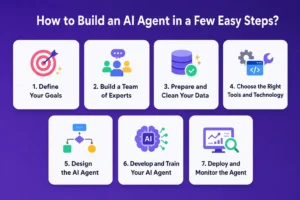
1. Define Your Goals
Start by deciding what your AI agent will do.
Is it answering customer questions, analyzing data, or making decisions?
Be clear on its tasks and what success looks like. Think about the data it needs, the level of autonomy it should have, and any ethical rules to follow.
2. Build a Team of Experts
Developing an AI agent requires professionals. As per your client’s project requirement, you may need a team of software developers, machine learning engineers, and data scientists.
If you don’t have the resources, you can hire an AI agent development company to have access to expert teams.
3. Prepare and Clean Your Data
High-quality data is the foundation of training AI agents. Collect data from reliable sources, remove errors, and organize it to ensure your AI learns correctly. Structured, clean data leads to better results.
4. Choose the Right Tools and Technology
Your tools depend on your AI agent’s tasks. For example, frameworks such as Hugging Face for natural language processing or TensorFlow for machine learning may be necessary for innovations in AI architecture.
Choose the right tools for your particular requirements and decide whether your agent will operate in-house or in the cloud.
5. Design the AI Agent
Decide how your AI agent will work. Will it focus on specific tasks, or manage multiple ones simultaneously?
Define how it interacts with users, processes data, and generates results. A strong design ensures smooth performance.
6. Develop and Train Your AI Agent
Now comes the exciting part, building your AI agent. Write code, integrate systems, and train your AI assistant using the prepared data.
Test it thoroughly to fix errors and ensure it performs well in real-world scenarios.
7. Deploy and Monitor the Agent
Once ready, launch your AI agent gradually. Monitor its performance and gather user feedback to improve its features.
Regular updates are key to keeping your AI effective and secure.
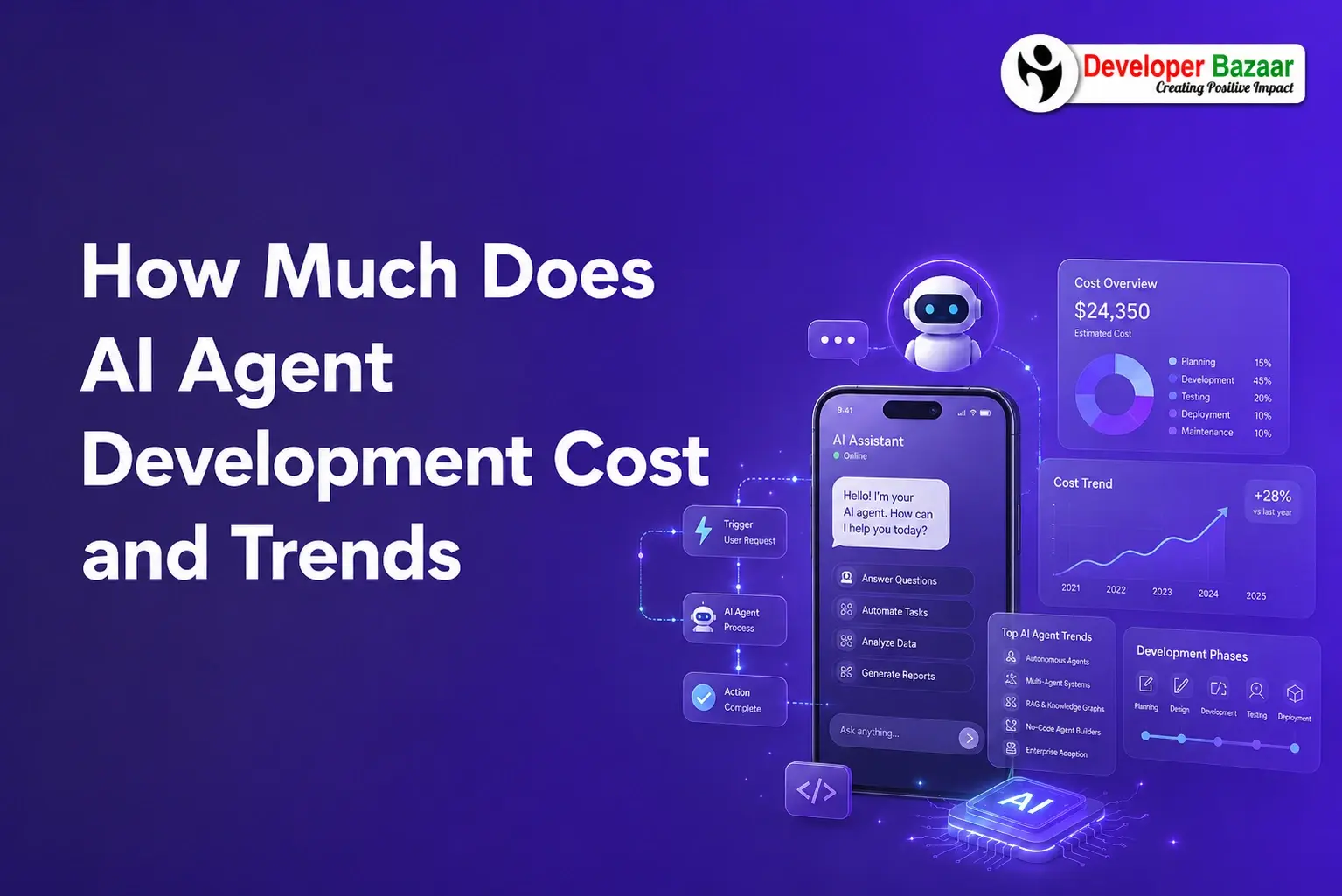
How Much Does AI Agent Development Cost?
The complexity and features you require will determine how much it costs to build an AI agent.
| Agent Type | What It Does | Typical Cost | Examples | |
| Basic / reflex agent | Answers simple questions using fixed rules or a knowledge base | $5,000 – $30,000 | FAQ bots, file sorting tools | |
| Intermediate agent | Uses ML and NLP for multi-step tasks and short-term memory | $30,000 – $80,000 | Virtual assistants, fraud alerts | |
| Advanced agent | Plans, reasons, and connects to several business systems (CRM, ERP) | $80,000 – $150,000 | Sales automation, support agents that take action | |
| Enterprise / multi-agent system | Coordinates several agents with compliance and security needs | $150,000 – $500,000+ | Healthcare diagnostics, autonomous operations | |
If you’re unsure about the best solution, an AI development services provider can help you weigh the options. Pre-built AI agents may cost less but might not meet unique business needs. Custom AI solutions, while pricier, offer better alignment with specific goals.
With a clear understanding of the steps and costs involved, you can make informed decisions about building and deploying your AI agents effectively.
Factors That Affect AI Agent Development Cost
Building an AI agent can vary greatly in cost, depending on several key factors. Here’s a closer look at what drives these differences:
1. Complexity of the AI Agent
Developing a simple AI chatbot, like one for answering FAQs, is relatively inexpensive.
Such projects use basic AI agent development techniques and can often be solved by a beginner with generative AI knowledge.
However, developing advanced AI agents, like those used in medical diagnostics, is much more demanding.
These systems rely on advanced innovations in AI architecture, require specialized medical data, and involve complex machine learning, computer vision, and deep learning models.
Because of this, their development costs are significantly higher.
2. Functionality and Features
The cost of a custom AI agent development solution increases as it becomes more advanced.
Features such as natural language processing, voice recognition, or AI agents with computer vision capabilities add to the expenses.
Additionally, user-friendly interfaces and seamless data integration are essential but can increase the price tag.
3. Information Needed
AI agents need high-quality data to perform well. The time and resources required to collect, clean, and train the model on extensive datasets make AI agent development more expensive.
On the other hand, simpler projects with smaller datasets cost less to develop.
4. Type of Development
If you’re developing AI agents occasionally, hiring an internal team can be costly.
You’ll need to maintain infrastructure, recruit data scientists and developers, and make technological investments.
Outsourcing the project to an experienced AI agent development company is often more cost-effective. It eliminates the need for long-term investments and lets you access expert services for a fraction of the cost.
5. Time Spent on Development
The timeline for your AI project also impacts the cost. Tight deadlines require more resources, whether that means hiring additional engineers, utilizing powerful computing tools, or extending work hours, all of which increase expenses.
6. Extra Expenses
Beyond the basics, you might need to spend more for specific licenses, enhanced scaling capabilities, or custom functionalities.
Industries like healthcare often require additional compliance measures, which add to the development cost.
What’s Next for AI Agents in 2026 and Beyond
The domain of artificial intelligence agents is advancing quickly, and in 2026, the following significant trends will influence their future:
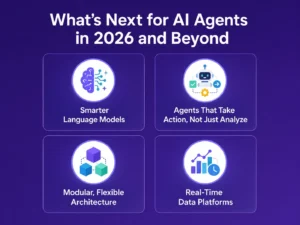
1. Smarter Language Models
Large language models keep getting better at understanding complex requests, which means agents make more accurate decisions with less human correction.
2. Agents That Take Action, Not Just Analyze
New systems pair analysis with execution. A retail agent, for example, can spot low stock and place a reorder on its own, without anyone clicking a button.
3. Modular, Flexible Architecture
Businesses can now adjust an agent’s skills without rebuilding it from the ground up, which makes this technology realistic for small teams, not just large enterprises.
4. Real-Time Data Platforms
Agents connected to live data platforms can react to changes immediately, such as a financial agent that flags a new investment opportunity the moment market data shifts.
How Businesses and AI Agents Work Together
AI agents have evolved far beyond basic scheduling and email drafting. Today, businesses rely on them to automate end-to-end workflows, enhance customer experiences, and support strategic decision-making across departments.
1. Multi-Agent Collaboration
Organizations are increasingly deploying teams of specialized AI agents that work together to execute complex tasks, such as managing marketing campaigns, analyzing large datasets, optimizing supply chains, or coordinating product launches.
2. Growing Enterprise Adoption
As AI agents consistently demonstrate their ability to automate repetitive tasks with speed and accuracy, businesses are expanding their adoption and increasing investments in AI-driven automation across operations.
3. 24/7 Personalized Customer Support
AI agents now deliver round-the-clock, context-aware customer assistance across multiple channels. By providing faster resolutions and personalized interactions, they are transforming how businesses engage, support, and retain customers.
Conclusion
AI agent development is no longer limited to large enterprises with massive budgets. Advances in AI frameworks, cloud infrastructure, and foundation models have made intelligent automation accessible to businesses of every size. However, building a successful AI agent isn’t just about choosing the lowest development cost, it requires selecting the right architecture, integrations, security measures, and long-term maintenance strategy.
Whether you’re planning a customer support assistant, an internal productivity agent, or a multi-agent enterprise solution, investing in a scalable and well-designed AI system delivers greater operational efficiency, faster decision-making, and measurable business value. Partnering with an experienced Agentic Ai development company ensures your investment aligns with your business goals while keeping future expansion in mind.
FAQs
1. Can one AI agent handle multiple business functions, or should I build separate agents?
It depends on the complexity of your workflows. A single AI agent can manage related tasks, but businesses often achieve better scalability and performance by deploying specialized agents that collaborate within a multi-agent architecture.
2. How does integrating existing business software affect AI agent development costs?
Integrating CRMs, ERPs, payment gateways, inventory systems, or custom APIs increases development effort. The more systems your AI agent must communicate with, the higher the implementation and testing costs.
3. Is it possible to upgrade a basic AI agent into an enterprise-grade solution later?
Yes. If the initial architecture is designed for scalability, businesses can gradually add memory, autonomous decision-making, additional integrations, and multi-agent capabilities without rebuilding the entire solution.
4. How do businesses measure the ROI of an AI agent after deployment?
Common performance metrics include reduced operational costs, faster response times, higher employee productivity, improved customer satisfaction, increased automation rates, and lower manual workload across business processes.
5. What industries usually require custom AI agents instead of off-the-shelf solutions?
Industries such as healthcare, finance, manufacturing, logistics, and legal services typically require custom AI agents because they involve industry-specific workflows, regulatory compliance, sensitive data handling, and complex integrations.
6. What is the biggest mistake businesses make when budgeting for AI agent development?
Many organizations budget only for initial development and overlook expenses related to API usage, cloud infrastructure, model fine-tuning, security updates, monitoring, and ongoing optimization, all of which are essential for long-term success.