

In the last few years, global disruptions, rising customer demands, and fast-changing markets have made supply chain systems more complex. Many businesses tried to depend on ready-made tools, but they quickly realized those tools cannot handle real-world problems.
Earlier, companies using basic software had to wait for updates. But businesses that build custom supply chain management software could quickly change their systems and keep operations running.
The global supply chain software market is expected to reach $36.39 billion in 2026 and grow to $56.01 billion by 2031. A large part of this growth is coming from companies choosing to develop supply chain management software that fits their exact needs.
So the big question is not how to build, but how much it costs.
This guide will help you understand the cost to develop supply chain management software, what affects pricing, and why more companies are choosing custom solutions.
Custom vs Ready-Made SCM Solutions: The Core Differences
There are two main options: off-the-shelf SCM software and custom SCM software. Both work in very different ways and your choice will directly impact your business performance, flexibility, and long-term cost.
What is Off-the-Shelf SCM Software?
Off-the-shelf SCM software is a ready-made solution. It is already built by a company and sold to many businesses at the same time. You don’t need to build anything from scratch. You simply pay a monthly or yearly subscription and start using it.
These tools come with a fixed set of features that are designed to work for a wide range of businesses. Because of this, they are quick to set up and easy to start with.
When is it a good choice?
- Small businesses benefit because they usually don’t need complex systems.
- Simple supply chains can run smoothly without heavy customization.
- Quick setup is possible because the software is already built and ready to use.
What are the limitations?
- Limited flexibility – You can only use the features provided. You cannot fully change how the system works.
- Hard to customize – If your business has unique processes, it may not fit well into the software.
- Depends on vendor updates – You cannot make changes on your own. You must wait for the software provider to release updates or new features.
What is Custom SCM Software?
Custom SCM software is built specifically for your business. Instead of using a ready-made product, you create supply chain management software that matches your exact needs.
Developers work closely with your team to understand how your supply chain works. They study your processes, systems, and goals. Based on this, they design and build software that fits perfectly with your operations.
When is it a good choice?
- Complex operations – If your supply chain involves multiple locations, suppliers, or workflows
- Large enterprises – Companies that manage large volumes of data and operations
- Businesses needing full control – When you want complete ownership and customization
What are the benefits?
- Full flexibility – You can design the system exactly how your business works
- Better integration – It easily connects with your existing tools like ERP, CRM, or warehouse systems
- Long-term savings – You don’t have to pay ongoing subscription fees
- Strong competitive advantage – Your software is unique, so competitors cannot copy your system
Why Modern Businesses Are Moving Beyond Pre-Built SCM Software?
Many companies are now choosing to build custom supply chain management software instead of using ready-made tools.
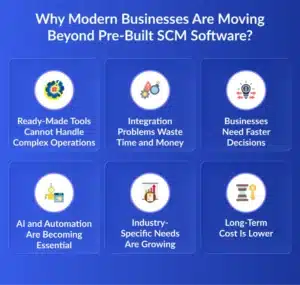
1. Ready-Made Tools Cannot Handle Complex Operations
Every business is different. Some operate in many countries. Some have multiple suppliers. Some deal with special rules. Generic tools are made for “average” businesses.
Result: You start working around the software instead of the software helping you.
2. Integration Problems Waste Time and Money
Most businesses already use tools like ERP systems, warehouse software and tracking devices. Connecting these with ready-made SCM tools is very hard. It often needs extra coding, testing and fixes. In fact, integration can take up to 60% of the project cost.
When you develop and supply chain management software from scratch, it is designed to connect smoothly with your existing systems.
3. Businesses Need Faster Decisions
Businesses steadily change their workflow. Trade rules, supplier issues and global risks keep shifting.
Studies show:
- 91% of leaders are changing supply chain strategies
- 87% want more flexible systems
Ready-made tools update slowly.
4. AI and Automation Are Becoming Essential
Modern supply chains are getting smarter. Businesses now use AI for:
- Demand forecasting
- Route optimization
- Inventory planning
Reports show:
- 50% of companies are investing in AI
- Early users reduced logistics cost by 15%
- Inventory dropped by 35%
With custom solutions, you can directly add AI into your workflows instead of using limited add-ons.
5. Industry-Specific Needs Are Growing
Different industries need different features:
- Pharma – temperature tracking
- Retail – SKU-level forecasting
- Automotive – parts lifecycle tracking
Ready-made tools cannot fully support these needs.
6. Long-Term Cost Is Lower
At first, ready-made tools look cheaper. But over time, costs increase because of:
- Monthly subscriptions
- Extra user fees
- Add-ons
- Integration costs
After 5 – 10 years, businesses often spend more than the supply chain management software development cost of a custom solution.

Key Factors That Influence the Cost of Custom Supply Chain Management Development
The cost to develop supply chain management software is not fixed. It changes based on your business needs, system size, and technical requirements.
1. Project Size and Complexity
This is the most important factor that affects the total cost. The more complex your system is, the more time and effort developers need to build it.
- Simple system (MVP): A basic version includes only essential features, fewer users and limited workflows. It is faster to build and costs less. This is a good starting point for businesses testing an idea.
- Enterprise system: A large system includes multiple modules like inventory, logistics, supplier management and analytics. It supports many users, locations, and complex workflows. This requires more development time, testing and planning, so the cost becomes much higher.
2. Features and Functionality
Every advanced feature you add to your supply chain management software development, it increases the development cost. The type and depth of features play a big role in pricing.
- Basic features: Functions like order tracking, inventory alerts and simple reporting are easier to build. They require less time and fewer resources.
- Advanced features: Features like AI-based demand forecasting, real-time shipment tracking, and supplier analytics are more complex. They need advanced technologies, skilled developers, and more testing.
3. Third-Party Integrations
Your SCM software does not work alone. It needs to connect with other systems your business already uses.
- Common integrations include ERP systems, CRM tools, warehouse software, and IoT devices.
- Each integration involves building APIs, aligning data formats, testing connections, and maintaining them over time.
4. Technology Stack
The technology used to develop supply chain management software also affects the cost.
- Modern systems use cloud platforms, microservices architecture, and APIs.
- These technologies make the system flexible, scalable, and future-ready.
However, they require more expertise and development time compared to traditional systems.
5. Development Team
The team you hire has a major impact on your budget.
- Developers in the US usually charge between $150 – $200 per hour.
- Developers in India typically charge between $15 – $55 per hour.
Choosing the right team helps you balance cost and quality when you build custom supply chain management software.
6. UI/UX Design
Supply chain software is used by different people like managers, warehouse staff and executives. So, the design must be simple and easy to use.
- A basic interface with simple dashboards costs less.
- Advanced UI with custom dashboards, data visualizations, and mobile-friendly design costs more.
7. Security and Compliance
SCM softwares handle sensitive data such as pricing, inventory and supplier information. That’s why security is very important.
- You may need features like data encryption, secure login systems, and access controls.
- If your business follows regulations (like GDPR or industry standards), extra compliance measures are required.
Cyberattack costs are expected to reach $138 billion by 2031, so investing in security is essential.
8. Maintenance and Updates
After you build supply chain management software, the system needs regular maintenance.
- This includes bug fixes, updates, performance improvements, and security patches.
- On average, maintenance costs around 15% to 25% of the initial development cost every year.
How Much Does It Cost to Develop Supply Chain Management Software?
The cost to develop supply chain management software depends on what features you want and how complex your system is. Instead, you build your budget based on different modules (features) your business needs.
Module-by-Module Cost Breakdown
Each module is like a building block. You can choose only what you need and grow later.
- Inventory Management ($8,000 – $40,000):
This is the most basic and important feature. It helps you track stock, check low inventory, and manage items across different locations. If you add features like automatic reordering or multi-warehouse tracking, the cost increases.
- Order Management System ($10,000 – $45,000):
This module manages orders from start to finish. It tracks orders, updates status, and handles delivery. Advanced features like returns management and automated workflows increase the price.
- Procurement & Vendor Management ($12,000 – $50,000):
This helps you manage suppliers, purchase orders, and contracts. Simple systems cost less, but features like supplier performance tracking and compliance monitoring increase cost.
- Warehouse Management System ($15,000 – $70,000):
This controls warehouse operations like picking, packing, and shipping. If you add automation or smart warehouse features, the cost goes higher.
- Demand Forecasting ($20,000 – $80,000):
This predicts future demand. Basic forecasting is cheaper. But using AI in Supply Chain for smart predictions increases cost because it needs data and advanced algorithms.
- Logistics & Shipment Tracking ($15,000 – $60,000):
This tracks deliveries and manages shipping routes. Real-time tracking and route optimization increase development effort.
- Supplier Portal ($10,000 – $35,000):
This allows suppliers to manage orders, invoices, and communication in one place. More features like dashboards and automation increase cost.
- Reporting & Analytics ($8,000 – $40,000):
This shows data in dashboards. Simple reports cost less. Custom reports and real-time analytics cost more.
- AI & Machine Learning ($30,000 – $150,000+):
This is where automation in supply chain becomes powerful. Features like smart predictions, risk alerts, and demand sensing come under this. This is also where AI in supply chain management is growing fast.
- Mobile Application ($12,000 – $50,000):
A mobile app helps field teams and warehouse staff access data anytime. More features like barcode scanning or offline mode increase cost.

MVP vs Enterprise Supply Chain Management Software: Cost Comparison and What to Expect
When you plan to develop supply chain management software, it is better to start with your actual requirements.
Some businesses begin with a small version (MVP), while others invest in a full enterprise platform.
1. Basic MVP (Minimum Viable Product)
Estimated Cost: $15,000 – $60,000
Timeline: 2 – 4 months
An MVP is the simplest version of your software. It is not a “cheap product,” but a smart starting point. It focuses only on the most important features needed to run your core operations.
When you build supply chain management software as an MVP, the goal is to test your idea quickly with real users.
What you get:
- 1 – 2 core modules (like inventory or order management)
- A basic dashboard to view data
- Limited number of users
- One system integration (like ERP or CRM)
Best for: Startups, small businesses, or companies trying a new supply chain process.
2. Mid-Level SCM System
Estimated Cost: $60,000 – $200,000
Timeline: 4 – 9 months
A mid-level system is the next step after an MVP. This is where most growing businesses invest when they need better control and efficiency.
At this stage, you build custom supply chain management software with more features and better integration across departments. The system becomes more stable and supports daily business operations.
What you get:
- 4 – 6 connected modules (inventory, orders, procurement, logistics, etc.)
- Advanced reporting and analytics dashboards
- Multiple user roles with access control
- Integration with systems like ERP and CRM
- Basic demand forecasting
Best for: Growing businesses with multiple teams and departments.
It also aligns well with modern supply chain trends like automation and data-driven operations.
3. Enterprise SCM Platform
Estimated Cost: $200,000 – $500,000+
Timeline: 9 – 18+ months
An enterprise SCM platform is a full-scale, highly advanced system built for large organizations. It is designed to handle complex operations across multiple locations, countries, and business units.
What you get:
- Fully integrated modules covering all supply chain functions
- AI-powered demand forecasting and analytics
- IoT integration for real-time tracking of goods and assets
- Multi-country and multi-currency support
- Strong security and compliance systems
Best for: Large enterprises, manufacturers, and global businesses.
At this stage, technologies like automation in supply chain are essential. Many companies also start exploring advanced capabilities like agentic AI in supply chain management to automate decision-making.
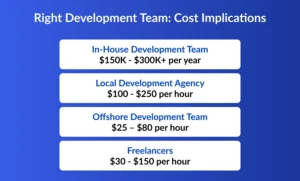
Choosing the Right Development Team: Cost Implications Explained
The team you choose has a direct impact on your supply chain management software development cost. Even if two businesses want to build the same system, their final cost can be very different depending on who they hire.
1. In-House Development Team
Estimated Cost: $150,000 – $300,000+ per year
An in-house team means you hire full-time developers, designers, testers, and a project manager to work only for your company. They build and manage your software internally.
This option gives you complete control over the project. Your team understands your business deeply, and communication is fast because everyone works together.
However, this is the most expensive option. You have to pay salaries, provide benefits, set up office space and spend time hiring the right people. Building a skilled team can take months.
Best for: Large companies that want long-term control and have the budget to invest in building their own team.
2. Local Development Agency
Estimated Cost: $100 – $250 per hour
A local agency is a professional logistics and supply chain software development company located in your country or region. They work closely with your team and usually follow structured processes.
The biggest advantage is easy communication. You share the same time zone, language and work culture. This makes meetings, feedback and project management smoother. You also get better accountability through contracts.
Best for: Projects that require strong collaboration, high security or strict compliance standards.
3. Offshore Development Team
Estimated Cost: $25 – $80 per hour
Offshore teams are located in other countries, often in regions like India or Eastern Europe. Many businesses choose this option to develop supply chain management software at a lower cost.
The main benefit is cost savings. You can access skilled developers at much lower rates compared to local teams. Offshore teams also offer a large talent pool, making it easier to find the right expertise.
However, there can be challenges like time zone differences and communication gaps. These issues can be managed with proper planning, clear communication and the right project management tools.
Best for: Businesses that want to reduce costs while still building a high-quality product.
4. Freelancers
Estimated Cost: $30 – $150 per hour
Freelancers are independent developers or designers hired for specific tasks. They are usually found on platforms like Upwork or Toptal.
Freelancers offer flexibility. You can hire them only when needed and for specific parts of your project. This can help reduce costs, especially for small tasks.
However, building a full SCM system with freelancers can be risky. Managing multiple freelancers, ensuring quality, and maintaining consistency can be difficult. There is also a higher chance of delays or communication issues.
Best for: Small features, short-term work or support tasks, not for building a complete system.
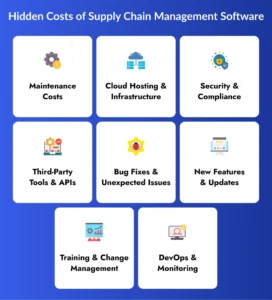
Hidden Costs of Supply Chain Management Software
Many businesses only focus on the initial cost to develop supply chain management software. But the truth is, you must keep it running, secure and updated.
These ongoing costs are important to understand because they directly affect your long-term budget.
1. Maintenance Costs
Estimated Cost: 15% – 40% of development cost per year
After you build supply chain management software, it needs regular care to keep working properly. Just like a machine, software also needs maintenance.
This includes fixing bugs, updating features, and improving system performance. Over time, new issues may appear as more users start using the system. Regular updates also make sure to stay compatible with new technologies.
2. Cloud Hosting & Infrastructure
Estimated Cost: $6,000 – $60,000+ per year
Your software needs a place to run. Most businesses use cloud platforms like AWS, Google Cloud, or Azure to host their systems. The cost depends on software complexity and how much data it handles. If your business grows, your software will need more storage, servers and computing power.
3. Security & Compliance
Estimated Cost: $20,000 – $100,000+ per year
Security is very important because your SCM system handles sensitive data like pricing, supplier details, and inventory information.
To protect this data, you need regular security checks, updates, and compliance audits. If your business follows strict regulations, you must also meet legal standards.
4. Third-Party Tools & APIs
Estimated Cost: $2,000 – $20,000+ per year
When you develop and supply chain management software, you often connect it with external services. These services help your system work better.
Examples include:
- Payment gateways
- Map and location services
- Email and SMS notifications
These tools usually charge monthly or usage-based fees.
5. Bug Fixes & Unexpected Issues
Estimated Cost: $5,000 – $25,000 per year
Some issues only appear when real users start using the software.
These problems can include:
- System errors
- Feature malfunctions
- Performance slowdowns
6. New Features & Updates
Estimated Cost: $15,000 – $80,000+ per year
As new requirements arise, you may want to add new features or improve existing ones. This helps you stay updated with the latest supply chain trends and technologies like AI in supply chain and automation.
7. Training & Change Management
Estimated Cost: $5,000 – $30,000
When you create supply chain management software, your team needs to learn how to use it properly.
Training is important for:
- Warehouse staff
- Managers
- Operations teams
You may also need to change some business processes to match the new system.
8. DevOps & Monitoring
Estimated Cost: $8,000 – $30,000 per year
To keep your system running smoothly, you need constant monitoring and support. This is handled through DevOps.
It includes:
- Tracking system performance
- Setting alerts for issues
- Managing servers and infrastructure
Final Thoughts
Supply chains are becoming more complex every day. Businesses are no longer dependent only on ready-made tools because they cannot handle real-world challenges, changing markets and growing customer demands.
That is why more companies are choosing to build custom supply chain management software that fits their exact needs. From better flexibility to improved integration and long-term savings, custom solutions give businesses full control over their operations.
However, the cost to develop supply chain management software depends on many factors, such as features, team, technology, and system size. It is also important to remember that the investment does not stop after development. Maintenance, updates, security, and scaling are all part of the total cost.
Modern technologies like AI in supply chain, and agentic AI in supply chain management are changing how businesses operate.
If you are planning to build custom supply chain management software, working with an experienced custom software development company, Developer Bazaar Technologies can helps you grow your business in a smarter way. The right team helps you choose the right features and control costs.

FAQs
1. How do I get started with SCM software development?
Start by defining your business goals, identifying key problems, and setting a budget. Then partner with a reliable logistics and supply chain software development company to plan and build your solution step by step.
2. How do I choose the right features for my SCM software?
Start by identifying your business problems and daily challenges. Then choose features that solve those problems first. It is always better to start small and add more features later.
3. Can small businesses benefit from custom supply chain management software?
Yes, small businesses can benefit by starting with an MVP. It helps them manage operations better and scale easily as they grow without depending on limited, ready-made tools.
4. Is custom SCM software better than ERP systems?
SCM software and ERP systems serve different purposes. ERP handles overall business processes, while SCM focuses only on supply chain operations. Custom SCM software can also integrate with ERP systems for better results.
5. Can SCM software integrate with existing business systems?
Yes, custom solutions are designed to integrate with systems like ERP, CRM, warehouse tools, and third-party services. This helps create a smooth and connected workflow.