

| Market Snapshot 2026
The global online airline booking platform market is projected to reach USD 261.9 billion in 2026, growing at a CAGR of 7.5% through 2035. Over 70% of all travel bookings are now made online, with 63% happening via mobile. There has never been a better time to build a custom flight booking app. Source: futuremarketinsights.com/ |
Introduction: Why Build a Flight Booking App?
Air travel is now a mainstream necessity not only a luxury. Millions of passengers book tickets daily, and the vast majority of those bookings happen on a smartphone. If you are a travel startup, an airline or an Online Travel Agency (OTA) exploring a new vertical, flight booking app development is one of the most lucrative bets you can make in 2026.
This comprehensive guide answers the key question: how do you build a custom flight-booking app that is fast, AI-powered, and competitive with giants like MakeMyTrip, Skyscanner, Google Flights, and Expedia?
Flight Booking App Market: Stats You Need to Know
Before diving into development, here are the figures that help you understand why the market opportunity is real and massive:
| Metric | Data Point |
| Global Online Travel Agency (OTA) Market Size (2026) | USD 561.3 Billion |
| Projected OTA Market Size (2031) | USD 761.3 Billion |
| OTA Market CAGR (2026 – 2031) | 6.29% |
| Travel Bookings via Mobile Devices (2025) | 63.5% of OTA Market Share |
| Transportation Booking Share (2025) | 43.8% of OTA Market Share |
| Leisure Traveler Share (2025) | 77.7% of OTA Market Share |
| Asia-Pacific OTA Market Share (2025) | 38.3% of Global Market |
| Accommodation Segment Growth (2026 – 2031) | 6.4% CAGR |
| Mobile Booking Segment Growth (2026 – 2031) | 6.33% CAGR |
| Asia-Pacific Market Growth (2026 – 2031) | 6.8% CAGR |
Source: https://www.mordorintelligence.com/
These numbers make the case clear. An online flight booking app development project is not just a tech product, it is an entry point into a trillion-dollar industry.
Types of Flight Booking Apps
Not all flight booking apps are the same. Understanding the different models helps you decide what type of airline ticket booking app solution to build:
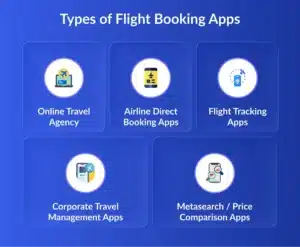
1. Online Travel Agency (OTA) Apps
These apps (like MakeMyTrip, Expedia, and Yatra) aggregate flight data from multiple airlines and global distribution systems, allowing users to compare and book flights across carriers in one place. Building a custom OTA is the most feature-rich and commercially rewarding model.
2. Airline Direct Booking Apps
Built by airlines themselves (IndiGo, Air India, Southwest), these apps handle ticketing, check-in, boarding pass management, and loyalty programs. They require deep integration with airline reservation systems.
3. Flight Tracking Apps
Flight tracking app development focuses on real-time flight status, delay alerts, and live radar. Apps like Flightradar24 and FlightAware fall in this category. They are often a feature layer within larger booking apps.
4. Corporate Travel Management Apps
Designed for business travelers and travel managers, these apps handle approvals, expense reporting, policy compliance, and multi-traveler bookings.
5. Metasearch / Price Comparison Apps
Apps like Google Flights and Skyscanner do not sell tickets directly, they aggregate prices and redirect users to airline or OTA websites. They monetize through referral commissions.
Must-Have Features in a Flight Booking App
To build a custom flight booking app requires a carefully curated feature set for both user-facing and admin panels. Here is the complete breakdown:
| Feature | User Panel | Admin Panel |
| Flight Search | Multi-city, one-way, round-trip search with smart filters (airline, stops, time, price) | Manage flight inventory and fare classes |
| Real-Time Pricing | Live fare updates, price alerts, fare calendar view | Dynamic pricing rule configuration |
| Seat Selection | Interactive seat map with class/preference filters | Seat inventory management per flight |
| Booking & Reservation | Instant booking with PNR generation, itinerary confirmation | Booking management, cancellations, modifications |
| Secure Payments | Cards, UPI, wallets, BNPL, multi-currency support | Payment reconciliation, refund processing |
| User Profiles | Saved travelers, frequent flyer numbers, past bookings | User management and segmentation |
| Check-in & Boarding Pass | Web/mobile check-in, QR-code boarding pass | Check-in window configuration |
| Flight Tracking | Live flight status, delay/gate change push alerts | Flight status monitoring dashboard |
| Cancellation & Refund | One-tap cancellation, automated refund tracking | Refund policy setup, dispute resolution |
| Loyalty & Rewards | Miles/points earning, tier status, redemption | Loyalty program configuration & analytics |
| Multi-Language & Currency | Localization for global markets | Language and currency management |
| Reviews & Ratings | Airline and flight ratings, user reviews | Moderate and respond to reviews |
Advanced Features That Differentiate Your App
- AI-powered price prediction and fare alerts
- Chatbot and virtual travel assistant (NLP-powered)
- Voice search and booking capability
- Augmented Reality (AR) cabin preview and airport navigation
- Biometric authentication (Face ID, fingerprint)
- Predictive delay alerts using machine learning
- Smart itinerary builder with hotel and cab integration
- Offline mode for boarding passes and trip details
- Carbon footprint tracker per flight
AI Integration in Flight Booking Apps: The 2026 Standard
AI in travel industry has become a key driver of innovation and business growth. Here’s how AI integration can turn a standard booking app into a smarter travel platform:
1. AI-Powered Price Prediction
Machine learning models trained on historical fare data, booking patterns, and demand signals can predict whether a fare will rise or fall. This feature alone drives significant booking conversion – users act faster when they see a “Prices likely to rise” alert.
2. Personalized Recommendations Engine
AI analyzes past travel history, preferences, search behavior, and even social patterns to surface hyper-relevant flight suggestions. Instead of showing 200 results, your app shows the top 5 that the user is most likely to book.
3. Natural Language Processing (NLP) Chatbots
Conversational AI allows users to search and book flights in plain language, “Book me a direct morning flight from Delhi to Mumbai next Friday under Rs. 5,000.” NLP-powered chatbots also handle FAQs, cancellations, and real-time support at scale, reducing customer service costs by up to 40%.
4. Dynamic Pricing & Revenue Optimization
Airlines already use dynamic pricing, but AI app development enables OTAs and independent platforms to offer real-time competitive pricing, flash sales, and demand-based offers automatically.
5. Predictive Flight Delay Alerts
By integrating with weather APIs, historical delay datasets, and air traffic APIs, ML models can predict disruptions hours before they occur and proactively notify passengers.
6. Smart Add-On Suggestions
AI identifies the right moment to upsell seat upgrades, lounge access, travel insurance, or extra baggage, based on traveler profile and booking context, increasing average order value without annoying users.
7. Fraud Detection & Payment Security
AI models monitor transaction patterns in real time to flag fraudulent bookings, reducing chargebacks and protecting revenue.
| AI Integration Insight
According to industry data, AI-powered personalization increases booking conversion rates by 15 – 35% on travel platforms. Integrating even basic ML-based recommendations and chatbot support can meaningfully move your revenue numbers within the first quarter of deployment. |
Recommended Tech Stack for Flight Booking App Development
Choosing the right technology stack is one of the most important decisions in your flight booking app development guide.
Here is what a modern, scalable stack looks like:
| Layer | Technologies |
| Mobile Frontend | Flutter, React Native (cross-platform); Swift (iOS native); Kotlin (Android native) |
| Web Frontend | React.js, Next.js, Angular – for web booking portals |
| Backend | Node.js, Python (Django/FastAPI), Ruby on Rails – for APIs and business logic |
| Database (Relational) | PostgreSQL, MySQL – for structured booking and user data |
| Database (NoSQL) | MongoDB, Redis – for flexible data, caching, session management |
| Real-Time / Messaging | Apache Kafka, RabbitMQ – for live price updates and alerts |
| Cloud Infrastructure | AWS (EC2, S3, Lambda), Google Cloud Platform, Microsoft Azure |
| AI / ML | TensorFlow, PyTorch, scikit-learn – for prediction models; OpenAI API for chatbots |
| GDS / Flight APIs | Amadeus, Sabre, Travelport – for live flight inventory and pricing |
| Payment Gateway | Stripe, Razorpay, PayPal, Braintree – for secure multi-method payments |
| Push Notifications | Firebase Cloud Messaging (FCM), Apple Push Notification Service (APNs) |
| Maps & Location | Google Maps Platform, HERE Maps – for airport navigation, nearby services |
| Security | SSL/TLS encryption, OAuth 2.0, JWT, PCI-DSS compliant payment handling |
| DevOps / CI/CD | Docker, Kubernetes, GitHub Actions, Jenkins – for scalable deployments |
Critical API Integrations for Flight Booking Apps
No flight booking app can function without connecting to real-time flight data. The core APIs and integrations your development team must plan for include:
1. Global Distribution Systems (GDS)
GDS platforms are the backbone of airline inventory. They aggregate real-time availability, schedules, and fares from hundreds of airlines worldwide.
- Amadeus Travel APIs – the most popular choice, with a developer-friendly sandbox
- Sabre APIs – widely used by enterprise OTAs and airline direct systems
- Travelport (Galileo/Apollo) – strong in corporate travel integrations
2. Low-Cost Carrier (LCC) APIs
GDS systems do not always cover budget airlines. You will need direct integrations with carriers like IndiGo, SpiceJet, AirAsia, and Ryanair through their own API programs or aggregators.
3. Payment APIs
Support multiple payment methods relevant to your target market: Stripe or Razorpay for card payments, PhonePe/Google Pay/UPI for India, PayPal for international markets, and BNPL providers like Simpl or LazyPay for younger audiences.
4. Flight Status & Tracking APIs
For real-time flight tracking app development capabilities, integrate FlightAware, AviationStack, or OpenSky Network to display live aircraft positions, ETAs, and gate information.
5. Identity & Authentication
DigiLocker integration (India), passport/ID verification through providers like Onfido or AU10TIX, and social logins via Google/Apple Sign-In reduce friction at registration and check-in.
6. Hotel, Car Rental & Travel Insurance APIs
Expand your app into a full-stack OTA by integrating hotel inventory (Hotelbeds, Booking.com Partner API), car rentals (Rentalcars.com API), and travel insurance (Bajaj Allianz, Cover Genius).
Step-by-Step: How to Build a Flight Booking App
The following roadmap outlines how travel app development companies develop a production-grade flight booking app from concept to launch.
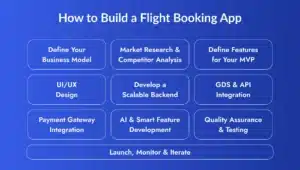
Step 1: Define Your Business Model & Target Audience
Before writing a single line of code, answer these questions:
- Are you building an OTA, an airline app, or a corporate travel tool?
- Who is your primary user: leisure traveler, business traveler, or travel agent?
- How will you monetize- commission, subscription, markup, or advertising?
Clarity here shapes every feature and architectural decision.
Step 2: Market Research & Competitor Analysis
Analyze competitors like MakeMyTrip, EaseMyTrip, Cleartrip, and Skyscanner to identify feature gaps and user pain points. Review app store feedback to uncover common issues such as slow searches, payment failures, poor cancellation experiences, and limited real-time flight updates.
Step 3: Define Features for Your MVP
Start with the essential features: flight search, booking, secure payments, booking confirmation, and user profiles. Advanced features like AI recommendations and loyalty programs can be added later.
| Expert Tip: Start with MVP
An MVP usually takes 8 – 12 weeks to build and costs between $25,000 and $80,000. Launching early helps validate your idea, collect user feedback, and attract investors before scaling. |
Step 4: UI/UX Design
Focus on a clean and simple design that makes booking quick and easy. Display transparent pricing, refund policies, and trust signals to improve user confidence and conversions.
Invest in wireframing and prototyping before development. A polished UI can reduce drop-off on the checkout page by 30 – 40%.
Step 5: Develop a Scalable Backend
Build a reliable backend that can handle real-time flight searches, bookings, payments, and notifications. A scalable architecture ensures smooth performance as your user base grows.
Step 6: GDS & API Integration
Connect your platform with travel systems like Amadeus or Sabre to access real-time flight schedules, fares, and seat availability. Carefully test all booking and cancellation workflows to ensure accuracy. Reliable API integrations are critical to delivering a seamless booking experience.
Step 7: Payment Gateway Integration
Integrate your primary payment gateway with full PCI-DSS compliance. Build support for card payments, UPI, net banking, and digital wallets from day one. Implement 3D Secure authentication, fare lock (hold a price for 24 hours), and automated refund workflows for cancellations.
Step 8: AI & Smart Feature Development
In this phase, add the intelligent layer: connect your price prediction model, configure the recommendation engine, build the NLP chatbot using Dialogflow or a custom LLM integration, and set up the push notification system for price alerts and delay warnings.
Step 9: Quality Assurance & Testing
Thorough testing is non-negotiable for a flight booking app, a payment failure at 2 AM on a travel day is a reputational disaster. Your QA process should include: functional testing of all booking flows; performance/load testing (simulate 10,000 concurrent users); security penetration testing; payment gateway testing in sandbox and live modes; device and OS compatibility testing (iOS 16+, Android 10+); and accessibility testing for WCAG 2.1 compliance.
Step 10: Launch, Monitor & Iterate
Launch the app on a reliable cloud platform and continuously monitor its performance. Track important metrics such as booking conversions, payment success rates, and user retention. Use real customer feedback and analytics to improve the product and plan future updates.
Cost to Develop a Flight Booking App in 2026
The cost to develop a flight booking app varies widely based on complexity, team size, and location. Here is a practical breakdown:
| App Type | Timeline | Cost Range | Ideal For |
| Basic MVP | 8 – 12 weeks | $25,000 – $60,000 | Startups validating an idea |
| Mid-Level App | 3 – 5 months | $60,000 – $1,20,000 | OTAs entering the market |
| Full-Scale OTA Platform | 6 – 10 months | $1,20,000 – $2,50,000 | Enterprise travel businesses |
| Enterprise with AI & GDS | 10 – 18 months | $2,50,000 – $5,00,000+ | Large travel conglomerates |
Key Factors That Influence Development Cost
- Platform Choice – Building separate iOS and Android apps costs more than using Flutter or React Native for both platforms.
- GDS Integration – Connecting with systems like Amadeus or Sabre requires specialized expertise, which increases development costs.
- AI Features – Simple recommendation engines are affordable, while advanced AI and custom LLM features are more expensive.
- Development Team Location – Development rates vary by region, with offshore teams generally costing less than US or European teams.
- Third-Party Services – Costs for GDS access, maps, payment gateways, and other APIs can add significantly to the budget.
- Security & Compliance – Meeting payment security and data privacy requirements can increase the overall project cost.
How to Monetize a Flight Booking App
Building the app is only half the story. Here are the proven monetization strategies used by successful flight booking platforms:
- Commission on Flight Bookings – Earn a percentage of every airline ticket booked through your platform.
- Ancillary Services – Generate additional revenue by offering seat upgrades, extra baggage, lounge access, and travel insurance.
- Hotel & Car Rental Partnerships – Earn referral commissions when users book hotels or rental cars through your app.
- Subscription Plans – Offer premium memberships with benefits like exclusive deals, free cancellations, or priority support.
- Sponsored Listings – Charge airlines and travel providers to promote their offers within search results.
- Corporate Travel Services – Partner with businesses and provide managed travel solutions through long-term contracts.
- Loyalty Program Partnerships – Collaborate with banks and credit card providers to offer rewards and travel benefits.
Common Challenges in Flight Booking App Development
Understanding the obstacles ahead helps you plan better and choose the right travel app development company to partner with:
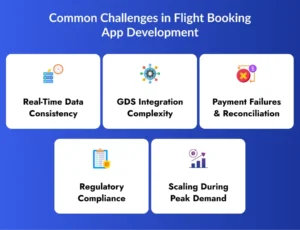
1. Real-Time Data Consistency
Flight prices and availability change every few seconds. Your app must query GDS APIs in real time and handle race conditions where a seat sells out between search and payment.
Solution: Implement seat/fare locking during checkout with a countdown timer.
2. GDS Integration Complexity
Integrating with GDS platforms like Amadeus and Sabre can be complex due to detailed booking workflows and data structures.
Solution: Work with experienced integration specialists and allocate sufficient development time.
3. Payment Failures & Reconciliation
Failed payments, currency conversions, and banking issues can affect booking accuracy and revenue tracking.
Solution: Build retry mechanisms, use idempotency keys, and maintain detailed transaction logs.
4. Regulatory Compliance
Flight booking apps must comply with industry regulations, payment security standards, and data privacy laws.
Solution: Follow PCI-DSS, GDPR/DPDP requirements, and airline fare and refund policies.
5. Scaling During Peak Demand
Travel bookings often surge during holidays, promotions, and peak travel seasons, putting pressure on app performance.
Solution: Use scalable cloud infrastructure, serverless computing, and CDN caching to handle high traffic efficiently.
How to Choose the Right Flight Booking App Development Company
Building a flight booking app is a complex task. Below are key guidelines to follow when evaluating a travel app development company:
- Portfolio in Travel Tech – Ask for live flight booking or OTA apps they have successfully launched.
- GDS Integration Experience – Verify experience with Amadeus, Sabre, or other travel APIs.
- AI/ML Expertise – Look for AI-powered features such as recommendations, chatbots, and automation.
- Cross-Platform Development – Ensure proficiency in Flutter or React Native for iOS and Android apps.
- Security & Compliance – Confirm knowledge of PCI-DSS, data encryption, and secure payment systems.
- Post-Launch Support – Check if they provide ongoing maintenance, monitoring, and updates.
- Transparent Pricing – Choose a partner with clear project scope and milestone-based billing.
- Android & iOS Specialization – Verify strong expertise across both mobile platforms.
| ⚠️ Red Flag
Be careful when choosing a development company that offers very cheap, ready-made flight booking apps. Travel platforms need real-time booking systems, secure payment processing, and reliable airline data integrations. While a template-based solution may seem affordable at first, it often struggles as your business grows and can lead to higher costs later for fixes and upgrades. |
Future Trends in Flight Booking App Development
In the next 3 to 5 years, there will be significant changes to how flight booking apps work. Building the app with these trends, gives your app long-term competitive relevance:
- Agentic AI Travel Planning – AI agents that autonomously research, book, and manage entire trips on behalf of users.
- Voice-First Booking – “Hey Siri, book my usual Mumbai-Delhi morning flight for next Monday”, conversational booking without opening the app.
- Super-App Integration – Flight booking as a feature inside super-apps (WhatsApp, PhonePe) rather than standalone apps.
- Blockchain for Ticketing – Tamper-proof, transferable digital tickets on blockchain to eliminate fraud and simplify refunds.
- AR Airport Navigation – Real-time AR overlays guiding travelers from check-in counter to gate in complex terminals.
- Biometric Travel – Face-scan-based check-in and boarding, reducing the need to present physical documents.
- Sustainable Travel Filters – Carbon-aware booking options, sorting flights by emissions, not just price.
- Generative AI Content – AI-written, personalized destination guides and travel tips embedded directly in the booking flow.
Conclusion
At Developer Bazaar Technologies, we have spent 10+ years building travel technology products. And the opportunity in flight booking app development has never been larger, or more technically demanding. Building an app that users trust with their travel plans requires real-time data infrastructure, hassle-free payment options, intuitive UX, and intelligent AI capabilities.
Whether you are a startup exploring online flight booking app development, an airline modernizing its digital presence, or an enterprise looking for a custom OTA platform, the fundamentals remain the same: start with a well-defined MVP, integrate the right APIs, invest in UI/UX, and build for scale from day one.
The right mobile app development company will not just write code, they will act as a strategic partner who understands the fine details of GDS systems, aviation compliance, and AI integration in the travel industry.

FAQs
1. How long does it take to develop a flight booking app?
A basic MVP takes 8 – 12 weeks. A mid-level flight booking app takes 3 – 5 months. A full-scale OTA platform with AI integration and GDS connectivity typically takes 6 – 12 months, depending on team size and feature scope.
2. Which GDS is best for a flight booking app?
Amadeus is the most developer-friendly choice with strong documentation and a free sandbox. Sabre is preferred for enterprise OTAs with heavy domestic US airline content. Travelport excels in corporate travel. For a new app, start with Amadeus.
3. Can a small startup build a flight booking app?
Yes, with the right approach. Start with an MVP focused on a specific niche (e.g., one domestic market, corporate travel for SMBs, or a specific airline alliance). Use cross-platform development (Flutter) to control costs. Partner with an experienced travel app development company to reduce the learning curve on GDS integrations.
4. Is AI integration necessary for a flight booking app in 2026?
Competitive advantage increasingly depends on AI. While a basic app can function without it, AI-powered price alerts, personalized recommendations, and NLP chatbots have moved from differentiators to user expectations. At minimum, integrate a price prediction model and a chatbot for customer support.
5. How do flight booking apps make money?
The primary revenue streams are: commission per booking (2 – 5%), ancillary upsell (baggage, seats, insurance), hotel/car cross-sell, subscription premium tiers, and advertising from travel brands and airlines.