

Technology is changing very fast. Today, developers are not working alone. They are working with smart systems that help them write, test, and improve code. This new way of building software is called AI-assisted development.
AI-assisted development is changing how software is built, tested, and optimized. AI tools are now part of coding environments. They suggest code, fix errors, test applications and even guide developers when they get stuck.
For businesses that want to stay competitive, understanding AI-assisted software development is not an option anymore, it is necessary.
In this guide, we will explain what AI-assisted development is, the benefits to AI-assisted development, how it helps developers, and the challenges you should know about.
What is AI-Assisted Development?
AI-assisted development is a modern way of building software with the help of artificial intelligence. Instead of writing every line of code manually, developers use smart systems that guide, support and automate parts of the work. These intelligent systems act like a virtual assistant or even a tech lead who is always available inside the coding environment.
In general, AI-assisted software development helps developers build applications faster, with fewer mistakes and better quality. It reduces manual effort and allows developers to focus on solving important problems instead of repeating routine tasks.
Developers use AI-assisted development tools to improve speed, accuracy, and efficiency during the entire AI-assisted development process.
What AI-Assisted Development Tools Can Do
AI-assisted tools help developers by:
- Suggesting code while typing
- Fixing syntax errors instantly
- Detecting bugs early
- Automating testing processes
- Improving application security
- Recommending best practices
- Guiding developers on the next logical step
These tools support every stage of AI-assisted development workflows, from writing the first line of code to final deployment.
How AI-Assisted Development Works
AI-assisted development works using advanced technologies that allow machines to learn, understand and automate tasks. The main technologies behind it include:
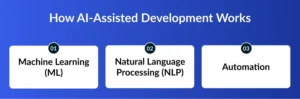
1. Machine Learning (ML)
- Learns from large amounts of code data
- Identifies patterns in programming
- Detects bugs and improves suggestions over time
- Predicts possible errors before they happen
2. Natural Language Processing (NLP)
- Understands human language
- Converts text instructions into working code
- Helps developers communicate with systems easily
For example, a developer can type: “Create a login form with email and password.”
The AI tool understands the request and generates the basic structure of the code automatically.
3. Automation
- Handles repetitive tasks
- Runs automated tests
- Manages formatting and code structure
- Speeds up debugging and deployment
Because of these technologies, AI-assisted app development becomes faster, easier and more efficient. Developers save time, reduce errors, and build high-quality software with less stress.
Global AI Investment and Growth Statistics for 2026
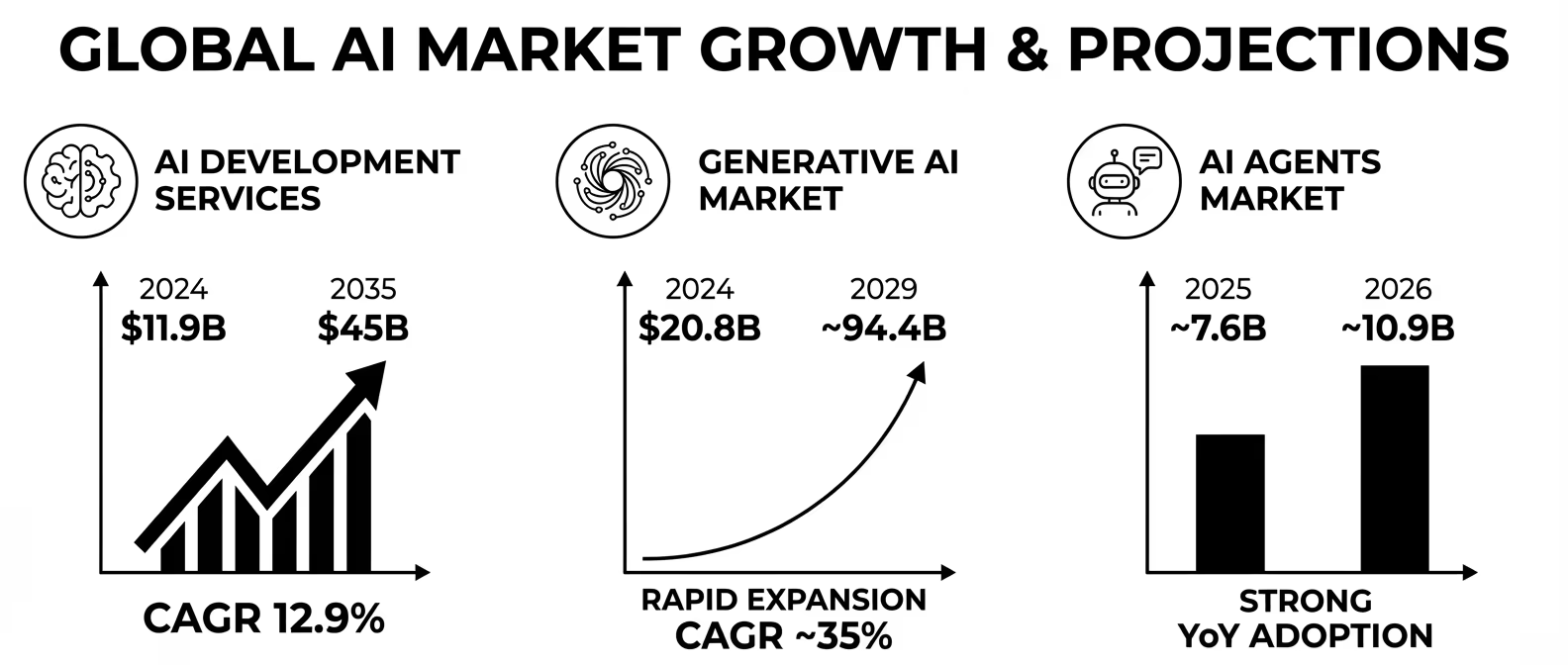
Artificial intelligence is now one of the largest global investment sectors. In 2025, AI attracted $225.8 billion, accounting for 48% of total venture funding, showing strong investor confidence.
The AI-as-a-Service (AIaaS) market is projected to reach $123.89 billion by 2031, as businesses prefer cloud-based AI solutions over building from scratch. Meanwhile, AI infrastructure is expanding at a rapid 39.05% CAGR, supporting growing demand.
Global AI spending is expected to rise from $1.5 trillion in 2025 to $3.3 trillion by 2029, with the broader AI market projected to hit $3.49 trillion by 2033.
Generative AI is growing even faster, increasing from $91.57 billion in 2026 to $400 billion by 2030, pushing companies to invest in automation, analytics, and creative AI tools.
These numbers clearly show that AI is a long-term global transformation.
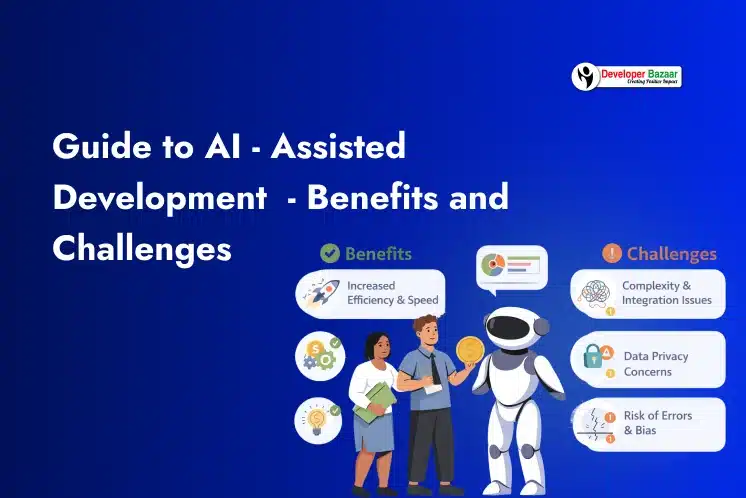
What are the Benefits of AI-Assisted Development?
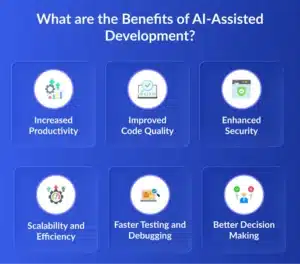
Smart AI-assisted tools that guide and support them throughout the AI-assisted development process. These tools improve productivity, quality and efficiency. Understand the major benefits to AI-assisted development:
1. Increased Productivity
One of the biggest benefits to AI-assisted development is higher productivity. AI-assisted development tools save a lot of time by automating repetitive and time-consuming tasks.
These tools can:
- Format code automatically
- Fix syntax errors instantly
- Help with debugging
- Manage versions and updates
Because AI handles small and routine tasks, developers can focus on solving real and complex problems.
AI also gives real-time suggestions while coding. It recommends better ways to write code and helps remove hassles. Automated testing finds issues early, so projects move forward smoothly without delays.
This makes AI-assisted software development faster and more efficient.
2. Improved Code Quality
AI-assisted development helps developers write clean and high-quality code. Good code is easy to read, maintain and scale.
AI-assisted tools improve quality by:
- Detecting errors early
- Suggesting best coding practices
- Identifying duplicate or unnecessary code
- Recommending refactoring for better performance
When AI finds problems inside the development environment, developers can fix them immediately. This prevents bigger issues later in the project.
AI also helps reduce technical debt by keeping the code organized and well-structured. Clean code makes future updates easier and supports long-term growth.
3. Enhanced Security
Security is very important in modern software. Even small mistakes can lead to serious problems.
AI-assisted development tools improve security by:
- Scanning code for vulnerabilities
- Detecting weak encryption methods
- Identifying outdated libraries
- Flagging risky coding patterns
AI continuously monitors the codebase and alerts developers about new security threats. This reduces human error and strengthens overall application safety. As a result, AI-assisted app development becomes more secure and reliable.
4. Scalability and Efficiency
Large software projects are complex and difficult to manage manually. AI-assisted development workflows make scaling easier and more efficient.
AI helps by:
- Managing large and complex codebases
- Optimizing system resources
- Detecting performance trouble
- Supporting CI/CD pipelines
By reducing manual work, AI allows developers to focus on system design and innovation instead of repetitive debugging tasks. This makes AI-assisted software development more scalable and efficient, especially for growing businesses.
5. Faster Testing and Debugging
Testing is a very important part of the AI-assisted development process. AI automates testing frameworks so developers can run tests more frequently.
If an application fails a test, AI:
- Explains what went wrong
- Identifies the exact problem area
- Suggests possible fixes
This speeds up debugging and reduces downtime. Faster testing means faster product releases and better user experience.
6. Better Decision Making
AI uses predictive analytics to analyze data and suggest improvements. This helps teams make smarter decisions during development.
AI can help teams:
- Understand customer needs
- Analyze user behavior
- Predict future trends
- Improve product performance
With data-driven insights, AI-assisted app development becomes more strategic and customer-focused. Businesses that invest in AI development services can build smarter applications while optimizing their AI software development cost over time.
How Does AI Help Developers?
AI-assisted development supports developers throughout the entire software development lifecycle. It acts like a smart assistant inside the coding environment. It reduces manual effort, improves accuracy, and provides helpful guidance.
AI mainly helps developers in three important ways: automation, validation, and guidance.
1. Automation
Automation is one of the biggest advantages of AI-assisted development. AI handles repetitive tasks such as code testing, bug detection, formatting and deployment steps. This saves time and reduces manual effort.
Machine learning models also suggest the next best action while coding. If a test fails, AI explains what went wrong and suggests fixes. This makes developers more productive and confident in their work.
2. Validation
AI acts like a built-in quality checker during the AI-assisted development process. It validates code by checking dependencies, identifying rule violations and flagging duplicate or inefficient code.
AI also imposes best practices and coding standards. This helps clean, structured and high-quality software without waiting for manual reviews.
3. Guidance
Developers sometimes face challenges or get stuck while writing code. AI provides real-time guidance by offering contextual search results and suggesting logical next steps.
It can also provide code examples and explain errors in simple language. In many ways, AI works like a virtual tech lead, helping teams move forward faster and smarter.
AI-Assisted Development Examples
AI-assisted development is already being used in real-world projects across many industries. These examples show how AI-assisted tools improve speed, quality, and accuracy in software building.
- Automated Code Analysis: AI scans source code to detect bugs, errors and vulnerabilities. This reduces manual code review time and improves code quality.
- Automated Testing Frameworks: AI runs tests for web and mobile apps automatically. Developers can test more often and fix issues before release.
- Predictive Analytics: AI analyzes user data and predicts trends. This helps businesses build smarter applications based on real needs.
- Natural Language Processing (NLP): Developers can write simple instructions in plain English and AI generates code. NLP also helps build smart chatbots.
- Computer Vision: AI recognizes objects in images and videos. It is useful in security apps, healthcare apps, and autonomous systems.
- Automated Machine Learning (AutoML): AI trains models automatically, reducing development time and improving accuracy.
These examples clearly show the practical benefits of AI-assisted development and how it improves the overall process.
The Future of AI-Assisted Development and AI-Powered Development
The future of AI-assisted development is very promising. Many top-performing DevOps teams already rely on AI to release clean code multiple times a day. Maintaining this speed without AI is almost impossible.
Recent industry reports show that many organizations now consider AI-assisted development an essential part of their workflow.
In the future, we can expect:
- App generation using conversational prompts: Developers will describe apps in natural language, and AI will build them.
- Real-time visual app previews: Developers will see instant visual changes to validate AI output.
- AI ecosystem integration: Easy connectors to platforms like Microsoft, Google and Amazon services.
- Smarter low-code platforms: AI will simplify development while maintaining full control over the code.
As AI improves, AI-assisted development workflows will become more automated, faster and more reliable. Businesses investing in AI development services today will gain a strong competitive advantage.
Key Applications of AI in Software Development
From writing code to testing and security, AI-assisted tools support every stage of the AI-assisted development process. Below are the key applications of AI-assisted software development explained:
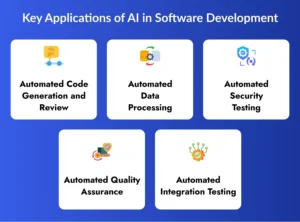
1. Automated Code Generation and Review
AI-assisted development tools can generate code from simple instructions. A developer can describe a feature and the AI automatically creates code snippets. This reduces manual coding and speeds up feature development.
AI also improves code quality by:
- Detecting errors and performance issues
- Helping in coding standards are followed
- Suggesting refactoring for better readability
- Providing real-time code completion inside IDEs
2. Automated Data Processing
Data handling is often time-consuming. AI automates data transformation and analysis, reducing manual effort.
AI helps by:
- Removing duplicate data
- Filling missing values
- Detecting errors in datasets
- Identifying patterns and trends quickly
This improves accuracy and efficiency, supporting smarter AI-assisted app development and better business decisions.
3. Automated Security Testing
Security is a major part of modern software. AI-assisted development tools continuously scan applications for vulnerabilities during development.
AI can:
- Detect security flaws early
- Suggest immediate fixes
- Monitor new threats in real time
- Reduce human security errors
This proactive approach strengthens application security and lowers long-term risks.
4. Automated Quality Assurance
Quality assurance is critical for stable software releases. AI-powered QA tools automate repetitive testing and bug detection tasks.
These tools:
- Detect complex bugs quickly
- Run regression tests automatically
- Monitor application performance
By improving speed and accuracy, AI enhances the overall AI-assisted development process.
5. Automated Integration Testing
Integration testing checks whether different modules of software work well together. AI simplifies this complex task by automating module interaction checks.
AI can:
- Detect integration issues early
- Simulate real-world usage scenarios
- Automatically update test cases when code changes
This makes large-scale AI-assisted software development more stable, efficient and scalable.
AI Software Development Cost: Quick Overview
Understanding AI software development cost is important before starting your project. In 2026, AI project budgets vary widely depending on complexity, technology stack, data requirements, and integration needs.
Here’s a high-level cost breakdown for common AI solutions:
- Simple AI Chatbot / Virtual Assistant: $10,000 – $50,000
- AI-Powered MVP / Proof of Concept: $25,000 – $75,000
- Custom Machine Learning Solution: $50,000 – $300,000
- Custom LLM / Generative AI Application: $75,000 – $500,000
- Computer Vision System: $80,000 – $400,000
- Enterprise AI Platform: $200,000 – $2,000,000+
- Full-Scale AI Transformation: $500,000 – $5,000,000+
The wide cost range depends on several factors, including data volume, model complexity, infrastructure setup, security requirements, and long-term maintenance. Businesses must carefully evaluate their goals, scalability needs, and integration scope to estimate the right investment.
Challenges and Limitations of AI-Assisted Development
Before fully adopting AI-assisted software development, teams should carefully consider these limitations to ensure smooth and secure implementation.
1. Limited Control Over Output
AI-assisted tools generate code automatically based on patterns and data. While this speeds up the AI-assisted development process, developers may feel they have less direct control over the final output. Teams must still review, edit and manage AI-generated code carefully to maintain ownership, quality, and accuracy.
2. Low-Quality or Complex Code
AI-generated code is not always simple or efficient. Sometimes, AI creates overly complex solutions for simple problems. Developers need to inspect, debug, and refine the generated code to ensure it meets performance and maintainability standards. Human supervision remains important in AI-assisted development workflows.
3. Lack of Context Awareness
AI understands general coding patterns, but it may not fully understand specific business requirements or unique project goals. Because of this, AI suggestions can sometimes be incomplete or slightly incorrect. Developers must verify that the code aligns with business logic and user needs.
4. Learning Curve
AI-assisted development tools require training and practice. Developers need time to understand how the tools work and how to use their suggestions properly. Without proper training, teams may not fully benefit from AI-assisted software development capabilities.
5. Security and Compliance Risks
AI tools may sometimes suggest solutions that do not fully follow industry standards or security guidelines. Organizations must perform manual validation and code reviews to ensure compliance and prevent vulnerabilities. Security checks remain an essential part of the AI-assisted development process.
6. AI Software Development Cost
Implementing AI-assisted development involves certain costs. Businesses must consider expenses such as:
- Tool subscriptions
- Integration setup
- Staff training
- Ongoing maintenance and updates
Although the initial AI software development cost may seem high, the long-term benefits to AI-assisted development, like improved productivity and reduced errors, often justify the investment.
Partner With Developer Bazaar Technologies To Enhance Your Business
Choosing the right technology partner is very important when adopting AI-assisted development. At Developer Bazaar Technologies, we help businesses modernize their software using smart, scalable, and secure AI-powered solutions.
Our team specializes in:
- End-to-end AI-assisted software development
- Custom AI-assisted app development
- Optimized AI-assisted development workflows
- Secure and scalable architecture design
- Cost-effective AI development services
We understand that every business has unique needs. That is why we design tailored solutions that improve productivity, reduce errors, and optimize your AI software development cost.
By partnering with Developer Bazaar Technologies, you get:
- Faster project delivery
- Improved code quality
- Stronger application security
- Scalable and future-ready systems
- Ongoing technical support and consultation

Conclusion
AI-assisted development is transforming how modern software is built. It improves productivity, enhances code quality, strengthens security, and supports scalability. By automating repetitive tasks and providing real-time guidance, AI-assisted tools allow developers to focus on innovation instead of routine work.
However, businesses must also understand the challenges, such as quality control, security validation, learning curves, and AI software development cost considerations.
When implemented correctly, the benefits to AI-assisted development far outweigh the limitations. Companies that invest in AI-assisted software development today will build faster, smarter, and more competitive applications in the future.

FAQs
1. What is AI-assisted development?
AI-assisted development is the use of artificial intelligence to support developers in writing, testing, and maintaining software. It automates repetitive tasks and provides intelligent suggestions.
2. What are the main benefits to AI-assisted development?
The main benefits include increased productivity, improved code quality, enhanced security, faster testing, and better scalability.
3. Is AI-assisted development expensive?
The AI software development cost depends on tools, integration, and training. While there may be initial investment costs, long-term savings from improved efficiency often balance the expense.
4. Can AI replace developers?
No. AI supports developers but does not replace them. Human review, creativity, and decision-making are still essential.
5. Is AI-assisted software development secure?
Yes, when used properly. AI-assisted development tools can detect vulnerabilities early, but manual validation and security checks are still important.
6. How can businesses start with AI-assisted development?
Businesses can begin by consulting professional AI development services providers like Developer Bazaar Technologies to assess needs and implement the right AI-assisted tools.