

This minimum viable product guide will help founders understand how to create a minimum viable product, validate ideas, reduce risk, and launch faster.
Key Takeaways:
- Validate your startup idea before investing heavily in development to reduce risk and avoid building something users don’t need.
- Focus only on essential features in your MVP to launch faster, save money, and gather feedback sooner.
- Use real user insights to refine your product, improve the user experience, and prioritize future features.
- Choose the right MVP type and technology stack based on your business goals, budget, and target audience.
- Mobile developers should focus on Kotlin for Android, Swift for iOS, or Dart for cross-platform app development with Flutter.
- Test thoroughly before launch to ensure reliability, performance, and a positive first impression.
- Keep development costs under control by avoiding unnecessary features and leveraging no-code or low-code tools when appropriate.
- Learn from successful companies like Airbnb, Dropbox, Uber, and Spotify, which started with simple MVPs before scaling.
- Avoid common mistakes such as overbuilding, skipping user research, delaying launch, and ignoring customer feedback.
- Partner with an experienced MVP development team to accelerate development and minimize costly mistakes.
- Remember that an MVP is not the final product, it’s a tool to validate, learn, iterate, and build a solution that truly meets market needs.
What Is a Minimum Viable Product (MVP)?
A Minimum Viable Product (MVP) is the simplest version of your product. It has only the most important features, just enough to solve one core problem for real users.
Think of it like this: you want to sell lemonade. Instead of building a fancy juice bar, you start with a small cart, a pitcher of lemonade, and a sign. People buy it. You learn what they like. Then you grow. That is the concept of an MVP for startups.
An MVP can be:
- A mobile app with basic features
- A simple website or landing page
- A SaaS tool with one key function
- A clickable prototype or demo
The goal of an MVP is not to build a perfect application. The goal is to test your idea fast, with real users, before spending too much time or money.
Why Should Startups Build an MVP First?
Many startups fail because they spend too much time and money building products before knowing whether customers actually want them. In fact, according to CB Insights, 35% of startup failures happen because there is no real market demand for the product.
This is why building a Minimum Viable Product (MVP) is one of the smartest steps a startup can take. It helps you test your idea, reduce risk, and make better business decisions before making a large investment.
1. Faster Time to Market
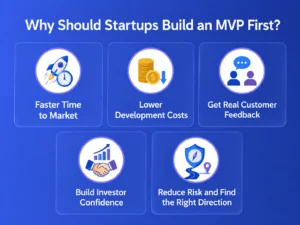
In today’s competitive market, speed matters. An MVP allows you to launch your product in a few weeks or months instead of spending a year building a full-featured solution. This helps you reach users faster and start learning from them immediately.
2. Lower Development Costs
Building a complete product can be expensive. An MVP focuses only on the essential features, helping you save money and avoid unnecessary development work.
Benefits include:
- Lower development costs
- Reduced design expenses
- Less maintenance effort
- Lower business and operational risk
3. Get Real Customer Feedback
Instead of relying on assumptions, an MVP lets real users interact with your product. Their feedback helps you understand:
- What customers actually need
- Which features are most valuable
- What problems still need solving
- How users interact with your product
This makes it easier to improve the product based on real data rather than guesswork.
4. Build Investor Confidence
Investors want proof that people are interested in your idea. A successful MVP demonstrates that your product solves a real problem and has market potential.
An MVP can help you show:
- Early user interest
- Market validation
- Growth opportunities
- Business potential
This evidence can make fundraising conversations much stronger.
5. Reduce Risk and Find the Right Direction
The first version of a product is rarely perfect. An MVP helps you identify what works and what doesn’t before investing heavily in development. By learning early, you can make smarter decisions, improve your product faster, and build something customers truly want.
Types of MVPs
Not all MVPs look the same. Choose the type that fits your idea best.
| MVP Type | What It Is | Best For |
| Landing Page MVP | A simple webpage explaining your product | Testing demand before building |
| Concierge MVP | You do the work manually behind the scenes | Service-based businesses |
| Wizard of Oz MVP | Looks automated, but humans handle it | AI/automation startups |
| Prototype MVP | Clickable design without real code | Testing UX and flow |
| Single-Feature MVP | A working app with just one key feature | App startups |
| Email/Pre-Launch MVP | Collect emails before launch | Building an audience first |
Step-by-Step: How to Build a Minimum Viable Product
Follow these essential steps to develop a minimum viable product that validates market demand, attracts users, and supports long-term growth.
Step 1: Validate the Problem
Before you write a single line of code, ask yourself: Does this problem really exist?
Many startups skip this step. They fall in love with their idea and assume people want it. This is a costly mistake.
How to validate your problem:
- Talk to 10-20 potential users directly
- Ask them about their pain points (not your solution yet)
- Use tools like Google Trends, Reddit, and SEMrush to see what people search for
- Study your competitors, what are users complaining about?
Step 2: Know Your Target Audience
You can’t build a product for everyone. Trying to do that is like shouting in a crowd, nobody hears you.
Create a User Persona, a fictional profile of your ideal customer.
Ask these questions:
- How old are they?
- What is their job?
- What problem keeps them up at night?
- Where do they spend time online?
- What tools or apps do they currently use?
Step 3: Define the Core Features
Now comes the most important decision: What features go into your MVP?
The answer is, there are only few features that solve the core problem.
Use the MoSCoW Method to sort features:
| Priority | Category | Meaning |
| Must Have | Core features | MVP cannot work without these |
| Should Have | Important | Add in next version |
| Could Have | Nice-to-have | Add when you have more time |
| Won’t Have | Future plans | Not needed right now |
Step 4: Choose the Right Technology
The tech stack you choose affects your speed, cost, and ability to grow. Pick the right tools from the start.
Common choices for MVPs:
- Mobile Apps: Mobile App Development Services often use React Native or Flutter to build apps for both Android and iOS from a single codebase.
- Web Apps / SaaS: Next.js or React for frontend, Node.js or Python (Django) for backend. Startups building subscription-based platforms often work with SaaS Development Services providers to accelerate development and scalability.
- AI-Powered Products: OpenAI API, LangChain, or Hugging Face. Working with an experienced AI App Development Company can help startups build AI-powered MVPs faster and more efficiently.
- No-Code/Low-Code MVPs: Bubble, Webflow, Glide, or Adalo
Step 5: Design the User Experience (UX)
Users decide very quickly whether they like your product. If it’s hard to understand or use, they may leave. Good UX design helps make your MVP simple, clear, and easy to navigate.
Key UX principles for an MVP:
- Keep it simple: Remove clutter. Show only what the user needs
- Clear navigation: Users should always know where they are and what to do next
- Fast loading: Slow apps lose users instantly
- Mobile-first: Most users are on their phones
Tools to design your MVP:
- Figma – Industry standard for UI/UX design
- Adobe XD – Great for prototyping
- InVision – Share clickable prototypes with stakeholders
Step 6: Develop the MVP
Now it’s time to turn your idea into a real product. Choose the development approach that best fits your budget, timeline, and resources.
Ways to build an MVP:
-
- Hire a Software Development Company – They manage the entire development process from start to finish and specialize in MVP development services and startup product launches.
- Hire Freelancers – A more affordable option, but you’ll need to coordinate and manage the work yourself.
- Build In-House – Ideal if you have a technical team or a co-founder who can develop the product.
- Use No-Code Tools – The quickest and most cost-effective way to create and test an MVP.
Step 7: Test Before You Launch
Before launching your MVP, make sure everything works properly. Even small issues can create a bad first impression.
Key tests to run:
-
- Feature Testing – Check that each feature works as expected.
- System Testing – Make sure all features work smoothly together.
- User Testing – Let a few real users try the product and share feedback.
- Performance Testing – Ensure the app can handle users without slowing down or crashing.
- Security Testing – Verify that user information is safe and protected.
Step 8: Launch and Collect Feedback
Your MVP is ready. Start with a small launch and learn from real users.
Ways to launch your MVP:
- Soft Launch – Share it with friends, early users, or a small test group first.
- Product Hunt – List your product to reach potential early adopters.
- Social Media – Promote it on LinkedIn, X (Twitter), Instagram, and other platforms.
- Content Marketing – Publish blogs, videos, or guides about the problem your product solves.
- Email Campaigns – Inform your subscribers and early supporters about the launch.
Step 9: Improve and Iterate
The goal of an MVP is to learn what users really need. Use their feedback to make your product better.
Focus on:
- Keeping the features users enjoy the most.
- Fixing bugs and areas that cause confusion.
- Removing features that people rarely use.
- Adding improvements and new features users request.
How Much Does It Cost to Build an MVP?
One of the most common questions founders ask is: how much does it cost to build an MVP?
The answer depends on the type of product, the features you need, and the team you hire. However, the estimates below can give you a general idea.
Estimated MVP Development Costs
| MVP Type | Estimated Cost (USD) |
| Landing Page / No-Code MVP | $500 – $5,000 |
| Simple Web App MVP | $10,000 – $30,000 |
| Mobile App MVP (Single Platform) | $15,000 – $50,000 |
| Mobile App MVP (iOS + Android) | $30,000 – $80,000 |
| SaaS MVP | $20,000 – $60,000 |
| AI-Powered MVP | $30,000 – $100,000+ |
What Affects MVP Development Cost?
Understanding the cost to develop MVP solutions helps startups plan budgets more effectively and avoid unnecessary expenses.
Several factors can increase or decrease the cost of building an MVP:
- Features and Complexity – More features require more development time and budget.
- Platform Choice – Building for web only is usually cheaper than developing for web, iOS, and Android.
- Design Requirements – Basic designs cost less, while custom UI/UX designs require a larger investment.
- Development Team Location – Hourly rates vary by region. Teams in North America generally charge more than teams in India or Southeast Asia.
- Hiring Model – Development agencies may cost more, but they usually handle the entire project and provide better accountability.
- Project Timeline – Faster delivery often requires additional resources, which can increase costs.
How to Reduce MVP Development Costs
These strategies can significantly reduce MVP development cost for startups while still delivering a functional and market-ready product.
If you’re working with a limited budget, these strategies can help:
- Use no-code or low-code tools to build the first version.
- Focus only on the core features needed to validate your idea.
- Hire experienced developers from cost-effective regions.
- Use existing open-source tools, APIs, and frameworks instead of building everything from scratch.
Remember, the goal of an MVP is not to build a perfect product. It’s to launch quickly, test your idea with real users, and learn before making larger investments.
Real-World MVP Examples
Many of today’s biggest companies started with a simple MVP. They focused on solving one problem, tested their idea, and improved based on user feedback.
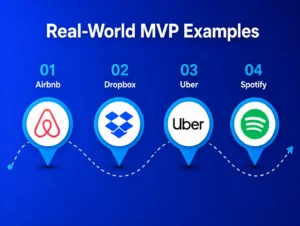
1. Airbnb
Airbnb started in 2008 when its founders rented out space in their apartment through a basic website. The site included a few photos and a simple payment option. This small experiment proved that people were willing to pay for short-term stays, and the business grew from there.
2. Dropbox
Before building the actual product, Dropbox created a short video explaining how the service would work. The video attracted thousands of interested users and validated the idea. Only after seeing strong demand did the team start developing the product.
3. Uber
Uber’s first version was very simple. It operated only in San Francisco and allowed users to book a black car. There were no advanced features like ratings or ride-sharing. The goal was simply to make transportation easier.
4. Spotify
Spotify launched with a basic desktop application in a few European countries. It offered a limited music library but solved a major problem, easy access to music. As user demand grew, Spotify gradually added more songs, features, and markets.
What do all these have in common? They started small. Solved one real problem. Listened to users. Then scaled.
Common MVP Mistakes to Avoid
Building an MVP is about learning quickly and reducing risk. Avoid these common mistakes to increase your chances of success.
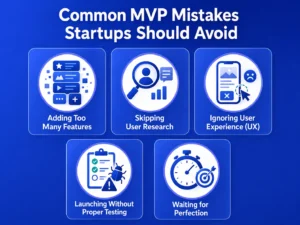
1. Adding Too Many Features
Many founders try to include every idea in the first version of their product. This increases development time and cost. Focus only on the core feature that solves the main problem for your users.
2. Skipping User Research
Don’t assume you know exactly what users want. Talk to potential customers, understand their challenges, and validate your idea before investing in development.
3. Ignoring User Experience (UX)
Even if your product works well, users may leave if it’s difficult to navigate. Keep the design simple, intuitive, and easy to use from the beginning.
4. Launching Without Proper Testing
Bugs and technical issues can create a poor first impression. Test your MVP thoroughly and gather feedback from a small group of users before launching publicly.
5. Waiting for Perfection
Many startups delay their launch because they want everything to be perfect. The purpose of an MVP is to learn from real users. Launch early, collect feedback, and improve the product over time.
How to Choose the Right MVP Development Partner
Whether you want to build a minimum viable product for a mobile app, SaaS platform, or AI solution, choosing the right development partner is critical.
A reliable digital product development Company can guide startups from idea validation to launch while minimizing development risks.
What to Look for in an MVP Development Partner:
1. Experience Building MVPs
Choose a team that has experience developing MVPs for startups and businesses. Review their portfolio and case studies to see the types of products they have built and the results they achieved.
2. Strong Technical Skills
Make sure the team has expertise in the technologies your product requires. Whether you’re building a web app, mobile app, SaaS platform, or AI solution, they should have the right technical knowledge to support your vision.
3. Clear Communication
Good communication is essential for a successful project. Look for a team that responds quickly, keeps you updated on progress, and explains technical concepts in a simple way.
4. Flexible Development Process
MVP requirements often change as new ideas and feedback emerge. A good development partner should follow an agile approach and be able to adapt to changes without slowing down the project.
5. Ongoing Support After Launch
Launching your MVP is only the beginning. Choose a partner who can help with bug fixes, updates, maintenance, and future improvements as your product grows.
Questions to Ask Before Hiring
Before making a decision, ask these important questions:
- How many MVPs have you developed?
- What is your average MVP development timeline?
- How do you handle changes during the project?
- Which technologies and platforms do you specialize in?
- Can you share examples of MVPs you have built for other clients?
Taking the time to choose the right development partner can save you time, money, and effort while increasing the chances of building a successful MVP.
Final Thoughts
Building a Minimum Viable Product (MVP) is one of the fastest and smartest ways to turn an idea into a real business. Instead of spending months or years building a complete product, an MVP helps you validate your concept, understand user needs, and reduce development risks.
The most successful startups don’t start with perfect products, they start with simple solutions to real problems. By focusing on core features, gathering feedback, and continuously improving, you can build a product that truly meets market demand.
Whether you’re creating a SaaS platform, mobile app, AI solution, or marketplace, a well-planned MVP gives you the insights needed to grow with confidence and invest your resources wisely.
FAQs
1. How do I know which features should be included in my MVP?
Start by identifying the single biggest problem your product solves. Include only the features required to solve that problem. Everything else can be added later based on user feedback. A good rule is: if the MVP can function without a feature, it probably doesn’t belong in the first version.
2. Should I build a web MVP or a mobile app MVP first?
The right choice depends on where your target users are. If users are likely to access your product from multiple devices, a web MVP is often faster and more affordable. If your idea relies heavily on mobile-specific features such as GPS, camera access, or notifications, starting with a mobile MVP may make more sense.
3. What metrics should I track after launching my MVP?
Focus on metrics that show whether users find value in your product. These may include user sign-ups, retention rate, feature usage, customer feedback, conversion rate, and churn rate. Tracking these metrics helps you make data-driven decisions for future updates.
4. When should I move from an MVP to a full-scale product?
You should consider expanding your product when users consistently engage with it, provide positive feedback, and demonstrate a clear demand for additional features. Strong retention and repeat usage are often signs that your MVP has achieved product-market fit.
5. Can an MVP help me attract investors or secure funding?
Yes. Investors are more likely to invest in a startup that has validated its idea with real users. An MVP demonstrates market demand, reduces perceived risk, and provides valuable data that can strengthen your pitch and improve fundraising opportunities.