




Projects Completed
Happy Clients
Delivery Rate
Communication
Apps Downloads
Years of Growth
 By
Developer Bazaar Technologies
By
Developer Bazaar Technologies

Have you ever considered why it’s so hard to predict the benefits, delivery schedule, or cost of software development?
When teams use agile software development, these are some of the biggest challenges they face. However, this information is critical; investors rely on it to choose whether to fund a project and to forecast future maintenance costs.
So, how can we improve the ease and accuracy of these predictions?
In this article, we will look at the world of software cost estimating, including the methods used to obtain these values and much more.
Now let’s look at agile software development and its most popular methods.
Agile software development is the method for developing software with a focus on speed, flexibility, and efficiency.
Agile divides the project into manageable, smaller jobs rather than following a rigid method like traditional software development.
Teams collaborate closely, communicate frequently, and pay great attention to client input at every stage.
Scrum and Kanban methods while developing Agile Software help teams to stay organized, adapt to changes, and deliver software that meets the customer’s needs.
The result? Software is produced faster, problems are detected early, and everyone agrees.
Building high-quality software development applications is made simpler with this method, which also keeps teams and clients satisfied.
High-quality software that satisfies customer requirements more quickly, easily, and collaboratively is produced by agile software development.
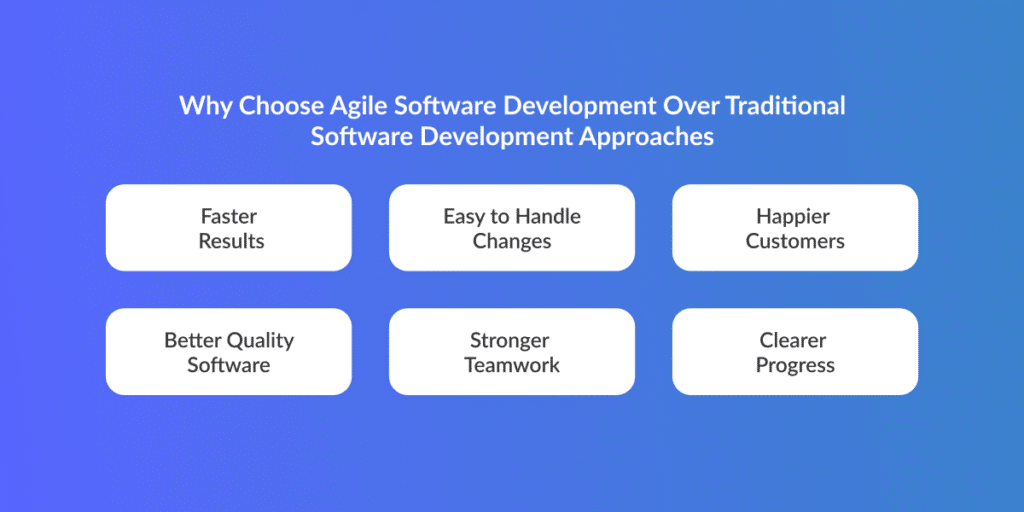
As compared to traditional methods, agile methods of software development services are more adaptable and customer-focused.
Agile focuses on delivering working software in smaller chunks, so you don’t have to wait months to see progress.
Traditional software development follows a longer process, often delaying results.
If something changes like customer needs or market trends, Agile makes it simple to adjust the plan.
Traditional approaches struggle with this flexibility, making them harder to adapt.
With constant feedback and collaboration, Agile ensures the software development services meet customer expectations.
Traditional methods might miss the mark since customer input is often limited.
Agile teams test the software regularly, catching issues early.
Traditional approaches usually wait until the end, which can lead to bigger problems.
Agile places a strong emphasis on cooperation between developers, testers, and clients, which streamlines and increases process efficiency.
Traditional methods often separate these roles, which can slow things down.
Agile involves regular updates and check-ins, so everyone knows what’s happening. Traditional software development might leave teams and customers guessing until the final stages.
Choosing Agile software development can produce software products that are better, faster, and more suited to the needs of their clients.
It’s a more innovative and flexible method of developing software for today’s rapidly changing world.
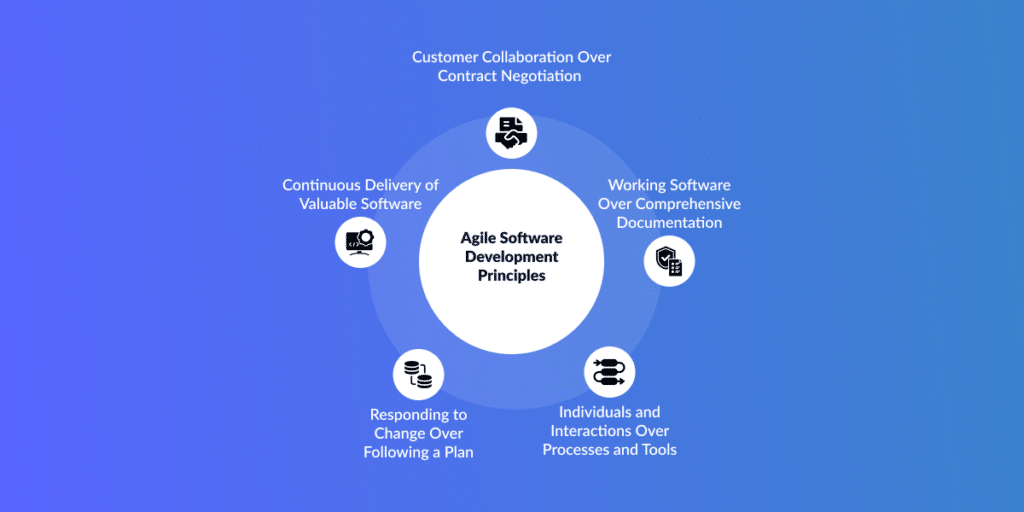
Agile software development is flexible, user-centric, and efficient because it is attached to its fundamental principles.
The following are the key principles:
Customers are actively involved at every stage of the development process while developing agile software. This makes sure that the result will fulfill their requirements beyond their expectations.
Agile software focuses on producing accessible tools that adds value for the client rather than wasting too much time on long papers.
Agile software adds a high value to collaboration and communication than it does on strictly following procedures or technologies.
Agile understands that things change. Teams are flexible and adjust to new priorities or requirements, ensuring the software stays relevant.
Agile software development supports frequent updates, allowing customers to track work and provide feedback that positively impacts the final product.
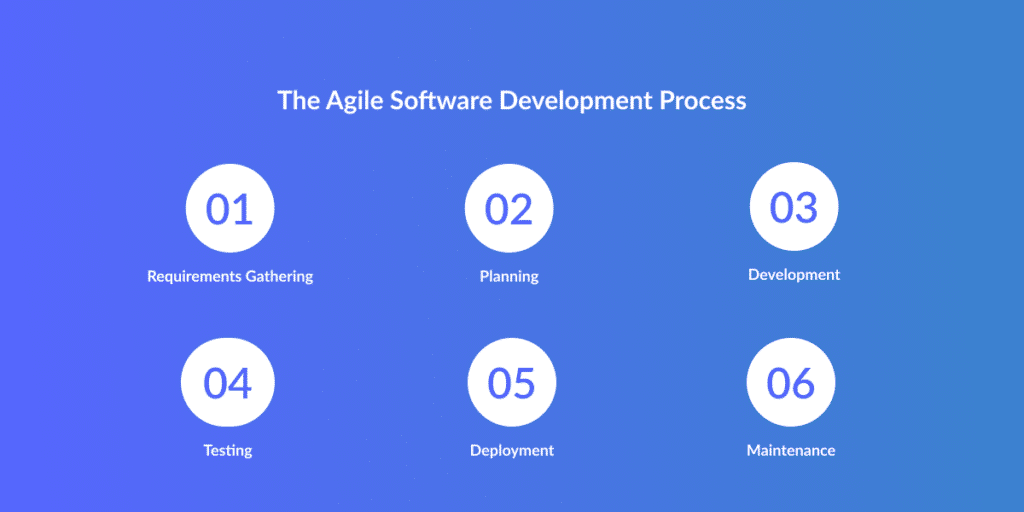
The Agile software development process divides projects into simpler and smaller projects that are easily manageable, planned, executed, and improved.
In this step, understand the customer’s requirements. The team connect with the client to gather all the important details. Then they decide which needs are most important and should be done first.
Unlike traditional software development, Agile development method allows changes to the requirements as the project moves forward, making it more flexible.
After understanding the requirements, the team makes a plan for the first phase (called an iteration) of the project. Each phase focuses on delivering certain features or improvements.
The plan includes timelines, tasks, and goals so everyone knows what to work on and when. Agile plans can change based on feedback or new needs that come up during the project.
In this step, the team starts building the software. They work in short cycles called sprints, which usually last 1–4 weeks.
Each sprint creates a working part of the software. This step-by-step approach helps the team deliver useful results quickly and adjust to any feedback they get.
Testing is an ongoing activity in Agile. Rather than waiting until the end of the project, the team tests the program at each sprint.
This covers functional, performance, and user acceptance tests. Catching and resolving issues early ensures improved quality and lowers the cost of future adjustments.
When a version of the software has been completed and properly tested, it is released for client usage. Deployment in Agile is often incremental, meaning customers receive updates and new features regularly.
This ensures they benefit from the software immediately while the team continues to refine and expand it.
After the software is released, the team keeps checking its performance. They fix any issues and add new features as software maintenance.
Agile makes sure the software is always updated and helpful to the customer, even if their requirements change over time.
This process is more adaptable and customer-focused than traditional software development, which tries to plan everything from the beginning and experience with changes.
Agile’s step-by-step approach and focus on continuous improvement contribute to the development of software that actually satisfies the needs of customers.
The cost of Agile software development depends on different things such as its complexity, UI & UX, and the team’s location. Usually, the cost can be in range between $35,000 and $150,000.
Whether you want do develop a simple software or an advanced software, Agile is a great choice because it helps manage time, keeps quality high, and controls costs.
Agile software development is all about teamwork, being flexible, and making great-quality software.
Some of the best ways:
Sprints, which are short work cycles that usually span two to four weeks, are used in the Scrum technique.
The team concentrates on completing a set of tasks during each sprint.
The Kanban system arranges tasks into columns such as “To Do,” “In Progress,” and “Done” using a board.
This practice means developers add their work (code) to a shared project often.
Tests are written by developers before the software is written to ensure it functions as intended.
In this method, two developers work together on the same task:
These methods help Agile teams work faster, reduce mistakes, and deliver software that matches users’s requirements.
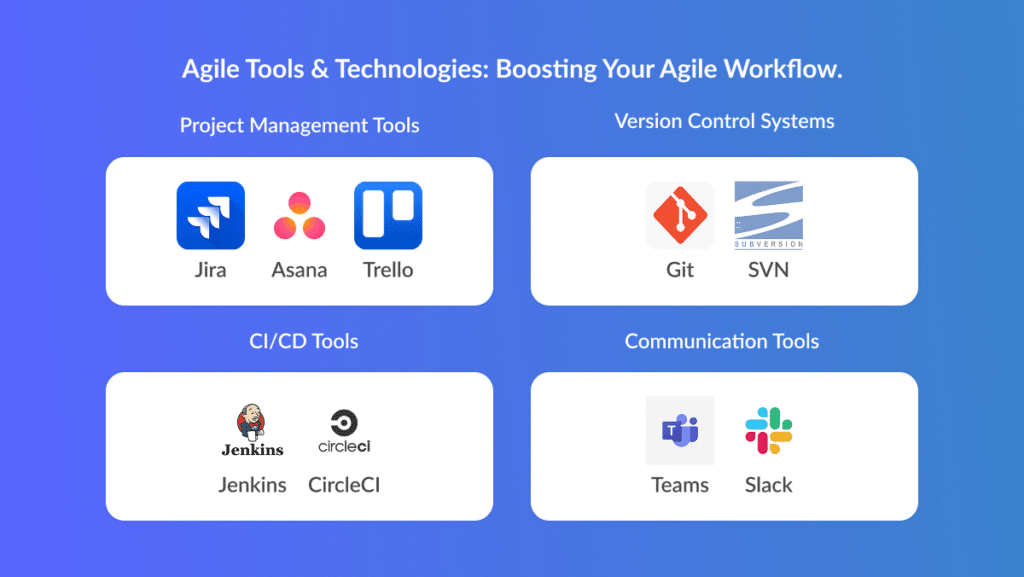
When teams use the right technologies to stay connected, productive, and organized, agile software development works best.
Here’s how different tools can help your Agile projects:
These tools assist teams in planning tasks, setting priorities, and keeping track of their progress.
These solutions make it easier for teams to collaborate on coding projects and track changes.
Tools for continuous integration and delivery make software creation, testing, and deployment easier and faster.
These tools assist teams of Agile developers in communicating, especially while working remotely.
These tools along with Agile principles help developer teams to stay organized, communicate better, and work more efficiently.
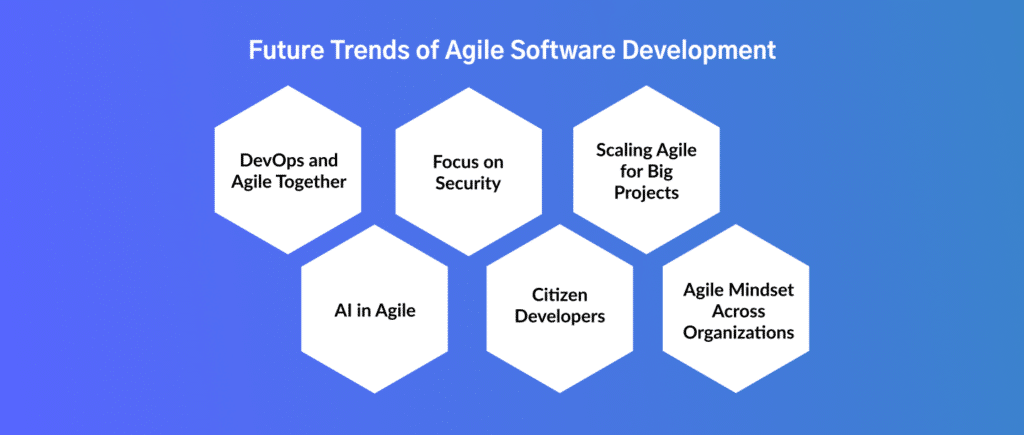
The new and evolving trends are being utilized in agile software development. Let’s examine the next step:
DevOps techniques like continuous delivery, infrastructure as code, and automated testing are being used by agile software developers.
These practices make the software development process faster. For example, automated workflows remove delays, and quick feedback helps make the product better.
Security is now part of the Agile process from the beginning. Instead of fixing security issues at the end, teams are using methods like code reviews and automated scans to build safe and secure software. This reduces risks like data leaks or hacks.
Special frameworks like LeSS (Large-Scale Scrum) and SAFe (Scaled Agile Framework) are used by large companies with massive projects.
These help them manage many teams and departments while keeping everything organized. It ensures projects run smoothly, even when they’re complex.
Artificial intelligence (AI) is making Agile development smarter. AI tools can do repetitive tasks like sorting the backlog, reviewing code, or testing.
AI also gives teams helpful insights about project progress and possible risks so they can make smart decisions.
People who are not skilled coders can now create software thanks to low-code techniques and no-code platforms. These “citizen developers” collaborate alongside experienced programmers using agile methods, which simplifies projects and introduces fresh concepts.
Agile is no longer limited to software teams. Companies are using Agile ideals such as flexibility, collaboration, and continuous improvement in numerous areas, including marketing and operations. This helps businesses adapt quickly to market changes.
By following these trends, businesses can make their Agile processes better, faster, and ready for the future of software development applications.
Agile software development has helped many companies achieve amazing results.
Let’s explore some well-known businesses that have used Agile to succeed.
Spotify used Agile software development to make its platform better and faster. By creating small, independent teams called “squads,” they could quickly update their app, listen to user feedback, and stay ahead of market changes. This approach helped Spotify deliver a personalized music experience to millions.
Amazon adopted Agile methods to bring new ideas to life. They used Agile software development to test features, gather feedback, and improve their e-commerce platform.
This helped Amazon offer better services and make shopping online easier for everyone.
Netflix utilizes Agile practices to keep its platform running smoothly. By testing new ideas and listening to user feedback, Netflix improves its app regularly.
Agile software development allows them to quickly add new features and ensure a great streaming experience for their viewers.
These companies prove that Agile is a smarter, faster way to build software compared to traditional software development.
Whether for streaming services or e-commerce, Agile makes software development applications and services more flexible and customer-focused.
In 2026, Agile software development is a modern, flexible way to build high-quality software that meets customer needs. Its focus on collaboration, frequent feedback, and adaptability ensures faster results and better solutions compared to traditional methods.
With methods like Scrum and Kanban, regular testing, and continuous delivery, Agile creates software that evolves with changing requirements. Companies like Spotify, Amazon, and Netflix showcase how Agile helps businesses stay competitive and innovative.
Whether for small projects or large-scale operations, Agile’s principles and tools make it an excellent choice for today’s fast-moving world of software development.
A: The main difference between Agile and Waterfall is their approach to project management. Waterfall follows a traditional, step-by-step process, while Agile uses an iterative, flexible process to adapt quickly to changes.
A: Agile is better for projects needing flexibility and quick updates, while Waterfall works well for projects with clear, unchanging steps. Choose based on your project’s needs.
A: The Agile life cycle has five stages: Project Initiation, Planning, Development, Production, and Retirement. In 2026, it will focus on flexible and customer-centric solutions.
A: The five levels of Agile planning are Vision, Roadmap, Release, Iteration, and Daily Stand-Up. These levels help teams stay organized and efficient.
A: In 2026, Agile is seeing trends like using AI and machine learning to improve automation, data-driven decisions, and faster workflows with better accuracy.
A: Agile innovation focuses on fast developing new products and services using short sprints and feedback loops, offering businesses a competitive advantage in 2026 and beyond.
Co-Founder
Developer Bazaar technologies


This minimum viable product guide will help founders understand how to create a minimum viable product, validate ideas, reduce risk, and launch faster. Key Takeaways: Validate your startup idea before investing heavily in development to reduce...
This minimum viable product guide will help founders understand how to create a minimum viable product, validate ideas, reduce risk, and launch faster. Key ...
Key Takeaways: White-label mortgage CRM solutions provide a customizable platform that helps lenders simplify loan management and improve customer engagement. Essential features such as loan origination, document management, automation, compliance tracking, and customer communication enhance operational...
Key Takeaways: White-label mortgage CRM solutions provide a customizable platform that helps lenders simplify loan management and improve customer engagement. Essential features such as ...
Businesses now manage large inventories, faster deliveries, multiple warehouses, and real-time order tracking. Manual processes and spreadsheets often create delays, stock errors, and higher operational costs. This is why many companies choose to develop warehouse management...
Businesses now manage large inventories, faster deliveries, multiple warehouses, and real-time order tracking. Manual processes and spreadsheets often create delays, stock errors, and higher ...
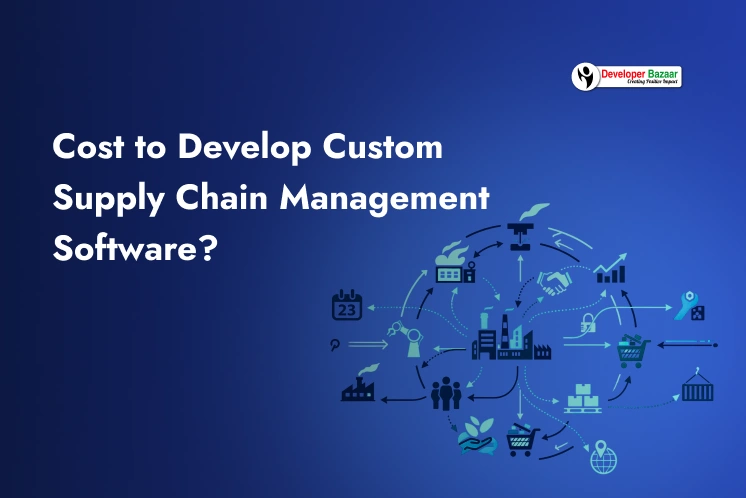
In the last few years, global disruptions, rising customer demands, and fast-changing markets have made supply chain systems more complex. Many businesses tried to depend on ready-made tools, but they quickly realized those tools cannot handle...
In the last few years, global disruptions, rising customer demands, and fast-changing markets have made supply chain systems more complex. Many businesses tried to ...
Key Takeaways: The global Dealer Management System (DMS) market is expected to reach approximately US$ 10.8 billion by 2026, driven by the growing need for automation, inventory management, and customer retention. Custom dealership management systems provide...
Key Takeaways: The global Dealer Management System (DMS) market is expected to reach approximately US$ 10.8 billion by 2026, driven by the growing need ...

What will logistics look like by 2030? Will robots deliver packages? Will warehouses run without people? Will goods move faster and safer across the world? The logistics industry is changing very fast. New tools like Artificial...
What will logistics look like by 2030? Will robots deliver packages? Will warehouses run without people? Will goods move faster and safer across the ...

Key Takeaway Logistics Automation helps companies move goods faster, reduce errors and lower operational costs across storage, shipping and delivery. Automation in logistics uses tools like AI, RPA, cloud systems and robots to handle tasks automatically...
Key Takeaway Logistics Automation helps companies move goods faster, reduce errors and lower operational costs across storage, shipping and delivery. Automation in logistics uses ...
Did you know how much does it really cost to build a smart queue management system in 2026? In 2026, many businesses want to reduce long waiting lines and provide faster service. A queue management system...
Did you know how much does it really cost to build a smart queue management system in 2026? In 2026, many businesses want to ...

The hotel industry is growing fast, and technology is playing a huge role in its success. One of the most important tools hotels use today is a Hotel Management Software System. This type of software helps...
The hotel industry is growing fast, and technology is playing a huge role in its success. One of the most important tools hotels use ...

Did you know that Microsoft just invested $1.5 billion in Dubai-based G42, while OpenAI partnered with UAE companies for the $500 billion Stargate Project? This isn’t coincidence—it’s recognition that Dubai has become the world’s most strategic...
Did you know that Microsoft just invested $1.5 billion in Dubai-based G42, while OpenAI partnered with UAE companies for the $500 billion Stargate Project? ...

Complete the form below and validate your idea now.
✔ Your idea is 100% protected by our Non Disclosure Agreement.
