

Key Takeaways:
- Retail mobile app development is becoming a necessity as customers increasingly prefer mobile shopping experiences over traditional retail channels.
- A well-designed retail app helps businesses increase sales, improve customer retention, and strengthen brand visibility through personalized and convenient shopping experiences.
- Essential features such as product catalogs, secure payments, order tracking, push notifications, and customer support play a crucial role in delivering a smooth user experience.
- Following a structured process to develop a retail app, from goal setting and market research to development and testing, helps reduce risks and ensures long-term success.
- AI integration is changing retail applications by enabling personalized recommendations, intelligent chatbots, inventory forecasting, and data-driven decision-making.
- The retail app development cost varies based on app complexity, features, platforms, and integrations, making proper planning essential for budget optimization.
- Future trends such as AI App Development, Augmented Reality shopping, Voice Commerce, Hyper-Personalization, and Omnichannel experiences are reshaping the retail industry and creating new growth opportunities.
- Partnering with an experienced retail app development services provider can help businesses build scalable, secure, and customer-focused applications that drive measurable business results.
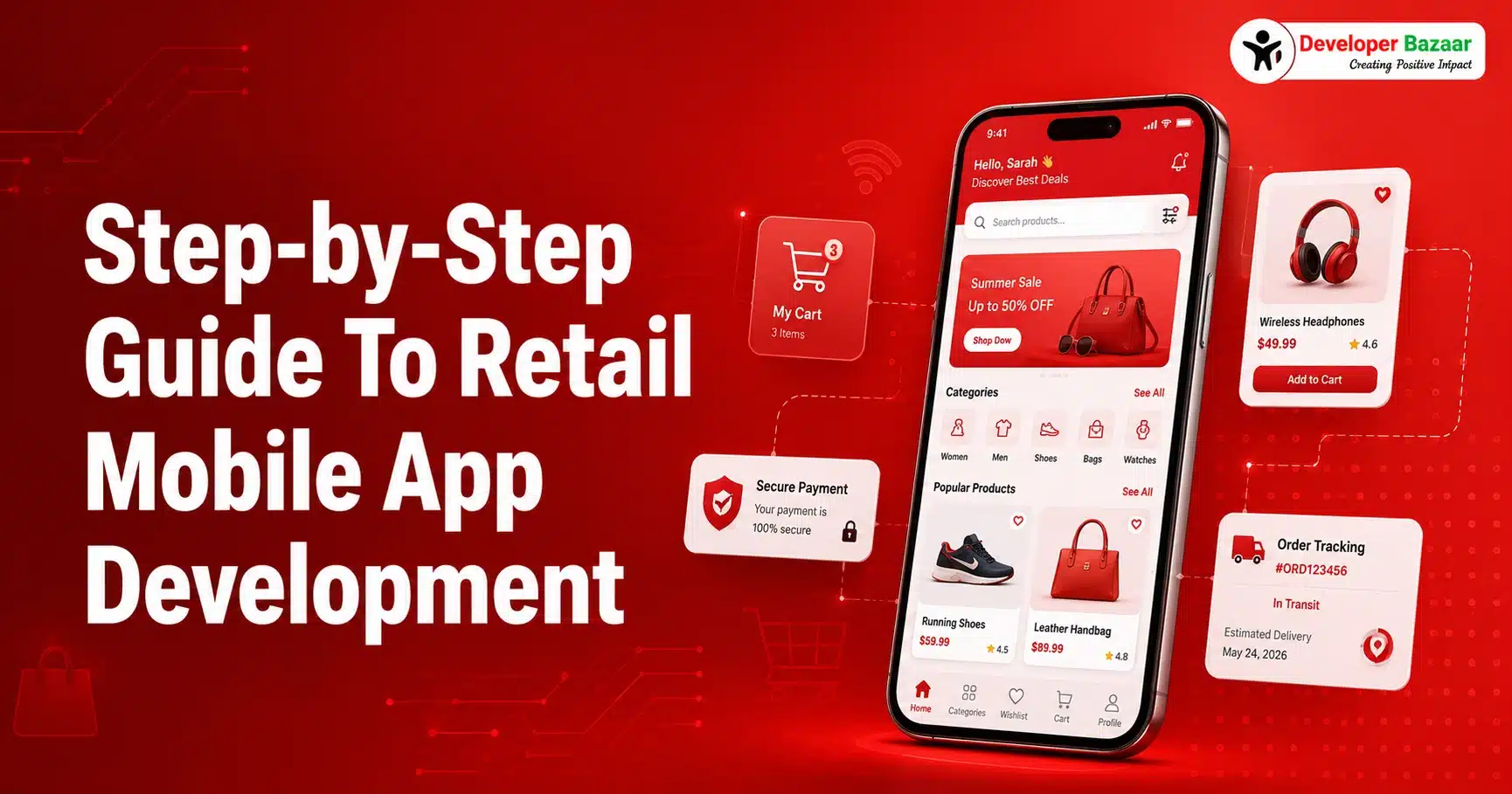
In today’s digital world, customers want everything at their fingertips. They shop online, compare products and make payments using their smartphones. This shift in customer behavior has made retail mobile app development an essential investment for businesses.
Whether you own a small retail store, a growing eCommerce brand, or a large retail chain, a mobile app can help you reach more customers, improve shopping experiences, and increase sales.
In this guide, we will explain everything you need to know about retail app development, including its benefits, features, development process, costs, and future trends.
Why Businesses Need Retail App Development
Retail businesses face intense competition. Customers have countless shopping options and can switch brands within seconds. A retail mobile app helps businesses stay connected with customers, provide personalized experiences, and create a direct sales channel that is available 24/7.
The growing demand for mobile commerce is making retail apps more important than ever. According to Swell.is the global app development market is projected to reach $618.65 billion by 2031, growing at a CAGR of 15.18% between 2026 and 2031. This rapid growth shows how businesses across industries are investing in mobile applications to improve customer engagement and drive revenue.
1. Better Customer Convenience
Modern customers expect fast and hassle-free shopping experiences. A retail app allows them to browse products, compare prices, place orders, and track deliveries anytime, anywhere. This convenience helps businesses meet customer expectations and improve satisfaction.
2. Increased Sales
Retail apps simplify the buying process through features like personalized recommendations, quick checkout, and targeted promotions. These capabilities encourage customers to make purchases more often and increase the average order value.
Additionally, retail apps already dominate the mobile commerce ecosystem. General retail accounts for nearly 50% of App Store commerce, generating more than $600 billion in transactions, highlighting the significant revenue potential for businesses that invest in retail app development.
3. Improved Customer Loyalty
Customer retention is just as important as acquiring new customers. Retail apps make it easier to build loyalty through reward programs, exclusive offers, personalized discounts, and push notifications. These features keep customers engaged and encourage repeat purchases.
4. Stronger Brand Visibility
A retail app places your brand directly on a customer’s smartphone. Every time users unlock their devices, your app icon serves as a reminder of your business. This constant visibility helps strengthen brand recognition and keeps your business top-of-mind.
5. Global Reach and Scalability
Retail apps also make it easier for businesses to expand into new markets. With support for multiple currencies, languages, and regional payment methods, retailers can serve customers worldwide. Modern app ecosystems support 40+ local currencies and tax handling across nearly 200 regions, allowing businesses to scale globally while providing a localized shopping experience.
Types of Retail Mobile Applications
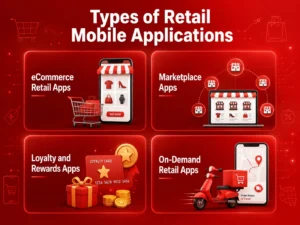
Different retail businesses have different goals and customer needs. As a result, there are several types of retail mobile apps, each designed to solve specific business challenges and improve the shopping experience.
1. eCommerce Retail Apps
eCommerce retail apps allow businesses to sell products directly to customers through a mobile platform. Customers can browse products, make purchases, track orders, and complete payments without visiting a physical store. These apps are commonly used by fashion brands, electronics stores, grocery businesses, and beauty product retailers.
2. Marketplace Apps
Marketplace apps bring multiple sellers and buyers together on a single platform. Instead of selling products from one business, these apps allow customers to compare products, prices, and vendors before making a purchase. Popular examples include multi-vendor marketplaces, local business platforms, and product comparison apps.
3. Loyalty and Rewards Apps
Loyalty and rewards apps are designed to improve customer retention and encourage repeat purchases. They offer features such as reward points, membership benefits, cashback offers, and exclusive discounts, helping businesses build stronger relationships with their customers.
4. On-Demand Retail Apps
On-demand retail apps focus on providing fast and convenient product delivery. Customers can place orders through the app and receive products within a short time frame, often on the same day. These apps are widely used by grocery delivery services, pharmacies, and local convenience stores.
Essential Features for Retail App Development
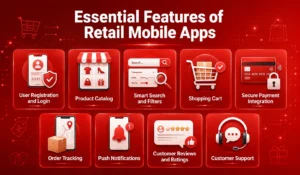
The success of a retail mobile app depends on how well it meets customer needs and simplifies the shopping journey. The right features can improve user experience, increase engagement, and encourage repeat purchases.
1. User Registration and Login
A simple registration process allows customers to create accounts quickly using email, mobile numbers, or social media profiles. Easy onboarding reduces friction and helps users start shopping without unnecessary delays.
2. Product Catalog
The product catalog serves as the digital storefront of a retail app. It should display detailed product information, high-quality images, pricing, categories, and stock availability to help customers make informed purchase decisions.
3. Smart Search and Filters
A powerful search system helps customers find products quickly without browsing through multiple pages. Features like keyword search, category filters, brand filters, and price sorting improve navigation and user satisfaction.
4. Shopping Cart
The shopping cart allows customers to review and manage products before checkout. Features such as quantity updates, item removal, and wishlists create a smoother and more flexible shopping experience.
5. Secure Payment Integration
Secure payment gateways enable customers to complete transactions safely and conveniently. Supporting multiple payment options increases trust and ensures a simple checkout process.
6. Order Tracking
Real-time order tracking keeps customers informed about their purchases from dispatch to delivery. This transparency builds trust and reduces the need for customer support inquiries.
7. Push Notifications
Push notifications help businesses engage users with personalized updates and timely information. They are effective for promoting offers, announcing new products, and reminding customers about abandoned carts.
8. Customer Reviews and Ratings
Customer reviews provide valuable insights into product quality and performance. They help shoppers make confident purchasing decisions while increasing credibility and trust in the brand.
9. Customer Support
Reliable customer support ensures users can quickly resolve issues or get assistance when needed. Features such as live chat, FAQs, and help centers improve customer satisfaction and strengthen brand loyalty.
Building a successful retail app requires careful planning, strategic decision-making, and a clear understanding of customer needs. Following a structured development process helps businesses reduce risks, control costs, and create an app that delivers real value to users.
Step-by-Step Process to Develop a Retail App
Building a successful retail app requires careful planning, strategic decision-making, and a clear understanding of customer needs. Following a structured development process helps businesses reduce risks, control costs, and create an app that delivers real value to users.
Step 1: Define Your Business Goals
Before you develop a retail app, it is important to clearly define your business objectives. Understanding what you want to achieve helps guide every decision throughout the development process, from feature selection to marketing strategies.
Ask questions like:
- Do you want to increase sales?
- Improve customer retention?
- Expand into new markets?
- Enhance customer service?
Having well-defined goals ensures that your retail app aligns with your overall business strategy and delivers measurable results.
Step 2: Understand Your Target Audience
Knowing your customers is one of the most important parts of retail mobile app development. A deep understanding of your audience helps you create features and experiences that match their expectations and shopping behavior.
Research:
- Age groups
- Shopping habits
- Device preferences
- Buying behavior
By understanding who your customers are and what they need, you can build a more engaging and user-friendly retail app that encourages long-term loyalty.
Step 3: Analyze Competitors
Competitor analysis helps you understand what works well in your industry and where opportunities for improvement exist. Studying successful retail apps can provide valuable insights into customer preferences and market trends.
Look at:
- Features
- User interface
- Customer reviews
- Pricing strategies
This research helps businesses identify gaps in the market and develop unique features that differentiate their app from competitors.
Step 4: Create an MVP
An MVP (Minimum Viable Product) is a simplified version of your retail app that includes only the most essential features. Instead of building a full-featured application immediately, businesses can launch an MVP to validate their idea and gather real-world feedback.
Launching an MVP allows businesses to:
- Test ideas
- Collect feedback
- Reduce development costs
- Improve future versions
This approach minimizes risks and helps ensure that future investments are based on actual customer needs rather than assumptions.
Step 5: Design an Easy-to-Use Interface
A well-designed user interface plays a major role in the success of a retail app. Customers expect smooth navigation, attractive layouts, and a simple shopping experience that allows them to find products and complete purchases quickly.
Customers should be able to:
- Find products quickly
- Navigate easily
- Complete purchases without confusion
Simple and intuitive designs often perform better because they reduce friction and make the shopping journey more enjoyable for users.
Step 6: Choose the Right Technology Stack
Selecting the right technology stack is critical because it directly impacts your app’s performance, security, scalability, and future maintenance requirements. The technology choice should align with your budget, business goals, and target audience.
Businesses can choose between:
- Android App Development
- iOS App Development
- Cross-platform development
Choosing the right platform ensures that your retail app delivers a reliable experience while reaching the maximum number of potential customers.
Step 7: Start Development
Once planning and design are complete, the actual development phase begins. During this stage, developers build all the technical components required to modernise the app concept into a fully functional solution.
During development, teams build:
- Frontend components
- Backend systems
- Databases
- APIs
- Security features
This stage requires close collaboration between designers, developers, and project managers to ensure that the final product meets business requirements and customer expectations.
Step 8: Testing and Quality Assurance
Before launch, the retail app must go through comprehensive testing to identify and resolve any issues. Thorough testing ensures that customers receive a stable, secure, and high-performing application from day one.
Testing includes:
- Functional testing
- Performance testing
- Security testing
- Device compatibility testing
Quality assurance helps prevent bugs, improve reliability, and ensure the app performs consistently across different devices, operating systems, and network conditions.
How AI Integration Is Transforming Retail Apps
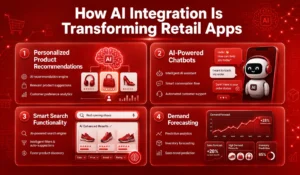
Artificial Intelligence is changing how customers shop online. Modern retail apps use AI to provide smarter and more personalized experiences.
1. Personalized Product Recommendations
AI analyzes customer behavior, browsing history, and purchase patterns to suggest relevant products. This helps customers discover items they are more likely to buy while increasing sales for retailers.
2. AI-Powered Chatbots
AI chatbots can answer customer questions, provide product information, and assist with order tracking at any time of day. This improves customer support while reducing operational costs.
3. Smart Search Functionality
AI improves search accuracy by understanding customer intent rather than relying only on exact keywords. Customers find products faster, which improves the shopping experience.
4. Demand Forecasting
AI can predict future demand by analyzing customer behavior and sales trends. This helps retailers manage inventory more efficiently and reduce stock shortages.
Cost to Develop a Retail App
One of the most common questions businesses ask is about the cost to develop a retail app. The final retail app development cost depends on several factors, including app complexity, features, platform selection, third-party integrations, and the location of the development team.
| App Type | Key Features Included | Estimated Development Cost |
| Basic Retail App | User registration, product catalog, shopping cart, payment gateway, basic search functionality, and customer profiles. | $15,000 – $40,000 |
| Mid-Level Retail App | Advanced search and filters, order tracking, push notifications, loyalty programs, customer reviews, and multiple payment options. | $40,000 – $80,000 |
| Advanced Retail App | AI integration, AR shopping experiences, multi-vendor functionality, advanced analytics, personalized recommendations, and omnichannel support. | $80,000 – $200,000+ |
Note: These are estimated costs and may vary based on project requirements, technology stack, customization level, and ongoing maintenance needs.
Factors Affecting Retail App Development Cost
Several factors influence retail app development cost.
- Number of Features: More features require additional development time and resources.
- Platform Selection: Building separate Android and iOS apps often costs more than using a cross-platform approach.
- Design Complexity: Highly customized user interfaces require additional design and development effort.
- Third-Party Integrations: Integrating payment gateways, CRM systems, shipping providers, and analytics tools can increase costs.
- AI Integration: Advanced AI capabilities such as recommendation engines and predictive analytics require additional investment.
Future Trends in Retail Mobile App Development
The future of retail mobile app development is being shaped by emerging technologies and changing customer expectations. Businesses that adopt these innovations can deliver better shopping experiences, improve customer satisfaction, and stay ahead of the competition.
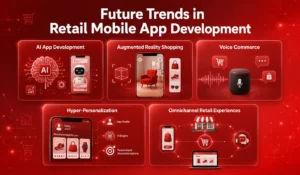
1. AI App Development
AI app development is changing the retail industry by making apps smarter and more personalized. AI can analyze customer behavior, recommend relevant products, automate customer support, and help retailers make data-driven decisions.
2. Augmented Reality Shopping
Augmented Reality (AR) allows customers to virtually view products before making a purchase. Whether it’s trying on clothes, previewing furniture, or visualizing home décor, AR helps customers shop with greater confidence and reduces product returns.
3. Voice Commerce
Voice commerce is making online shopping faster and more convenient. By using voice assistants, customers can search for products, place orders, and check delivery updates without typing, creating an easier shopping experience.
4. Hyper-Personalization
Modern retail apps are using customer data and AI to deliver highly personalized experiences. From customized product recommendations to tailored offers and promotions, hyper-personalization helps increase engagement and customer loyalty.
5. Omnichannel Retail Experiences
Future retail apps will connect multiple shopping channels into one unified experience. Customers will be able to move simply between online stores, physical locations, social media platforms, and customer support channels without any disruption.
How did we help Sora Store modernize retail operations with a scalable eCommerce solution?
E-commerce App Sora Store wanted to improve its digital presence and provide customers with a good shopping experience across mobile devices. The business faced challenges such as limited online engagement, inefficient order management, and difficulties in handling growing customer demand.
Our team developed a custom retail mobile application that streamlined the entire shopping journey. We implemented features such as an intuitive product catalog, secure payment integration, real-time order tracking, push notifications, and a user-friendly checkout process. The solution was designed to be scalable, allowing the business to support increasing traffic and transactions without performance issues.
Key Solutions Delivered
- Custom retail mobile app development for Android and iOS
- Secure payment gateway integration
- Real-time inventory and order management
- Personalized product recommendations
- Push notifications for promotions and order updates
- Scalable backend infrastructure
- Customer loyalty and engagement features
Business Impact
The new retail app helped Sora Store improve customer engagement, simplify operations, and increase online sales. Customers enjoyed a faster and more convenient shopping experience, while the business gained better control over inventory, orders, and customer interactions.
Results Achieved
- Increased customer engagement and retention
- Improved order management efficiency
- Faster checkout and payment processing
- Enhanced customer satisfaction
- Scalable platform ready for future growth
This project demonstrates how the right retail mobile app development strategy can help businesses modernize operations, improve customer experiences, and create new revenue opportunities in a competitive retail market.
How Can Developer Bazaar Technologies Help You with Retail App Development?
At Developer Bazaar Technologies, we help retailers build scalable and customer-centric mobile applications that streamline operations, enhance shopping experiences, and drive business growth. From concept to deployment, our team develops tailored retail solutions that align with your business goals and evolving customer expectations.
What We Offer:
- Custom Retail App Development tailored to your business model and requirements.
- Android and iOS App Development for an easy cross-platform customer experience.
- AI-Powered Features such as personalized recommendations, chatbots, and predictive analytics.
- Secure Payment & Order Management Systems for smooth and reliable transactions.
- Real-Time Inventory Tracking to improve operational efficiency and stock management.
- UI/UX Design Services focused on delivering intuitive and engaging shopping experiences.
- Ongoing Support and Maintenance to ensure optimal app performance and scalability.
With our expertise in mobile application development, we help businesses create digital solutions that increase customer engagement, improve retention, and maximize revenue.
EndNote
Retail mobile app development has become an essential part of modern retail success. Customers expect convenient, fast, and personalized shopping experiences, and mobile apps help businesses meet those expectations.
Whether you are planning a simple ecommerce app development project or a fully customized solution with AI integration, following a structured development process is key. From defining goals and choosing features to development, testing, and ongoing maintenance, every stage contributes to the success of the final product.
As technologies like AI, AR, and voice commerce continue to evolve, businesses that invest in retail app development today will be better positioned to compete and grow in the future.
FAQs
-
What features should I prioritize when building a retail mobile app?
The features you prioritize should depend on your business model and customer expectations. However, most successful retail apps include product catalogs, smart search, secure payment gateways, order tracking, push notifications, and customer support. If your budget is limited, start with essential features through an MVP and add advanced functionality as your user base grows.
-
How can AI integration improve the performance of a retail app?
AI integration helps retailers deliver more personalized shopping experiences by analyzing customer behavior and preferences. It can power product recommendations, automated customer support, demand forecasting, and personalized promotions. These capabilities not only improve customer satisfaction but also help increase conversion rates and customer retention.
-
Is it better to choose custom retail app development or a ready-made solution?
Custom retail app development offers greater flexibility, scalability, and control over features, design, and integrations. While ready-made solutions may be faster and less expensive initially, they often have limitations when your business grows. A custom solution is generally a better long-term investment for businesses looking to build a unique brand experience.
-
How does retail mobile app development support omnichannel retail strategies?
Retail mobile apps help connect online stores, physical outlets, social commerce channels, and customer support systems into a unified experience. Customers can browse products online, check in-store availability, redeem loyalty points, and track orders from a single platform. This consistency improves customer convenience and strengthens brand loyalty.
-
What factors have the biggest impact on retail app development cost?
Several factors influence retail app development cost, including app complexity, number of features, platform selection, UI/UX requirements, third-party integrations, and AI capabilities. Development costs also vary based on the expertise and location of the development team. Businesses should focus on their core requirements first and scale features gradually to optimize investment.