
Large Language Models (LLMs) don’t always give perfect answers. Businesses often need more accurate, relevant and customized outputs. Because of this, LLM optimization techniques like RAG (Retrieval Augmented Generation), prompt engineering, and fine-tuning play an important role.
In this blog, we will clearly explain RAG vs fine tuning vs prompt engineering, how they work, their differences, and when you should use each method.
The goal is simple to help you understand how to improve LLM performance in the easiest way possible.
2026 AI Optimization Landscape: Key Trends & Insights
The AI landscape is evolving rapidly and the way businesses use LLM optimization techniques like RAG, prompt engineering, and fine-tuning is changing at scale.
Here are some important insights that highlight the growing importance of these methods:
Rapid Adoption of AI
By 2026, over 80% of enterprise applications are expected to integrate LLMs or generative AI, a massive jump from less than 5% in 2023. This shows how quickly businesses are moving toward AI-driven solutions to stay competitive.
Enterprise Strategy Shift
Around 88% of enterprises already use AI regularly, and more than 70% of new production systems prefer RAG as the default approach. This is mainly because RAG can handle dynamic data and reduce incorrect or hallucinated responses, making it highly reliable.
Growth of Prompt Engineering
The demand for what is prompt engineering and its applications is rising fast. The market is expected to grow from $280 million in 2024 to $2.5 billion by 2032, showing how important prompt design has become in improving AI outputs without heavy investment.
Performance Gains with Hybrid Approaches
Businesses are increasingly combining methods instead of choosing just one. Studies show that using RAG vs fine tuning LLM together can improve accuracy by over 11 percentage points compared to using a single approach alone.
RAG vs Fine-Tuning vs Prompt Engineering: What’s the Difference?
When comparing RAG vs. fine-tuning vs. prompt engineering, we can understand the differences:
1. Approach
- Prompt Engineering: In prompt engineering, you improve the way you ask questions or give instructions to the model so it can generate better and more accurate answers without changing the model itself.
- RAG (Retrieval Augmented Generation): In RAG, you connect the model to external or internal data sources so it can fetch the most relevant and up-to-date information before generating a response.
- Fine-Tuning: In fine-tuning, you retrain the model using your own dataset so it learns specific knowledge and becomes better at performing particular tasks.
2. Goals
- Prompt Engineering: The goal is to guide the model to give the exact type of output you want by providing clear and structured instructions.
- RAG: The goal is to improve the accuracy and relevance of responses by adding real-time or company-specific data into the model’s context.
- Fine-Tuning: The goal is to make the model highly skilled in a specific domain so it can consistently deliver expert-level results.
3. Resource Requirements
- Prompt Engineering: It requires very little time and cost since you only need to modify prompts and do not need extra tools or infrastructure.
- RAG: It requires moderate effort because you need to build data pipelines, connect databases, and manage information retrieval systems.
- Fine-Tuning: It requires high investment because you need quality training data, powerful computing resources, and time to train the model.
If you are concerned about self-hosting LLM cost, prompt engineering is the most affordable option, while fine-tuning is usually the most expensive.
4. Applications
- Prompt Engineering: It works best for general tasks like content writing, coding help, idea generation, and other open-ended use cases.
- RAG: It is ideal for applications like chatbots, customer support systems, and knowledge bases where accurate and up-to-date information is important.
- Fine-Tuning: It is best suited for specialized applications such as legal AI, healthcare tools, or any system that needs deep expertise in a specific field.
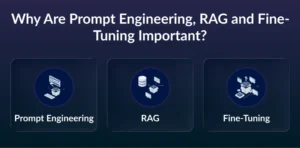
Why Are Prompt Engineering, RAG and Fine-Tuning Important?
These LLM customization methods are important because they help businesses use AI in real-world situations where accuracy, relevance, and control matter the most. Without these techniques, AI models may give generic or outdated answers.
1. Prompt Engineering
Prompt engineering helps you control how the AI behaves by improving the way you give instructions. You don’t need to change or retrain the model; instead, you guide it using clear, structured, and detailed prompts. This makes it a fast and cost-effective way to improve results, especially when you need quick outputs.
2. RAG
Retrieval Augmented Generation vs fine tuning shows that RAG focuses on giving the model access to external or internal data sources. This means the AI can pull real-time or company-specific information before answering. It is very useful for businesses that want AI to work with internal documents, knowledge bases, or frequently updated data, improving both accuracy and relevance.
3. Fine-Tuning
Fine-tuning improves the model by training it on a specific dataset related to a particular domain. This helps the model understand industry-specific language, patterns, and requirements. As a result, the model becomes more reliable and performs better in specialized areas like finance, healthcare, or legal applications.
Together, these methods help businesses:
- Improve accuracy: By guiding the model, adding real data, or training it further, outputs become more precise and useful.
- Use private data safely: Especially with RAG, businesses can use their internal data without exposing it publicly.
- Build smarter AI systems: Combining these methods leads to more intelligent and reliable applications.
- Deliver better user experiences: Users get faster, more relevant, and higher-quality responses.

What is Prompt Engineering?
Prompt Engineering is the process of writing clear, detailed and structured instructions so an AI model can generate the desired output. In this method, you do not change the model’s knowledge or retrain it, you simply guide it using better prompts.
Prompt engineering is one of the simplest LLM optimization techniques because it works by improving how you communicate with the model. The goal is to make sure the output matches your exact needs, whether it’s content writing, coding, or answering questions.
How Does Prompt Engineering Work?
Prompt engineering works through a continuous process of improvement and experimentation. It starts with writing an initial prompt, after which the model generates a response based on that input. You then carefully analyze the output to see what is missing or what can be improved.
Based on this, you refine or adjust the prompt to make it clearer, more specific or better structured. This cycle repeats until the output becomes accurate, relevant and useful for your needs.
Effective prompt engineering focuses on providing clear instructions so the model understands exactly what to do. It also involves maintaining a proper structure, adding specific details, and defining the correct tone and format for the response. The more precise and well-organized the prompt is, the better the results will be.
Prompt engineering is like giving that cook a clear and detailed recipe. The better the recipe, the better the final dish will turn out.
When to Use Prompt Engineering?
Choose prompt engineering when:
- You can clearly explain your task in a prompt: If your requirement can be described in simple and clear instructions, prompt engineering can guide the model to produce the desired output effectively.
- You only need general knowledge from the model: Prompt engineering works well when the task relies on common knowledge already present in the model, without needing external or private data.
- You are okay with some variation in outputs: Since the model may produce slightly different responses each time, prompt engineering is suitable when perfect consistency is not required.
- You need a fast solution with minimal setup: Prompt engineering does not require additional infrastructure or training, making it ideal for quick implementation.
- You have a limited budget or want to reduce self-hosting LLM cost: It is the most cost-effective method because it does not involve extra compute resources or complex systems.
Avoid Prompt Engineering When:
- You need highly accurate or real-time data: Prompt engineering alone cannot fetch updated or external information, which can limit accuracy in such cases.
- You require consistent outputs every time: If your application needs the same structured response repeatedly, prompt engineering may not be reliable enough.
- You are working with sensitive or private data: Since prompt engineering does not integrate secure internal data sources, it may not be suitable for confidential use cases.
- Your use case involves complex reasoning or large-scale automation: For advanced workflows or high-volume systems, prompt engineering alone may not provide the required performance and reliability.
What is Retrieval Augmented Generation (RAG)?
Retrieval Augmented Generation (RAG) is a method where an LLM is connected to external data sources (like company documents or databases) to fetch relevant information before generating an answer.
RAG does not retrain the model. It improves responses by adding the right data at the right time. This makes RAG very useful for businesses that want to build custom LLM application using their own internal data.
How Does RAG Work?
RAG (Retrieval Augmented Generation) works through a clear step-by-step process where it combines external data with the model’s knowledge to generate better answers.
1. Query
The process starts when a user asks a question or gives input. This query acts as a trigger that tells the RAG system to begin searching for relevant information.
2. Information Retrieval
In this step, the system searches through internal or external data sources such as databases, documents, or knowledge bases. It uses semantic search, which means it understands the meaning of the query instead of just matching keywords, helping it find more relevant and accurate information.
3. Integration
After finding the relevant data, the system combines this information with the original user query. This combined input gives the model more context and helps it better understand what kind of answer is needed.
4. Response
Finally, the model generates a response by using both its pre-trained knowledge and the retrieved data. This results in answers that are more accurate, detailed, and context-aware.
Additional Points:
- RAG systems often use vector databases to quickly find and retrieve the most relevant information based on similarity.
- RAG requires proper data pipelines and infrastructure setup, which makes it more complex compared to prompt engineering but much more powerful for data-driven applications.
When to Use RAG?
Choose RAG when:
- You need to use specific documents or internal data: RAG is ideal when your application must access company files, databases, or knowledge bases to generate accurate answers.
- Accuracy and factual correctness are critical: If your use case requires precise and reliable information, RAG helps by fetching verified data instead of relying only on the model’s memory.
- Your data changes frequently (real-time updates): RAG is useful when your data keeps updating, as it can pull the latest information whenever a query is made.
- You need answers with verifiable sources: It allows the model to provide responses backed by actual documents or references, improving trust and transparency.
- You are working with domain-specific or private information: RAG enables the use of proprietary or industry-specific data without retraining the model.
- You can invest in infrastructure and setup: Since RAG requires data pipelines, databases, and integration, it is suitable when you have the resources to support this setup.
Avoid RAG When:
- Your task is simple and does not need external data: If general knowledge is enough, using RAG may add unnecessary complexity.
- You cannot maintain a knowledge base: RAG depends on well-managed data sources, so it may not work well without proper maintenance.
- You need very fast responses with low latency: Because RAG involves data retrieval steps, it can slow down response time in some cases.
- You have limited technical resources or budget: Setting up and maintaining RAG systems can be costly and require technical expertise.
What is Fine-Tuning?
Fine-tuning LLM it is the process of retraining a pre-trained model using a smaller and more focused dataset related to a specific task or domain. Instead of starting from scratch, fine-tuning builds on an already trained model and improves its performance for a particular use case.
Fine-tuning works by adjusting the model’s internal parameters, which control how it understands and generates responses. By training the model on domain-specific data, it becomes more accurate, consistent, and reliable for that area. This makes fine-tuning one of the most powerful LLM optimization techniques, especially for specialized applications like legal, healthcare, or finance systems.
How Does Fine-Tuning Work?
Fine-tuning works through a supervised learning process where the model learns from structured and labeled data.
- You prepare a dataset with labeled examples: First, you collect and organize high-quality data where inputs and correct outputs are clearly defined, so the model knows what to learn.
- The model learns from this data: The model is then trained on this dataset, allowing it to understand patterns, relationships, and domain-specific language.
- It updates its internal weights and parameters: During training, the model adjusts its internal settings (weights) to better match the expected outputs based on the new data.
- It becomes more accurate for that specific task: After training, the model performs better and gives more consistent and relevant results for that particular use case.
Example: If you train a model on legal documents, contracts, and case studies, it will become much better at understanding and generating legal content.
When to Use Fine-Tuning?
Choose fine-tuning when:
- You need highly consistent outputs (same format/style every time): Fine-tuning trains the model to follow a fixed pattern, making outputs more predictable and uniform.
- You handle a large number of similar requests: It works best when the same type of task is repeated frequently, as the model becomes optimized for that specific use case.
- You can create high-quality training data: Fine-tuning requires well-structured and labeled examples so the model can learn effectively.
- You plan to use the model for a long time: Since fine-tuning requires time and cost, it is more suitable for long-term applications.
- You want to reduce prompt size and improve efficiency: A fine-tuned model needs shorter prompts because it already understands the task, which can reduce costs and improve speed.
Avoid Fine-Tuning When:
- Your requirements change frequently: Fine-tuned models are not flexible and may need retraining if your needs keep changing.
- You don’t have enough training data (at least 50–100 examples): Without sufficient data, the model cannot learn effectively and may perform poorly.
- You need real-time or updated information: Fine-tuning does not provide access to new or live data, as it only learns from past training data.
- You have a limited budget for training: Fine-tuning can be expensive due to compute and data preparation costs.
- You need a quick solution: Since fine-tuning takes time to train and test, it is not suitable for fast deployment needs.
RAG vs. Prompt Engineering vs. Fine-Tuning – Key Difference
When comparing RAG vs. fine-tuning vs. prompt engineering, the differences can be clearly understood in the table below:
| Aspect | Fine-Tuning | Prompt Engineering | RAG (Retrieval Augmented Generation) |
| Cost | High cost because it requires powerful computing resources, large datasets, and machine learning expertise for training. | Low cost, as it only involves writing better prompts without needing extra infrastructure or training. | Moderate cost since it requires investment in data pipelines, vector databases, and system integration. |
| Time Investment | High time investment because training can take days or weeks, depending on the dataset size. | Very fast since prompts can be created, tested, and improved quickly. | Moderate time required to set up retrieval systems and integrate data sources. |
| Output Precision | Very high precision, as the model is trained on domain-specific data and performs accurately for that task. | Moderate precision, which depends on how well the prompt is written and structured. | High precision because it combines model knowledge with real-time or external data. |
| Adaptability | Low flexibility since the model is optimized for specific tasks and may need retraining for changes. | High flexibility because prompts can be easily modified for different use cases. | Very high adaptability, as it can fetch updated information dynamically in real time. |
| Use of External Data | Does not use external data during inference and relies only on trained data. | Does not use external data and depends on the model’s existing knowledge. | Actively uses external data sources, making it suitable for dynamic and data-driven applications. |
| Best Environment | Best for stable environments where tasks and data remain consistent over time. | Ideal for quick, flexible, and short-term use cases with minimal setup. | Best for environments where information changes frequently, such as customer support or real-time systems. |
RAG vs Fine-Tuning vs Prompt Engineering Use Cases Across Industries
The choice between prompt engineering vs fine tuning vs RAG depends on the industry and the type of problem you are solving.
1. Healthcare
- Fine-Tuning: Used to train models on medical datasets for tasks like diagnosis support or clinical research summaries.
- Prompt Engineering: Helps build simple chatbots for patient queries like appointment booking or FAQs.
- RAG: Retrieves the latest medical research or treatment guidelines for accurate and updated responses.
2. Finance
- Fine-Tuning: Detects fraud by learning patterns from financial transaction data.
- Prompt Engineering: Generates financial summaries or investment insights quickly.
- RAG: Provides real-time updates on stock markets and financial news.
3. Customer Service
- Fine-Tuning: Trains models to match a company’s tone and improve customer interaction quality.
- Prompt Engineering: Handles basic queries like password reset or FAQs.
- RAG: Connects chatbots to product manuals or customer history for detailed support.
4. Marketing and Advertising
- Fine-Tuning: Creates AI models specialized in generating brand-specific campaigns or ad copies.
- Prompt Engineering: Quickly generates creative content like headlines or blog ideas.
- RAG: Uses real-time data (like weather or trends) to create dynamic and personalized ads.
5. Education
- Fine-Tuning: Customizes models for specific subjects or curriculum-based learning.
- Prompt Engineering: Generates quizzes, summaries, or study materials easily.
- RAG: Provides access to updated research papers and learning resources.
6. Legal Services
- Fine-Tuning: Trains models on legal documents for contract analysis or legal research.
- Prompt Engineering: Assists in drafting legal documents or emails.
- RAG: Retrieves recent case laws or legal updates for accurate insights.
How Developer Bazaar Technologies Can Power Your AI Strategy?
To successfully implement LLM customization methods, businesses often need expert guidance, tools, and infrastructure. This is where an experienced AI development company, Developer Bazaar Technologies can help.
We provide end-to-end LLM development services that help businesses build a custom LLM application tailored to their goals. Whether you need simple prompt engineering vs fine tuning LLM solutions or advanced RAG vs fine tuning LLM systems, our team use the right approach for your use case.
What We Offer:
- AI Strategy Consulting: Helping you choose between retrieval augmented generation vs fine tuning or prompt engineering based on your business goals.
- Custom AI Development: Building scalable and efficient AI solutions tailored to your industry.
- RAG Implementation: Designing data pipelines and integrating knowledge bases for real-time insights.
- Fine-Tuning Services: Training models with domain-specific data for high accuracy.
- AI Integration: Seamlessly integrating AI into your existing systems and workflows.
With the right partner, you can reduce self-hosting LLM cost and maximize performance while building future-ready AI systems.
Conclusion
Choosing between RAG vs fine tuning vs prompt engineering is not about picking one over the other, it’s about selecting the right tool for your specific needs.
- Fine-Tuning is best for high accuracy and domain expertise
- Prompt Engineering is ideal for flexibility and cost efficiency
- RAG is perfect for real-time, data-driven applications
Each method plays a key role in how to improve LLM performance, and in many real-world applications, they are used together for the best results.
As AI continues to evolve, businesses that adopt the right LLM optimization techniques will gain a strong competitive advantage. The future of AI lies in customization, and those who invest in the right strategy today will lead tomorrow.
FAQs
1. What is the main difference between RAG, fine-tuning, and prompt engineering?
The main difference lies in their approach: prompt engineering improves inputs, RAG adds external data, and fine-tuning retrains the model for specialization.
2. Which is better: RAG vs. fine-tuning LLM?
It depends on your needs, RAG is better for real-time data, while fine-tuning is better for domain-specific expertise.
3. Is prompt engineering enough for production systems?
Prompt engineering works well for simple use cases, but for complex or data-driven systems, RAG or fine-tuning may be required.
4. When should I use RAG instead of fine-tuning?
Use RAG when you need updated or external data, and fine-tuning when you need consistent and specialized outputs.
5. Which method is the most cost-effective?
Prompt engineering is the most cost-effective, followed by RAG, while fine-tuning is the most expensive.
6. Can these methods be combined?
Yes, many modern AI systems combine prompt engineering, RAG, and fine-tuning to achieve the best performance.