

Earlier, large language models (LLMs) were just exciting experiments in research labs. But these days, they are meant for real business systems across the world. Tools like GPT-3 changed how companies interact with customers, manage data, and automate work.
According to a 2025 McKinsey report, 78% of organizations are already using AI in at least one business function, up from 72% the year before. That number is growing fast. If your company is not moving forward with AI, your competitors probably are.
But the fact is, most companies are using the same ready-made tools. When everyone uses the same solution, no one gets a real competitive edge. The real power comes when you build custom LLM Application that fits your exact business needs.
This founder’s guide will explain to you everything you should know:
- What LLMs are and how they work?
- Why enterprises should use them?
- How to build custom LLM for enterprises step by step
- What is the Cost to develop LLM Application and more?
What Are Large Language Models (LLMs)?
Large Language Models are powerful AI systems trained on massive amounts of text. Think of them as digital brains that have “read” books, websites, articles, and documents from across the internet.
Some well-known examples include:
- ChatGPT – Great at writing natural conversations
- BERT – Excellent at understanding meaning and context
- T5 – Turns every task into a text problem
- Gemini – Works with text, images, and more
A recent Hostinger report showed that the top five LLM tools generate around 88% of the global market revenue. That means most businesses rely on only a few platforms.
But the major question is: Should you just use these tools? Or should you develop custom LLM application built only for your company?
For startups, pre-built tools may work. But for enterprises with sensitive data, large teams and complex systems, a custom approach is far better to choose.
How Do Large Language Models Actually Work?
Large Language Models (LLMs) work by using clear mathematical and engineering principles. They read massive amounts of text, learn patterns and then predict the next best word in a sentence.

1. Transformer Architecture – The Core Engine
Most modern LLMs are built on something called the transformer architecture. This idea was introduced in 2017 and completely changed the AI world. Before transformers, older AI models read text one word at a time, from left to right. That made it hard for them to understand long sentences or complex meanings.
Transformers work differently. They look at the entire sentence at once instead of reading word by word. This helps them understand the full context.
For example:
The word “bank” can mean:
- A place where you keep money
- The side of a river
If someone writes:
- “I deposited money in the bank.”
- “We sat by the bank of the river.”
The transformer studies all the words in the sentence together. That is how it understands the correct meaning. This architecture powers systems like ChatGPT, BERT, and Gemini.
2. Attention Mechanism – The Focus System
One of the most powerful ideas inside transformers is called the attention mechanism.
Think of attention like using a highlighter while reading a book. You highlight the most important words so you can understand the meaning faster.
For example:
“The CEO approved the merger after reviewing the financial report.”
The model automatically gives more importance to words like:
- CEO
- approved
- merger
- financial report
These words express the most important idea of the sentence.
Attention helps the model:
- Understand relationships between words
- Connect ideas across long paragraphs
- Give accurate and relevant responses
Without attention, the model would struggle to understand complex instructions.
3. Parameters – The Brain Power
Parameters are like tiny switches inside the AI brain. Each switch helps the model decide how important certain patterns are. Modern LLMs can have billions, even hundreds of billions of these parameters.
More parameters usually mean:
- Better understanding
- More accurate answers
- Stronger reasoning ability
- Higher computing power
- More training data
- Greater infrastructure cost
That is why training a large model requires powerful servers, GPUs, and cloud systems.
Why LLMs Matter to Enterprises?
Large Language Models (LLMs) are not just smart chatbots. They are powerful business tools that help companies save time, reduce costs, and grow faster. Enterprises that use LLMs effectively can improve productivity, customer experience, and decision-making at scale.
Today, 67% of organizations worldwide have adopted LLMs. Also, 88% of professionals say LLMs improved the quality of their work. By 2026, 30% of enterprises will automate over 50% of their network operations using AI and LLMs.
- Automate Repetitive Work: LLMs can handle boring and repetitive tasks like answering common questions or sorting documents. This frees employees to focus on more important and creative work.
- Better Decision-Making: LLMs analyze large amounts of data in seconds. They can read reports, summarize insights, and help leaders make smarter business decisions.
- Personalized Customer Experience: LLMs understand customer questions better than old chatbots. They give fast, natural, and helpful responses 24/7.
- Faster Operations: From document review to email drafting, LLMs speed up daily operations. This increases overall productivity.
When enterprises build LLM for themselves, they create systems that match their specific needs instead of using generic tools.
Use Cases of LLM Models Driving ROI
LLMs are being used in almost every major industry. They improve efficiency, reduce costs, and increase profits. Understand how different sectors use LLMs to drive real return on investment (ROI).
1. Finance (BFSI)
LLMs detect fraud by spotting unusual patterns in transactions. They also analyze financial news and reports to help traders make informed decisions. Investment firms use LLMs for market research and portfolio optimization. This saves analysts weeks of manual work.
2. Healthcare
In the US, 21% of healthcare organizations use LLMs to answer patient questions. Around 20% use medical chatbots. LLMs help doctors with clinical documentation and medical text summarization. This reduces paperwork and improves patient care.
3. Legal
Law firms deal with large contracts and complex legal documents. LLMs help lawyers review these documents much faster by identifying key clauses and risks. This speeds up due diligence and compliance processes. As a result, legal teams save time, reduce errors, and handle more cases efficiently.
4. Retail & eCommerce
Retail and e-commerce hold 27.5% of the LLM market share. LLMs power smart product search and personalized recommendations. They also generate product descriptions and marketing content automatically. This saves time and improves sales.
5. Education
In education, LLMs act like personal tutors for students. They explain difficult topics in simple language and create practice questions for better understanding. Teachers use LLMs to grade assignments and prepare lesson plans more quickly. This reduces administrative work and gives teachers more time to support students individually.
6. Real Estate
LLMs help home buyers search properties using natural language, such as “a quiet house with a big backyard near a good school.” The system understands the request and shows suitable listings.
Real estate agents also use LLMs to draft and summarize contracts and agreements. This makes paperwork faster, reduces errors, and speeds up property transactions.
How Businesses Use LLM Models: Key Applications and Benefits
Across industries, organizations use LLMs not just for chatbots but for improving internal work and customer experience. These applications help businesses grow smarter and faster.
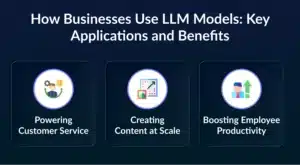
1. Powering Customer Service
LLMs create smarter chatbots that understand complex questions. They respond like humans and solve problems quickly. They also help human agents by summarizing customer history and suggesting replies in real time.
2. Creating Content at Scale
LLMs draft marketing copy, emails, reports, and internal documents in seconds. This saves time for content teams. They also create personalized content for different audiences and translate content into multiple languages.
3. Boosting Employee Productivity
LLMs summarize long reports and research papers quickly. Employees get key insights without reading everything. Developers use LLMs to write and debug code faster. This speeds up software development.
When companies build custom LLM for enterprises, they unlock these benefits in a secure and controlled environment.
Real-World Examples of Companies Putting LLMs to Work
Many global companies use them in their daily operations to improve customer service, personalization, and productivity. These real-world examples show how LLMs create measurable business impact.
1. Octopus Energy
Octopus Energy, a UK-based energy provider, has integrated an LLM similar to ChatGPT into its customer service system. The AI answers common customer questions quickly and accurately without human involvement.
Today, the system handles nearly half of all customer inquiries. This allows human agents to focus only on complex or sensitive issues, improving both efficiency and customer satisfaction.
2. Netflix
Netflix uses LLM technology to improve its content recommendation system. The AI analyzes user behavior such as watch time, pause patterns, and browsing history. By understanding these small actions, the system predicts what users might enjoy next. This leads to better recommendations, higher engagement, and longer viewing time on the platform.
3. Bank of America
Bank of America uses an AI-powered virtual assistant called Erica. This assistant helps customers with everyday banking tasks such as checking balances, reviewing transactions, and setting fraud alerts.
Erica has handled billions of customer interactions. It improves customer experience by providing instant support while freeing human staff to focus on advanced financial advice.
4. Duolingo
Duolingo invested in GPT-4 to enhance its premium learning features. The AI provides detailed explanations for mistakes and offers personalized feedback. Instead of just showing the correct answer, the system explains why it is correct. This makes the learning experience deeper, more interactive, and more effective for users.
How to Develop Custom LLM Model From Scratch?
Developing a Large Language Model (LLM) is not a one-day task. It is a structured and step-by-step journey that requires planning, quality data, strong security, and scalable infrastructure.
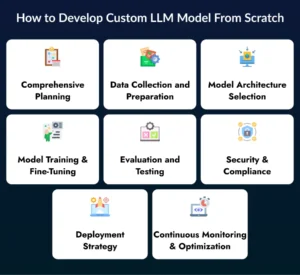
1. Comprehensive Planning
The first step is to clearly define your goal. Ask yourself: What problem are we solving? Is it customer support automation, document search, sales assistance, or internal knowledge management? A clear objective saves time, money, and effort.
You should also decide whether to build an internal team or partner with experts. Many companies choose to work with specialists to develop LLM for Enterprises effectively.
2. Data Collection and Preparation
Data is the foundation of any LLM. You need to collect relevant company data such as customer chats, product manuals, reports, emails, and internal documents.
After collecting data, you must clean and organize it carefully. Remove duplicate content, filter sensitive or biased information, and standardize formats. Then perform tokenization, which breaks text into smaller parts that the model can understand.
3. Model Architecture Selection
Now you must choose the right model structure. Transformer-based models are the most common because they understand context very well. However, for knowledge-heavy tasks, Retrieval-Augmented Generation (RAG) models work better because they pull real-time data from trusted sources.
You must balance model size and performance with your infrastructure capacity. A very large model may perform well but require expensive hardware.
4. Model Training & Fine-Tuning
Most enterprises do not build models from scratch because it is expensive and time-consuming. Instead, they fine-tune pre-trained models using their own company data.
Fine-tuning teaches the model your business language, tone, rules, and domain knowledge. This step transforms a general AI into a company-specific intelligent assistant. It is one of the most important stages when you build custom LLM Application for enterprise use.
5. Evaluation and Testing
After training, you must test the model carefully. Use automated performance tests to measure accuracy and speed. Also, involve human experts to review the quality of responses. Check whether the model gives correct answers, maintains the right tone, and follows compliance rules. Testing helps identify weaknesses before full deployment.
6. Security & Compliance
To build a secure LLM application for business, you must implement strong encryption, secure APIs, and strict access controls. Make sure your system follows data privacy laws like GDPR or other local regulations. Protecting customer and company data builds trust and prevents legal risks.
7. Deployment Strategy
Next, decide how you will deploy the model. You can choose cloud deployment, on-premises setup, hybrid models, or serverless options depending on your needs.
To build scalable LMM for enterprises, use containerization tools like Docker and orchestration tools like Kubernetes. These technologies help manage traffic, scale automatically, and maintain system stability as user demand grows.
8. Continuous Monitoring and Optimization
Launching the model is not the final step. You must monitor performance regularly to detect issues like model drift, where accuracy decreases over time.
Optimize inference speed using techniques such as quantization and batching. These methods reduce operating costs and improve response time. When enterprises build custom LLM applications, they must focus on long-term performance, scalability, and continuous improvement.
Challenges & Solutions While Developing LLM Models for Enterprises
Companies face many practical challenges like poor data quality, high costs, scalability issues, and compliance risks. The good news is that with the right strategy, you can overcome these challenges and successfully build custom LLM application for your business.
1. Data Availability and Quality
Problem: Many companies believe they have a lot of data. But when they start LLM training, they find that the data is scattered, duplicated, outdated, or incomplete. Low-quality data results in weak and inaccurate model performance.
Solution: Start with a proper data audit. Collect, clean, and organize your data carefully. Remove duplicates and fix errors. If needed, use high-quality synthetic data to fill gaps. Good data is the foundation when you develop LLM for enterprises.
2. Resource Management and High Costs
Problem: LLM development can be expensive. GPU costs, cloud bills, energy usage, and scaling expenses can increase quickly. Many enterprises underestimate these hidden costs.
Solution: Use cloud resources smartly. Scale up during training and scale down afterward. Fine-tune pre-trained models instead of building from scratch to save money. This helps you build secure LLM application for business without overspending.
3. User Adoption and Trust Issues
Problem: Employees may fear that AI will replace their jobs. Customers may not trust AI responses. Even a perfect system fails if people don’t use it.
Solution: Be transparent about how the system works. Train employees properly and show them how AI supports their work instead of replacing it. Clear communication builds trust and improves adoption.
4. Bias and Fairness Problems
Problem: LLMs learn from data. If the data contains bias, the model may produce unfair or discriminatory results. This can damage your brand reputation.
Solution: Use diverse training datasets. Test the model regularly for bias. Monitor outputs continuously after deployment. Responsible AI practices are essential when you build LLM for enterprises.
5. Scalability Issues
Problem: Your model may work well for 100 users, but struggle when 10,000 users access it. Slow response times can frustrate customers.
Solution: Design your system for scaling from the beginning. Use container tools and load balancing. Implement caching to avoid repeating the same calculations. This helps you build a scalable LMM for enterprises.
6. Regulatory and Compliance Challenges
Problem: Data privacy laws like GDPR keep changing. Enterprises must protect customer data and maintain audit records.
Solution: Build compliance into your architecture from day one. Encrypt data, control access, and document everything. Work with legal and AI experts to stay updated.
How Much Will It Cost for LLM Development?
Before you start building an LLM, you must understand the cost and time required. Clear budgeting helps you avoid surprises and keeps your project running smoothly. When you plan properly, you can control expenses and scale at the right speed.
The total cost depends on your goal, model type, data size, and infrastructure.
| Level | Project Type | Estimated Cost | Best For |
| Basic | Fine-tuning an existing model | $40,000 – $80,000 | Small automation tasks, chatbots, internal tools |
| Intermediate | Advanced fine-tuning + integrations | $80,000 – $150,000 | Customer support AI, document analysis, workflow automation |
| Advanced | Fully custom LLM from scratch | $150,000 – $300,000+ | Large enterprises needing full control and industry-specific AI |
- Basic projects are faster and more affordable.
- Advanced projects give full customization but require higher investment.
When you build a custom LLM for enterprises, always include hidden costs like data storage, monitoring tools, bandwidth, cloud usage, and long-term maintenance.
The Future of LLMs in Enterprises
LLMs are evolving very fast. What we see today is just the beginning. The future will bring smarter, more specialized, and more independent AI systems for businesses.
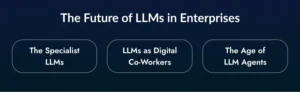
1. The Specialist LLMs
Today, many LLMs are general-purpose. In the future, we will see industry-specific LLMs trained deeply in finance, healthcare, law, or manufacturing. These specialist models will understand industry rules and language better. They will provide more accurate and reliable answers.
2. LLMs as Digital Co-Workers
LLMs will not remain separate tools. They will integrate directly into office software, CRM systems, and development platforms. For example, developers will get instant code suggestions. Marketing teams will get ready-made campaigns. Employees will work alongside AI like a smart assistant.
3. The Age of LLM Agents
The next big shift is LLM agents. These systems will complete multi-step tasks independently. For example, an AI agent could schedule meetings, send emails, and update calendars automatically. This level of automation will transform enterprise productivity.
Start Your LLM Journey with Developer Bazaar Technologies
Building an enterprise LLM is a strategic investment. It requires technical expertise, strong planning, and long-term support. Partnering with the leading LLM Development company makes this journey smooth and successful.
At Developer Bazaar Technologies, we help enterprises build custom LLM applications tailored to their goals and industry needs.
Our team offers:
- End-to-end AI consulting services
- Secure and scalable architecture
- Custom model fine-tuning
- Enterprise-grade deployment
- Continuous monitoring and optimization
We help businesses develop LLM for enterprises that process millions of queries while maintaining high performance and reliability.
Endnote
Large Language Models are no longer just experimental tools. They are powerful business systems that help enterprises automate work, improve customer experience, and make smarter decisions. Companies that move early gain a strong competitive advantage in their industry.
Building a custom and scalable LLM application requires clear planning, quality data, secure architecture, and continuous monitoring. While the cost and effort may seem high at first, the long-term return on investment can be much greater.
If you want full control, better security, and industry-specific performance, developing a custom LLM for enterprises is the right path. With the right AI development company and expert guidance, you can build a secure, scalable, and future-ready LLM solution that drives real business growth.
FAQs
1. Do enterprises need an in-house AI team to build an LLM application?
Not necessarily. Many enterprises partner with an experienced AI development company to reduce risk and speed up deployment. However, having an internal technical team helps in managing data, integrations, and long-term monitoring.
2. Can a custom LLM integrate with existing enterprise software?
Yes, a custom LLM can integrate with CRM systems, ERP platforms, HR tools, and internal dashboards using APIs. Proper integration ensures smooth workflows and allows employees to use AI directly within their daily tools.
3. How do enterprises measure ROI after deploying an LLM?
Enterprises measure ROI by tracking productivity improvement, cost reduction, faster response times, and customer satisfaction scores. Clear KPIs, such as reduced manual workload and improved operational speed, help evaluate success.
4. Is it safe to use sensitive company data for LLM training?
Yes, but only when strong security measures are in place. Enterprises must use encryption, access control, and compliance standards to protect confidential data during training and deployment.
5. Can small and mid-sized businesses also build custom LLM applications?
Yes, small and mid-sized businesses can start with fine-tuning pre-trained models instead of building from scratch. This approach reduces cost while still providing tailored AI solutions that support business growth.