

The technology landscape has shifted dramatically, creating an unprecedented paradox.74% of employers say they are struggling to find the skilled talent they need, while IDC predicts that by 2026, more than 90% of organizations worldwide will feel the pain of the IT skills crisis, amounting to $5.5 trillion in losses caused by product delays, impaired competitiveness, and loss of business.
This contradiction has triggered the most significant outsourcing surge in modern business history. Theglobal IT outsourcing market is projected to reach $812.70 billion by 2029, with the United States generating the highest revenue of $213.60 billion in 2025. What most executives don’t realize is that this isn’t just about cost savings anymore—it’s about survival in an economy where the tech talent shortage could cost up to $8.5 trillion by 2030.
These numbers show an excellent opportunity for organizations to invest in strategic IT outsourcing and capitalize on the evolving market before talent shortages intensify further. Developer Bazaar Technologies has created this comprehensive roadmap to guide businesses through the entire outsourcing transformation journey.
Why Is IT Outsourcing Gaining Popularity in 2026?
The answer is simple: talent scarcity and technological complexity. Modern organizations face unprecedented challenges in finding skilled IT professionals while simultaneously needing to implement cutting-edge technologies like AI, cybersecurity, and cloud infrastructure that require specialized expertise.
IT outsourcing has evolved from basic cost reduction to strategic capability enhancement, offering access to specialized talent pools, advanced technologies, and scalable solutions that would be impossible to build in-house within realistic timeframes and budgets.
Moreover, IT outsourcing provides competitive advantages through faster time-to-market, reduced operational risks, and access to global talent networks that enable innovation and growth. As a result, more organizations are embracing strategic outsourcing partnerships, driving consistent market expansion and transformation.
Top IT Outsourcing Trends and Practices in 2026
The following are the key IT outsourcing trends and practices that organizations should implement in 2026. We have organized these trends into strategic categories for comprehensive understanding.
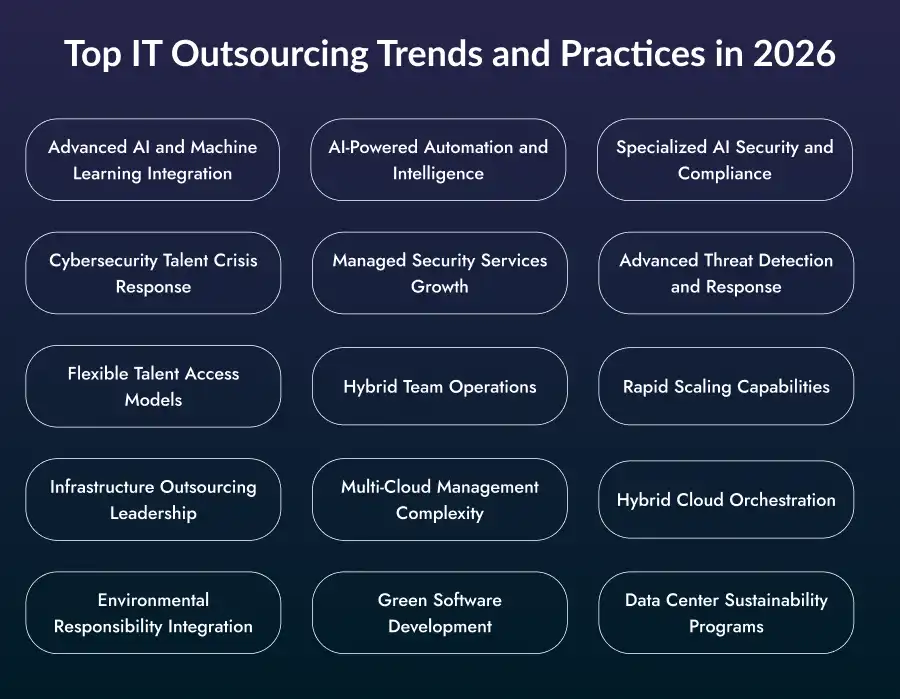
● Advanced AI and Machine Learning Integration
Organizations are increasingly outsourcing AI/ML projects as 78% now use AI in at least one business function, with specialized external partners providing expertise that’s scarce internally. Companies like Netflix and Spotify have successfully leveraged outsourced AI teams to develop recommendation algorithms and personalization features.
The complexity of implementing machine learning models, from data preprocessing to model deployment, requires specialized skills that are often more cost-effective to access through outsourcing partnerships rather than building in-house capabilities from scratch.
● AI-Powered Automation and Intelligence
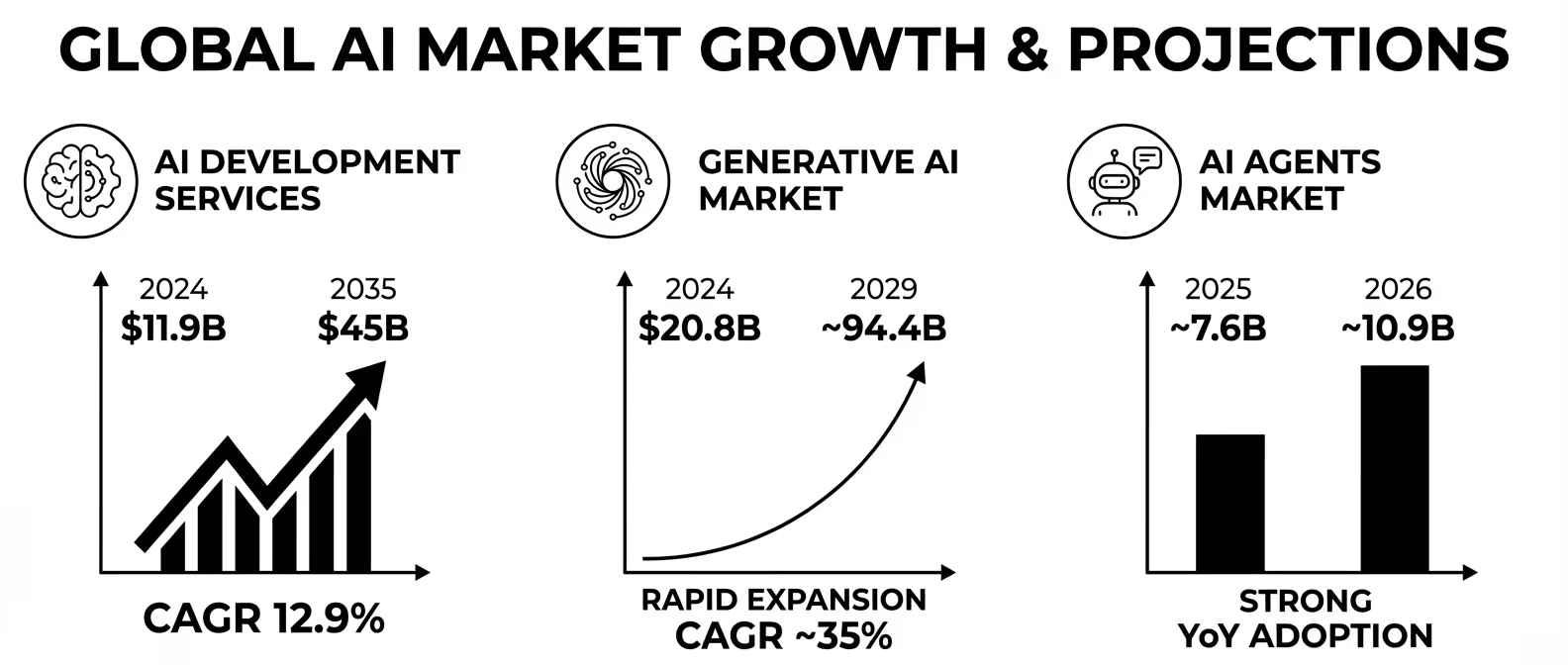
The global AI and ML outsourcing market is expected to grow at a 33% CAGR, making AI-focused outsourcing partnerships essential for accessing cutting-edge capabilities and maintaining competitive advantage.
Forward-thinking companies are outsourcing intelligent process automation, predictive analytics, and natural language processing projects to specialized providers. For instance, major banks are partnering with AI firms to develop fraud detection systems and automated customer service chatbots, enabling them to process millions of transactions with enhanced accuracy while reducing operational costs by up to 40%.
● Specialized AI Security and Compliance
With 33.9% of tech professionals reporting AI security skills shortages, outsourcing provides access to specialized AI security expertise and compliance frameworks. As AI systems handle sensitive data and make critical business decisions, ensuring robust security measures becomes paramount.
Organizations are partnering with specialized firms that understand AI-specific vulnerabilities, including model poisoning, adversarial attacks, and data privacy concerns. These partnerships help companies navigate complex regulatory requirements like GDPR and emerging AI governance standards while maintaining the integrity and trustworthiness of their AI implementations.
● Cybersecurity Talent Crisis Response
The shortage of 3.4 million cybersecurity professionals globally has made security outsourcing essential, with cybersecurity ranking among top 3 most outsourced IT functions. This critical skills gap means that even Fortune 500 companies struggle to hire qualified security professionals.
Organizations are responding by partnering with managed security service providers (MSSPs) who can provide immediate access to certified security experts, advanced threat intelligence, and 24/7 monitoring capabilities.
Companies like Target and Home Depot have significantly strengthened their security posture through strategic outsourcing partnerships following high-profile breaches.
● Managed Security Services Growth
Organizations are turning to managed security services as 67% report cybersecurity talent shortages and 25% experienced security department layoffs in 2024. The economic pressures combined with increasing cyber threats have created a perfect storm driving MSS adoption.
Small to medium enterprises particularly benefit from this trend, gaining enterprise-level security capabilities without the overhead of maintaining full security teams. Managed security providers offer comprehensive solutions including vulnerability management, incident response, and compliance monitoring, typically reducing security costs by 25-50% compared to in-house alternatives.
● Advanced Threat Detection and Response
With weekly cyberattacks reaching 1,900 per organization, outsourced security services provide 24/7 monitoring and advanced threat intelligence capabilities. Modern cyber threats operate around the clock, requiring constant vigilance that’s challenging for internal teams to maintain.
Security outsourcing partners leverage AI-powered threat detection systems, global threat intelligence networks, and specialized response teams to identify and neutralize threats within minutes rather than hours.
Companies like IBM Security and CrowdStrike have demonstrated how outsourced security operations centers (SOCs) can detect advanced persistent threats that might otherwise go unnoticed for months.
● Flexible Talent Access Models
Global spending on staff augmentation will reach $81.87 billion by 2025, as organizations prioritize maintaining project control while accessing specialized skills. This model allows companies to quickly scale their teams with specific expertise without long-term commitments.
For example, a fintech startup might augment their core team with blockchain developers for a three-month project, then pivot to mobile app developers for their next initiative. Staff augmentation provides the flexibility to access niche skills like DevOps engineering, cloud architecture, or specific programming languages exactly when needed, optimizing both costs and project timelines.
● Hybrid Team Operations
Companies are implementing hybrid models combining in-house strategic oversight with outsourced execution, providing control while accessing expertise unavailable internally. This approach maintains critical decision-making and intellectual property in-house while leveraging external specialists for implementation.
Technology giants like Microsoft and Google frequently use this model for non-core projects, keeping product strategy and architecture decisions internal while outsourcing development, testing, and maintenance tasks. This hybrid approach reduces project risks while ensuring access to global talent pools and specialized technologies.
● Rapid Scaling Capabilities
Staff augmentation enables businesses to scale teams faster than traditional hiring, addressing the IT Staff Augmentation services growth at 3.53% CAGR. Traditional hiring processes can take 3-6 months, while staff augmentation can provide qualified professionals within weeks.
This speed advantage is crucial for companies responding to market opportunities or urgent project demands. E-commerce companies, for instance, regularly use staff augmentation to rapidly scale their development teams during peak seasons, adding specialized developers for mobile apps, payment systems, or logistics platforms without the overhead of permanent hires.
● Infrastructure Outsourcing Leadership
Infrastructure outsourcing commands 45.7% of the IT outsourcing market, with cloud-managed services projected to expand at 3.5% CAGR through 2030. Organizations are recognizing that infrastructure management requires specialized expertise and significant capital investment that’s often better sourced externally.
Companies like Airbnb and Netflix have built their entire operations on outsourced infrastructure, leveraging AWS and other cloud providers to achieve global scale without maintaining physical data centers. This trend enables businesses to focus on core competencies while accessing enterprise-grade infrastructure and 99.9% uptime guarantees.
● Multi-Cloud Management Complexity
End-user spending on public cloud services will total $723.4 billion in 2025, driving demand for managed cloud services. As organizations adopt multiple cloud providers to avoid vendor lock-in and optimize costs, managing these complex environments becomes increasingly challenging.
Companies typically use AWS for compute, Google Cloud for AI services, and Microsoft Azure for enterprise applications, creating integration and security challenges. Managed cloud service providers specialize in orchestrating these multi-cloud environments, ensuring seamless data flow, consistent security policies, and optimized costs across different platforms.
● Hybrid Cloud Orchestration
The global managed services market size reached $335.37 billion in 2024 with 14.1% CAGR growth, reflecting complex infrastructure management needs. Modern businesses operate across on-premises data centers, private clouds, and multiple public cloud platforms, creating unprecedented complexity.
Successful hybrid cloud orchestration requires expertise in containerization, microservices, API management, and data synchronization across diverse environments. Companies like BMW and General Electric have partnered with specialized providers to create seamless hybrid cloud architectures that support both legacy systems and modern cloud-native applications.
● Environmental Responsibility Integration
By 2026, 50% of CIOs will have performance metrics tied to energy consumption, making sustainable IT practices essential for outsourcing partnerships. Environmental sustainability has become a board-level priority, with companies like Apple and Google committing to carbon neutrality.
IT outsourcing providers are responding by implementing green data centers, renewable energy sources, and carbon-neutral operations. Organizations are increasingly evaluating potential partners based on their environmental credentials, with sustainability metrics becoming as important as traditional cost and performance indicators in vendor selection processes.
● Green Software Development
The green technology market will reach $51.09 billion by 2029, with outsourcing providers implementing sustainable development practices and energy-efficient solutions. Software development practices significantly impact energy consumption through code efficiency, algorithm optimization, and resource utilization.
Leading outsourcing providers are adopting green coding practices, implementing energy-efficient development environments, and optimizing applications for reduced power consumption. Companies like Salesforce and SAP are partnering with environmentally conscious development teams to create software that minimizes computational resources and supports their broader sustainability goals.
● Data Center Sustainability Programs
With data center electricity consumption projected to double by 2030, outsourcing partners focusing on sustainable infrastructure provide competitive advantages. Data centers currently consume approximately 1% of global electricity, making sustainability initiatives critical for environmental and cost management.
Progressive outsourcing providers are investing in renewable energy sources, advanced cooling technologies, and energy-efficient hardware to reduce their environmental footprint. Companies partnering with these sustainable providers not only reduce their carbon footprint but also benefit from lower operational costs and enhanced brand reputation among environmentally conscious customers and stakeholders.
Benefits of Investing in IT Outsourcing
Implementing comprehensive IT outsourcing strategies provides various advantages to organizations. The top benefits are as follows:
1. Access to Specialized Talent and Skills
IT outsourcing enables access to specialized expertise in AI, cybersecurity, cloud computing, and emerging technologies that are scarce in the local job market. With 3.4 million empty cybersecurity positions globally and AI expertise in high demand, outsourcing partnerships provide immediate access to critical skills.
2. Significant Cost Reduction and ROI
Strategic IT outsourcing delivers cost savings of 30-75% compared to building in-house teams, while providing access to capabilities that would require substantial investment in recruitment, training, and infrastructure. Organizations can redirect saved resources toward core business functions and strategic initiatives.
3. Scalability and Operational Flexibility
Outsourcing partnerships enable rapid scaling of IT capabilities without the constraints of hiring, training, and managing full-time employees. This flexibility is crucial for project-based work, seasonal demands, and emerging technology implementations that require specialized skills.
4. Accelerated Time-to-Market
Access to experienced teams and established processes can reduce project delivery times by up to 25%, providing competitive advantages in rapidly evolving markets where speed of implementation determines market position and revenue opportunities.
5. Risk Mitigation and Compliance
Specialized outsourcing partners bring expertise in regulatory compliance, security standards, and best practices that reduce operational risks while ensuring adherence to industry requirements and data protection regulations.
How to Implement IT Outsourcing Strategy?
Now that you know the benefits, let’s jump into the step-by-step process to implement successful IT outsourcing strategies.
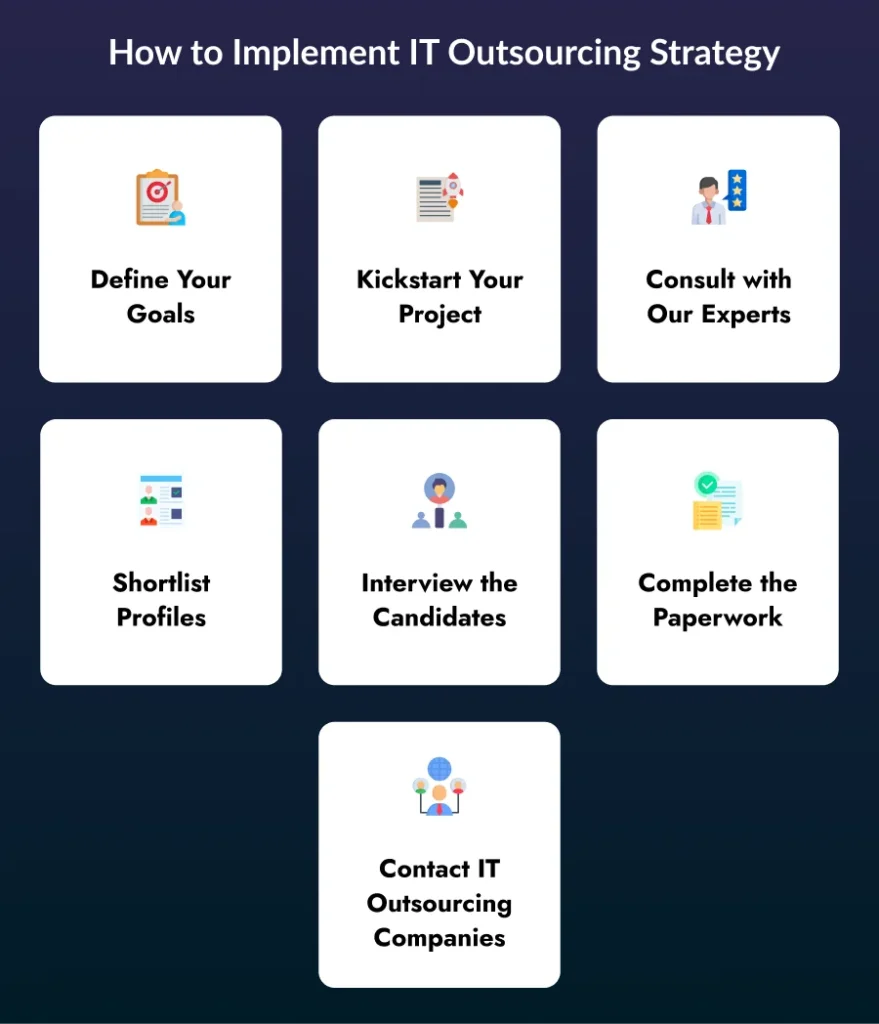
1. Define Your Goals
Establish clear objectives including cost targets, quality standards, delivery timelines, and success metrics. Determine your budget constraints, timeline requirements, and specific technology needs to guide your outsourcing approach.
2. Contact IT Outsourcing Companies
Research and reach out to established IT outsourcing providers like Developer Bazaar that specialize in your industry and technology requirements. Compare their expertise, track records, and service offerings.
3. Consult with Our Experts
Schedule consultations with potential partners to discuss your project requirements, technical challenges, and business objectives. Evaluate their understanding of your needs and proposed solutions.
4. Shortlist Profiles
Review candidate profiles and narrow down to the most qualified vendors based on technical expertise, industry experience, certifications, and alignment with your project requirements.
5. Interview the Candidates
Conduct detailed interviews with shortlisted candidates to assess their technical knowledge, communication skills, problem-solving abilities, and cultural fit for your organization and project needs.
6. Complete the Paperwork
Finalize contracts, service level agreements, NDAs, and other legal documentation. Establish clear terms for deliverables, timelines, payment schedules, and performance metrics.
7. Kickstart Your Project
Begin with pilot projects or initial phases to test partnership dynamics. Implement communication protocols, project management tools, and monitoring systems for successful collaboration.
Strategic Implementation Framework
For implementing comprehensive IT outsourcing strategies, organizations must balance cost optimization with capability enhancement and risk management. Here are the proven strategies for maximizing outsourcing value and business impact:
1. Performance-Based Contract Models
Outcome-based contracts are expected to increase by 15% in adoption by 2026, with organizations moving beyond traditional time-and-materials arrangements toward results-driven partnerships that align vendor success with business outcomes.
This approach ensures vendors have stake in project success while providing cost predictability and performance guarantees that traditional contracts cannot deliver.
2. Nearshore vs. Offshore Strategy
77% of EU companies that outsource IT do so within the European Union, while North American companies increasingly favor Latin American partners where average wages are 38% of US tech salaries.
Nearshore outsourcing provides timezone alignment, cultural compatibility, and improved communication while maintaining significant cost advantages over domestic alternatives.
3. Hybrid Outsourcing Models
70% of organizations view hybrid outsourcing as strategic pathway to competitive edge, combining in-house strategic oversight with external execution capabilities for optimal control and expertise access.
This approach enables organizations to maintain core competency development while accessing specialized skills for specific projects or functions.
4. Continuous Skill Development
5. Security and Compliance Integration
With cybersecurity talent shortages and increasing regulatory requirements, outsourcing partnerships must include comprehensive security frameworks and compliance expertise that reduce organizational risk while enabling innovation.
Conclusion
This is your complete guide to IT outsourcing in 2026. With 90% of organizations facing IT skills shortages by 2026 and the global outsourcing market reaching $812.70 billion, strategic outsourcing has become essential for business survival and competitive advantage.
Implementing IT outsourcing provides numerous benefits, including access to specialized talent, significant cost reduction, operational scalability, accelerated time-to-market, and comprehensive risk mitigation that traditional hiring cannot deliver within realistic timeframes and budgets.
The outsourcing landscape has evolved from simple cost reduction to strategic capability enhancement, with AI-first partnerships, security-as-a-service models, and hybrid team operations becoming standard practices for maintaining competitive positioning in rapidly evolving markets.
So, what are you waiting for? Follow this guide to implement strategic IT outsourcing today. If you want professional assistance, reach out to Developer Bazaar Technologies, the leading IT outsourcing partner specializing in AI, cybersecurity, and cloud technologies.
We have successfully delivered IT professionals for numerous organizations across various industries, helping them achieve cost optimization, capability enhancement, and competitive advantage through strategic partnerships. You can explore our outsourcing portfolio for detailed case studies and success stories.
FAQs
Q1. What is IT outsourcing and why is it important in 2026?
IT outsourcing involves partnering with external providers to handle technology functions, development projects, or managed services. With 74% of employers struggling to find skilled talent and 90% facing IT skills shortages by 2026, outsourcing provides essential access to specialized expertise.
Q2. How much can organizations save through IT outsourcing?
Cost savings typically range from 30-75% compared to building in-house capabilities, with average savings of 50-60% being common. However, the real value lies in accessing specialized skills and faster time-to-market that would be impossible to achieve internally.
Q3. Which IT functions should be outsourced first in 2026?
Start with cybersecurity, software development, and IT infrastructure. These areas have the biggest skill gaps and the highest success rates for outsourcing partnerships.
Q4. What are the key trends in IT outsourcing for 2026?
Major trends include AI-first outsourcing, security-as-a-service dominance, staff augmentation growth, cloud infrastructure focus, and sustainable IT practices driving vendor selection and partnership strategies.
Q5. How do I evaluate and select IT outsourcing partners?
Focus on proven expertise in your technology requirements, industry experience, security certifications, communication capabilities, and cultural fit. Conduct pilot projects before committing to long-term partnerships.
Q6. Should organizations choose nearshore or offshore outsourcing?
Nearshore outsourcing offers timezone alignment, cultural compatibility, and improved communication at a premium over offshore, but typically delivers better project outcomes and faster delivery times.
Q7. What are the risks of IT outsourcing and how to mitigate them?
Key risks include vendor dependency, security concerns, quality issues, and communication challenges. Mitigate through careful vendor selection, comprehensive contracts, regular monitoring, and hybrid outsourcing models.

RM Mishra
Co-Founder
Developer Bazaar technologies