
Key Takeaways:
- Generative AI Models create original text, images, code, audio, and video by learning patterns from massive datasets rather than copying existing content.
- Different model architectures, including GANs, VAEs, Transformers, Diffusion Models, Autoregressive Models, and Multimodal Models, are designed for different business and creative applications.
- Successful AI adoption depends not only on model capabilities but also on proper evaluation, governance, bias testing, and security controls.
- Businesses can accelerate AI implementation through model integration services or build tailored solutions with custom development and fine-tuning.
- As multimodal AI continues to evolve, organizations that invest in responsible deployment and high-quality data will gain a stronger competitive advantage.
Imagine teaching a computer to read millions of books, look at millions of pictures, and listen to thousands of songs. After all that learning, the computer can write a new story, draw a new picture, or even compose a new song. That is exactly what Generative Artificial Intelligence Models do.
Generative AI Models are computer programs that can create new content, like text, images, videos, music, and even computer code, all by themselves. They do this by learning from a huge amount of existing data.
In 2026, generative AI is considered as a business tool. Companies around the world now use GenAI Models to write content, build apps, detect fraud, serve customers, and much more.
But with great power comes great responsibility. Generative AI also carries serious risks like spreading false information, leaking private data, or creating unfair outputs.
Generative AI Models are AI systems that create new content (text, images, audio, video, code) by learning from large datasets. Major types include GANs, VAEs, Transformers (LLMs), Diffusion Models, Autoregressive Models, and Multimodal Models. Key risks include hallucinations, bias, data leakage, and deepfakes. Evaluation methods include FID scores, BLEU scores, human evaluation, and red teaming.
Generative AI Market Size and Growth Outlook
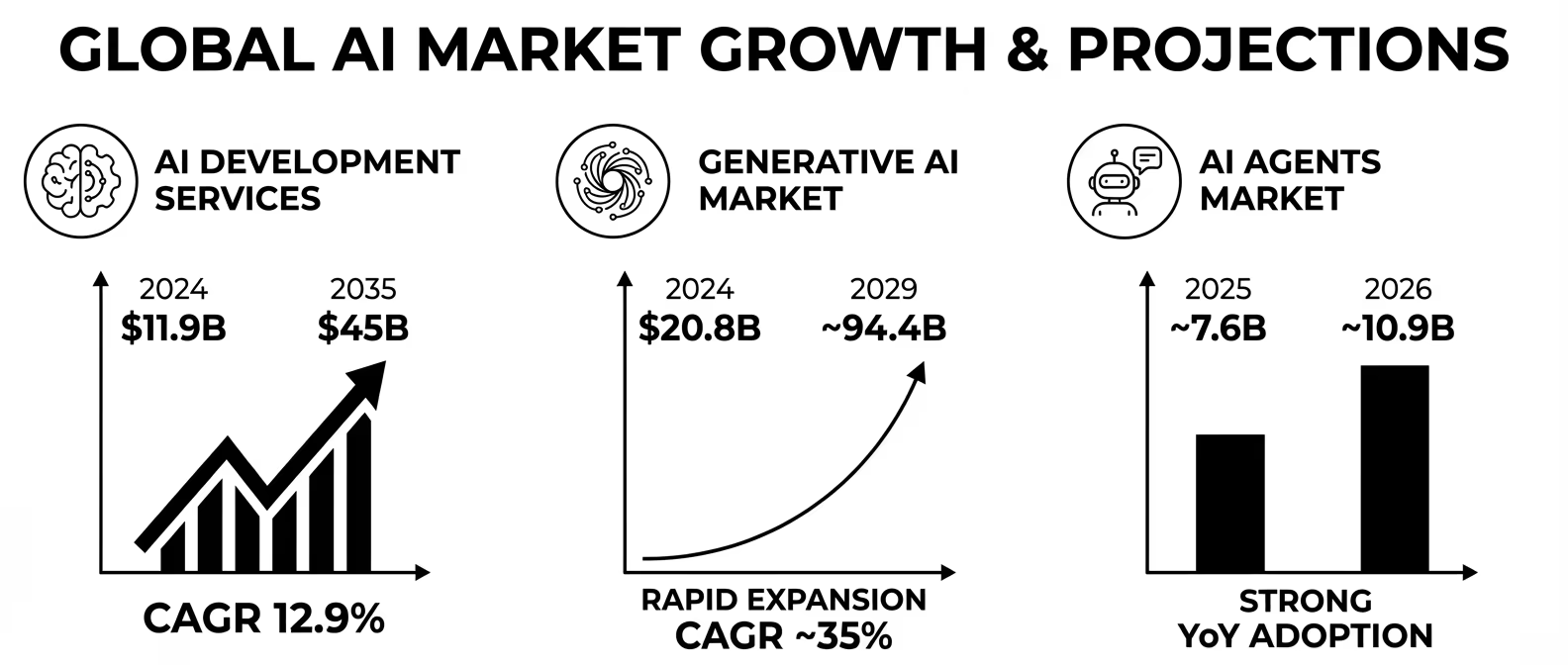
The global generative AI market is experiencing unprecedented growth, highlighting the increasing adoption of AI-powered solutions across industries. According to Gradview Research, it was valued at USD 22.2 billion in 2025. The market is expected to grow from USD 29.6 billion in 2026 to USD 324.7 billion by 2033, registering a remarkable CAGR of 40.8% during the forecast period.
North America dominated the market, accounting for 40.8% of the global revenue share, driven by rapid AI adoption, strong technology infrastructure, and significant investments from leading technology companies.
This rapid expansion is fueled by the growing demand for generative AI capabilities such as text generation, text-to-image creation, text-to-video generation, code generation, and super-resolution technologies.
Organizations across healthcare, finance, retail, manufacturing, education, and entertainment are increasingly leveraging generative AI to automate workflows, improve productivity, enhance customer experiences, and accelerate innovation.
As AI models continue to evolve, generative AI is expected to become a core component of enterprise digital transformation strategies worldwide.
What Are Generative AI Models?
A Generative AI Model is a type of Artificial Intelligence that learns patterns from existing data and then uses those patterns to create something new. It does not copy old data. It generates fresh, original output every time.
Think of it like a very smart student. The student reads hundreds of books. Later, when you ask them to write an essay, they do not copy from any book. Instead, they use what they learned to write something brand new.
Generative AI Models work the same way. They learn from:
- Text: Books, articles, websites, social media posts
- Images: Photographs, illustrations, paintings
- Audio: Music, speech, sound effects
- Code: Programming files and software
- Video: Movies, tutorials, clips
After learning from all this data, a GenAI Model can generate new text, images, audio, code, or video when you give it a prompt or instruction.
Popular examples of Generative AI Models include ChatGPT (text), DALL-E (images), Suno (music), GitHub Copilot (code), and Google Gemini (multimodal).
How Do Generative AI Models Work?
Every Generative AI Model follows a basic learning process. Below is mentioned how it works:
- Collect Data: The model gathers a massive amount of data, text, images, audio, or video.
- Train the Model: The model studies this data repeatedly. It learns the patterns, rules, and structures hidden in the data.
- Build Internal Knowledge: The model stores what it learned inside millions (or billions) of parameters, like tiny switches that store knowledge.
- Receive a Prompt: When you give it a question or instruction, the model uses its stored knowledge.
- Generate Output: The model creates a new, unique response, text, image, code, or audio, based on what it learned.
The model predicts what word, pixel, or sound should come next, and it does this millions of times per second to build a full, coherent output.
Types of Generative AI Models
There are many different types of generative AI models. Each one works differently and is better at specific tasks. Below is a full overview:
| Model Type | What It Does | Best Used For | Key Risk |
| GAN | Two networks compete to create realistic content | Images, videos, synthetic data | Deepfakes, data leaks |
| VAE | Compresses and rebuilds data to generate new samples | Image generation, anomaly detection | Sensitive pattern exposure |
| Transformer / LLM | Reads all text at once to understand context deeply | Chatbots, code, writing | Hallucinations, data leakage |
| Diffusion Model | Adds and removes noise to generate high-quality images | Art, image editing, design | Copyright issues, misuse |
| Autoregressive Model | Predicts next word/pixel one at a time | Text, audio generation | Bias, misinformation |
| Multimodal Model | Handles text, images, audio together | AI assistants, video understanding | Privacy, misuse across modalities |
Each model type in detail:
1. Generative Adversarial Networks (GANs)
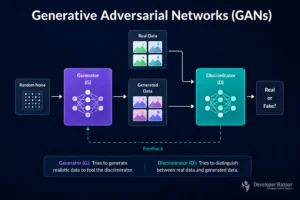
A GAN uses two neural networks that work against each other, like two players in a game.
- Generator: Creates fake content (like a fake image)
- Discriminator: Tries to tell if the content is real or fake
The Generator keeps improving until the Discriminator no longer tell the fake from the real. The result is very realistic content.
Best used for: Creating photorealistic images, generating synthetic training data, video generation, and face synthesis.
Real-world example: StyleGAN (creates hyper-realistic human faces that do not exist in real life).
2. Variational Autoencoders (VAEs)
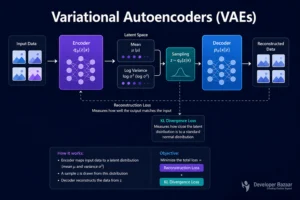
A VAE works like a zip file for data. It first compresses input data into a short code. Then it uses that code to recreate (or generate new versions of) the original data.
Best used for: Anomaly detection, image generation, drug discovery, and data compression.
Real-world example: VAEs are used in healthcare to generate synthetic patient data for medical research without risking real patient privacy.
3. Transformer Models and Large Language Models (LLMs)
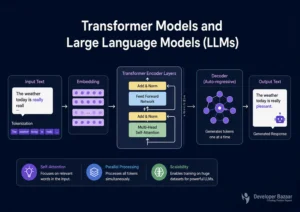
Transformer models read and understand entire sentences or documents all at once. This helps them understand context much better than older AI models.
Large Language Models (LLMs) are the biggest and most powerful transformer models. They are trained on billions of words from the internet, books, and code.
Best used for: Writing articles, answering questions, summarizing documents, writing code, and powering chatbots.
Real-world examples: ChatGPT (OpenAI), Claude (Anthropic), Gemini (Google), LLaMA (Meta).
4. Diffusion Models
A Diffusion Model works by first adding random noise (like static on a TV) to an image until it becomes pure noise. Then it learns to reverse that process, removing noise step by step to create a clear, beautiful image.
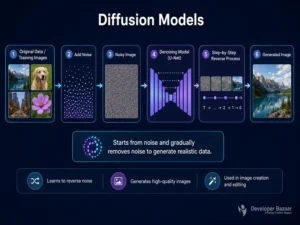
Best used for: High-quality image generation, photo editing, art creation, and video synthesis.
Real-world examples: Stable Diffusion, DALL-E 3, Midjourney, Adobe Firefly.
5. Autoregressive Models
An Autoregressive Model generates content one piece at a time. For text, it predicts the next word based on all the words that came before it. For images, it predicts the next pixel.
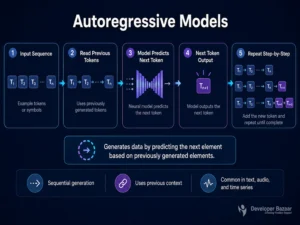
Best used for: Text generation, audio synthesis (like speech and music), and sequential data tasks.
Real-world examples: GPT series (text generation), WaveNet (speech synthesis by Google DeepMind).
6. Multimodal Generative AI Models
A Multimodal Generative AI Model can handle more than one type of data at the same time. It can read text, look at images, and listen to audio, all together.
For example, you can show a photo and ask a question about it in text. The model understands both the image and your text to give you a combined answer.
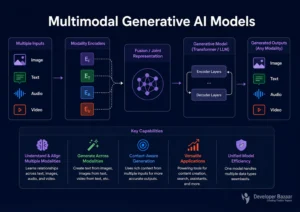
Best used for: AI assistants, video understanding, image captioning, complex question-answering, healthcare imaging, and education tools.
Real-world examples: GPT-4o (OpenAI), Gemini 1.5 Pro (Google), Claude 3 Opus (Anthropic).
Multimodal AI is the next big step in AI evolution. Instead of using separate tools for text, images, and audio, one multimodal model can do all of it. This makes AI assistants smarter, faster, and more useful for real-world tasks.
In 2026, most top-tier GenAI Models are multimodal, including ChatGPT, Gemini, and Claude.
What is the Difference Between Generative AI vs Large Language Models?
Many people use the terms Generative AI and Large Language Models (LLMs) as if they mean the same thing. But they are not the same. Here is the difference:
Generative AI is the broad category. It includes all AI models that can generate new content, text, images, audio, video, and code. Large Language Models (LLMs) are specific type of Generative AI. They focus only on text. They read and generate text using the Transformer architecture.
Think of it this way: All LLMs are Generative AI Models, but not all Generative AI Models are LLMs.
Generative AI vs Traditional AI: A Complete Comparison
Traditional AI is great at recognizing patterns and making decisions. But it cannot create new content. Generative AI changes that entirely.
Here is a comparison:
| Feature | Generative AI | Traditional AI |
| Main Goal | Create new content (text, images, audio) | Analyze and predict from existing data |
| Output Type | New data (never seen before) | Labels, scores, or decisions |
| Examples | ChatGPT, DALL-E, Gemini | Spam filters, recommendation engines |
| Training Data | Huge, diverse datasets | Labeled, structured datasets |
| Creativity | Yes, it creates new things | No, it only classifies or predicts |
| Use Case | Writing, design, coding, music | Fraud detection, image classification |
| Flexibility | Very flexible, handles many tasks | Designed for one specific task |
Traditional AI answers: ‘Is this email spam or not spam?’
Generative AI answers: ‘Write me a professional email reply for this message.’
Traditional AI classifies. Generative AI creates. Both are important, and many modern AI systems use both together.
Risks of Generative AI Models
Generative AI is powerful, but it also comes with real risks that businesses and users must understand and manage.
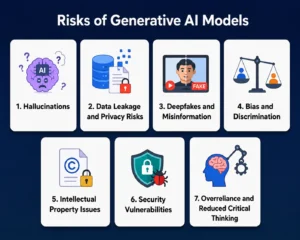
1. Hallucinations
A GenAI Model can sometimes generate information that sounds completely true but is actually wrong. This is called a ‘hallucination’. For example, an LLM might give you a fake court case or a non-existent study as a reference.
Why it happens: The model predicts what sounds right, not what is factually correct.
2. Data Leakage and Privacy Risks
When a model is trained on private or sensitive data, it might accidentally reveal that data in its outputs. This is a serious risk for companies using LLMs trained on internal business data.
3. Deepfakes and Misinformation
GANs and Diffusion Models can create hyper-realistic fake images, audio, and video. These deepfakes can be used to spread false information, impersonate people, or manipulate public opinion.
4. Bias and Discrimination
If a model learns from biased data, it will produce biased outputs. For example, an AI trained mainly on English text may perform poorly for people who speak other languages. Or it might show unfair preferences in hiring tools or medical recommendations.
5. Intellectual Property Issues
Generative AI Models learn from data that includes copyrighted content, books, songs, images, and code. This raises legal questions: Who owns the AI-generated output? Can a company use it commercially?
6. Security Vulnerabilities
Bad actors can misuse Generative AI to generate malware code, phishing emails, or social engineering scripts at scale. This makes cybersecurity threats faster and cheaper to produce.
7. Overreliance and Reduced Critical Thinking
When people rely too heavily on AI-generated content without checking it, quality and accuracy suffer. This is a risk in education, journalism, and healthcare.
How to Evaluate a Generative AI Model
Not all Generative AI Models are equal. Before you use or deploy a GenAI Model, you need to evaluate it carefully.
Here are the most important evaluation methods:
| Metric / Method | What It Checks | Used For |
| FID Score | How real the generated images look | Image models (GANs, Diffusion) |
| BLEU Score | How close the generated text is to a reference | Text generation, translation |
| Perplexity | How well the model predicts the next word | Language models (LLMs) |
| Human Evaluation | Real humans rate quality, safety, and usefulness | All model types |
| Red Teaming | Experts try to break or trick the model | Safety testing |
| Bias Audits | Checks if the model treats all groups fairly | All models, especially LLMs |
| Truthfulness Benchmarks | Tests if answers are factually correct | LLMs, chatbots |
| Robustness Testing | Checks how the model handles tricky or unusual inputs | All model types |
Evaluation Best Practices
- Always test with diverse, real-world inputs, not just perfect examples
- Check outputs for accuracy, bias, and safety before deployment
- Use automated metrics and human evaluation combination
- Run regular re-evaluations as the model updates or fine-tunes
- Test for adversarial inputs, tricky prompts that try to break the model
Generative AI Integration Services and Development Services
Building or integrating a Generative AI Model into your business requires deep technical expertise, the right infrastructure, and a solid strategy. This is where professional Generative AI Integration Services come in.
What Are Generative AI Integration Services?
Generative AI Integration Services help businesses connect existing GenAI Models (like GPT-4, Claude, or Gemini) into their own products and workflows. Instead of building a model from scratch, companies use APIs and pre-built models and integrate them into their systems.
Examples of what integration services include:
- Connecting an LLM to a customer support system to power an AI chatbot
- Integrating an image generation model into an e-commerce platform for product visuals
- Adding a code generation model to a developer tool or IDE
- Embedding a document summarization AI into an internal knowledge management system
What Are Generative AI Development Services?
Generative AI Development Services go further. These services help companies build custom Generative AI Models from the ground up, or fine-tune existing models on specific business data.
Examples of development services include:
- Fine-tuning an LLM on a company’s own data to create a domain-specific AI assistant
- Building a custom image generation model for a creative agency
- Developing a Retrieval-Augmented Generation (RAG) pipeline for accurate, data-grounded answers
- Creating a multimodal AI system that handles both text and image inputs for a healthcare provider
Any business that wants to go beyond generic AI tools and build a competitive advantage through AI customized for their own products, data, or industry needs Generative AI Development Services. Common sectors include healthcare, finance, legal, e-commerce, and software development.
In 2026, most top-tier GenAI Models are multimodal, including ChatGPT, Gemini, and Claude.
Top Real-World Applications of Generative AI Models
Generative AI Models are already changing how businesses operate across many industries:
- Healthcare – Generating synthetic patient data for research, supporting radiology imaging analysis, and drafting clinical documentation.
- Finance – Creating fraud detection reports, generating financial summaries, and building AI-powered trading assistants.
- E-commerce – Writing product descriptions, generating product images, and building personalized recommendation systems.
- Education – Creating personalized learning content, generating quiz questions, and building AI tutors
- Legal – Drafting legal documents, summarizing case files, and reviewing contracts.
- Software Development – Generating code, debugging errors, writing technical documentation, and building AI coding assistants:
- Marketing & Content – Writing blog posts, ad copy, social media content, and email campaigns at large scale.
Conclusion
Generative AI Models are changing the world. They can write, draw, code, compose music, and even understand images and audio, sometimes better than humans. From GANs to LLMs to Multimodal Generative AI Models, each type has its own strengths, use cases, and risks.
The key is to understand these models deeply. Evaluating GenAI Models properly, managing their risks, and using them responsibly is what separates smart AI adoption from reckless experimentation.
Whether you are looking for Generative AI Integration Services to add AI to an existing product or full Generative AI Development Services to build something custom, the opportunities are enormous if you approach them with the right knowledge. The future belongs to businesses that understand AI deeply. And now, you do.
FAQs
1. How do businesses choose between using a foundation model and fine-tuning one?
If your use case involves general tasks like content generation or customer support, a foundation model accessed through APIs is often sufficient. Fine-tuning becomes valuable when the AI must understand industry-specific terminology, internal processes, or proprietary knowledge, such as in healthcare, legal, or financial services.
2. Can Generative AI Models be deployed securely on private infrastructure?
Yes. Many organizations deploy open-source or enterprise AI models in private cloud or on-premises environments to keep sensitive business data within their own infrastructure. This approach is common in regulated industries where data privacy and compliance are critical.
3. What factors should businesses consider before selecting a Generative AI model?
Beyond accuracy, organizations should evaluate inference speed, scalability, deployment costs, licensing terms, multilingual capabilities, integration options, and compliance requirements. The right model depends on business goals rather than benchmark scores alone.
4. How often should a Generative AI Model be retrained or updated?
The update frequency depends on the application. Industries with rapidly changing information, such as finance, cybersecurity, or legal services, may require frequent model updates or Retrieval-Augmented Generation (RAG) systems to ensure responses remain accurate and relevant.
5. What is the difference between prompt engineering and fine-tuning?
Prompt engineering improves outputs by designing better instructions without changing the model itself. Fine-tuning modifies the model using additional training data so it consistently performs well for specialized tasks or industry-specific workflows.
6. How can businesses measure the ROI of Generative AI implementation?
Key performance indicators include reduced operational costs, faster content creation, improved customer response times, higher employee productivity, increased automation rates, and measurable improvements in customer satisfaction or revenue generation after deployment.