

Projects Completed
Happy Clients
Delivery Rate
Communication
Apps Downloads
Years of Growth
 By
Developer Bazaar Technologies
By
Developer Bazaar Technologies
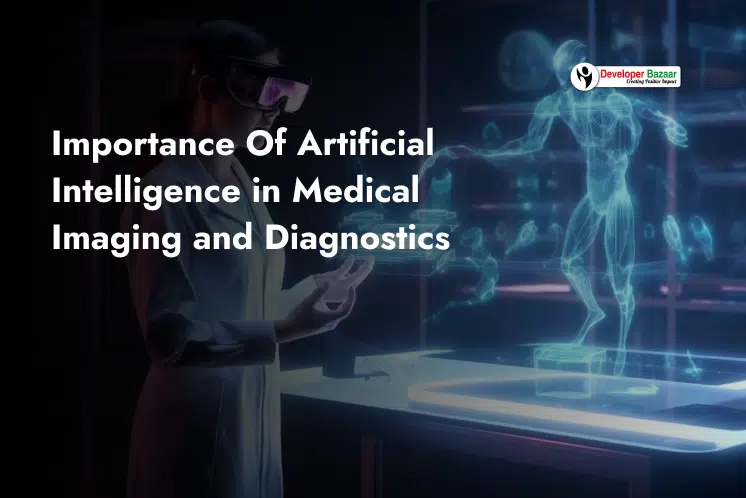
Artificial Intelligence (AI) is changing the way we look and perform in the healthcare industry. One of the most exciting areas is Artificial Intelligence in Medical Imaging. AI helps doctors find diseases early, look at medical images quickly, and make better decisions. It acts like a smart helper that reads X-rays, MRIs, and CT scans faster than humans.
AI can spot things that the human eye may miss, helping doctors give better treatment to patients. This guide explains how AI works in medical imaging, why it is important, the current market growth, and how you can use it to improve healthcare services.
Artificial Intelligence in healthcare means using smart computer systems that can think and learn like humans. These systems can look at medical data, understand it, and help doctors make decisions. Artificial Intelligence in Medical Imaging helps in many areas like image analysis, patient records, and even talking to patients using AI powered chatbots.
By adding AI to healthcare, doctors can work faster, reduce mistakes, and give better care to patients. That’s why many hospitals and clinics are now choosing AI-powered tools.
Artificial InteIligence in Medical Imaging is like having a super-smart assistant that looks at pictures of the inside of your body and tells the doctor what’s wrong. These pictures can come from X-rays, CT scans, or MRIs. AI tools can check them quickly and give important details.
When you use Artificial Intelligence for medical diagnostics, it improves the chances of finding and treating health problems early. It also helps doctors feel more confident in their decisions.
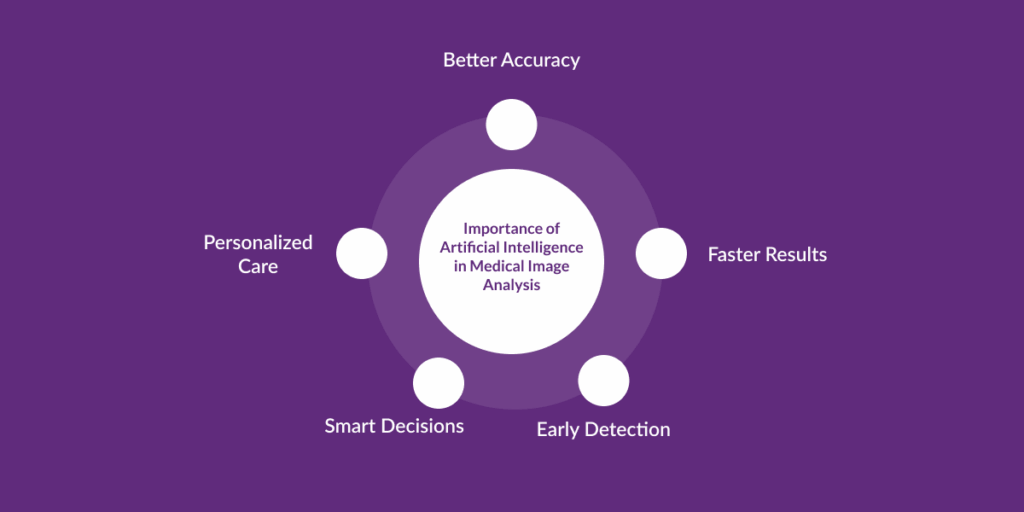
The role of Artificial Intelligence in Medical Image Analysis is more important than ever. Here is the reason why so:
AI systems don’t get tired or distracted. They always look at images the same way. This helps doctors avoid missing problems.
AI can check thousands of images in seconds. This helps hospitals treat patients faster, especially in emergencies.
AI can spot diseases like cancer in a very early stage before they get worse. Early treatment means better recovery for patients.
AI doesn’t just look at one image. It can combine scan results with patient records, lab reports, and even genetic info. That means doctors get a full picture of what’s happening inside the body.
With all this information, AI helps doctors create treatment plans that are made just for one patient. That’s called precision medicine.
AI is not here to replace doctors but it’s here to help them do their jobs better.
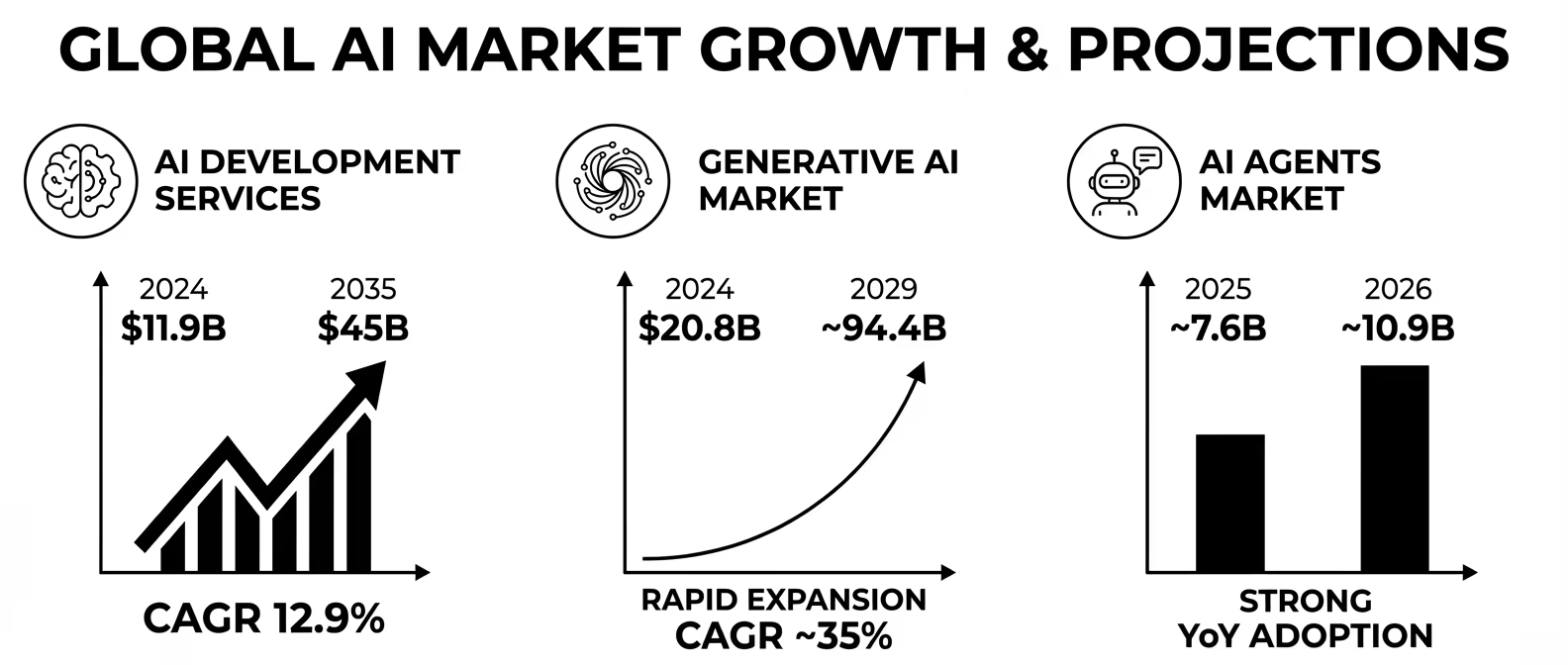
The future of Artificial Intelligence in Medical Imaging looks bright and expanding rapidly. Below are the current stats mentioned according to GlobeNewsWire:
Global Growth:
These numbers show that hospitals, clinics, and healthcare companies are investing heavily in AI technology.
Medical Imaging Market:
What This Means:
As the demand for medical imaging grows, the need for Artificial Intelligence in Medical Image analysis will also grow. Hospitals required tools that make image reading faster and more accurate.
AI App Development Companies are already working on AI-powered tools for clinics, labs, and hospitals. If you’re planning to invest or build your own solution, now is the perfect time.
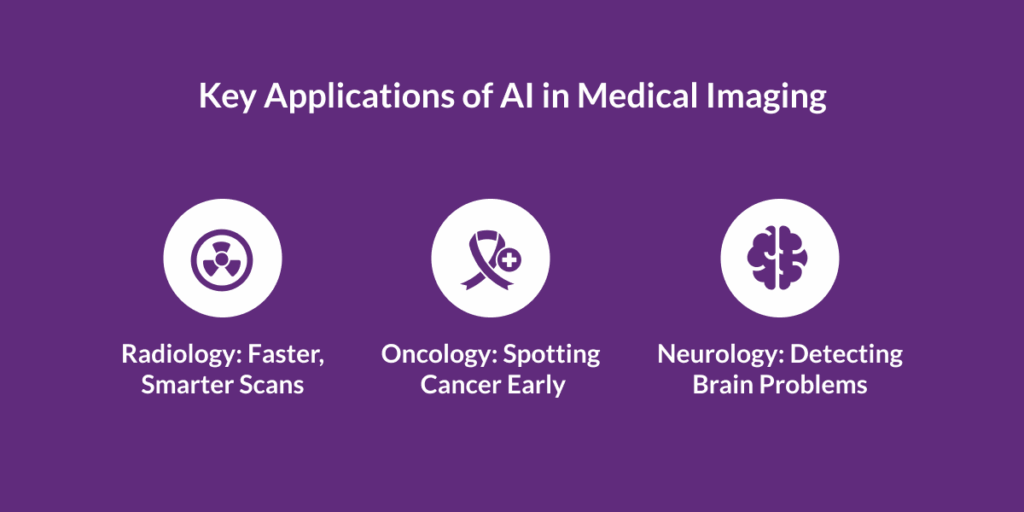
Artificial Intelligence in medical imaging is changing the way doctors detect and treat diseases. Today, AI is used in radiology, oncology, and neurology to help doctors analyze images quickly and accurately. These smart systems can spot things that even experienced eyes might miss.
Radiologists use imaging tests like X-rays, MRIs, and CT scans to look inside the body. AI in medical imaging helps by detecting issues like lung nodules or brain injuries faster and with more precision.
For example, in chest CT scans, AI can find small lung nodules that may lead to cancer. This helps catch problems early, when they are easier to treat.
In cancer care, AI in medical imaging is helping doctors detect tumors early. One of the biggest wins is in breast cancer screening. Using deep learning, a type of AI, computers can look at mammograms and tell if a lump is harmless or harmful.
With over 5 million mammograms from around the world being studied, this technology is saving lives by catching cancer early.
AI helps doctors read brain scans to find early signs of stroke, Alzheimer’s, or brain tumors. AI in medical image analysis can spot tiny changes in the brain that a human might miss.
For example, diffusion-weighted imaging (DWI) helps spot strokes early, and AI models using this method have shown over 94% accuracy.
AI in medical imaging helps in doing things faster and accurately. It also makes diagnoses more consistent.
Doctors and radiologists are smart, but they’re human, and humans can make mistakes. Fatigue or stress can affect decision-making. AI never gets tired. It gives the same answer every time.
For example, in detecting pneumonia on chest X-rays, AI can match or even beat human doctors in accuracy.
Finding diseases early makes them easier to treat. AI is great at this. Take diabetic retinopathy, an eye disease that can cause blindness. AI can find signs of this disease before a patient notices any symptoms. That means faster treatment and better chances of recovery.
In breast cancer screening, AI helps reduce missed diagnoses and false alarms. AI tools have been shown to catch signs of cancer that doctors didn’t find easily. This makes tests more trustworthy and reduces the number of unnecessary procedures.
AI in medical image analysis is helping move healthcare toward precision medicine where treatments are tailored to each patient based on accurate data.
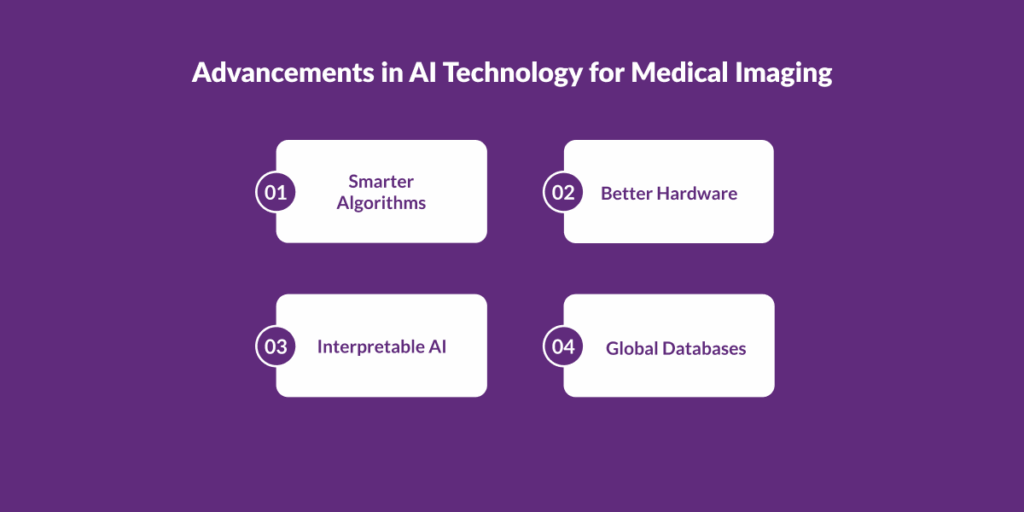
AI in medical imaging is growing fast. With better software, smarter algorithms, and stronger hardware, the tools keep getting better.
In the early 2010s, basic machine learning was used. Now, we have deep learning and AI large language models that can read and understand complex medical images. These algorithms can learn from huge image databases and become better over time.
AI tools need fast processors to work quickly. For this high-performance GPUs and AI processors are required and plays an important role. These allow real-time analysis of scans, helping doctors get results quickly even during an emergency.
The future of AI in medical imaging isn’t only for better results but it also builds trust. New models are being designed to explain how they reach their conclusions. This helps doctors understand and trust the technology.
Thanks to cloud-based platforms, AI systems can learn from global datasets like 5 million mammograms from 5 continents. This helps make AI tools more accurate and less biased.
If you’re planning to build an AI system for medical diagnostics, working with an experienced AI app development company can help you bring the latest technology to your hospital or clinic.
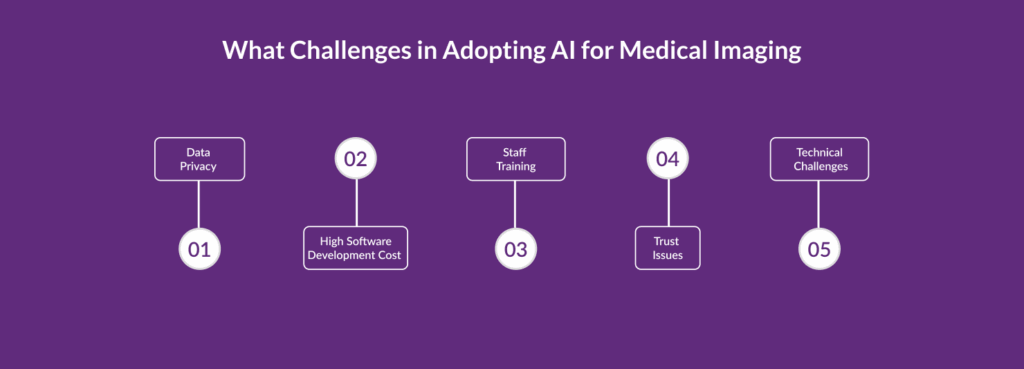
Even though AI in medical imaging is powerful, there are a few obstacles in the path to adapt these advanced technologies.
To work well, AI needs a lot of patient images. But this raises privacy concerns. Hospitals must follow strict rules like HIPAA (in the U.S.) to keep patient data safe. A software development company must build strong security systems to protect sensitive health data.
Buying AI software and upgrading equipment can be expensive. The software development cost includes not only building the AI but also training staff and maintaining hardware. Smaller clinics may find this hard. Partnering with a reliable healthcare app development company can help make the transition smoother and more affordable.
Doctors and technicians need to learn how to use AI tools. That means training sessions and workshops. If people don’t know how to use the tools, the AI won’t be helpful.
Some doctors worry about AI making mistakes, or even replacing them. It’s important to explain that AI supports, not replaces, medical professionals. Transparency helps build trust.
Integrating AI with existing hospital software can be tricky. The systems must talk to each other smoothly. Also, AI tools must be tested on different types of data to make sure they work for everyone.
To fix these problems, hospitals should work with experts who provide artificial intelligence development services and know the ins and outs of the software development process.
Medical imaging is a key part of healthcare. It helps doctors see inside the body without surgery. Common imaging tools include:
Now, Artificial Intelligence (AI) is being added to these traditional tools and the results are amazing.
When we combine AI with medical imaging, we get faster, smarter, and more accurate results. Think of it like a super team. The machines take pictures (MRI, CT, etc.), and AI quickly looks at those images to find signs of illness.
This is called Artificial Intelligence in Medical Imaging. It’s already helping doctors detect things like tumors, brain problems, and even heart diseases faster than before.
MRI scans are usually slow and take time. But AI helps in reducing the time needed.
A study in the Journal of Magnetic Resonance Imaging found that AI can reduce MRI scan time without making the image blurry. This helps patients spend less time in machines and allows hospitals to serve more people.
AI is also great at finding small problems in images that the human eye might get missed to detect.
For example:
AI in Medical Imaging is called a game-changer, it helps doctors see more, spot faster, and treat better.
Some people worry that AI will take over jobs. But in reality, AI works with doctors, not against them.
This teamwork means fewer mistakes and better care for patients.
Artificial Intelligence in Medical Imaging is an advanced technology that takes a big step in making healthcare faster, better, and more personal.
With the help of AI doctors now work smartly and faster with accuracy. It helps plan treatments that fit each patient perfectly.
This powerful tool is saving time, reducing errors, and even saving lives. But this is just the beginning. As hospitals and clinics start using AI more, the quality of care will only get better.
Whether you’re a patient, doctor, or someone building healthcare software, it is the right time to start and grow in this competitive market. AI in Medical Imaging is the future.
If you’re looking to develop AI healthcare tools, you can work with a trusted healthcare app development company to build something powerful, accurate, and useful.
A: AI in diagnostic imaging is used to quickly scan and analyze images like X-rays, MRIs, and CT scans. It finds patterns, spots early signs of diseases, and helps doctors make better decisions.
For example:
This makes diagnosis faster, more accurate, and safer for patients.
A: Artificial Intelligence for medical diagnostics helps doctors in many ways:
AI also works with lab tests, health records, and even voice recordings to give a full picture of the patient’s health. Doctors use this information to make better decisions, earlier than ever before.
There are many AI tools for medical imaging available today. Some of the popular ones include:
These tools use Artificial Intelligence in Medical Image analysis to support radiologists and improve patient outcomes.
If you want to create your own tool, you can contact an AI app development company to help you build it.
A: The future of AI in medical imaging looks very bright!
Here’s what we can expect:
Also, as the software development cost of AI tools goes down, more hospitals will be able to use them. AI will soon be in every hospital, helping to save lives with speed and accuracy.
A: Yes, AI is used in MRI. In fact, MRI is one of the areas where AI is helping the most. AI helps in:
This makes MRIs safer, faster, and more helpful. Hospitals are now using Artificial Intelligence in Medical Imaging tools to improve MRI quality and efficiency.
Co-Founder
Developer Bazaar technologies

Key Takeaways: The cost to develop an AI app typically ranges from $10,000 to $500,000+, depending on app complexity, AI features, integrations, security requirements, and the development team. Choosing pre-trained AI models instead of building custom...
Key Takeaways: The cost to develop an AI app typically ranges from $10,000 to $500,000+, depending on app complexity, AI features, integrations, security requirements, ...
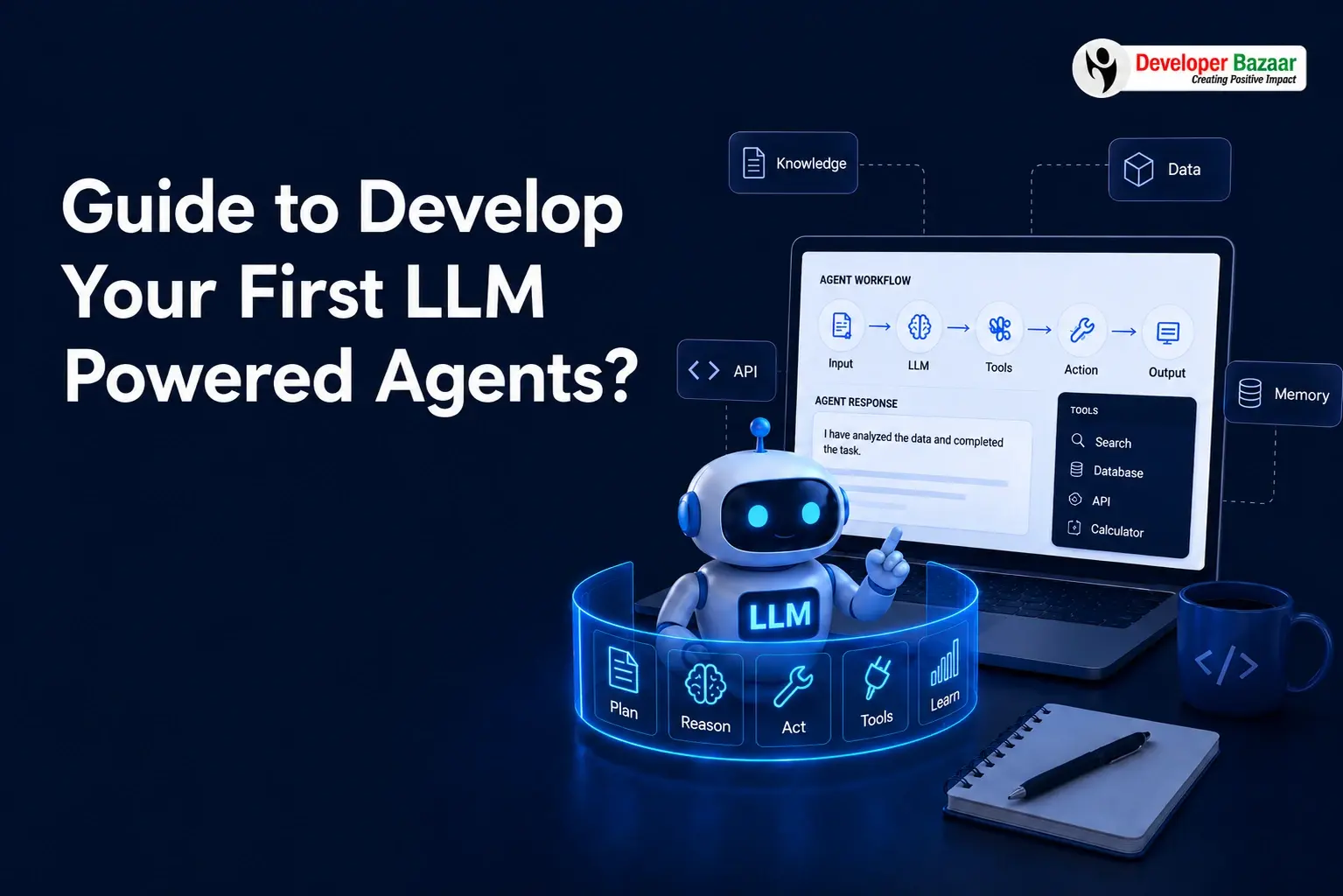
Key Takeaways: Building an LLM agent is easier when you start with one well-defined task instead of trying to automate everything at once. Most businesses can build powerful AI agents using pre-trained LLMs without training a...
Key Takeaways: Building an LLM agent is easier when you start with one well-defined task instead of trying to automate everything at once. Most ...
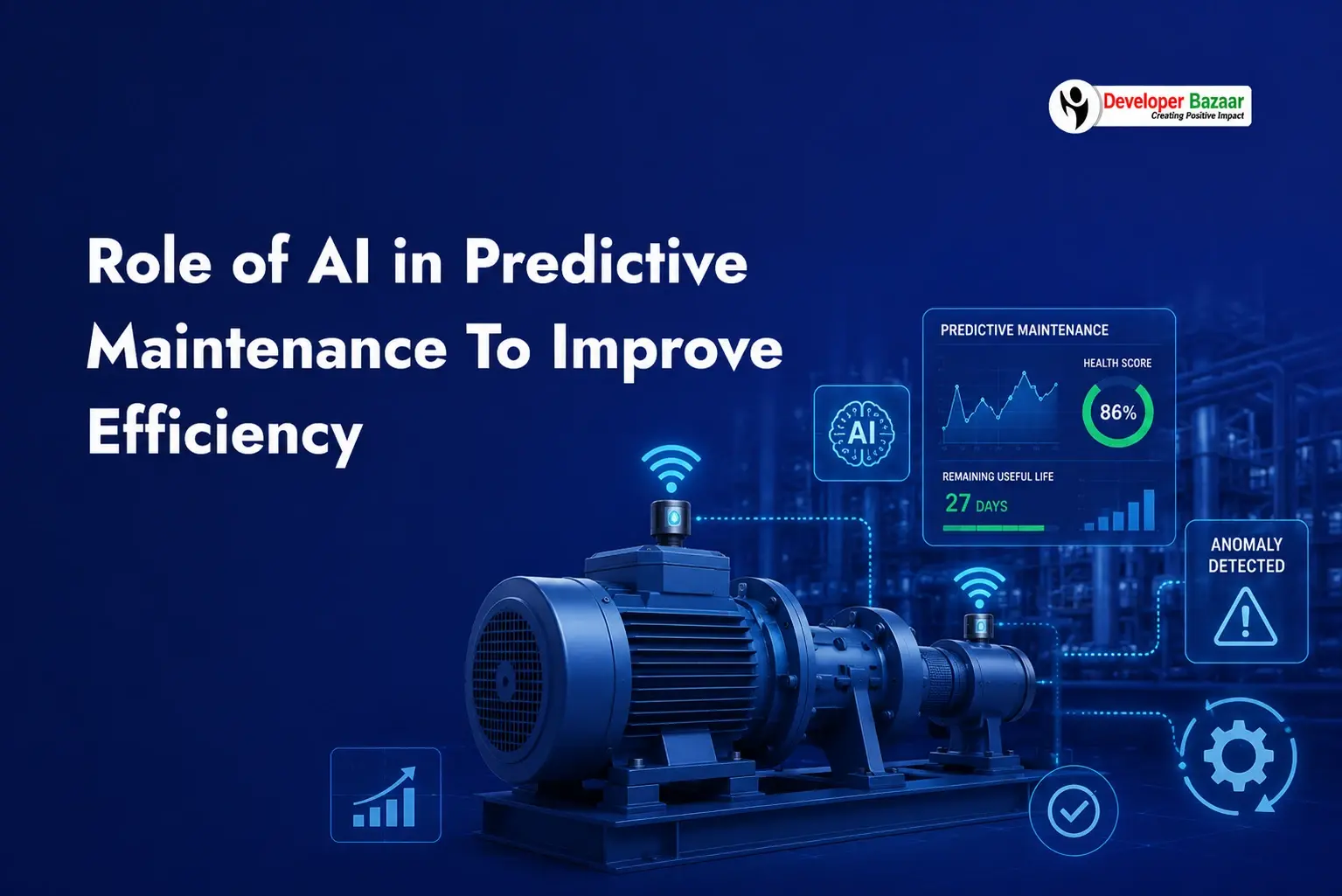
Key Takeaways: AI predictive maintenance prevents equipment failures before they happen by analyzing real-time sensor data and identifying early warning signs. Predictive maintenance with AI is more efficient than reactive or preventive maintenance, helping businesses reduce...
Key Takeaways: AI predictive maintenance prevents equipment failures before they happen by analyzing real-time sensor data and identifying early warning signs. Predictive maintenance with ...
Key Takeaways: AI software delivers long-term business value by improving decision-making, automation, customer experiences, and operational efficiency. Successful AI projects require more than coding, they depend on quality data, the right AI model, seamless integration, and...
Key Takeaways: AI software delivers long-term business value by improving decision-making, automation, customer experiences, and operational efficiency. Successful AI projects require more than coding, ...
Key Takeaways: AI agents go beyond traditional automation by reasoning, planning, and executing multi-step healthcare workflows with minimal human intervention. Agentic AI delivers value across the healthcare ecosystem, from clinical documentation and medical imaging to patient...
Key Takeaways: AI agents go beyond traditional automation by reasoning, planning, and executing multi-step healthcare workflows with minimal human intervention. Agentic AI delivers value ...
Key Takeaways: AI integration helps mobile apps deliver personalized experiences, automate repetitive tasks, improve customer support, and strengthen security. Businesses can start with pre-built AI APIs like OpenAI, Google AI, or AWS AI, making AI adoption...
Key Takeaways: AI integration helps mobile apps deliver personalized experiences, automate repetitive tasks, improve customer support, and strengthen security. Businesses can start with pre-built ...
Key Takeaways: Generative AI Models create original text, images, code, audio, and video by learning patterns from massive datasets rather than copying existing content. Different model architectures, including GANs, VAEs, Transformers, Diffusion Models, Autoregressive Models, and...
Key Takeaways: Generative AI Models create original text, images, code, audio, and video by learning patterns from massive datasets rather than copying existing content. ...
Is your business still depending on old software systems that slow down growth and innovation? Many companies struggle with outdated applications that are costly, hard to maintain, and unable to meet modern customer expectations. The growing...
Is your business still depending on old software systems that slow down growth and innovation? Many companies struggle with outdated applications that are costly, ...
Businesses today collect huge amounts of data every second. Finding unusual activities or errors in this massive data is difficult for humans. This is where AI Anomaly Detection becomes helpful. AI-powered systems can quickly scan data,...
Businesses today collect huge amounts of data every second. Finding unusual activities or errors in this massive data is difficult for humans. This is ...
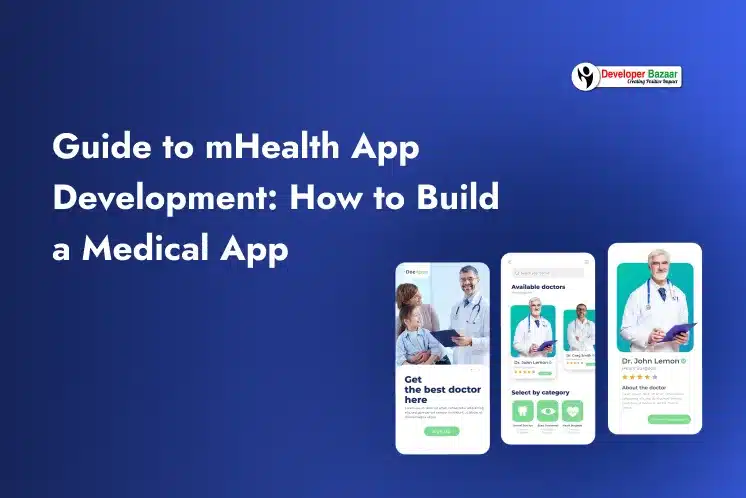
Healthcare is becoming more digital every year. Hospitals, clinics, startups, and healthcare companies are now using mobile apps to offer better medical services. These custom mHealth app developments help patients connect with doctors, track their health,...
Healthcare is becoming more digital every year. Hospitals, clinics, startups, and healthcare companies are now using mobile apps to offer better medical services. These ...
Complete the form below and validate your idea now.
✔ Your idea is 100% protected by our Non Disclosure Agreement.
