


Quick Answer: How to Build a Stock Trading App?
To build a stock trading app, you need to plan your app’s features, choose the right tech stack, get the proper licenses (like SEBI/SEC registration), integrate real-time market data and payment gateways, build a secure trading engine, and partner with an experienced mobile app development company. The full stock trading app development cost usually ranges between $20,000 and $150,000+, depending on features and complexity.
Now, understand this process step by step, so even someone new to this topic can understand it easily.
What Is a Stock Trading App?
A stock trading app is a mobile application that lets people buy and sell shares, stocks, mutual funds, and other financial products using their smartphone. Apps like Zerodha, Robinhood, and Groww are popular examples.
People use these apps because they are fast, easy to use, and let you trade from anywhere, no need to call a broker or visit an office.
If you’re planning to build a stock trading app, you’re entering a market that is growing every year. More people now want to invest money from their phones, which makes this a great business opportunity.
Why Businesses Want to Develop a Stock Trading App
The stock trading and investing app market is growing rapidly, from $63.62 billion in 2025 to $76.59 billion in 2026, and is expected to reach $150.82 billion by 2030. This growth is driven by rising retail investor participation, smartphone adoption, AI-powered investment tools, and demand for real-time market insights.
Here’s why businesses are investing in stock trading app development:
- Growing investor demand – More people are looking for simple and accessible ways to invest.
- Recurring revenue opportunities – Apps generate income through brokerage fees, subscriptions, and premium features.
- Mobile-first investing – Widespread smartphone usage makes investing more convenient than ever.
- Rising trust in digital finance – Users are increasingly comfortable managing investments online.
- AI-driven experiences – Advanced analytics and AI insights help improve trading decisions.
With strong market growth and increasing digital adoption, now is an ideal time to build a stock trading app.
Step-by-Step Process to Build a Stock Trading App
While developing any app, you need to follow a step-by-step process to make the task simpler. If you understand and implement the below-mentioned process of stock trading app development, you can easily build your revenue-generating app.
Step 1: Research and Planning
Before writing even one line of code, you need to plan everything:
- Who is your target audience? (Beginners, experienced traders, or both?)
- Which markets will you cover? (Stocks, mutual funds, crypto, forex?)
- Which countries will you operate in? (This affects legal rules.)
- What makes your app different from Zerodha, Robinhood, or Groww?
This step is very important. Without proper planning, even the best trading platform development can fail.
Step 2: Get Legal Approvals and Licenses
A stock trading app deals with people’s money, so governments have strict rules.
- In India, you need approval from SEBI (Securities and Exchange Board of India).
- In the USA, you need registration with the SEC (Securities and Exchange Commission) and FINRA.
- You also need to follow KYC (Know Your Customer) and AML (Anti-Money Laundering) rules.
Skipping this step can get your app banned or shut down. Always work with a legal advisor along with your development team.
Step 3: Define Core Features
List the essential features your app will offer, such as user registration, market watchlists, portfolio management, real-time data, and trading functionality. Prioritize features based on user needs and business goals.
Step 4: Choose the Right Technology Stack
Select suitable technologies for frontend, backend, databases, APIs, and cloud infrastructure. The right tech stack ensures scalability, security, performance, and long-term maintainability of the platform.
Step 5: Design an Intuitive UI/UX
Create a clean, user-friendly interface that simplifies investing and trading. Focus on easy navigation, fast interactions, and a trustworthy design that builds user confidence and engagement.
Step 6: Develop the Application
Build the frontend, backend, and administrative systems while integrating trading APIs, payment gateways, and security mechanisms. Ensure smooth communication between all platform components.
Step 7: Test for Quality and Security
Conduct extensive testing to identify bugs, performance issues, and security vulnerabilities. Verify the accuracy of market data, transaction processing, and overall platform reliability before launch.
Step 8: Launch and Continuous Improvement
Deploy the app on relevant platforms and promote it through digital marketing channels. Continuously monitor performance, release updates, add new features, and adapt to changing market demands.
Must-Have Features for a Stock Trading App
If you want to develop a stock trading app that users love, here are the features you cannot skip:
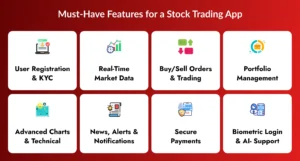
Below are 8 essential features, combining related points and removing Multi-Language Support as it’s important but not a core requirement for an MVP stock trading app.
1. User Registration & KYC Verification
A seamless onboarding process helps users sign up using email, phone number, or social accounts. Integrated KYC verification ensures compliance with financial regulations and helps prevent fraud.
2. Real-Time Market Data & Watchlists
Users expect live stock prices, market trends, and real-time updates. A personalized watchlist allows them to track preferred stocks and monitor market movements efficiently.
3. Buy/Sell Orders & Trading Execution
The app should enable users to place buy and sell orders quickly with minimal latency. Smooth order execution is critical for delivering a reliable trading experience.
4. Portfolio Management Dashboard
A comprehensive portfolio tracker helps users monitor investments, view holdings, analyze performance, and track profits or losses in real time.
5. Advanced Charts & Technical Analysis
Interactive charts and technical indicators allow users to analyze stock performance and make informed trading decisions based on market trends and historical data.
6. News, Alerts & Market Notifications
Real-time news feeds, price alerts, and personalized notifications keep users informed about market developments and investment opportunities.
7. Secure Payments & Account Management
Users should be able to securely deposit funds, withdraw earnings, and manage different investment accounts through a protected payment infrastructure.
8. Biometric Login & AI-Powered Support
Features like fingerprint or Face ID authentication enhance security, while AI chatbots and customer support systems provide quick assistance and improve user experience.
How AI Is Changing Stock Trading Apps
Artificial intelligence is transforming the way users invest, trade, and manage their portfolios. By integrating AI-powered capabilities, businesses can deliver smarter, more personalized, and data-driven trading experiences.
1. AI-Based Stock Recommendations
AI algorithms can analyze market trends, historical stock performance, user behavior, and risk tolerance to provide personalized investment suggestions. This helps investors discover opportunities that align with their financial goals and trading preferences.
2. Robo-Advisors
AI-powered robo-advisors automate investment planning by creating and managing portfolios based on a user’s objectives and risk profile. They offer cost-effective investment guidance while continuously rebalancing portfolios to optimize returns.
3. Fraud Detection and Risk Monitoring
AI can monitor account activities in real time to identify unusual transactions, suspicious login attempts, or potential security threats. This proactive approach of ai in fraud detection helps protect user funds and enhances trust in the platform.
4. AI Chatbots and Virtual Assistants
Intelligent chatbots provide instant support by answering common user queries, assisting with account-related tasks, and guiding users through trading processes. This improves customer satisfaction while reducing support costs.
5. Predictive Market Analysis
AI can process vast amounts of financial data, market news, and historical trends to identify patterns and generate predictive insights. While market outcomes can never be guaranteed, these insights help users make more informed investment decisions.
6. Personalized Trading Experience
AI can tailor dashboards, content, notifications, and investment suggestions based on individual user behavior and preferences. This creates a more engaging experience and helps improve user retention over time.
Integrating AI into stock trading app development is becoming a key differentiator for platforms looking to deliver smarter investment experiences and stay competitive in the evolving fintech market.
Best Tech Stack for Stock Trading App Development
Choosing the right technology stack is essential for building a secure, scalable, and high-performance stock trading application.
| Technology Layer | Recommended Technologies | Purpose |
| Frontend (iOS) | Swift | Delivers a fast, secure, and native experience for iPhone and iPad users. |
| Frontend (Android) | Kotlin | Enables high-performance Android app development with modern features and reliability. |
| Cross-Platform Development | React Native, Flutter | Allows businesses to build apps for both iOS and Android using a single codebase, reducing development time and cost. |
| Backend Development | Node.js, Python (Django), Java (Spring Boot) | Handles business logic, user management, transactions, and API integrations. |
| Database | PostgreSQL, MongoDB, MySQL | Stores user information, trading records, portfolios, and transaction history securely. |
| Real-Time Market Data APIs | NSE APIs, BSE APIs, Alpha Vantage, Polygon, IEX Cloud | Provides live stock prices, market trends, trading data, and financial insights. |
| Cloud Infrastructure | AWS, Google Cloud Platform (GCP), Microsoft Azure | Ensures scalability, high availability, data backup, and reliable application performance. |
| Security & Authentication | SSL Encryption, Two-Factor Authentication (2FA), Biometric Login | Protects user accounts, financial transactions, and sensitive data from unauthorized access. |
| AI & Machine Learning | TensorFlow, PyTorch, Scikit-learn, Python AI Models | Powers stock recommendations, fraud detection, predictive analytics, and personalized user experiences. |
Your Mobile App Development Services provider should have experience with finance apps specifically, since regular apps and finance apps have very different security needs.
Cost to Build a Stock Trading App
This is probably the most common question – “What’s the stock trading app development cost?”
The honest answer is: it depends. But here’s a simple breakdown to give you an idea.
Factors That Affect Cost
- App complexity – More features = higher cost
- Platform – iOS, Android, or both
- Design – Simple design vs. premium custom design
- Team location – Developers in different countries charge differently
- AI features – Adding AI increases development time and cost
- Third-party integrations – Payment gateways, stock data APIs, KYC services
Estimated Cost Range
| App Type | Estimated Cost |
| Basic app (limited features) | $20,000 – $40,000 |
| Mid-level app (standard features + AI basics) | $40,000 – $80,000 |
| Advanced app (full features + AI + multi-platform) | $80,000 – $150,000+ |
The cost to develop a stock investment app also includes ongoing costs like:
- Server hosting fees
- API subscription fees (for live market data)
- Maintenance and updates
- Customer support costs
So when planning your budget, don’t just think about the one-time development cost, think about long-term costs too.
How to Choose the Right Development Company
Since this app handles people’s money, choosing the right development partner is critical. Here’s what to look for:
1. Fintech Development Experience
Look for a company with proven experience in fintech, trading, or investment app development. Industry expertise helps ensure compliance, security, and a smoother development process.
2. Strong Portfolio and Technical Expertise
Review the company’s previous projects to assess their capabilities in building scalable and user-friendly financial applications. A strong portfolio demonstrates their ability to handle complex development requirements.
3. Security and Compliance Knowledge
Since trading apps handle sensitive financial data, your development partner should have expertise in encryption, secure APIs, authentication systems, and regulatory compliance standards.
4. AI and Advanced Technology Capabilities
If you plan to include features like stock recommendations, predictive analytics, or fraud detection, choose a company with hands-on experience in AI app development and intelligent automation solutions.
5. Post-Launch Support and Transparent Pricing
A reliable cross-platform development company provides ongoing maintenance, performance monitoring, and feature updates after launch. They should also offer clear pricing structures and detailed project estimates without hidden costs.
Best Trading Apps for Inspiration
Before starting your stock trading app development project, it’s worth analyzing some of the most successful trading platforms in the market. These apps have attracted millions of users through unique features, strong user experiences, and innovative business models.
1. Robinhood
One of the most popular stock trading apps globally, Robinhood helped popularize commission-free trading. Its simple interface and easy onboarding process have made investing more accessible to new users.
2. eToro
eToro stands out with its social trading features, allowing users to follow and copy the portfolios of experienced investors. This approach makes investing more approachable for beginners.
3. Cash App
Originally launched as a payment platform, Cash App expanded into stock trading by offering commission-free investing. Its success demonstrates the growing demand for financial “super apps” that combine multiple services in one platform.
4. Revolut
Revolut has evolved from a digital banking app into a comprehensive financial ecosystem. Its integrated stock trading capabilities show how investing can be seamlessly combined with banking and payments.
5. Webull
Known for its advanced charts, market analytics, and trading tools, Webull appeals to more active traders who want deeper market insights and a feature-rich trading experience.
6. Trade Republic
One of Europe’s fastest-growing investment platforms, Trade Republic focuses on low-cost investing, a streamlined user experience, and access to multiple asset classes within a single app.
7. Trading 212
Popular in the UK, Trading 212 offers commission-free investing alongside a user-friendly interface. Its success highlights the importance of balancing simplicity with powerful investment tools.
8. Freetrade
Freetrade has built a strong user base by providing accessible investing options and a modern mobile-first experience. Its growth demonstrates the demand for transparent and easy-to-use trading platforms.
By studying these successful stock trading apps, businesses can identify proven features, understand user expectations, and discover opportunities to create unique value in an increasingly competitive market.
Key Mistakes to Avoid in Stock Trading App Development
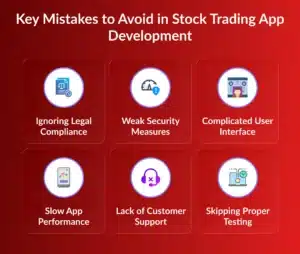
When you build a stock trading app, avoid these common mistakes: Ignoring legal compliance. This can get your app shut down completely.
1. Ignoring Legal Compliance
Failing to meet financial regulations and licensing requirements can lead to penalties, legal issues, or even the shutdown of your app.
2. Weak Security Measures
Stock trading apps handle sensitive financial data, so poor security can make your platform vulnerable to hacking, fraud, and data breaches.
3. Complicated User Interface
An overly complex design can confuse users and reduce engagement, making them more likely to switch to a simpler competitor app.
4. Slow App Performance
Since stock prices change in real time, delays or lag can frustrate users and negatively impact their trading experience.
5. Lack of Customer Support
Users need quick and reliable assistance, especially when dealing with transactions, account issues, or technical problems.
6. Skipping Proper Testing
Even minor bugs or technical errors can result in incorrect transactions, financial losses, and loss of user trust.
Final Thoughts
The stock trading industry continues to grow as more investors turn to mobile platforms for convenient and accessible investing. For businesses, this presents a significant opportunity to launch innovative trading solutions that meet evolving user expectations.
Success in stock trading app development depends on combining strong security, real-time market data, intuitive user experiences, and regulatory compliance with the latest technologies such as AI and advanced analytics. Building a platform that is reliable, scalable, and easy to use can help attract and retain users in a highly competitive market.
Whether you’re creating a trading app for retail investors, active traders, or wealth management services, partnering with an experienced Fintech app development company can help accelerate development, reduce risks, and ensure long-term success. With the right strategy and technology foundation, your stock trading app can become a trusted platform for modern investors.

FAQs
Q1. How long does it take to build a stock trading app?
The development timeline depends on the app’s complexity, features, integrations, and compliance requirements. A basic stock trading app can take around 4 – 6 months, while a feature-rich platform with AI capabilities, advanced analytics, and real-time trading functionality may require 6 – 9 months or longer.
Q2. Can I add cryptocurrency trading to my stock trading app?
Yes, many modern investment platforms offer both stock and cryptocurrency trading within a single application. However, integrating crypto trading requires additional security measures, exchange integrations, and compliance with cryptocurrency regulations in your target markets.
Q3. Do I need a license to launch a stock trading app?
Yes, stock trading applications must comply with financial regulations and licensing requirements specific to the countries they operate in. Depending on your region, approvals from regulatory authorities such as SEBI in India, the SEC in the United States, or similar organizations may be required.
Q4. Is AI necessary for a stock trading app?
AI is not mandatory, but it can significantly enhance the user experience and platform capabilities. Features such as personalized stock recommendations, fraud detection, predictive analytics, and AI-powered chatbots can help differentiate your app from competitors.
Q5. What is the minimum budget required to build a stock trading app?
The cost of stock trading app development varies based on features, technology stack, and third-party integrations. A basic MVP can start from around $20,000 – $30,000, while a fully featured trading platform with AI, advanced security, and real-time analytics may require an investment of $50,000 or more.