


Projects Completed
Happy Clients
Delivery Rate
Communication
Apps Downloads
Years of Growth
 By
Developer Bazaar Technologies
By
Developer Bazaar Technologies
AI in travel is changing the way the tourism industry works. With the help of smart technologies, travel companies are now able to offer faster, safer, and more personalized services to customers.
From booking hotels to planning a trip, AI-powered solutions make everything easier and more efficient. This article explains how AI in the travel industry works, its real-life uses, and how it’s shaping the future of tourism.
AI integration in the travel industry has transformed many parts of the travel experience. Airlines, travel apps, hotel websites, and even airport systems are now using AI technology to help travelers.
For example:
This smart technology helps travel companies save time, reduce mistakes, and improve customer satisfaction. It’s no longer just a luxury, it’s becoming a must-have.
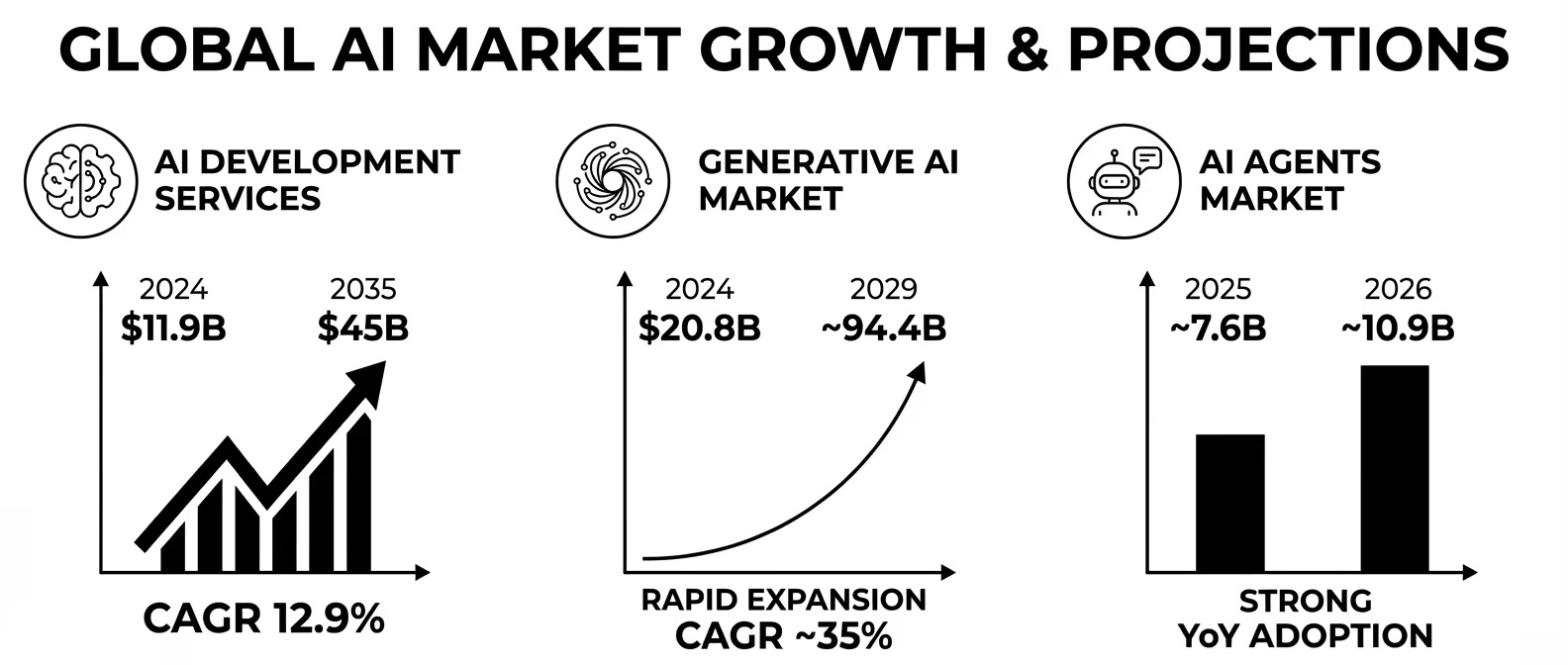
The demand for AI app development in travel is growing very fast. Here’s what the numbers say:
Reports also say that by 2026, the market value of AI services in the travel industry could reach $1.2 billion.
This shows that more and more travel businesses are investing in smart technology to stay ahead in the market.
The future of travel is smart, and AI in travel is leading the way.
AI can do many things such as:
Travel companies can also create new partnerships using AI-based machine learning algorithms. These partnerships help reach more people, offer better deals, and build smarter services.
Also, new job roles like AI experts, data analysts, and tech support staff are being created as businesses adopt expert AI solutions.
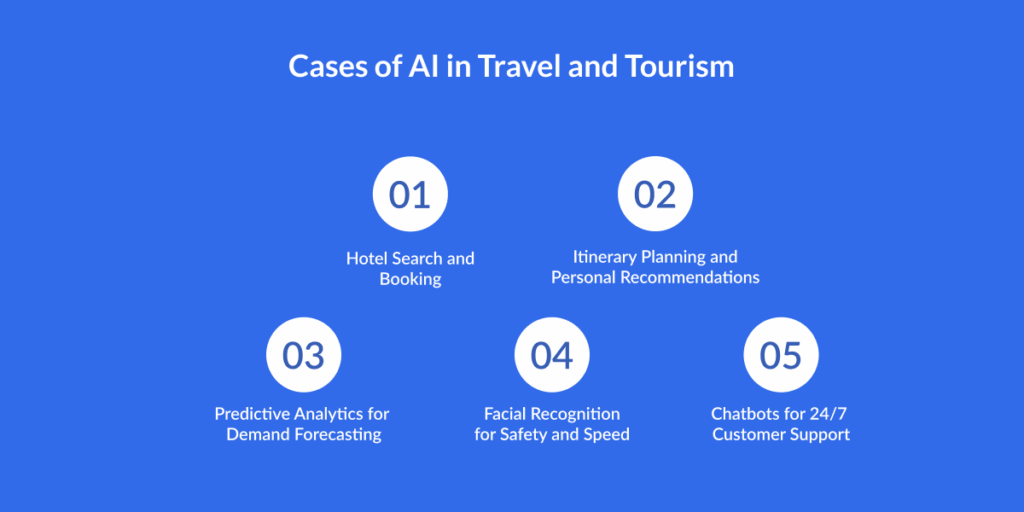
Artificial intelligence is changing how the travel and tourism industry works by offering many smart solutions.
Here’s how businesses use AI to make travel easier and better for customers.
AI helps travelers find the best hotels by showing smart recommendations. It studies user behavior and shows hotels that match their needs and budget. With AI-powered solutions, the booking process becomes quick, clear, and hassle-free.
AI in travel creates personalized travel plans. It looks at your travel history, preferences, and even the weather to suggest perfect destinations and activities.
Travel businesses use AI-based machine learning algorithms to predict customer demand. This helps them prepare for busy times, manage resources better, and offer the right services at the right time.
Airports and hotels use facial recognition to speed up check-ins and increase safety. It also gives travelers a smooth and contactless experience.
AI in travel industry includes smart chatbots that work round the clock. They answer questions, help with bookings, and share important travel updates instantly.
Before integrating artificial Intelligence in your travel and tourism industry, check out how well-known travel companies are using AI technology to improve their services, increase efficiency, and deliver better experiences to their customers.
Expedia is a leading online travel company, and it’s using AI-powered solutions to make travel planning faster and smarter. One of its best features is the AI chatbot, which is available on platforms like Facebook Messenger and the Expedia app.
Here’s what the chatbot does:
By using AI in travel, Expedia improves user satisfaction, shortens the booking process, and makes travel planning more enjoyable and stress-free.
Marriott International, a global hotel chain, has adopted AI integration in the travel industry to stay competitive and improve revenue management.
how Marriott uses AI:
This use of AI technology not only increases Marriott’s operational efficiency but also enhances the customer experience by offering better deals and more tailored travel packages.
Both of these brands Expedia and Marriott are great examples of how AI in the travel industry is helping companies provide smarter services, optimize operations, and grow faster in a highly competitive market.
Adding AI in travel industry involves various steps like design, development, and testing. Each step has its own cost, depending on the tools, features, and size of the project.
The total cost to build a basic AI-powered solution for travel can start from $30,000, but it may go higher depending on:
If you want a more advanced solution like AI-based machine learning algorithms, voice assistants, or travel planners, the cost will increase accordingly.
AI in the travel industry is helping companies create smarter, faster, and more enjoyable travel experiences for everyone.
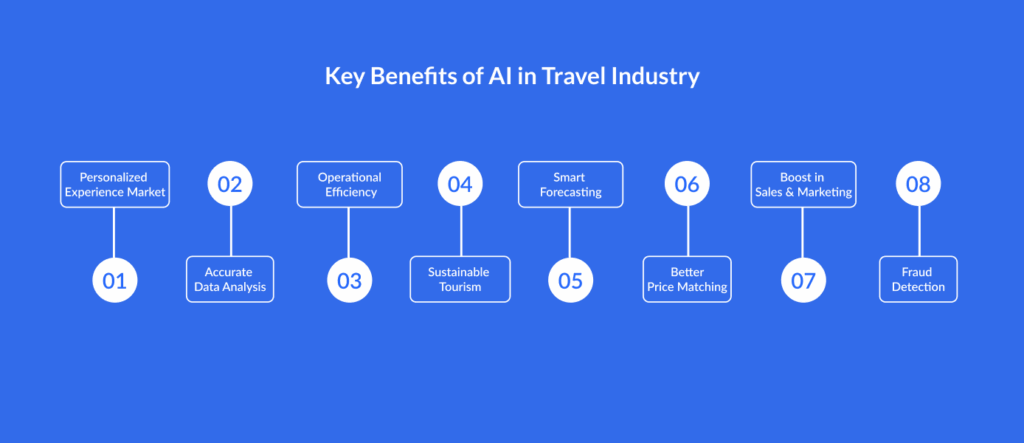
There are various benefits:
AI tools can study your past travel history, search behavior, and preferences to suggest places, hotels, and food that match your interests. This makes every trip feel special and personal. It also increases customer satisfaction and brings repeat business for travel companies.
AI-powered solutions collect and study large amounts of data quickly, such as booking trends or seasonal travel patterns. Travel businesses use this information to understand customer needs and market demand. This helps in making better decisions, avoiding guesswork, and planning smart strategies.
AI in travel reduces the need for repetitive manual work by automating tasks like ticket bookings, schedule updates, and answering the questions and answers. It saves time and reduces errors that can happen with human handling. This leads to faster services and more focus on complex customer needs.
AI integration in travel industry supports eco-friendly practices by helping plan the most fuel-efficient routes and reducing resource waste. It can also track energy and water use to cut down extra consumption. This not only protects the environment but also supports green tourism goals.
AI-based machine learning algorithms can predict future travel trends using past booking data, weather, and market changes. This helps travel agencies manage inventory, staff, and pricing ahead of time. Accurate forecasting also reduces problems like overbooking or sudden resource shortages.
AI technology tracks market demand, competitor pricing, and user behavior to set the best possible price in real time. This dynamic pricing model ensures fair rates for travelers and better profit for businesses. It increases customer trust and helps boost bookings and sales.
With AI app development, companies can show customized offers, ads, and travel packages to the right customers at the right time. AI tools help identify high-value customers and optimize marketing campaigns automatically. This improves customer engagement and gives higher return on marketing investment.
AI-powered systems keep travel platforms secure by monitoring user activity and spotting suspicious behavior instantly. It helps prevent problems like fake bookings, identity theft, or online payment fraud. This builds customer trust and ensures safe transactions for everyone.
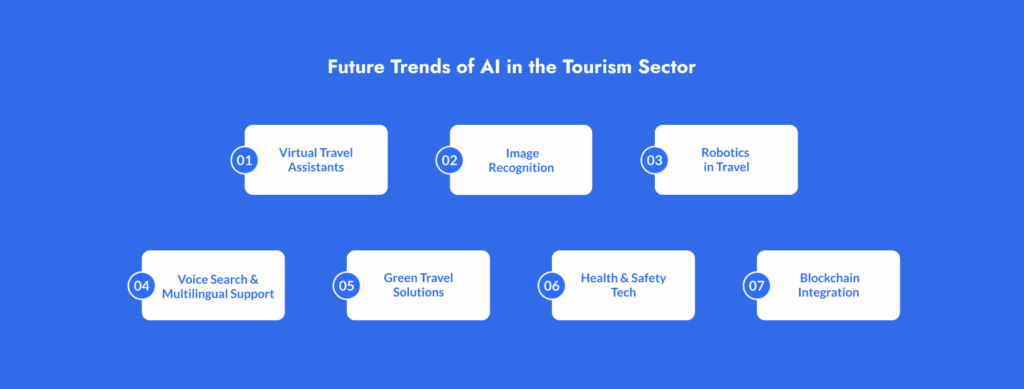
The future of AI in travel is full of smart tools and innovative experiences. These upcoming trends are set to reshape how we plan, enjoy, and manage our trips:
AI-powered chatbots and assistants will be available 24/7 to answer traveler queries, manage bookings, and give trip updates in real time. This helps travelers get instant support without waiting for human help.
By just scanning a monument, landmark, or dish using your phone camera, AI will instantly provide information and suggestions. This creates interactive and informative travel experiences on the go.
Robots will assist travelers at airports and hotels by handling luggage, giving directions, or offering room service. They make travel more convenient, contactless, and efficient.
Travelers will be able to search, book, or ask for help using voice commands in their native language. This removes language barriers and offers a smoother user experience.
AI helps reduce pollution by planning fuel-efficient routes and managing energy and waste at hotels and airports. It supports sustainable and eco-friendly travel practices.
AI tools will monitor health data, air quality, and crowd levels to ensure safer travel during health crises or peak times. This adds an extra layer of safety for both travelers and providers.
Blockchain combined with AI ensures secure, tamper-proof bookings and payments. It builds trust by making all transactions transparent and traceable.
Companies that adopt these AI-powered solutions early will gain a competitive edge and provide unforgettable travel experiences.
To sum it up, integrating AI in the travel industry brings a wide range of benefits from personalized travel recommendations to fraud prevention and seamless customer support. AI tools like multilingual chatbots, weather and traffic prediction, and virtual travel assistants greatly enhance the overall travel experience.
Developer Bazaar Technologies is your trusted technology partner for building powerful AI-driven travel solutions. With a skilled team and years of experience, we specialize in delivering AI development services and AI-powered solutions that match your unique business needs.
We work closely with you at every step from idea to launch to make sure the AI integration fits smoothly into your current system. Whether it’s automating bookings, enabling dynamic pricing, or creating smart travel assistants, our expert AI solutions are built to increase your efficiency and drive real growth.
Partner with Developer Bazaar Technologies to unlock the full potential of AI technology in travel and give your customers a smarter, safer, and more satisfying journey.
A: A basic AI travel app development cost around $30,000. However, costs can increase depending on features, company size, and location.
A: AI tools like chatbots provide 24/7 support, answer questions quickly, and help with bookings offering a better travel experience.
A: Yes, with built-in fraud detection and secure data handling, AI-powered solutions protect users and companies alike.
A: AI travel assistants, virtual hotel tours, dynamic pricing systems, and smart recommendation engines are common examples.
A: AI increases efficiency, boosts sales, reduces costs, and creates happier customers all of which help businesses grow faster.
Co-Founder
Developer Bazaar technologies

Key Takeaways: The cost to develop an AI app typically ranges from $10,000 to $500,000+, depending on app complexity, AI features, integrations, security requirements, and the development team. Choosing pre-trained AI models instead of building custom...
Key Takeaways: The cost to develop an AI app typically ranges from $10,000 to $500,000+, depending on app complexity, AI features, integrations, security requirements, ...
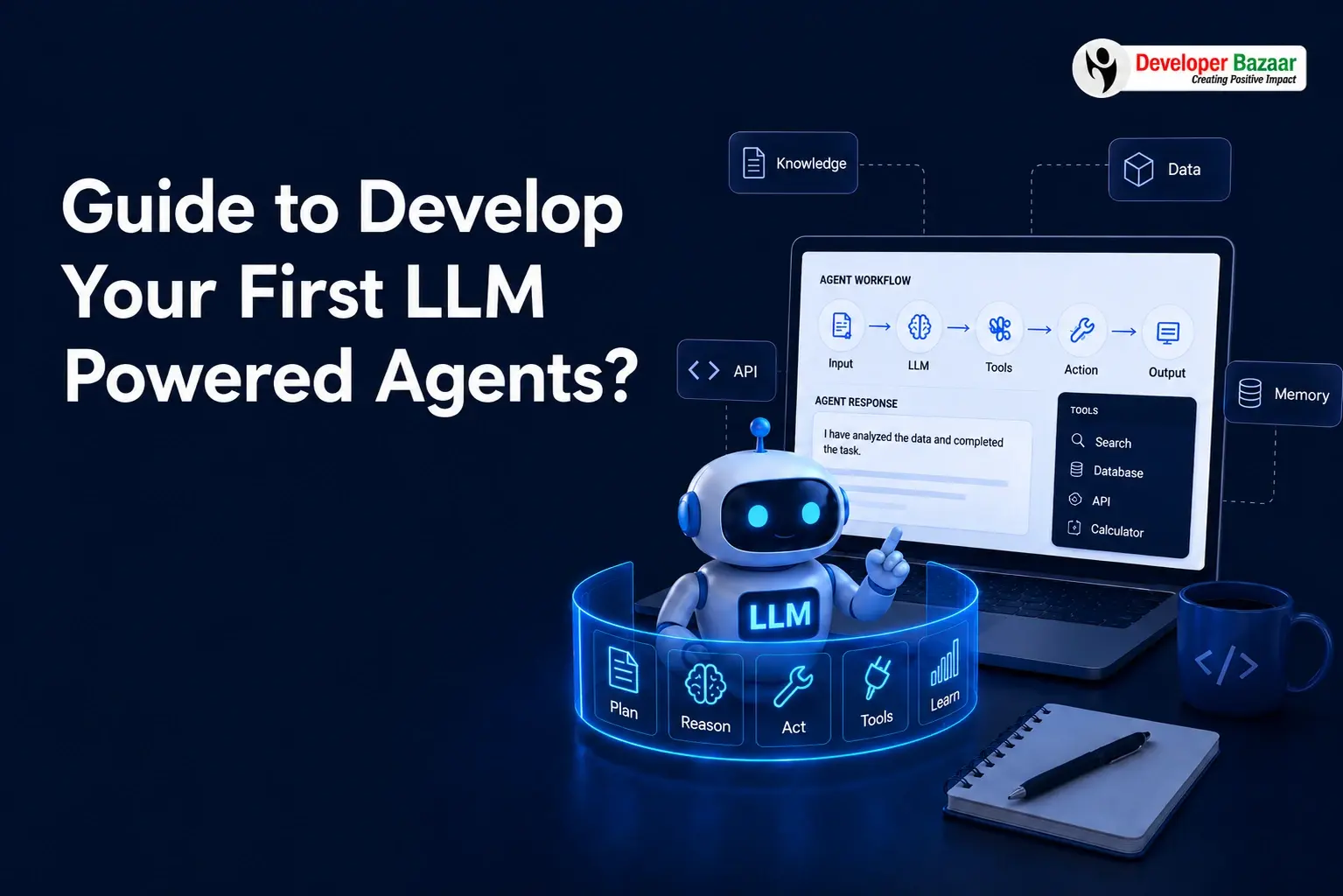
Key Takeaways: Building an LLM agent is easier when you start with one well-defined task instead of trying to automate everything at once. Most businesses can build powerful AI agents using pre-trained LLMs without training a...
Key Takeaways: Building an LLM agent is easier when you start with one well-defined task instead of trying to automate everything at once. Most ...
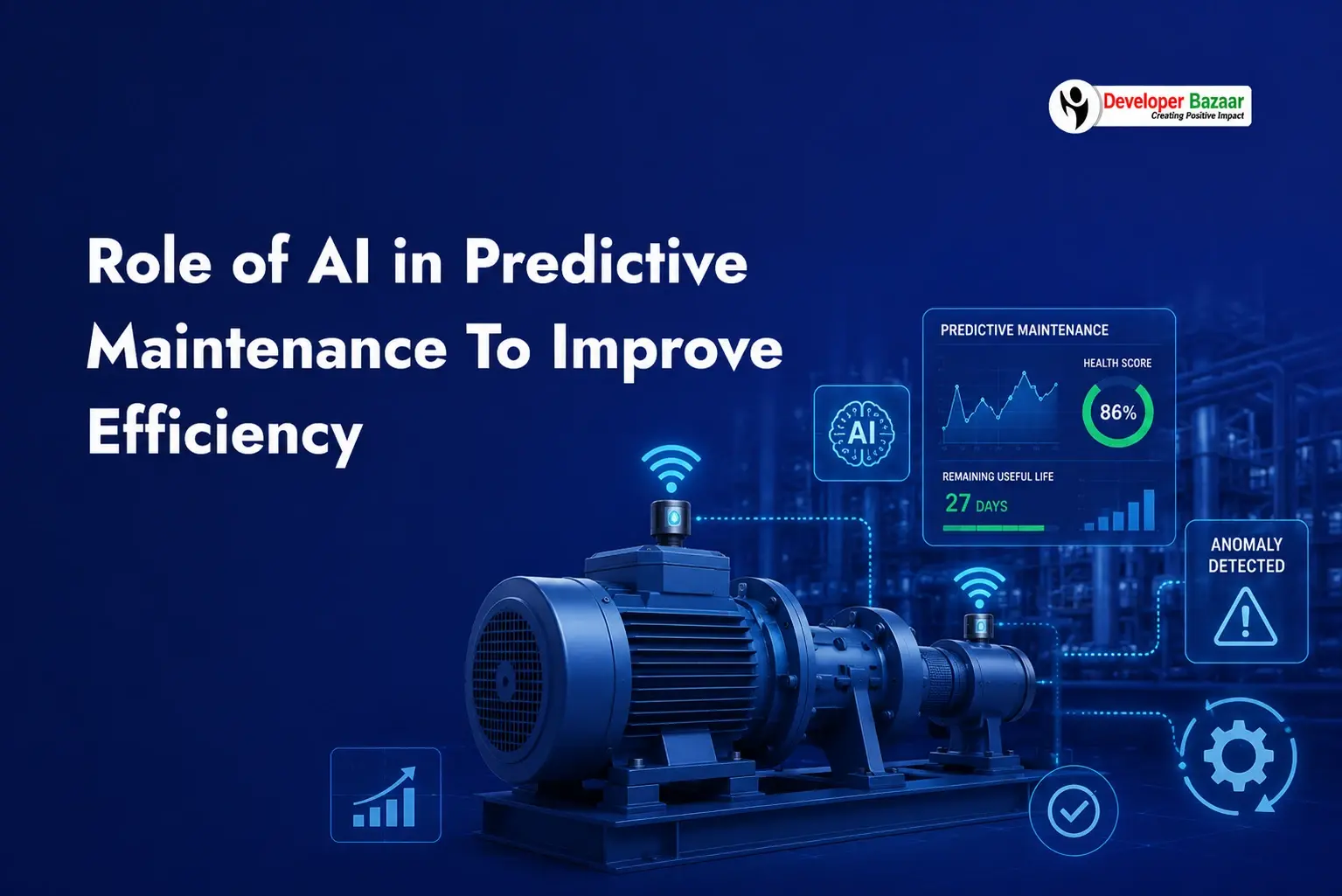
Key Takeaways: AI predictive maintenance prevents equipment failures before they happen by analyzing real-time sensor data and identifying early warning signs. Predictive maintenance with AI is more efficient than reactive or preventive maintenance, helping businesses reduce...
Key Takeaways: AI predictive maintenance prevents equipment failures before they happen by analyzing real-time sensor data and identifying early warning signs. Predictive maintenance with ...
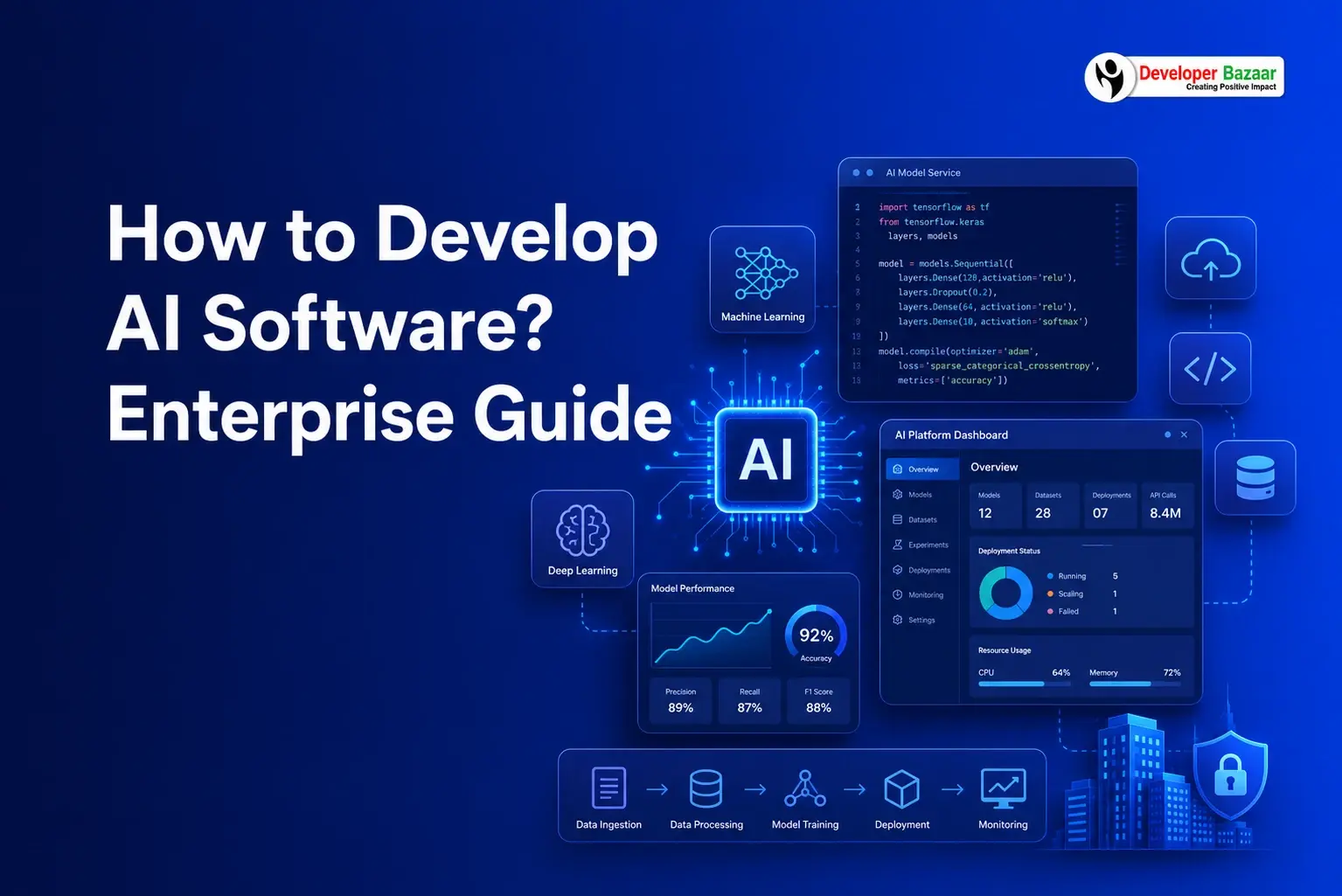
Key Takeaways: AI software delivers long-term business value by improving decision-making, automation, customer experiences, and operational efficiency. Successful AI projects require more than coding, they depend on quality data, the right AI model, seamless integration, and...
Key Takeaways: AI software delivers long-term business value by improving decision-making, automation, customer experiences, and operational efficiency. Successful AI projects require more than coding, ...
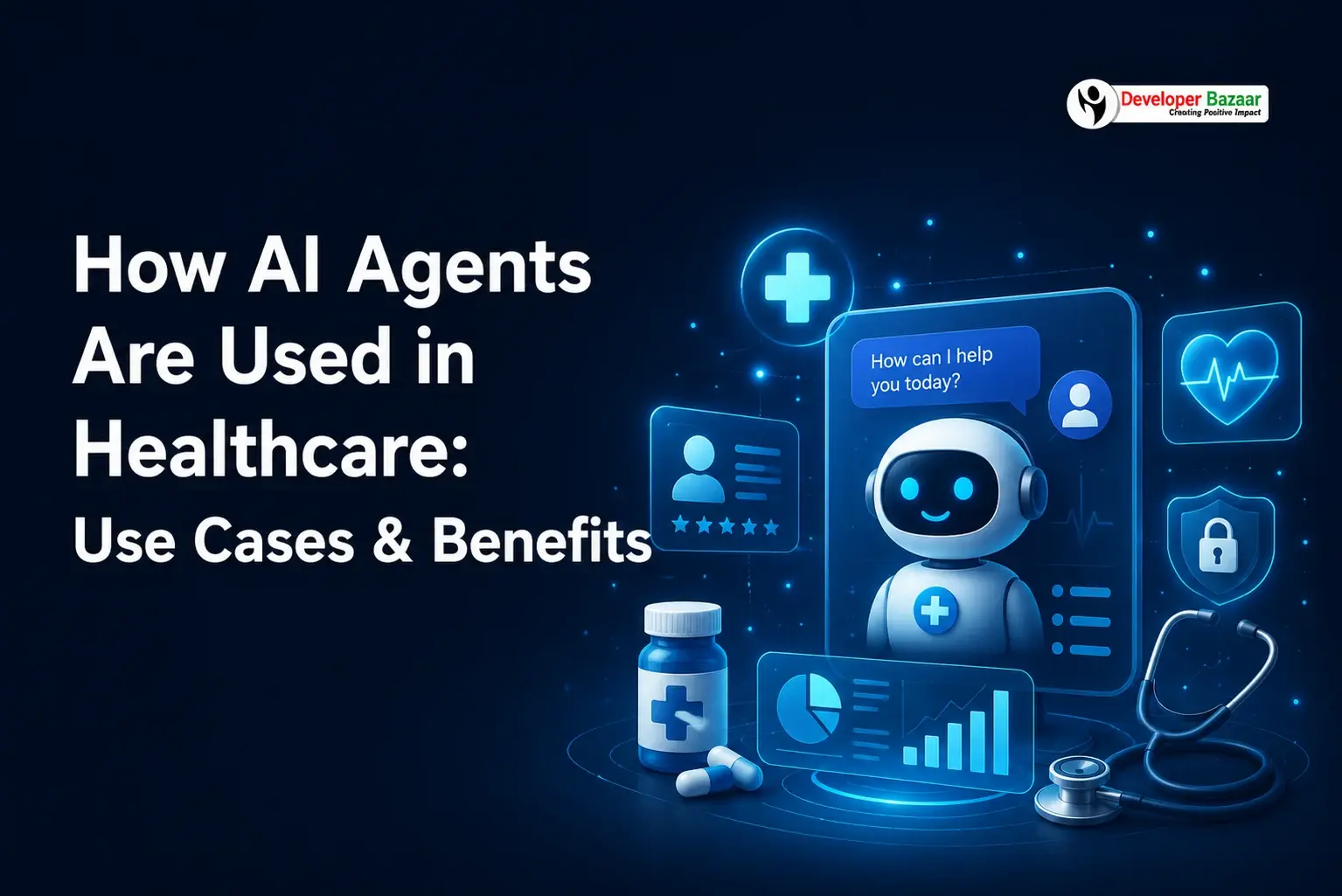
Key Takeaways: AI agents go beyond traditional automation by reasoning, planning, and executing multi-step healthcare workflows with minimal human intervention. Agentic AI delivers value across the healthcare ecosystem, from clinical documentation and medical imaging to patient...
Key Takeaways: AI agents go beyond traditional automation by reasoning, planning, and executing multi-step healthcare workflows with minimal human intervention. Agentic AI delivers value ...
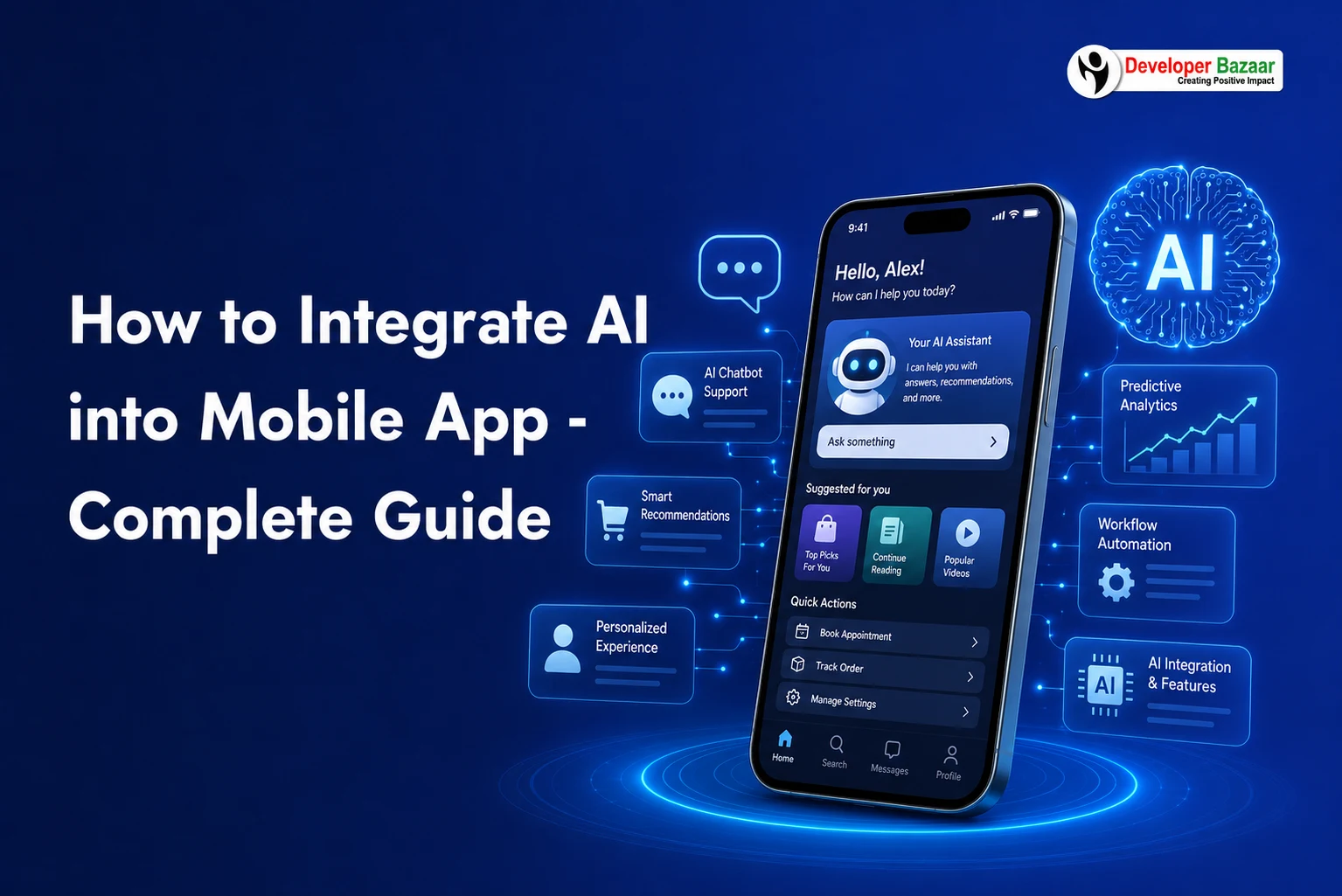
Key Takeaways: AI integration helps mobile apps deliver personalized experiences, automate repetitive tasks, improve customer support, and strengthen security. Businesses can start with pre-built AI APIs like OpenAI, Google AI, or AWS AI, making AI adoption...
Key Takeaways: AI integration helps mobile apps deliver personalized experiences, automate repetitive tasks, improve customer support, and strengthen security. Businesses can start with pre-built ...
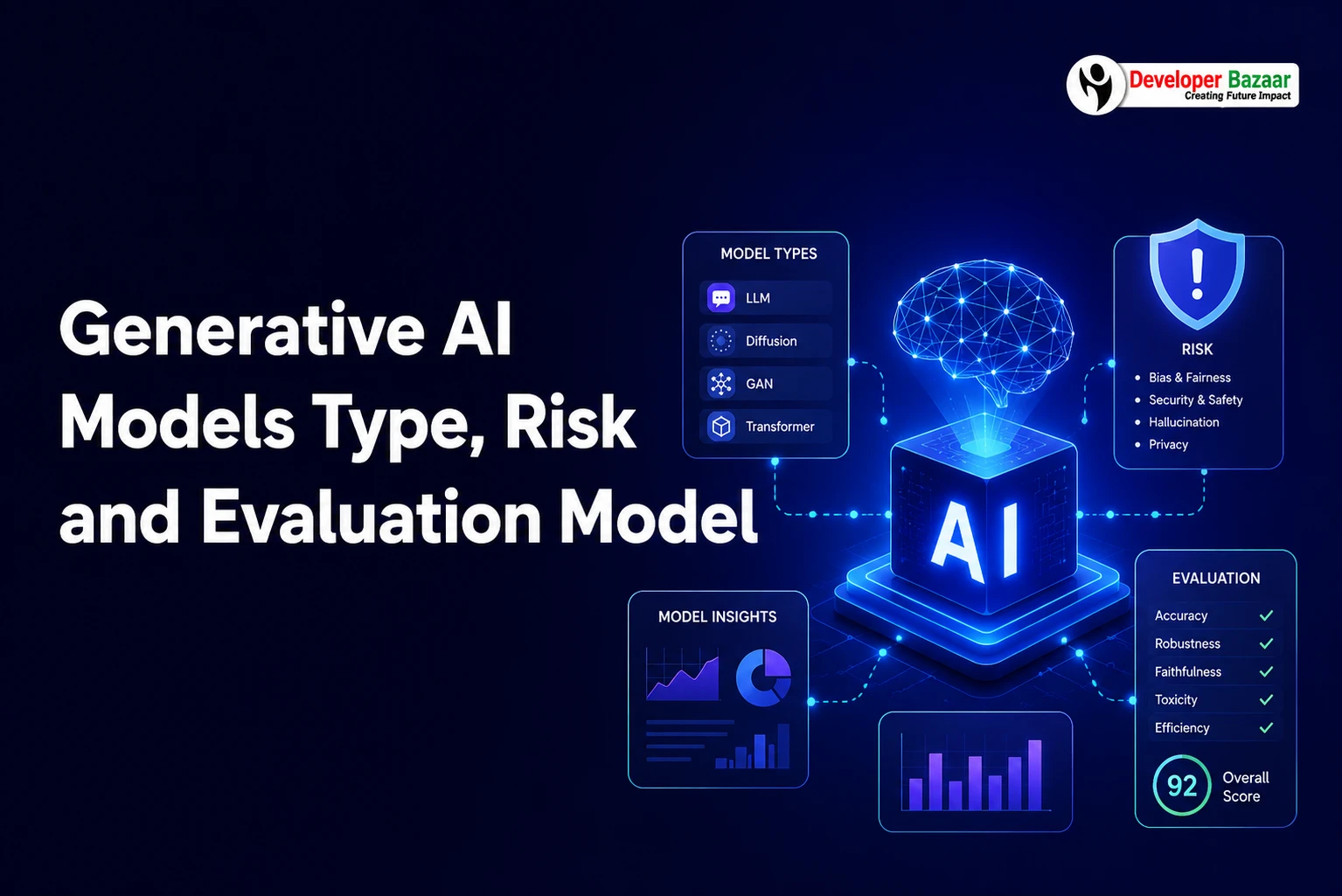
Key Takeaways: Generative AI Models create original text, images, code, audio, and video by learning patterns from massive datasets rather than copying existing content. Different model architectures, including GANs, VAEs, Transformers, Diffusion Models, Autoregressive Models, and...
Key Takeaways: Generative AI Models create original text, images, code, audio, and video by learning patterns from massive datasets rather than copying existing content. ...
Is your business still depending on old software systems that slow down growth and innovation? Many companies struggle with outdated applications that are costly, hard to maintain, and unable to meet modern customer expectations. The growing...
Is your business still depending on old software systems that slow down growth and innovation? Many companies struggle with outdated applications that are costly, ...

Businesses today collect huge amounts of data every second. Finding unusual activities or errors in this massive data is difficult for humans. This is where AI Anomaly Detection becomes helpful. AI-powered systems can quickly scan data,...
Businesses today collect huge amounts of data every second. Finding unusual activities or errors in this massive data is difficult for humans. This is ...
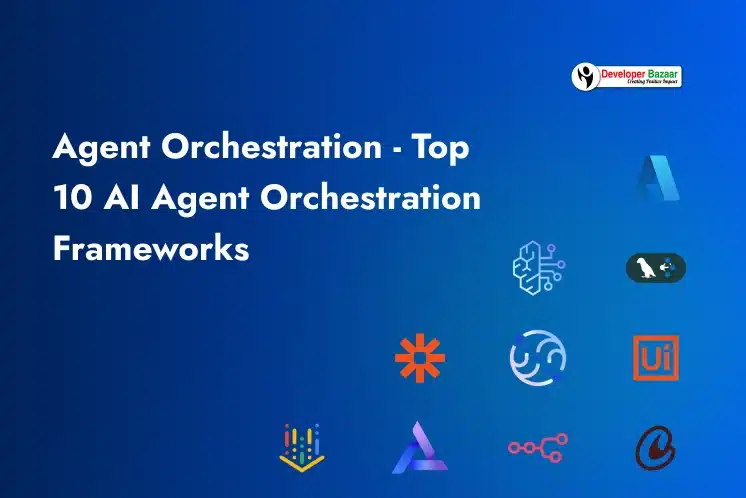
AI agents are becoming part of everyday business systems. According to Gartner, 40% of enterprise applications will include AI agents by the end of 2026, up from less than 5% in 2025. But there is a...
AI agents are becoming part of everyday business systems. According to Gartner, 40% of enterprise applications will include AI agents by the end of ...

Complete the form below and validate your idea now.
✔ Your idea is 100% protected by our Non Disclosure Agreement.
