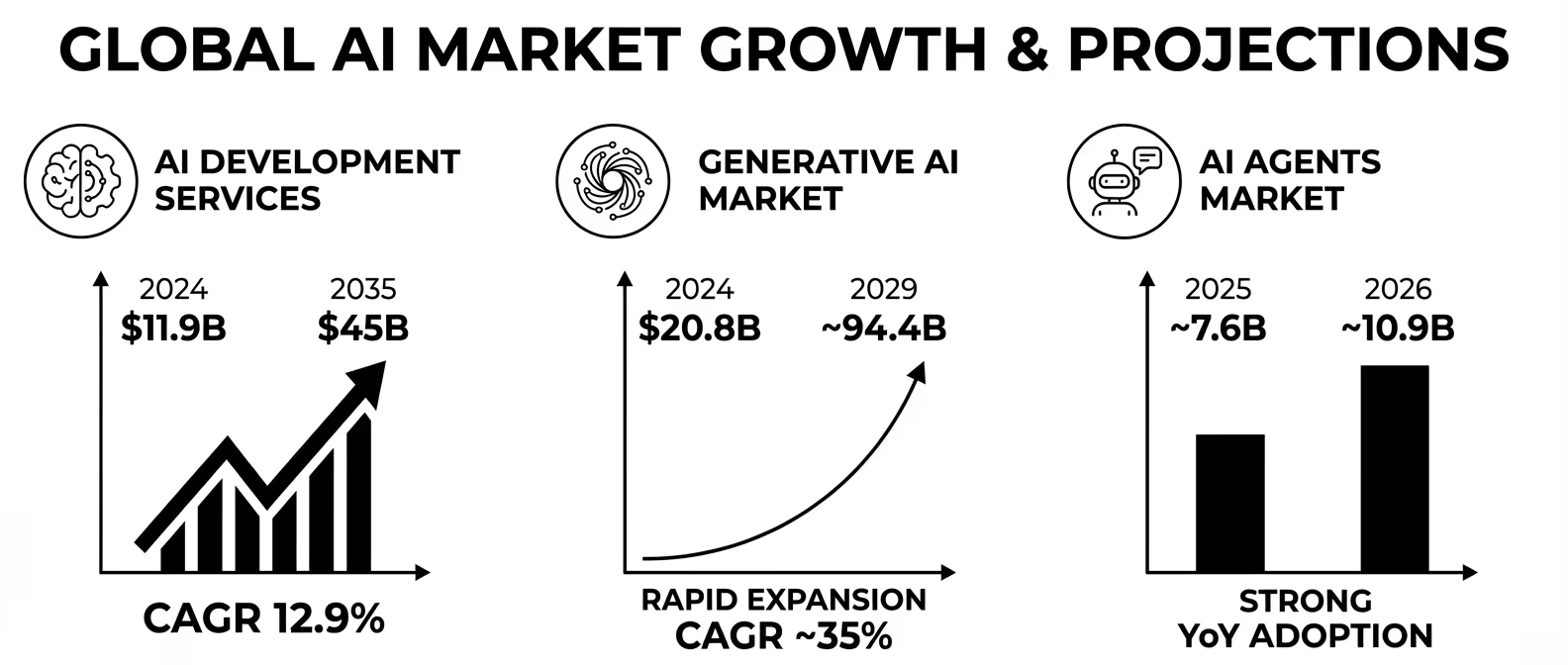

The global AI in healthcare market has reached $22.6 billion in 2025 and is projected to hit $110.61 billion by 2030, with health management apps like Noom leading this transformative wave. As businesses rush to develop AI healthcare app like Noom solutions, the opportunity has never been more promising.
What Will You Learn?
- Core components required to develop AI based health management app platforms
- Step-by-step process to create AI based health management app solutions
- Comprehensive healthcare app development cost analysis
- Advanced AI features and recommendation systems implementation
- Expert insights for successful deployment with fitness and wellness app development company
This guide provides actionable insights into creating successful AI-powered health management platforms that combine psychology, technology, and personalized coaching for sustainable health outcomes.
What is an AI-based Health Management App and Why Noom Succeeds?
An AI-powered health management app represents a sophisticated integration of machine learning algorithms, behavioral psychology, and personalized data analytics designed to help users achieve sustainable health outcomes. When you develop AI healthcare app like Noom, you’re creating platforms that emphasize behavior modification through intelligent analysis and personalized interventions rather than simple data collection.
According to Noom’s Chief Product Officer Aaron Severs: “Welli was built by data scientists and machine learning engineers in digital healthcare who are well-versed in Noom’s program and philosophy.”
This psychology-first methodology, enhanced by artificial intelligence, sets successful apps apart from conventional calorie-counting applications. The integration of Cognitive Behavioral Therapy principles with machine learning creates comprehensive platforms that address both psychological and physiological aspects of health management. Noom’s success stems from this holistic approach, focusing on understanding the ‘why’ behind eating behaviors rather than simply tracking ‘what’ users consume. This approach becomes crucial when businesses aim to develop AI mental health app like Noom solutions that address comprehensive wellness needs.
● Essential Core Benefits for Health Management Apps
Modern AI health management platforms integrate multiple sophisticated technologies to deliver personalized user experiences. According to Noom’s recent AI announcement, “Noom now leverages AI to power new photo, text and voice food logging features, making it easier than ever to track meals and nutrition accurately.” Machine learning algorithms analyze user behavior patterns, food preferences, and progress data to deliver highly personalized AI based recommendation systems that adapt to individual needs.
Natural Language Processing capabilities enable advanced chatbots like Noom’s “Welli” to provide 24/7 support, understanding user queries in natural language and providing contextually relevant health guidance. Computer vision technology represents another crucial component, as demonstrated by Noom’s body scan feature, where “AI technology will analyze the footage to determine precise body composition measurements.” Predictive analytics engines complete the technological foundation by forecasting health outcomes and suggesting preventive measures.
Why AI-powered Health Apps are Critical for Modern Wellness?
Healthcare organizations worldwide are recognizing the transformative potential of AI in healthcare applications, with substantial market opportunities and proven ROI metrics. The convergence of artificial intelligence and health management represents a fundamental shift toward preventive, personalized healthcare delivery.
● Market Impact and ROI Potential for AI Healthcare App Development
The digital health market presents a massive $4.2 billion opportunity, with AI-powered applications demonstrating superior performance metrics. According to recent healthcare AI statistics, “Hospitals report ROI of $3.20 for every $1 spent, often within 14 months of implementation,” demonstrating tangible value of AI integration. User retention comparisons reveal significant advantages for AI-powered platforms, with intelligent health apps achieving 65-75% retention rates after six months compared to 25-30% for traditional fitness applications.
Revenue models for businesses that develop an app like Noom have evolved beyond simple subscription services to include premium coaching tiers, enterprise partnerships with healthcare providers, and pharmaceutical collaborations. Noom’s pricing strategy ranges from $17 monthly for basic weight management to $69 monthly for comprehensive medical support, demonstrating the scalability of AI-enhanced health platforms. The global AI in healthcare market, valued at $26.69 billion in 2024 and expected to grow at a CAGR of 38.5%, indicates sustained demand for innovative health management solutions.
● Healthcare Industry Trends and Future Outlook for AI Development
The rapid adoption of generative AI in healthcare signals a fundamental transformation in how medical professionals and patients interact with health technology. Research indicates that 40% of U.S. physicians are ready to use generative AI when interacting with patients at the point of care, demonstrating widespread acceptance among healthcare professionals. This acceptance creates opportunities for healthcare app development company specialists to create solutions that seamlessly integrate with existing clinical workflows.
Types and Approaches to AI Health App Development
Understanding various approaches to create AI based health management app solutions helps businesses choose appropriate development strategies. Each approach offers distinct advantages serving different user needs, from behavior modification to clinical decision support and preventive wellness management.
● Noom's Approach for Sustainable Health Management
Psychology-first methodology with AI enhancement represents the gold standard for sustainable health management applications. This approach integrates Cognitive Behavioral Therapy principles with sophisticated machine learning algorithms to address psychological roots of health behaviors rather than focusing solely on symptom management. Companies looking to develop AI healthcare app like Noom must understand this integration through daily psychology-based lessons lasting 5-10 minutes, combined with color-coded food classification systems helping users make informed decisions without restrictive dietary rules.
The platform’s habit formation tracking and reinforcement mechanisms use AI to identify patterns in user behavior and provide targeted interventions at optimal moments. Success lies in focusing on long-term lifestyle changes rather than quick fixes, making it particularly effective for weight loss, habit formation, stress management, and chronic disease prevention. This approach becomes essential when businesses aim to develop AI mental health app like Noom solutions addressing comprehensive wellness needs beyond physical health metrics.
● Medical Focus for Healthcare Providers
EMR integration and clinical decision support systems leverage artificial intelligence to assist healthcare providers in diagnosis and treatment planning by processing vast amounts of clinical data. These applications focus on real-time vital sign monitoring, symptom pattern recognition, drug interaction checking, and clinical decision support algorithms that enhance provider capabilities rather than replacing clinical judgment.
Clinical data-driven apps serve healthcare providers and patients with complex medical conditions, particularly those requiring chronic disease management, remote patient monitoring, and comprehensive clinical documentation. The value proposition centers on improving diagnostic accuracy, reducing administrative burden, and enabling proactive health management through predictive analytics.
● Wellness and Prevention Through AI Technology
Activity tracking with AI coaching focuses on preventive health through fitness optimization and lifestyle modification, using computer vision and sensor data for real-time feedback. These applications leverage movement analysis using pose estimation technology, nutritional analysis and meal planning algorithms, workout optimization based on performance data, and seamless integration with wearable devices. Fitness and wellness app development company specialists often prioritize this approach for broader consumer markets.
Step-by-Step AI Health App Development Guide
Development of AI healthcare app solutions requires systematic approaches balancing technical complexity with user experience design and regulatory compliance. This comprehensive guide outlines essential phases for creating successful AI-powered health management platforms from initial concept to market deployment.
1. Strategic Planning and AI Framework Design
Market research and target audience analysis forms the foundation of successful healthcare app development. AI development experts emphasize that “not every healthcare application needs ML algorithms under the hood. Sometimes all you need is good old coding.” This phase requires conducting comprehensive competitive analysis to identify market gaps, defining specific AI use cases with measurable success metrics, and selecting appropriate machine learning models based on data availability and user needs.
The technology stack planning should include cross-platform development frameworks like React Native or Flutter, Python-based backend systems with Django or Flask, and AI/ML frameworks such as TensorFlow or PyTorch that can scale with user growth. Compliance framework design represents critical components that must be integrated from the beginning rather than added later. HIPAA compliance for patient data protection, GDPR requirements for international users, and FDA regulations for medical claims must be thoroughly understood throughout the development lifecycle.
2. MVP Development and Core AI Integration
User registration and onboarding systems should collect essential health data while maintaining user privacy and engagement, focusing on core functionality demonstrating AI value proposition. MVP development priorities include implementing secure user authentication and data encryption, establishing basic AI recommendation engines, creating data collection mechanisms for user inputs and device integrations, conducting initial machine learning model training with available datasets, and implementing essential compliance features protecting user data.
The technical architecture foundation requires careful selection of frontend technologies such as React Native for cross-platform compatibility, backend frameworks like Python Django or Flask with PostgreSQL databases for data integrity, AI/ML deployment systems using TensorFlow Serving or PyTorch for model inference, and cloud infrastructure on AWS or Google Cloud with HIPAA-compliant configurations.
3. Advanced AI Features Implementation for Personalized Health Management
Personalized coaching algorithm development represents core differentiators for AI health apps, requiring sophisticated machine learning models trained on healthcare-specific datasets. As demonstrated by Noom’s approach, the development team “delivered an AI solution more knowledgeable about Noom than any external model because it has been trained on Noom-specific information.” Advanced features include computer vision for food and exercise recognition using pre-trained models like YOLO or custom convolutional neural networks, natural language processing for chat interactions implementing transformer models for context-aware responses, and predictive analytics for health outcomes using time-series forecasting models.
AI implementation best practices emphasize starting with pre-trained models and fine-tuning for healthcare contexts, implementing A/B testing frameworks for algorithm optimization, ensuring model interpretability for healthcare compliance requirements, and building robust data pipelines for continuous learning. Development teams should focus on creating AI systems that learn from user interactions while maintaining privacy and security standards, implementing feedback loops, and improving recommendations over time.
4. Testing, Optimization, and Deployment of AI Healthcare Solutions
AI model validation and accuracy testing require comprehensive evaluation across diverse user populations and use cases, following the principle that businesses should “always start with a proof of concept before wasting hundreds of thousands on an irrelevant product.” Testing frameworks must include model accuracy testing through cross-validation with clinical datasets, beta testing with real users gathering feedback on AI recommendations, performance optimization for latency reduction and memory efficiency, security testing including penetration testing and HIPAA compliance audits, and app store preparation ensuring compliance with iOS App Store and Google Play requirements.
Deployment considerations require implementing progressive rollout strategies to manage risks, establishing real-time monitoring and alerting systems for AI performance, creating feedback loops for continuous model improvement, and implementing post-launch analytics for user behavior tracking. The deployment phase should include comprehensive documentation for healthcare providers and users, training materials for support teams, and established protocols for handling AI system issues that may affect user health outcomes.
Development Budget Planning for AI Healthcare Apps
Cost to develop an app like Noom varies significantly based on AI features complexity, compliance requirements, and target market scope. Understanding the financial investment required helps businesses make informed decisions about feature prioritization and development timelines.
Healthcare App Development Cost Breakdown
| Development Phase | Cost Range | Key Components |
|---|---|---|
| MVP Development | $35,000 - $50,000 | Frontend, Backend, Basic AI |
| Advanced AI Features | $30,000 - $50,000 | Computer Vision, NLP, ML Models |
| Infrastructure & Compliance | $10,000 - $15,000 | Cloud Hosting, HIPAA, Security |
| Annual Maintenance | $10,000 - $15,000 | Updates, Retraining, Support |
Cost Optimization Strategies for AI Health App Development
Phased development approaches enable businesses to validate AI concepts before major investments, following strategies that healthcare AI experts recommend of starting with “customized AI models adapted from existing AI models” before investing in completely custom solutions. Cost optimization strategies include leveraging open-source AI libraries like TensorFlow and PyTorch instead of custom development, utilizing cloud-based AI services such as Google Cloud AI and AWS SageMaker for faster implementation, implementing gradual AI complexity by starting with rule-based systems before evolving to machine learning.
Common budget overruns stem from underestimating compliance costs which can add 30-40% to total budgets, inadequate data preparation and cleaning efforts requiring significant additional resources, insufficient testing across diverse user populations leading to post-launch fixes, and lack of proper planning for post-launch monitoring and maintenance requirements. HIPAA compliance alone “can cost anywhere from $10,000 to over $150,000, based on organization size, infrastructure, current compliance levels.”
Essential Technologies and Advanced AI Strategies
The technology stack for AI healthcare app development must balance cutting-edge AI capabilities with robust security, scalability, and compliance requirements. Modern healthcare applications require sophisticated integration of multiple AI technologies to deliver personalized, secure, and effective health management solutions.
● Core Technology Stack for AI Healthcare App Development
Frontend development for AI healthcare apps typically utilizes React Native for cross-platform development with 85% code reuse efficiency, Flutter for Google’s high-performance UI toolkit, or native Swift and Kotlin development for platform-specific AI features requiring deep integration with device capabilities. Backend infrastructure relies heavily on Python for AI and ML integration due to extensive libraries and frameworks, Node.js for real-time features and WebSocket connections, and cloud platforms like AWS with HIPAA compliance or Google Cloud Healthcare APIs providing pre-built healthcare-specific services.
The AI and machine learning technology stack centers on TensorFlow for production-ready machine learning platforms scaling to millions of users, PyTorch for research-friendly deep learning frameworks enabling rapid prototyping, scikit-learn for traditional machine learning algorithms, and Hugging Face Transformers for pre-trained natural language processing models. Database solutions require PostgreSQL for ACID compliance essential for healthcare data integrity, MongoDB for flexible document storage of unstructured health data, and Redis for caching and real-time data processing enabling instant AI based recommendation responses.
● Advanced AI Implementation Techniques for Health Management
Federated learning for privacy-preserving AI enables model training without centralizing sensitive health data, addressing privacy concerns while maintaining AI effectiveness across diverse user populations. This approach provides enhanced data privacy and compliance benefits, reduced data transfer costs, improved model robustness across diverse populations, and significant regulatory compliance advantages essential for healthcare applications. Real-time recommendation systems powered by streaming data processing enable immediate responses to user actions and health status changes through Apache Kafka for real-time data streaming, Apache Spark for distributed data processing, TensorFlow Serving for real-time model inference, and Redis for low-latency caching delivering instant recommendations.
Multi-modal AI integration combines text analysis for symptom descriptions and mood tracking, image processing for food recognition and body composition analysis, voice analysis for stress detection and medication compliance monitoring, and sensor data integration for activity tracking and vital signs monitoring. This comprehensive approach allows AI healthcare apps to understand user health through multiple data streams, providing more accurate and personalized recommendations than single-modal systems.
Conclusion
The journey to develop AI healthcare app solutions requires strategic planning, technical expertise, and deep understanding of healthcare regulations. Success in this rapidly growing market depends on balancing sophisticated AI capabilities with intuitive user experiences while maintaining strict compliance with healthcare data protection standards.
Key implementation factors include recognizing that AI integration requires specialized mobile app development company expertise in both technology and regulatory requirements, understanding that compliance and privacy considerations are non-negotiable elements built into foundations rather than added later, adopting phased development approaches starting with proven AI components before investing in custom algorithms, and prioritizing user experience design making sophisticated AI accessible through intuitive interfaces. Success factors for AI health apps center on developing clear value propositions addressing specific health challenges, building robust data architectures supporting personalization while protecting privacy, implementing continuous learning capabilities for algorithm improvement, and establishing strong partnerships with healthcare providers and institutions.
The AI healthcare app market presents enormous opportunities for businesses ready to invest in comprehensive, compliant solutions. As healthcare industry leaders note, “People are seeking a healthy, high-quality lifestyle. Health is the new luxury,” indicating strong market demand for innovative health management platforms. The convergence of advanced AI technologies, regulatory support, and consumer demand creates optimal environments for businesses looking to develop AI healthcare app solutions scaling across diverse healthcare settings and user needs.
FAQs
Q1. What makes an AI health app different from regular fitness apps?
AI health apps use machine learning for personalized recommendations, behavior prediction, and adaptive coaching based on individual patterns, unlike traditional apps that only track data.
Q2. How long does it take to develop an AI healthcare app like Noom?
Typically 8-14 months including 3-4 months MVP, 4-6 months AI integration, and 2-4 months testing and compliance validation for full deployment.
Q3. What are the main regulatory challenges for AI health apps?
HIPAA compliance, FDA approval for medical claims, GDPR for international users, with costs ranging $10,000-$150,000 for certifications and ongoing compliance.
Q4. Do I need a team of AI specialists to build a health management app?
Yes, or partner with experienced healthcare app development services companies that provide AI, regulatory, and healthcare domain expertise for comprehensive solutions.
Q5. What AI technologies are essential for a Noom-like app?
Machine learning for personalization, NLP for coaching, computer vision for recognition, and predictive analytics for outcomes with generative AI in healthcare integration.
Q6. How do I measure the success of AI recommendations in my health app?
Track user engagement rates, goal achievement percentages, recommendation accuracy, retention rates, and clinical outcomes through comprehensive A/B testing and analytics.
Q7. What budget should I allocate for AI health app development?
Plan $125,000-$300,000 with 30-40% for AI development, 25-30% for compliance, remainder for core features, infrastructure, and ongoing maintenance requirements.
Q8. When should I partner with a healthcare app development company?
When you need AI expertise, regulatory guidance, healthcare knowledge, or want to accelerate time-to-market with proven experience in developing successful AI-powered health platforms.