

Key Takeaways:
- The cost to develop an AI app typically ranges from $10,000 to $500,000+, depending on app complexity, AI features, integrations, security requirements, and the development team.
- Choosing pre-trained AI models instead of building custom models can significantly reduce development time and overall project costs.
- High-quality, well-organized data is one of the biggest factors affecting both AI performance and the final development budget.
- Building an MVP (Minimum Viable Product) first helps validate your idea before investing in advanced AI capabilities.
- AI app development continues after launch. Regular model updates, performance monitoring, and maintenance are essential to keep the application accurate and secure.
- Businesses can either build AI-powered applications or use AI tools to accelerate software development, depending on their goals.
- The right AI development partner can help balance cost, scalability, security, and long-term business growth while avoiding unnecessary expenses.
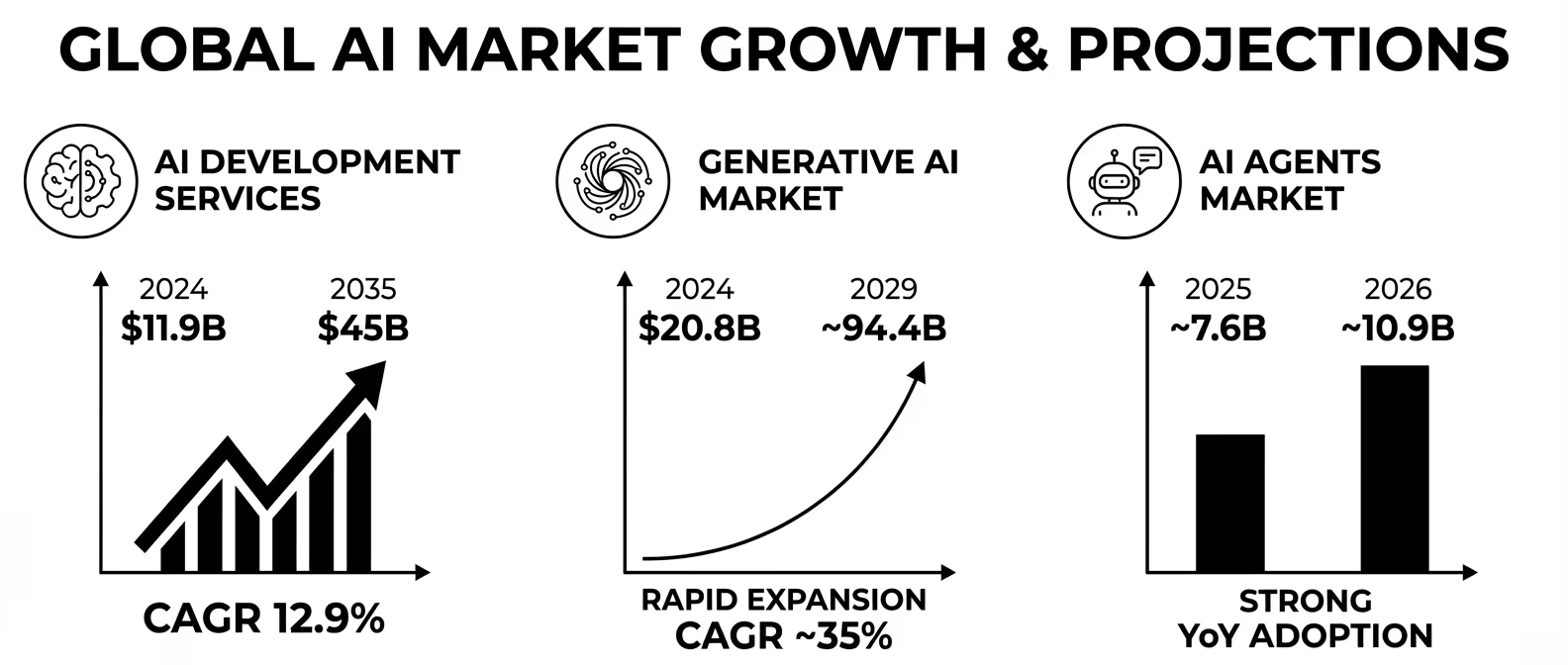
Do you want to develop an AI app, but keep asking, “How much will it cost?” You’re not alone. As AI adoption continues to grow, more businesses are investing in intelligent applications. In fact, the global AI apps market was valued at USD 2.94 billion in 2024 and is expected to reach USD 26.36 billion by 2030, growing at a CAGR of 38.7% from 2025 to 2030. AI apps are transforming industries such as healthcare, finance, retail, and manufacturing, creating new opportunities for businesses of all sizes. This blog explains the AI app development cost, the factors that affect pricing, how to develop an AI app, and the best ways to integrate AI into your application.
What Is an AI App?
An AI app is a mobile or web application that uses artificial intelligence to think, learn, and help users. Normal apps only follow fixed rules. But when you build an AI app, the app can look at data, learn patterns, and give smart answers on its own.
For example, an AI app can recommend movies, answer questions like a human, spot objects in photos, or predict what a customer wants to buy next.
Today, almost every top company wants to create an AI app because users love smart, personal, and fast experiences. This is why so many businesses now search for reliable AI App Development services to turn their idea into reality.
Cost to Develop an AI App: The Real Numbers
The cost to develop an AI app is never one fixed number. It depends on what your app does, how smart it needs to be, and who builds it. Based on data from leading development agencies, here is a simple breakdown of ai app development cost by app type.
| App Type | What It Does | Estimated Cost |
| Basic AI App | Simple chatbot, FAQ bot, or basic recommendation feature | $10,000 – $40,000 |
| Mid-Level AI App | Personalization, image recognition, and natural language search | $40,000 – $150,000 |
| Advanced AI App | Custom AI models, voice assistants, predictive analytics | $150,000 – $300,000 |
| Enterprise AI App | Large-scale AI systems, compliance, and multiple integrations | $300,000 – $500,000+ |
These numbers match what most trusted industry reports say. Agencies like Appinventiv and other development companies confirm that a typical AI app development cost falls between $40,000 and $400,000+ for most business apps, while very simple prototype tools can cost much less, and large enterprise systems can go beyond $500,000.
What Makes Up the Total Cost to Develop an AI App?
When you build an AI app, your money goes into many small parts, not just “the AI.”
Here is where the budget usually goes:
| Cost Component | Why It Matters | Typical Share of Budget |
| Data collection & cleaning | AI needs clean, organized data to learn properly | 25% – 40% |
| AI model development | Building or training the “brain” of the app | 20% – 30% |
| App design (UI/UX) | Makes the app easy and nice to use | 10% – 15% |
| Backend & app development | Builds the app’s core structure and features | 15% – 25% |
| Testing & quality checks | Finds and fixes mistakes before launch | 10% – 15% |
| Cloud & infrastructure | Servers that run the AI and store data | 10% – 20% |
| Maintenance (yearly) | Keeps the app updated and working well | 15% – 25% of the build cost, per year |
Factors That Change the AI App Development Cost
Several factors influence the overall AI app development cost, and understanding them helps businesses plan their budget more effectively.
From the complexity of the application to the type of AI model, platform choice, security requirements, and ongoing maintenance, each decision affects the final investment.
Here are the key factors that determine how much it costs to build an AI-powered application.
1. App Complexity
The more features your AI app includes, the higher the development cost. A basic AI chatbot is much faster and cheaper to build than an app with advanced features like computer vision, voice recognition, real-time recommendations, or predictive analytics because these require more development time, testing, and AI expertise.
2. Type of AI Model
Your choice of AI model has a major impact on the overall budget. Using pre-trained AI models or APIs, such as OpenAI, Google Gemini, or Claude, is usually more affordable than building and training a custom AI model from scratch. Custom models require large datasets, specialized engineers, and significant computing power.
3. Data Readiness
AI systems depend on high-quality data to perform accurately. If your business data is incomplete, unorganized, or contains errors, developers must spend extra time cleaning, labeling, and preparing it before AI development can begin. This additional work increases both project time and cost.
4. Platform Selection
The number of platforms you support directly affects development expenses. Building an AI app for both iOS and Android requires more design, development, testing, and maintenance than creating an app for a single platform. Cross-platform technologies can help reduce costs but may still require platform-specific optimization.
5. Development Team Location
Developer rates vary significantly across different regions. Hiring AI developers in countries like the United States, Canada, or the United Kingdom generally charge much higher hourly rates than equally skilled teams in India or Southeast Asia. Choosing the right development partner can help optimize your budget without compromising quality.
6. Third-Party Integrations
Many AI apps need to connect with external platforms such as payment gateways, CRM systems, ERP software, cloud storage, or communication tools. Each integration requires additional development, testing, and security measures, which increases the overall project cost.
7. Security and Compliance Requirements
Applications that handle sensitive user data, especially in industries like healthcare, finance, or insurance, must meet strict security and regulatory standards. Implementing encryption, secure authentication, access controls, and compliance with regulations such as GDPR or HIPAA requires extra development effort and increases costs.
8. Ongoing Maintenance and AI Model Updates
AI app development does not end after launch. AI models need regular monitoring, retraining, performance improvements, bug fixes, and software updates to maintain accuracy and reliability. Businesses should plan for annual maintenance costs to keep the application secure, efficient, and up to date.
How to Develop an AI App: Step-by-Step Guide?
Building an AI app involves much more than adding an AI model to your software. A successful AI application requires clear planning, quality data, the right technology, and continuous improvements after launch. Below is a simple step-by-step process followed by most businesses to build reliable and scalable AI applications.
1. Define the Problem and Business Goals
Start by identifying the specific problem your AI app will solve. Whether you want to automate customer support, provide personalized recommendations, detect fraud, or generate content, having a clear objective helps you choose the right AI technology and avoid unnecessary development costs.
2. Collect and Prepare High-Quality Data
AI models learn from data, so the quality of your data directly affects the app’s performance. Gather relevant, accurate, and well-organized data, then clean and label it by removing duplicates, correcting errors, and filling in missing information before training or integrating the AI model.
3. Choose the Right AI Model
Select an AI model based on your business needs, budget, and timeline. Pre-trained AI models and APIs are faster and more affordable for most projects, while custom-trained models provide greater flexibility and accuracy for unique business requirements but require more time and investment.
4. Design an Intuitive User Experience
A great AI app should be easy to use, regardless of how advanced the technology is. Design a clean interface with simple navigation, clear prompts, and smooth user interactions so people can easily communicate with the AI and complete tasks without confusion.
5. Develop the AI Application
During development, the frontend, backend, and AI model are integrated into a single application. Developers build the core features, connect APIs, create databases, implement authentication, and ensure the AI responds quickly and accurately across all supported platforms.
6. Test the App Thoroughly
Before launching, test every part of the application to ensure it performs as expected. This includes checking AI response accuracy, app performance, security, compatibility across devices, and the overall user experience. Fixing issues early helps deliver a more reliable product.
7. Launch and Monitor Performance
After testing is complete, deploy the app to production and make it available to users. Monitor user behavior, AI performance, server health, and system logs to identify problems, improve response quality, and ensure the application continues to perform efficiently.
8. Continuously Improve and Update the AI
AI applications require ongoing maintenance even after launch. Regularly update the AI model using new data, improve its accuracy, add new features, fix bugs, and optimize performance to keep the app relevant, secure, and effective as user needs evolve.
How to Develop an App Using AI?
There are two common ways businesses use AI during app development. One focuses on building an AI-powered application, while the other uses AI tools to speed up the development process.
1. Build an App with AI Features
In this approach, AI becomes part of the application itself. You can integrate features like AI chatbots, personalized recommendations, image recognition, voice assistants, predictive analytics, or content generation using pre-trained AI models or custom-built solutions. This is the right choice if your goal is to offer intelligent features that improve the user experience.
2. Use AI Tools to Develop the App Faster
AI can also help developers build apps more efficiently. AI-powered coding assistants can generate code, create UI layouts, write documentation, suggest improvements, generate test cases, and identify bugs. While these tools reduce development time and costs, experienced developers are still needed to customize the app, ensure security, optimize performance, and deliver a production-ready solution.
Integrating AI into Mobile App: What You Should Know
Integrating AI into a mobile app is not as scary as it sounds. It simply means adding smart features into an app that already exists, or building them in from day one.
Common examples include chatbots, voice search, smart recommendations, image recognition, and predictive text.
- Start with one AI feature, not ten. A single smart feature done well beats five features done poorly.
- Use APIs from trusted AI providers instead of building everything from scratch.
- Test the AI feature with real users early, so you catch mistakes before full launch.
- Plan for data privacy from day one, especially if your app collects personal information.
When you integrate AI the right way, your app feels smarter, faster, and more helpful, and users come back again and again.
AI App Development Services vs. Mobile Application Development Services
Many businesses get confused between AI App Development services and regular Mobile Application Development services. Here is the simple difference.
| Feature | AI App Development Services | Mobile Application Development Services |
| Core Focus | Building smart, learning-based features | Building the app’s structure, design, and features |
| Skills Needed | AI/ML engineers, data scientists | App developers, UI/UX designers |
| Data Requirement | Needs large, clean datasets | Needs basic app content only |
| Cost Level | Usually higher, due to AI models and data work | Usually lower for simple, non-AI apps |
| Best For | Apps needing smart predictions or automation | Apps needing solid design and basic functions |
Most modern apps actually need both. A strong development partner offers AI Development Services and app-building skills together, so your idea becomes one smooth, smart, working product.
Simple Tips to Reduce Your AI App Development Cost
Building an AI app does not always require a huge budget. With the right planning and development approach, businesses can reduce costs without sacrificing quality or performance. Here are some practical ways to keep your AI app development budget under control.
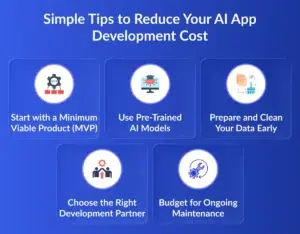
1. Start with a Minimum Viable Product (MVP)
Instead of building every feature at once, launch an MVP with only the most important AI functionality. This helps you validate your idea, gather real user feedback, and invest in additional features only after confirming market demand.
2. Use Pre-Trained AI Models
For most applications, pre-trained AI models and APIs are faster and more cost-effective than building a custom model from scratch. They reduce development time, require less data, and eliminate the high costs of model training and infrastructure.
3. Prepare and Clean Your Data Early
Well-organized, accurate data speeds up AI development and improves model performance. Cleaning and preparing your data before development begins helps avoid delays, reduces rework, and lowers overall project costs.
4. Choose the Right Development Partner
Development costs vary significantly depending on the location and experience of your team. Working with an experienced AI Software development company in regions with competitive pricing can help you build a high-quality application while staying within your budget.
5. Budget for Ongoing Maintenance
AI applications require regular updates, performance monitoring, and model improvements after launch. Planning a maintenance budget from the beginning helps prevent unexpected expenses and keeps your application secure, accurate, and reliable over time.
Final Thoughts
Now you know the real answer to “how much does it cost to develop an AI app.” The price depends on your app’s size, the AI features you choose, and the team you hire. Start small, plan your data early, and grow step by step.
Whether you want to build an AI app for your business or create an AI app as a personal project, the right plan keeps your budget in control and your app powerful.
If you want expert help, a trusted partner, Developer Bazaar Technology, offers full AI Development Services and Mobile application Development services that can guide you from idea to launch, without wasting your time or money.
FAQs
1. Should I use a pre-trained AI model or build a custom AI model?
For most startups and small businesses, pre-trained AI models are the better choice because they reduce development time, lower costs, and require less data. Custom AI models are recommended only when your business has unique requirements or needs specialized predictions that existing models cannot provide.
2. Which AI features increase app development costs the most?
Features such as computer vision, voice recognition, predictive analytics, recommendation engines, and custom large language models (LLMs) generally cost more because they require advanced AI development, larger datasets, additional testing, and greater computing resources than basic chatbot functionality.
3. Can I add AI to my existing mobile app instead of building a new one?
Yes. Many businesses integrate AI into their existing mobile applications by adding features like chatbots, image recognition, personalized recommendations, or voice search. This approach is often more affordable than rebuilding the entire application from scratch.
4. Is cross-platform AI app development cheaper than building separate Android and iOS apps?
In many cases, yes. Using frameworks like Flutter or React Native allows businesses to maintain a single codebase for both platforms, reducing development time and costs. However, some advanced AI features may still require platform-specific customization.
5. How much should I budget for AI app maintenance after launch?
A good rule of thumb is to allocate 15% – 25% of the initial development cost annually for maintenance. This budget covers AI model updates, cloud infrastructure, security patches, bug fixes, performance optimization, and compatibility with new operating system releases.
6. How do I know if my business actually needs an AI-powered app?
AI is valuable when your app needs to automate repetitive tasks, personalize user experiences, analyze large amounts of data, generate content, or make intelligent predictions. If your application only performs simple workflows, traditional software may be a more cost-effective solution.