
A complete, data-backed ranking of the best coding languages for jobs, salary, and long-term career growth.
Key Takeaways:
- Python remains the most in-demand programming language in 2026, driven by strong growth in AI, machine learning, data science, and automation.
- JavaScript and TypeScript continue to dominate web development, making them essential skills for frontend and full-stack developers.
- Enterprise technologies remain strong, with Java and C# offering stable career opportunities across banking, healthcare, and large-scale business applications.
- High-performance languages such as C++, Go, and Rust are increasingly sought after for cloud infrastructure, systems programming, cybersecurity, and modern software architecture.
- Mobile developers should focus on Kotlin for Android, Swift for iOS, or Dart for cross-platform app development with Flutter.
- SQL remains a must-have skill for developers, analysts, and data professionals because virtually every application relies on databases.
- Salary potential is often highest in specialized fields, with Rust, Go, Scala, and Swift developers frequently commanding premium compensation.
- The best language to learn depends on your career goals, but mastering one language deeply makes it easier to learn others and expand your opportunities over time.
Picking the right programming language can shape your entire career. Recruiters scan resumes for specific languages, companies build hiring plans around skill availability, and the list of best coding languages shifts a little every year as new tools enter the market and older ones fade. Whether you are choosing your first language, planning a job switch, or building a hiring plan, you need a clear, current view of which languages actually matter.
This guide ranks the top 20 high-demand programming languages using data from trusted sources, including the TIOBE Index, the Stack Overflow Developer Survey, GitHub Octoverse, and job platforms like Indeed and Glassdoor.
Each entry explains what the language does, why companies want it, where developers use it, and how much it typically pays. By the end, you will know exactly which languages dominate the job market and which one fits your goals best.
Quick Answer: Top Programming Languages in 2026
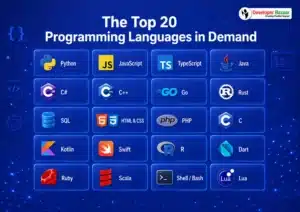
If you only have a minute, here is the short version. Ranked by overall job demand, these are the most in-demand programming languages of 2026:
- Python
- JavaScript
- TypeScript
- Java
- C#
- C++
- Go
- Rust
- SQL
- HTML & CSS
- PHP
- C
- Kotlin
- Swift
- R
- Dart
- Ruby
- Scala
- Shell / Bash
- Lua
Keep reading for the full breakdown of each language, including salary data, use cases, and which one you should learn first.
How We Ranked These Languages
This ranking combines four types of data instead of relying on a single source, since no single index tells the full story.
- The TIOBE Index tracks search volume for tutorials and information about each language.
- The Stack Overflow Developer Survey gathers responses from tens of thousands of working developers about what they actually use, admire, and want to skill.
- GitHub Octoverse studies real contribution activity across millions of repositories worldwide.
- Job board data from Indeed, Glassdoor, and CoderPad adds a hiring-demand layer on top.
Together, these four angles balance long-term popularity against current market demand, giving a more reliable picture than any single ranking alone.
2026 Programming Language Statistics: Demand, Jobs & Salaries
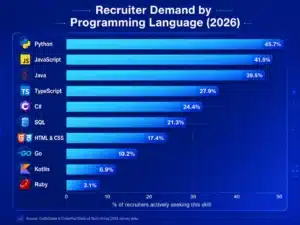
The chart below shows how many recruiters are actively seeking each skill, based on 2025-2026 hiring survey data, followed by a detailed breakdown of US job postings and salary ranges for all 20 languages.
Recruiter demand by programming language, based on the share of companies actively hiring for each skill.
Source: statista.com/
Job Postings & Demand by Language
| Language | US Job Postings | Recruiter Demand |
| Python | 89,000+ | 45.7% |
| JavaScript | 56,000+ | 41.5% |
| TypeScript | 44,000+ | 27.9% |
| Java | 77,000+ | 39.5% |
| C# | 32,000+ | 24.4% |
| C++ | 12,000+ | N/A* |
| Go | 4,100+ | 10.2% |
| Rust | 1,000+ | N/A* |
| SQL | 4,000+ | 21.3% |
| HTML & CSS | 8,600+ | 17.4% |
| PHP | 7,300+ | N/A* |
| C | N/A* | N/A* |
| Kotlin | 3,000+ | 6.9% |
| Swift | 600+ | N/A* |
| R | N/A* | N/A* |
| Dart | N/A* | N/A* |
| Ruby | 4,900+ | 3.1% |
| Scala | N/A* | N/A* |
| Shell/Bash | N/A* | N/A* |
| Lua | N/A* | N/A* |
* Some specialized languages are not tracked as standalone job categories on major job boards. Roles using these languages are typically listed under broader titles such as Embedded Engineer, Data Scientist, or DevOps Engineer, so a separate posting count or recruiter-demand percentage was not available.
The Top 20 High-Demand Programming Languages
Programming languages are the foundation of modern software development, powering everything from mobile apps and websites to AI systems and cloud platforms.
As technology continues to evolve, certain programming languages remain in high demand due to their versatility, performance, and strong career opportunities.
1. Python
Python tops nearly every major ranking, and the reason is simple: its clean, readable syntax lets beginners write working code within days, while libraries like TensorFlow, PyTorch, and scikit-learn make it the default choice for AI and machine learning work. The TIOBE Index places Python in the number one spot, and recruiter surveys consistently rank it as the single most requested skill in job postings worldwide.
Why it’s in demand: Python drives AI development, data science, backend web development, and automation. Startups and enterprises both lean on it for everything from chatbots to large data pipelines.
Best for: Beginners, data scientists, AI/ML engineers, backend developers.
Average salary: $98,000 – $169,000 per year (US).
2. JavaScript
JavaScript remains the only language that runs natively inside every web browser, which keeps it essential no matter how many new frameworks appear. A majority of professional developers use it regularly, and it anchors massive ecosystems like Node.js, React, and Next.js.
Why it’s in demand: Every interactive website, single-page application, and most React Native mobile apps rely on JavaScript in some form.
Best for: Frontend developers, full-stack engineers, web and cross-platform app builders.
Average salary: $90,000 – $160,000 per year (US).
3. TypeScript
TypeScript is the breakout story of the past two years. Built by Microsoft as a typed extension of JavaScript, it catches errors before code even runs, which matters more as AI coding tools generate larger volumes of code that need careful checking. Modern frameworks like Next.js and Angular now default to it when scaffolding new projects.
Why it’s in demand: Large engineering teams prefer TypeScript because its type system prevents costly bugs and keeps big codebases maintainable.
Best for: Web developers on large or long-term projects, teams using AI coding assistants.
Average salary: $58,000 – $129,000 per year (US), more at senior levels.
4. Java
Java has held a top-five spot in global rankings for more than two decades, with no sign of disappearing. Its platform independence, strong security, and proven scalability make it the backbone of enterprise software, banking systems, and Android apps. Recruiter demand keeps it among the top three most sought-after languages year after year.
Why it’s in demand: Large enterprises depend on Java for critical systems that must run reliably for decades, while Android still uses it alongside Kotlin.AI de
Best for: Enterprise developers, backend engineers, Android app developers.
Average salary: $91,000 – $158,000 per year (US).
5. C#
Microsoft built C# for the .NET ecosystem, and it has become the standard choice for Windows applications, enterprise software, and game development through Unity. C# recently posted one of the largest year-over-year demand gains of any language, helped by .NET’s expanding cross-platform support and tighter Azure integration.
Why it’s in demand: Companies already invested in the Microsoft stack need C# developers for business tools, cloud-native apps, and games.
Best for: .NET developers, enterprise software engineers, Unity game developers.
Average salary: $99,000 – $161,000 per year (US).
6. C++
C++ remains the go-to choice whenever raw performance matters most. Game engines like Unreal Engine, high-frequency trading systems, and a growing share of AI infrastructure depend on its ability to manage memory directly and run close to the hardware. It consistently ranks in the top four on the TIOBE Index.
Why it’s in demand: Performance-critical software, from video games to self-driving car systems, has no real substitute for C++’s speed and control.
Best for: Game developers, systems programmers, performance engineering roles.
Average salary: $90,000 – $151,000 per year (US).
7. Go (Golang)
Google designed Go to be simple, fast, and easy for large teams to use together, and that exact promise is why cloud-native companies adopted it so widely. Go powers core infrastructure tools like Docker and Kubernetes and handles high-volume concurrent requests with far less complexity than older languages.
Why it’s in demand: Cloud computing and microservices architecture both lean heavily on Go for reliable, scalable backend systems.
Best for: Backend engineers, DevOps specialists, cloud infrastructure developers.
Average salary: $107,000 – $181,000 per year (US), among the higher-paying languages here.
8. Rust
Developers have voted Rust the most admired programming language for ten years running, and that enthusiasm is finally turning into real hiring demand. Rust delivers C++-level speed with memory safety guaranteed at compile time, which is why Amazon, Microsoft, and Cloudflare have built critical infrastructure with it.
Why it’s in demand: Security-critical systems, blockchain platforms, and performance-sensitive infrastructure increasingly choose Rust over older systems languages.
Best for: Systems programmers, blockchain developers, security-focused engineers.
Average salary: $114,000 – $190,000 per year (US).
9. SQL
SQL is technically a query language rather than a general-purpose programming language, but no list of in-demand coding skills is complete without it. Nearly every application that stores data depends on a relational database, and SQL is how developers and analysts retrieve, update, and manage that data.
Why it’s in demand: Data drives every modern application, and SQL is the universal skill for working with structured data.
Best for: Backend developers, data analysts, database administrators.
Average salary: $105,000 – $162,000 per year (US).
10. HTML & CSS
HTML and CSS form the foundation of every website on the internet. HTML structures content, while CSS controls how it looks. Almost every developer learns both before moving on to JavaScript or any framework, and recruiters still list them among the most commonly required web skills.
Why it’s in demand: Every web project, however advanced the backend, still needs a solid HTML and CSS frontend layer.
Best for: Beginners, frontend developers, web designers.
Average salary: $70,000 – $127,000 per year (US) for dedicated web roles.
11. PHP
PHP carries an outdated reputation that does not match its real footprint. A large majority of websites running a server-side language still use PHP, often through modern frameworks like Laravel that have improved the developer experience significantly. WordPress alone, built on PHP, powers a huge share of the web.
Why it’s in demand: Countless existing sites and content management systems need ongoing PHP maintenance, even if it is rarely the first pick for brand-new projects.
Best for: Backend web developers working with WordPress, Laravel, or other CMS platforms.
Average salary: $81,000 – $149,000 per year (US).
12. C
C is the grandparent of modern programming languages, and it still holds a top spot in global popularity rankings. Operating systems, embedded devices, and firmware all run on C because of its direct control over hardware and memory, even though it rarely comes up in startup pitch meetings.
Why it’s in demand: Embedded systems, IoT devices, and operating system development all depend on C’s efficiency and predictability.
Best for: Embedded systems engineers, firmware developers, CS students learning core concepts.
Average salary: $90,000 – $150,000 per year (US), similar to C++ roles.
13. Kotlin
Google made Kotlin the preferred language for Android development back in 2019, and most professional Android developers have switched to it since. Kotlin offers more concise syntax than Java while staying fully compatible with existing Java code, and Kotlin Multiplatform now lets teams share code across Android, iOS, and web.
Why it’s in demand: Mobile-first companies need Android developers, and Kotlin has become the standard skill for that role.
Best for: Android developers, backend engineers already in the Java ecosystem.
Average salary: $127,000 – $134,000 per year (US).
14. Swift
Apple built Swift to replace Objective-C, and it has been the standard language for iOS, macOS, watchOS, and tvOS development since 2014. Its modern syntax and built-in safety features make app development faster and less error-prone, and Apple keeps investing in the language and its SwiftUI framework.
Why it’s in demand: Every iOS and macOS app on the App Store ultimately depends on developers who know Swift.
Best for: iOS developers and anyone building for the Apple ecosystem.
Average salary: $124,000 – $172,000 per year (US).
15. R
R has reclaimed ground in data science after losing some territory to Python over the past decade. It excels at classical statistical analysis and data visualization, which makes it a staple in academic research, bioinformatics, and financial modeling, and it recently climbed back into the TIOBE top ten.
Why it’s in demand: Statisticians, researchers, and financial analysts still prefer R for tasks that demand deep statistical rigor.
Best for: Data analysts, statisticians, academic researchers.
Average salary: $90,000 – $140,000 per year (US), in line with other data roles.
16. Dart
Dart would attract little attention on its own, but paired with Google’s Flutter framework, it has become a serious option for cross-platform app development. A single Dart and Flutter codebase can run on Android, iOS, web, and desktop, which appeals to teams that need to move fast.
Why it’s in demand: Startups and product teams favor Dart and Flutter when speed to market matters more than native platform optimization.
Best for: Mobile developers building cross-platform apps with small teams.
Average salary: $100,000 – $140,000 per year (US), similar to mobile dev pay.
17. Ruby
Ruby’s clean, readable syntax once made it one of the most loved web development languages, largely thanks to the Ruby on Rails framework. Its overall market share has declined as companies adopted other backend options, but Ruby still powers plenty of production applications, and Rails remains a fast way to launch a product.
Why it’s in demand: Established companies running on Rails, plus startups that value rapid development, continue to hire Ruby developers.
Best for: Backend developers, especially in startup environments.
Average salary: $95,000 – $170,000 per year (US).
18. Scala
Scala is a specialized choice rather than an everyday pick, but it dominates one specific niche: large-scale data processing. Apache Spark, the engine behind much of the world’s big-data infrastructure, runs on Scala, so data engineers handling massive datasets eventually run into it.
Why it’s in demand: Companies processing huge data volumes for analytics or machine learning pipelines need engineers who know Scala and Spark.
Best for: Data engineers and backend developers working with distributed systems.
Average salary: Often exceeds $130,000 per year (US) for specialized roles.
19. Shell / Bash
Shell scripting rarely tops popularity charts, but it quietly powers much of the world’s software infrastructure. Deployment scripts, automation tasks, and continuous integration pipelines all rely on Shell or Bash commands, and every backend or DevOps engineer needs at least working knowledge of it.
Why it’s in demand: Modern DevOps practices and cloud infrastructure management depend on Shell scripting for automation at scale.
Best for: DevOps engineers, system administrators, backend developers.
Average salary: $90,000 – $140,000 per year (US), usually bundled into DevOps pay.
20. Lua
Lua is small, fast, and built to be embedded inside other applications rather than used on its own. Game developers have scripted gameplay logic with it for years, most notably within Roblox, where its typed dialect Luau has become one of GitHub’s fastest-growing languages by percentage growth.
Why it’s in demand: Game studios and infrastructure tools that need lightweight, embeddable scripting continue to rely on Lua.
Best for: Game scripting specialists, developers building extensible tools.
Average salary: $80,000 – $130,000 per year (US), usually folded into game dev pay.
Comparison Table: Top Programming Languages at a Glance
Use this quick-reference table to compare all 20 languages side by side before reading the detailed sections above.
| Rank | Language | Best For | Trend |
| 1 | Python | AI/ML, data science, automation | Rising |
| 2 | JavaScript | Web frontend, full-stack apps | Stable |
| 3 | TypeScript | Large-scale, typed web apps | Rapidly rising |
| 4 | Java | Enterprise software, Android | Stable |
| 5 | C# | .NET apps, Unity games, Azure cloud | Rising |
| 6 | C++ | Games, performance-critical systems | Stable |
| 7 | Go | Cloud infrastructure, microservices | Rising |
| 8 | Rust | Systems, security, blockchain | Rapidly rising |
| 9 | SQL | Databases, data analysis | Stable, universal |
| 10 | HTML & CSS | Web structure and styling | Stable, universal |
| 11 | PHP | CMS, server-side web (WordPress, Laravel) | Gradually declining |
| 12 | C | Embedded systems, OS, firmware | Stable |
| 13 | Kotlin | Native Android, JVM backend | Stable |
| 14 | Swift | iOS, macOS app development | Stable |
| 15 | R | Statistics, academic research | Recovering |
| 16 | Dart | Cross-platform apps (Flutter) | Rising |
| 17 | Ruby | Web apps (Ruby on Rails) | Declining |
| 18 | Scala | Big data (Apache Spark) | Stable, niche |
| 19 | Shell/Bash | Automation, DevOps, CI/CD | Stable, universal |
| 20 | Lua | Game scripting, embedded tools | Stable, niche growth |
Which Programming Language Should You Learn First?
The best programming language to learn depends entirely on your goal, not on whatever tops a popularity chart this month. If you want to break into AI, data science, or you are coding for the first time, start with Python. Its gentle learning curve and large community make early mistakes easy to fix, and the skill transfers directly into one of today’s hottest job markets.
If your goal is building websites or web apps, start with JavaScript, then add TypeScript once you feel comfortable. JavaScript runs in every browser, so it gives you something visible and interactive almost immediately, while TypeScript adds the safety net professional teams expect.
Anyone targeting mobile app development should choose based on platform: Kotlin for native Android, Swift for native iOS, or Dart with Flutter for one codebase that covers both.
If enterprise software, banking systems, or large corporate IT environments interest you, Java or C# offer stable, long-term career paths with demand that rarely disappears even as other trends shift.
Finally, if you are drawn to systems programming, game engines, or performance-critical software, C++ and Rust both reward their steeper learning curves with some of the highest salaries on this entire list.
Final Thoughts
The programming language landscape shifts every year, but the underlying pattern stays consistent: languages that solve real, widespread problems stay in demand, while niche or outdated tools slowly fade from job postings. Python’s grip on AI and data science, JavaScript and TypeScript’s hold on the web, and steady enterprise demand for Java and C# all point to where most hiring will continue.
Rather than chasing whatever language trends online this month, pick one that matches the kind of work you actually want to do, and commit to learning it properly. Once you feel comfortable, adding a second or third language becomes far easier, and that combination of skills is exactly what makes developers valuable in today’s job market.

FAQs
1. What is the most in-demand programming language in 2026?
Python remains the most in-demand programming language in 2026 across nearly every major index, including TIOBE, Stack Overflow, and recruiter surveys. Its dominance comes from its central role in AI and machine learning development, paired with strong demand across data science, web development, and automation.
2. Which coding language should beginners learn first?
Python is the most recommended first language because of its readable syntax and large support community. If web development is your main interest, JavaScript makes more sense as a starting point, since it is the only language that runs natively inside web browsers.
3. Which programming language pays the highest salary?
Specialized languages like Rust, Go, and Scala tend to pay the highest average salaries because fewer developers know them well relative to demand. Python and JavaScript still offer strong overall pay simply because they appear in far more job postings across every experience level.
4. What is the difference between a programming language and a coding language?
There is no real difference. “Programming language” is the more formal, technical term, while “coding language” is the everyday version people use in casual conversation. Both describe the same thing: a structured language developers use to write instructions for computers.
5. How many programming languages exist today?
Estimates suggest more than 700 programming languages exist, but only around 20 to 30 see regular use in professional software development. The languages covered in this guide account for the overwhelming majority of production software written today.
6. Do professional developers need to know more than one language?
Yes. Most professional developers use multiple languages depending on the task at hand. A typical developer might use Python for data analysis, JavaScript for a web frontend, and SQL for database queries, all within the same week.