

Key Takeaways:
- White-label mortgage CRM solutions provide a customizable platform that helps lenders simplify loan management and improve customer engagement.
- Essential features such as loan origination, document management, automation, compliance tracking, and customer communication enhance operational efficiency.
- Development cost depends on factors like feature complexity, UI/UX design, technology stack, third-party integrations, and security requirements.
- Regular maintenance, security updates, and scalability are crucial for ensuring long-term performance, regulatory compliance, and business growth.
Buying a house is one of the biggest steps in a person’s life. But filling out mortgage papers, waiting for approvals, and running back and forth to the bank can feel slow and stressful. This is where mortgage software development helps. It makes the whole loan process faster, safer, and easier for everyone, such as banks, brokers, and home buyers.
In this mortgage software development guide, you will learn what mortgage software is, why businesses need it, what features it should have, how AI mortgage software development is changing the game, and how much it costs to build mortgage software.
Mortgage Software Market Overview
The mortgage industry is rapidly moving toward digital-first experiences as lenders, banks, and mortgage brokers look for faster and more efficient ways to serve customers. Today’s borrowers expect to apply for loans, upload documents, track application status, and receive approvals online without visiting a branch.
This shift is driving strong demand for mortgage software development solutions. Financial institutions are increasingly investing in custom mortgage software to automate loan processing, improve customer experiences, reduce operational costs, and meet evolving regulatory requirements.
The broader digital lending market is expected to reach approximately $20.5 billion by 2026, growing at a CAGR of nearly 13.8%. This growth is being fueled by technologies such as Artificial Intelligence (AI), machine learning, cloud computing, and automation, which help lenders make faster decisions, detect fraud, and streamline mortgage operations.
In addition, stricter compliance requirements around KYC (Know Your Customer), AML (Anti-Money Laundering), and data security are encouraging organizations to adopt modern mortgage management software that can handle these processes efficiently.
As competition increases, banks, fintech startups, and mortgage providers are turning to custom mortgage software development to deliver secure, scalable, and user-friendly lending experiences that meet the expectations of today’s digital consumers.
What Is Mortgage Software Development?
Mortgage software development means building computer programs and applications that help banks, lenders, and brokers manage home loans. This software helps with things like checking loan applications, verifying documents, calculating monthly payments, and keeping all customer information safe in one place.
Think of it like a smart helper. Instead of a person checking every paper by hand, the software checks it for them, quickly and correctly. This saves time for the bank and reduces stress for the person applying for the loan.
Why Do Businesses Need Custom Mortgage Software?
There are two main paths a company can choose. They can buy ready-made software, or they can build mortgage software made just for them.
Ready-Made Mortgage Software
Ready-made software is like buying a shirt off the shelf. It is quick to get and usually cheaper at the start. Companies can start using it almost right away because it has already been used and tested by many other businesses.
- Fast to set up and start using
- Lower starting cost, usually paid monthly
- Already tested, so fewer bugs
But an important thing to be considered is, ready-made software may not match every need of a business. It may not connect well with other systems the company already uses, and the company has to depend on another company for updates and support.
Custom Mortgage Management Software
Custom Mortgage Management Software is like getting a shirt tailored just for you. It is built around what your business actually needs. If you create mortgage software with custom features, it will match your rules, your customers, and your team’s way of working.
- Matches your exact business needs and rules
- Connects easily with banking systems, CRMs, and credit bureaus
- Can grow and change as your business grows
- Gives you full control, you don’t depend on another vendor
Many banks and mortgage brokers choose custom mortgage software solutions because rules around loans change often. A custom system can be updated quickly to follow new laws and stay safe for customers.
Types of Mortgage Software You Should Know
Not all mortgage software does the same job. Different tools handle different parts of the loan journey. Here are the main types used in mortgage software development services today.
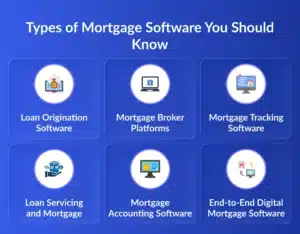
1. Loan Origination Software (LOS)
This software helps lenders collect documents, check the borrower’s details, and approve or reject a loan. It is the starting point of the whole mortgage journey.
2. Mortgage Broker Platforms
These platforms help brokers connect borrowers with the right lender. They link with credit bureaus and bank systems so brokers can quickly find the best loan deal for their customer.
3. Mortgage Tracking Software
This lets the borrower see exactly where their loan application stands, step by step. No more calling the bank again and again to ask, “Is my loan approved yet?”
4. Loan Servicing and Mortgage Management Software
Once a loan is approved, this software manages monthly payments, interest, and account records. Mortgage management software development in this area focuses on keeping payment records correct and on time.
5. Mortgage Accounting Software
This handles the money side, tracking payments, doing financial reports, and following rules like GDPR and PCI-DSS that protect customer data.
6. End-to-End Digital Mortgage Software
This is the most advanced type. It lets a person apply for, get approved for, and manage their entire home loan online, without ever visiting a bank branch. Many of these systems now use AI mortgage software development services to work even faster and smarter.
Must-Have Features in Mortgage Software
To build mortgage software that is easy to use and delivers a smooth experience, you need the right set of features. Below are the most important ones and why they matter.
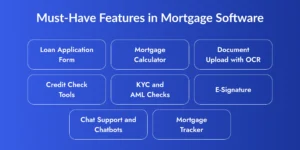
1. Loan Application Form
Instead of showing one long form, divide the loan application into smaller, easy-to-complete steps. This makes the process less overwhelming and improves completion rates.
2. Mortgage Calculator
A mortgage calculator helps users estimate how much loan they may qualify for and what their monthly repayments could be. This gives them a clearer picture before applying.
3. Document Upload with OCR
Users can upload important documents such as ID proofs, salary slips, and bank statements directly through the platform. OCR technology automatically reads and extracts information, reducing manual data entry.
4. Credit Check Tools
By connecting with credit bureaus, the software can quickly verify a user’s credit score and credit history. This speeds up the loan evaluation process and improves decision-making.
5. KYC and AML Checks
These checks help verify a user’s identity and ensure compliance with financial regulations. They also play an important role in preventing fraud and suspicious activities.
6. E-Signature
E-Signature functionality allows users to sign loan agreements and documents online. This removes the need for printing, scanning, or visiting a branch in person.
7. Chat Support and Chatbots
Chatbots can instantly answer common questions, while live chat support connects users with real agents when additional help is needed. This improves customer service and response times.
9. Mortgage Tracker
A mortgage tracker lets users monitor the progress of their loan application in real time. They can easily see whether their application is under review, approved, or funded.
These features are not just nice to have. They build trust. When users see that an app is clear, fast, and safe, they feel more confident using it for something as important as a home loan.
How AI Is Changing Mortgage Software Development
Artificial Intelligence (AI) is one of the biggest changes in the mortgage world today. AI mortgage software development is helping lenders work faster and smarter, and it is helping borrowers get answers quicker.
- Faster Approvals: AI can read documents and check details in seconds instead of days.
- Smarter Risk Checks: AI looks at a person’s financial history and predicts if they can repay the loan, helping lenders make safer choices.
- Fraud Detection: AI spots unusual patterns that may point to fake documents or fraud.
- AI Chatbots: These bots answer borrower questions any time of day, even at midnight.
- Personal Recommendations: AI can suggest the best loan plan based on a person’s income and goals.
Adding AI Integration into mortgage software is no longer just a “nice extra.” It is becoming an important part of staying competitive. Companies that use software development for their mortgage tools can offer a faster and smoother experience to their customers.
Process to Build Mortgage Software
Now understand how mortgage software is actually built. Whether you want to develop mortgage software for a small brokerage or a large bank, the process usually follows these steps.
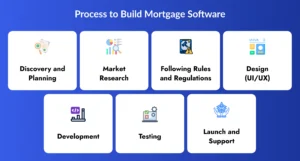
Step 1: Discovery and Planning
The project begins with understanding the business goals, target users, and challenges the software needs to solve. The development team works closely with stakeholders to define the project’s scope, key features, budget, and timeline.
For example, a mortgage brokerage may want software that helps customers apply for loans online, while a bank may need a complete platform that manages loan applications, approvals, underwriting, and servicing. Identifying these requirements early helps avoid costly changes later.
Step 2: Market Research
Before development starts, the team analyzes the market to understand user expectations, industry trends, and competitor offerings. This research helps identify opportunities to build a better and more competitive product.
For instance, if competing mortgage platforms require users to manually enter financial information, adding features such as OCR-based document processing and automated data extraction can create a faster and more convenient user experience.
Step 3: Following Rules and Regulations
Mortgage software handles highly sensitive personal and financial data, making regulatory compliance a critical part of the development process. The platform must follow industry standards and legal requirements to protect both users and lenders.
Mortgage software must follow strict rules to protect people’s personal and money information.
- GDPR for keeping customer data private and safe.
- PCI-DSS for keeping payment information safe.
- AML/KYC checks for stopping fraud and confirming who a person is, following guidance from agencies such as the Financial Crimes Enforcement Network (FinCEN).
In the United States, lenders also follow the mortgage rules published by the Consumer Financial Protection Bureau (CFPB), which explains how loan applications and disclosures must be handled to protect borrowers.
Step 4: Design (UI/UX)
A well-designed interface makes the mortgage process easier and less stressful for users. Designers create wireframes, prototypes, and user journeys to ensure every step is simple and intuitive.
For example, instead of showing a lengthy loan application form on a single page, the process can be divided into smaller sections such as personal information, income details, property information, and document uploads. This improves user engagement and reduces application abandonment.
The design should also provide a consistent experience across smartphones, tablets, and desktop devices.
Step 5: Development
Once the design is finalized, developers begin building the actual software. This includes creating the user interface, backend systems, databases, APIs, and integrations with third-party services.
A typical technology stack may include:
- Python, Java, or JavaScript for backend development.
- React or Angular for creating responsive user interfaces.
- AWS, Microsoft Azure, or Google Cloud for secure cloud hosting and scalability.
During this stage, developers may also integrate services such as credit score providers, e-signature platforms, payment gateways, and document verification tools.
Step 6: Testing
Before launch, the software undergoes extensive testing to ensure everything works as expected. Testing helps identify bugs, security vulnerabilities, and performance issues before users encounter them.
Different types of testing include:
- Functional testing to verify features work correctly.
- Security testing to protect sensitive financial data.
- Performance testing to ensure the platform can handle thousands of users simultaneously.
- Cross-browser testing to provide a consistent experience across devices.
For example, testers may simulate hundreds of users submitting loan applications at the same time to ensure the platform remains stable during peak demand.
Step 7: Launch and Support
After successful testing, the software is deployed and made available to real users. However, launching the platform is only the beginning.
Ongoing maintenance is essential to keep the software secure, compliant, and competitive. Development teams regularly release updates, fix bugs, improve performance, and introduce new features based on user feedback and changing market requirements.
For example, a lender may later decide to add AI-powered loan recommendations or automated underwriting capabilities, requiring continuous platform enhancements.
Cost to Build Mortgage Software
One of the most common questions business owners ask is: what is the mortgage software development cost?
The honest answer is, it depends. The cost to build mortgage software changes based on how many features you want, how complex the system is, and which country your development team is based in.
Cost Based on Complexity
| App Complexity | Average Timeline | Average Cost |
| Simple solution with basic features | 3 – 4 months | $30,000 – $50,000 |
| Medium complexity with moderate features | 4 – 9 months | $50,000 – $120,000 |
| Highly complex system with advanced features (including AI) | 9 months to 1 year or more | $120,000 – $300,000 or more |
Cost Based on Developer Location
| Region | Hourly Price Range |
| North America | $40 – $250 / hour |
| Australia | $35 – $150 / hour |
| Western Europe | $35 – $180 / hour |
| South America | $25 – $120 / hour |
| Eastern Europe | $25 – $110 / hour |
| India and Asia | $20 – $80 / hour |
As you can see, hiring a development team from India and Asia is often more budget-friendly without giving up on quality. Many global companies now choose teams from this region for mortgage software development outsourcing.
What Affects the Final Cost?
- Number and complexity of features
- Integrations needed (credit bureaus, banks, payment systems)
- Whether you build a software, web app, or mobile app
- How strict the compliance and security requirements are
- Choice of technology stack, including AI tools, which significantly influence the cost to develop custom software.
- Ongoing maintenance and support after launch
Why Choose Custom Mortgage Software Solutions
To sum it all up, here is why so many businesses are choosing to invest in custom mortgage software solutions instead of off-the-shelf options:
- Built around your exact business needs, not someone else’s
- Easier to follow changing legal rules
- Can connect smoothly with your other systems and tools
- Ready for the future with AI mortgage software development built in
- Gives your business a real edge over competitors using basic tools
Whether you are a bank, a mortgage broker, or a fintech startup, working with a team that offers complete mortgage software development services and solutions, from planning to AI integration, can help turn your idea into a safe, smart, and easy-to-use product while optimizing the cost to develop custom software.

Wrapping Up
Mortgage software development is quickly becoming a must-have for any business in the home loan industry. From simple mortgage calculators to advanced AI-powered systems, the right software can save time, reduce errors, and make home buyers happier.
If you are planning to build mortgage software, start by listing what problems you want to solve, choosing the right features, and picking a digital product development company who understands both technology and the mortgage industry’s rules. With the right plan, you can create mortgage software that is safe, smart, and built to last.
FAQs
1. Should I buy ready-made software or build custom mortgage software?
Ready-made software is faster and cheaper to start with, but it may not fit every business need. Custom mortgage software solutions cost more upfront but match your exact rules, connect easily with your other systems, and can grow with your business over time.
2. Do I need a mobile app along with mortgage software?
Most lenders today build both a website and a mobile app so borrowers can apply for loans, upload documents, and track their application from anywhere. Working with an experienced app and software development company helps the app run smoothly for the large number of Android users worldwide.
3. How does OCR technology improve mortgage loan processing?
OCR (Optical Character Recognition) automatically extracts information from documents such as bank statements, salary slips, and identity proofs. This reduces manual data entry, speeds up verification, and minimizes human errors.
4. What third-party integrations are commonly used in mortgage software?
Common integrations include credit scoring services, identity verification providers, payment gateways, e-signature platforms, accounting software, fraud detection systems, and customer communication tools.
5. Is cloud-based mortgage software better than on-premise solutions?
Cloud-based mortgage software offers easier scalability, lower infrastructure costs, automatic updates, and remote accessibility. However, some financial institutions may choose on-premise deployment due to internal security or regulatory requirements.
6. How can AI improve mortgage underwriting?
AI can analyze financial data, credit history, income patterns, and risk factors much faster than manual processes. This helps lenders make more accurate underwriting decisions while reducing approval times.