

Planning a short family trip should feel exciting, not stressful. But many travelers still spend hours checking hotel websites, comparing prices, reading reviews, and getting confused before making a booking.
Today, users expect everything to work smoothly in just a few taps, just like the experience offered by Booking.com. This growing demand has pushed many businesses to invest in hotel booking apps. However, building a hotel booking platform is not as simple as it looks.
Without proper planning, businesses often overspend on unnecessary features or launch apps that feel slow and difficult to use. That is why understanding the Hotel Booking App Development Cost before starting is very important.
On average, the cost to develop hotel booking app solutions ranges between $20,000 and $80,000, depending on features, design complexity, platforms, and integrations. The complete development timeline usually takes around 3 to 9 months.
Whether you are a startup, hotel chain, or travel business, this guide will help you understand what is worth your investment in 2026.
Is Building a Hotel Booking App Still Worth the Investment in 2026?
Yes, building a hotel booking app is still a smart investment in 2026 — but only if you build it with the right strategy.
The travel industry continues to grow rapidly. More travelers now prefer booking hotels online instead of calling hotels directly. They want faster search, better prices, secure payments, and instant confirmation.
According to market reports, the online accommodation booking market was valued at $340.92 billion in 2025 and is expected to grow from $361.54 billion in 2026 to $484.95 billion by 2031, expanding at a 6.05% CAGR during the forecast period.
This growth creates huge opportunities for businesses that want to develop hotel booking app platforms.
Why Businesses Are Investing in Hotel Booking Apps?
- Direct Bookings Save Money: A hotel booking app helps businesses reduce OTA commission costs and increase direct booking profits. It also gives full control over customer data and improves customer retention.
- Travelers Want Better User Experience: Modern hotel booking apps offer faster search, smooth navigation, secure payments, and easy booking experiences.
- Mobile Bookings Are Growing Fast: Most travelers now prefer booking hotels through smartphones because mobile apps provide faster bookings and convenient payment options.
- AI Integration Creates Competitive Advantage: AI integration helps hotel booking apps deliver smart recommendations, chatbot support, dynamic pricing, and personalized travel experiences to improve customer engagement.
Different Types of Hotel Booking Apps: Which One is Best?
Not every hotel booking app works the same way. Choosing the right business model is very important because it directly affects your Hotel Booking App Development Cost.
Below are the main types of hotel booking apps.
| App Type | How It Works | Examples | Revenue Model | Best For |
| OTA Platform | Full hotel marketplace with booking and payments | Booking.com, Airbnb | Commission fees | Large travel businesses |
| Aggregator App | Compares prices from multiple platforms | Trivago, Kayak | Ads and referral income | Traffic-based businesses |
| Hotel Chain App | Dedicated app for one hotel brand | Marriott Bonvoy | Direct bookings | Hotel groups |
| Corporate Travel App | Business travel management | Navan | Subscription model | Corporate travel companies |
| Niche Booking App | Focused traveler category | Hipcamp | Commission + subscriptions | Startups targeting niche users |
Hotel Booking App Development Process: Step-by-Step Guide
A successful travel app development project requires proper planning and execution. Below is the complete step-by-step process to create hotel booking app platform.
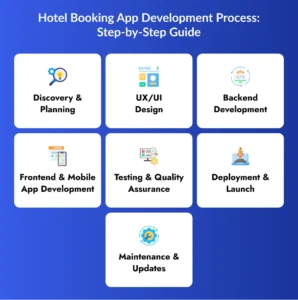
Step 1: Discovery & Planning
This is the first and most important stage of hotel booking app development. The development team understands your business goals, target audience, required features, competitors, and project budget. Businesses also decide whether they need an Android app, iOS app, web platform, or cross-platform solution. Proper planning helps reduce risks and avoids unnecessary development costs later.
Estimated Cost: $2,000 – $5,000
Timeline: 2 – 4 weeks
Step 2: UX/UI Design
A simple and attractive design helps users book hotels faster and improves customer experience. Designers create wireframes, user journeys, interactive prototypes, and booking flows to make navigation smooth and easy. A well-designed interface also increases user engagement and booking conversions.
Estimated Cost: $3,000 – $10,000
Timeline: 3 – 6 weeks
Step 3: Backend Development
Backend development builds the core functionality of the hotel booking app. Developers create the booking engine, user management system, hotel listings, payment processing, notifications, and database structure. This stage also includes API integrations with hotel systems and travel service providers for real-time booking updates.
Estimated Cost: $8,000 – $25,000
Timeline: 6 – 12 weeks
Step 4: Frontend & Mobile App Development
In this stage, developers build the actual user interface that customers interact with. Technologies like React Native, Flutter, Swift, and Kotlin are commonly used to create fast and responsive hotel booking apps. Cross-platform development helps businesses reduce costs while launching apps on both Android and iOS platforms.
Estimated Cost: $10,000 – $30,000
Timeline: 6 – 10 weeks
Step 5: Testing & Quality Assurance
Testing ensures the app works smoothly across all devices and platforms before launch. The QA team checks app speed, security, payment systems, booking flow, search filters, and overall performance. Proper testing is important because even small issues can affect customer trust and lead to booking losses.
Estimated Cost: $3,000 – $8,000
Timeline: 4 – 8 weeks
Step 6: Deployment & Launch
Once the app passes testing, it is launched on the Google Play Store, Apple App Store, and web servers. Developers also monitor the app during launch to quickly fix any performance or technical issues. A smooth deployment process helps businesses deliver a better experience to users from day one.
Estimated Cost: $2,000 – $5,000
Timeline: 2 – 4 weeks
Step 7: Maintenance & Updates
After launch, regular maintenance is needed to keep the app secure, updated, and high-performing. Businesses invest in bug fixes, security updates, performance improvements, new features, and AI integration enhancements. Continuous updates help improve user experience and keep the app competitive in the travel market.
Annual Maintenance Cost: Around 15% – 25% of the total development cost
Cost to Develop Hotel Booking App
The Hotel Booking App Development Cost mainly depends on the app’s complexity, features, design quality, third-party integrations, and technology stack. A simple hotel booking app with basic search and payment features will cost much less than a large OTA platform with AI integration, real-time inventory management, and advanced analytics.
| App Complexity | Features | Estimated Cost |
| Basic MVP App | Hotel search, booking, payment | $20,000 – $40,000 |
| Mid-Level App | Reviews, filters, maps, notifications | $40,000 – $80,000 |
| Advanced OTA App | AI integration, loyalty system, analytics, multi-language | $80,000 – $200,000+ |
What Drives the Price Up?
Several factors directly affect the Hotel Booking App Development Cost. The more advanced features, integrations, and customizations you add, the higher the overall development budget becomes. Understanding these factors helps businesses plan their investment more effectively.
1. Platform Choice
Building separate apps for Android, iOS, and web platforms increases both development time and cost. Each platform requires different coding, testing, and maintenance processes. Many businesses now choose cross-platform technologies like React Native or Flutter to reduce development expenses by nearly 30% – 40%.
2. Third-Party Integrations
Hotel booking apps often need integrations with payment gateways, PMS systems, GDS providers, maps, and CRM software. These integrations help provide real-time booking updates and better customer management. However, each integration adds more complexity, testing, and ongoing maintenance costs.
3. Custom Design
Apps built using ready-made templates are more affordable but offer limited customization. A custom UI/UX design creates a unique user experience and stronger brand identity, but it requires additional design work, testing, and development time. This significantly increases the overall project cost.
4. AI Integration
Modern hotel booking apps are increasingly using AI integration for personalized recommendations, chatbots, and smart search functionality. Adding AI features requires skilled AI engineers, machine learning models, and data processing systems. Because of this, AI-powered apps are usually more expensive to develop.
5. App Security
Hotel booking apps handle sensitive customer information, including payment details and personal data. Strong security features like data encryption, PCI DSS compliance, secure authentication, and fraud protection are necessary to protect users. Advanced security implementation increases development and maintenance costs.
6. Development Team Location
The cost to develop hotel booking app solutions also depends on the location of your Mobile App Development Company. Developers in the US usually charge higher hourly rates compared to offshore teams in Asia or Europe. Many startups prefer offshore development because it offers quality development at lower costs.
| Region | Hourly Rate |
| US | $100 – $200+ |
| LATAM | $35 – $95 |
| Europe | $40 – $110 |
| Asia | $25 – $65 |
7 Benefits of Building an App Like Booking. Com For Businesses
Building a hotel booking app helps businesses improve customer experience, increase direct bookings, and strengthen their digital presence. Here are some major benefits businesses can achieve with hotel booking app development.
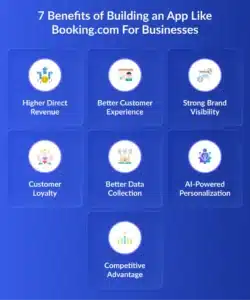
1. Higher Direct Revenue
A dedicated hotel booking app helps businesses reduce dependency on third-party OTA platforms. This allows companies to avoid high commission charges and increase their direct booking profits.
2. Better Customer Experience
Users prefer fast and smooth booking experiences on mobile apps. A well-designed booking app makes hotel search, room selection, and payment processing much easier for customers.
3. Strong Brand Visibility
A branded mobile app helps businesses build a stronger online presence in the travel industry. It also improves customer trust and keeps the brand visible on users’ smartphones.
4. Customer Loyalty
Hotel booking apps can include loyalty programs, reward points, and personalized discounts to encourage repeat bookings. These features help businesses improve long-term customer retention.
5. Better Data Collection
Businesses can track customer behavior, booking patterns, and user preferences through their own app. This valuable data helps improve marketing strategies and customer engagement.
6. AI-Powered Personalization
AI integration allows businesses to provide personalized hotel recommendations, smart offers, and AI chatbot support. This improves customer satisfaction and increases booking conversions.
7. Competitive Advantage
A modern hotel booking app helps businesses compete with top hotel booking apps in the market. Advanced features, better user experience, and direct customer engagement create a strong competitive edge.
Conclusion
The demand for hotel booking apps continues to grow rapidly in 2026. Travelers want fast, simple, and personalized booking experiences directly from their mobile devices.
The average Hotel Booking App Development Cost ranges between $20,000 and $80,000, while advanced platforms may cost much more depending on features, integrations, and AI capabilities.
Businesses that carefully plan their travel app development strategy can create scalable platforms that increase bookings, improve customer loyalty, and reduce dependency on third-party travel websites.
Whether you want to build hotel booking app solutions for a niche audience or create a large OTA platform, partnering with an experienced Mobile App Development Company can help you save time, reduce risks, and launch successfully.
Choosing the right Hotel Booking App Development Services provider is one of the most important decisions for long-term success.

FAQs
1. Can a hotel booking app support multiple currencies and languages?
Yes, modern hotel booking apps can support multiple currencies and languages to serve global travelers. This improves user experience and helps businesses expand into international markets.
2. Which payment gateways can be integrated into a hotel booking app?
Hotel booking apps can integrate popular payment gateways like Stripe, PayPal, Razorpay, and Apple Pay. The choice depends on your target audience and business location.
3. Is cloud hosting important for hotel booking apps?
Yes, cloud hosting helps hotel booking apps handle high traffic, improve performance, and store large amounts of booking data securely. It also supports easy scalability as the business grows.
4. Can businesses add cancellation and refund management features?
Yes, hotel booking apps can include cancellation, refund, and rescheduling features. These options improve customer convenience and reduce manual support work for businesses.
5. How do hotel booking apps generate revenue?
Hotel booking apps can earn revenue through booking commissions, subscription plans, featured hotel listings, advertisements, and service fees. Many businesses also generate profits through direct hotel partnerships.
6. Why is API integration important in hotel booking apps?
API integrations help apps connect with hotel databases, payment systems, maps, and travel providers. This allows users to access real-time room availability, pricing, and booking confirmations.
7. Can hotel booking apps include loyalty and rewards programs?
Yes, businesses can add loyalty programs that offer reward points, discounts, cashback, and special offers. These features help improve customer retention and encourage repeat bookings.