
Today, businesses communicate with customers across many platforms, including email, WhatsApp, social media, and websites. Managing all these channels manually takes a lot of time and effort.
When you build an AI agent for multi-channel outreach, you create a smart system that can talk to customers, send messages, follow up, and even manage leads automatically. These systems are also called autonomous AI agent for outreach because they can work on their own without constant human help.
In this blog, you will learn how to create an AI agent for multi-channel outreach, its features, cost, and future trends in a simple and easy way.
What Is an AI Agent for Multi-Channel Outreach?
An AI agent for multi-channel outreach is like a smart digital assistant that helps businesses talk to customers in real time. It can understand customer needs, send replies, and manage conversations across different platforms without human help. When you create an AI agent for multi-channel outreach, you build a system that can handle communication smoothly and efficiently.
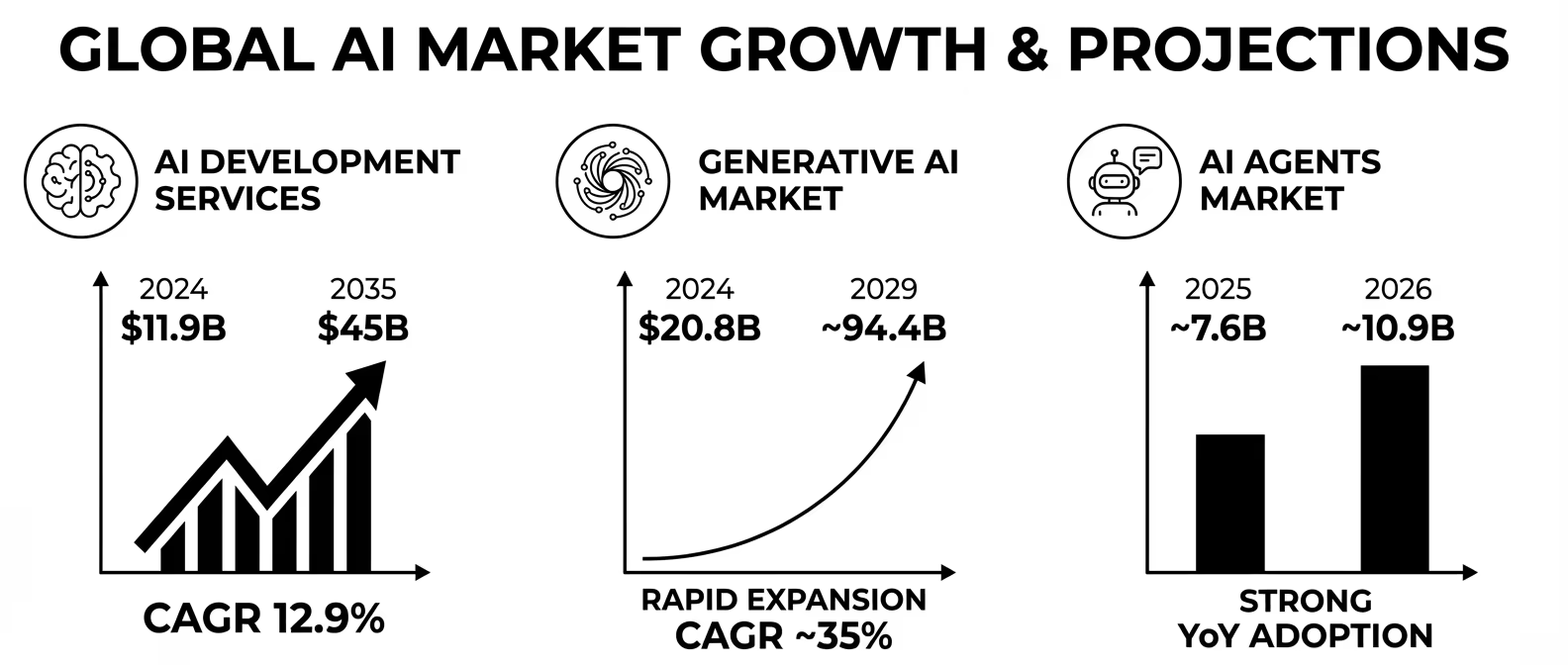
The demand for such AI solutions is growing very fast. The global AI agents market size is projected to reach USD 182.97 billion by 2033, growing at a CAGR of 49.6% from 2026 to 2033. This growth is driven by the increasing need for automation, better natural language processing (NLP), and the rising demand for personalized customer experiences.
An AI agent for managing leads plays an important role in business growth. It can collect customer data, send messages, follow up with leads, and even book meetings automatically. This helps businesses save time and never miss a potential customer.
At the same time, an AI agent for managing phone calls can handle voice communication. It can answer incoming calls, talk in a human-like way, and solve basic customer queries. This makes customer support faster and more efficient. They can:
- Work automatically without manual effort
- Learn from data and past interactions
- Improve their performance over time
This makes AI agents a powerful tool for modern businesses looking to scale their outreach and improve customer engagement.
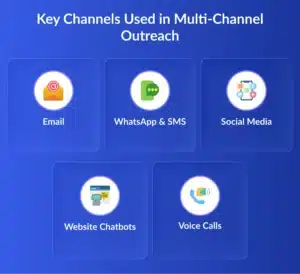
Key Channels Used in Multi-Channel Outreach
To build AI agent for multi channel outreach, you must connect it with different communication platforms. Each channel plays a unique role in reaching and engaging customers.
Understand them in detail:
1. Email
Email is one of the most powerful and widely used outreach channels. AI can send personalized emails based on customer behavior, interests, and past interactions. It can also automate follow-ups, ensuring no lead is missed. This helps businesses build strong relationships and improve response rates over time.
2. WhatsApp & SMS
WhatsApp and SMS are great for quick and direct communication. AI can send instant updates, reminders, promotional offers, and important alerts. Since people check messages more often than emails, this channel helps businesses connect faster and increase engagement. It is especially useful for time-sensitive communication.
3. Social Media
Social media platforms like LinkedIn, Instagram, and Facebook are important for modern outreach. AI can automatically reply to messages, comments, and inquiries from users. It can also engage with potential customers and nurture leads through regular interaction. This helps businesses stay active and responsive without manual effort.
4. Website Chatbots
Website chatbots allow businesses to talk to visitors in real time. AI-powered chatbots can answer questions, guide users, and collect important information. They are available 24/7, which means customers get instant support anytime they visit your website. This improves user experience and increases the chances of conversion.
5. Voice Calls
Voice communication is still very important for many businesses. With an AI agent for managing phone calls, companies can automate both customer support and sales calls. The AI can answer calls, speak naturally, and handle basic queries without human involvement. This reduces the workload for quick response to every caller.
Core Features of an AI Outreach Agent
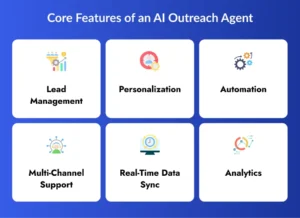
When you create an AI agent for multi-channel outreach, it should include important features that make communication smarter and more efficient.
Here are the key features explained in detail:
1. Lead Management
An AI agent for managing leads helps businesses collect, track, and organize customer information in one place. It keeps data like contact details, interactions, and preferences well-structured. This makes it easier to understand leads and move them through the sales process smoothly.
2. Personalization
Personalization means sending the right message to the right person. The AI analyzes user behavior, past interactions, and preferences to create customized messages. This makes customers feel valued and increases the chances of engagement and conversion.
3. Automation
Automation allows the AI agent to handle repetitive tasks without human effort. It can send welcome messages, reminders, and follow-ups automatically based on triggers. This saves time and makes sure that no important communication is missed.
4. Multi-Channel Support
A good AI agent works across multiple platforms like email, chat, social media, and voice calls. This allow consistent communication with customers, no matter where they are. It helps businesses manage all interactions from a single system.
5. Real-Time Data Sync
An autonomous AI agent for real-time data syncs keeps all customer data updated instantly across different tools and platforms. This means every team always sees the latest information. It reduces errors and improves decision-making.
6. Analytics
Analytics helps businesses measure how well their outreach is performing. The AI tracks important metrics like email open rates, click rates, and response rates. These insights help improve strategies and make better business decisions.
Step-by-Step Guide to Building an AI Outreach Agent
Building an AI outreach agent may sound complex, but you can break it down into simple steps. When you build an AI agent for multi-channel outreach, following a clear process helps you create a system that works smoothly and delivers good results.
Step 1: Define Your Goal
Start by deciding what you want your AI agent to do. It could focus on sales, customer support, or marketing. For example, you may want it to generate leads, answer customer questions, or promote products. Clear goals make it easier to plan features and workflows. This step is very important when creating an AI agent that manages outreach, as it sets the direction for the entire system.
Step 2: Choose the Right Technology
Next, select the right tools and technologies for your project. You can work with an experienced AI development company that provides AI tools, cloud platforms, and APIs. These technologies help your agent run smoothly and scale easily. You can also use agentic AI development services to build more advanced and intelligent systems. Choosing the right tech stack for better performance and future growth.
Step 3: Collect and Prepare Data
AI systems need good-quality data to function properly. Collect important data like customer details, chat history, and purchase behavior. This data helps the AI understand user needs and respond correctly. Make sure the data is clean, organized, and up to date. Proper data preparation improves accuracy and makes your AI agent more reliable.
Step 4: Build or Integrate AI Models
In this step, you start Integrating AI into your system. You can use chatbots for text conversations, voice assistants for calls, and language models for understanding user queries. These AI models help your system think, respond, and learn from interactions. You can either build custom models or use pre-built solutions based on your needs and budget.
Step 5: Connect Multiple Channels
To build AI agent for multi channel outreach, you must connect it with different communication platforms. These include email tools, WhatsApp APIs, social media platforms, and CRM systems. This integration allows your AI agent to manage conversations from one place. It helps in a smooth and consistent experience for users across all channels.
Step 6: Design Smart Conversations
Your AI agent should communicate in a simple and friendly way. Design conversations that are easy to understand and helpful for users. The AI should be able to understand questions, give clear answers, and guide users properly. Good conversation design improves user experience and builds trust with customers.
Step 7: Automate Workflows
Automation is a key part of any outreach system. Set triggers for different actions, such as sending a message after signup, following up when there is no reply, or reminding users about meetings. This reduces manual work and maintain timely communication. Automation makes your system faster and more efficient.
Step 8: Test and Improve
Once your AI agent is ready, test it carefully across all channels. Check if the responses are accurate and helpful. Fix any errors and improve the system based on feedback. Regular testing helps you make the AI smarter over time. This step is important for building a strong and reliable autonomous AI agent for outreach that performs well in real situations.
Cost to Build an AI Outreach Agent
The cost to build an AI agent depends on features, complexity, and integrations. Here’s a clearer breakdown with estimated pricing:
| AI Agent Type | Features Included | Description | Estimated Cost |
| Basic AI Agent | – Simple chatbot
– 1-2 channels (email or chat) – Basic automation |
A simple solution for small businesses. It can handle basic queries and send simple messages, but has limited intelligence. | $15,000 – $25,000 |
| Mid-Level AI Agent | – Multi-channel support
– CRM integration – Automated workflows |
A more advanced system that can manage leads, send follow-ups, and work across multiple platforms efficiently. | $25,000 – $50,000 |
| Advanced AI Agent | – Full automation
– Voice + chat support – Real-time data sync – AI personalization |
A powerful system with an autonomous AI agent for real-time data syncs, smart conversations, and high-level automation for large businesses. | $50,000 – $150,000+ |
Future Trends in AI Outreach
AI outreach is changing quickly with new technologies and smarter systems. These future trends will help businesses communicate better, automate tasks, and improve customer experience.
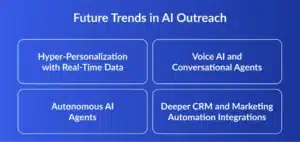
1. Hyper-Personalization with Real-Time Data
In the future, AI will send highly personalized messages using real-time data. This means the system will understand what users are doing at that moment and respond accordingly. For example, if a user visits a product page, the AI can instantly send a relevant message or offer. This level of personalization will improve customer experience and increase engagement.
2. Voice AI and Conversational Agents
Voice technology is growing fast, and more businesses will use AI for voice communication. Tools like AI agent for managing phone calls will become smarter and more human-like. These agents will handle customer support, sales calls, and queries with natural conversations. This will make communication faster and more comfortable for users.
3. Autonomous AI Agents
Future systems will rely more on an autonomous AI agent for outreach that can work without human intervention. These agents will manage complete workflows, from lead generation to conversion. They will learn from data, make decisions, and improve automatically. This will reduce manual work and increase efficiency for businesses.
4. Deeper CRM and Marketing Automation Integrations
AI will connect more deeply with CRM and marketing tools. By better Integrating AI, businesses can sync data across platforms in real time. This helps in tracking customer journeys, managing leads, and improving campaigns. It also enables that all teams have updated information, leading to better decision-making.
Conclusion
When you build an AI agent for multi-channel outreach, you create a smart solution that can handle communication, manage leads, and improve customer engagement across different platforms.
From emails and social media to voice calls, AI helps businesses stay connected with their customers 24/7. With features like automation, personalization, and real-time updates, an autonomous AI agent for outreach can save time, reduce manual work, and increase conversions.
By working with the right AI development company, businesses can build powerful and scalable solutions. As technology continues to grow, integrating AI into outreach strategies will become essential for staying competitive in the market.
FAQs
1. Can AI outreach agents work for small businesses?
Yes, AI agents can be used by businesses of all sizes, including small businesses. You can start with a simple setup like a chatbot or email automation and gradually add more features as your business grows. This makes it a flexible and cost-effective solution.
2. How long does it take to build an AI outreach agent?
The time required depends on the features and complexity of the system. A basic AI agent with limited functionality can be built in a few weeks. However, a more advanced system with multiple channels and integrations may take a few months to develop properly.
3. Do AI outreach agents require constant monitoring?
No, AI outreach agents are designed to work automatically without constant supervision. However, it is important to check the system from time to time to check, it is working correctly. Regular updates and improvements help maintain accuracy and performance.
4. Can AI agents integrate with existing tools?
Yes, AI agents can easily connect with existing tools like CRM systems, email platforms, and marketing software. This allows smooth data sharing and better coordination between different systems. It also helps businesses manage everything from one place.
5. Are AI outreach agents secure?
Yes, AI agents can be very secure if they are built using proper security practices. They use encryption, secure APIs, and data protection methods to keep customer information safe. It is important to follow security standards during development.
6. How do AI agents improve customer engagement?
AI agents respond quickly and are available 24/7, which helps keep customers engaged at all times. They also send personalized messages based on user behavior and preferences. This makes communication more relevant and improves overall customer experience.