


Agentic AI is a new generation of artificial intelligence that does more than respond. It thinks, plans, acts, and learns on its own. Unlike normal chatbots, agentic systems can:
- Understand a business goal
- Break it into steps
- Use tools and APIs
- Complete multi-step tasks
- Learn from feedback
This blog explains how to create an agentic AI system from the ground up using simple and clear steps. Whether you are a startup or an enterprise, this guide will help you understand the full process of building Agentic AI system successfully.
What is Agentic AI?
Agentic AI is a type of AI that can think and act independently to achieve goals without constant human help. It does not just answer questions like a chatbot. Instead, it:
- Decides what to do next
- Uses tools and software
- Handles multi-step workflows
- Adjusts when things change
Generally, it behaves like a smart assistant that can manage tasks from start to finish.
For example:
- It can monitor competitors and send weekly reports.
- It can analyze support tickets and suggest improvements.
- It can manage workflows and update systems automatically.
This is why businesses want to develop an Agentic AI system to improve productivity and save time.
How Does Agentic AI Work?
Agentic AI follows four main steps to complete tasks independently. Each step plays an important role in helping the system think and act like a smart assistant.
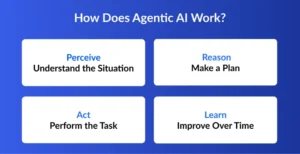
1. Perceive – Understand the Situation
In this step, the AI collects information from different sources. It gathers data from databases, apps, APIs, and real-time systems to understand what is happening.
This step is like the AI “looking and listening” before doing anything. For example, if the goal is to create a sales report, it first collects all relevant sales data from the system to understand the full picture.
2. Reason – Make a Plan
After collecting the data, the AI starts thinking. It analyzes the information and decides the best way to complete the task. It may break the task into smaller steps, choose the right tools, and collect additional data if needed. Using advanced language models and reasoning systems, it creates a clear action plan before moving forward.
3. Act – Perform the Task
Once the plan is ready, the AI begins executing it. It connects with tools, software, and APIs to carry out actions automatically. For example, it can send emails, update CRM systems, generate reports, or trigger workflows. You can also set safety rules and limits to make sure the system works securely and stays within defined boundaries.
4. Learn – Improve Over Time
After completing the task, the AI does not stop there. It reviews the results and checks whether the outcome met the goal. It learns from user feedback, task results, and any mistakes made during the process. This learning step helps the system improve its performance and make better decisions in the future.
How to Build Agentic AI from Scratch
To successfully build an Agentic AI system, you need a clear strategy, the right technology, quality data, and continuous improvement. Below is a simple, step-by-step process to help you understand how to develop a powerful and reliable agentic AI solution from scratch.
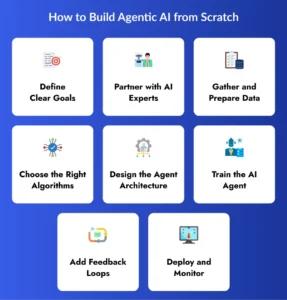
Step 1: Define Clear Goals
Every successful AI project starts with a clear goal. Before you begin, ask yourself one simple question: What problem will this AI solve?
Be very specific about the purpose of your system. Decide what tasks it should automate, who will use it, and what results you expect. For example, you may want to automate customer support replies, generate weekly business reports, or monitor system performance.
Clear goals act like a roadmap. When you know your destination, it becomes much easier to develop Agentic AI system that delivers measurable results.
Step 2: Partner with AI Experts
Agentic AI is more advanced than a simple chatbot. It requires smart architecture, advanced machine learning models, and secure infrastructure.
That is why many businesses choose professional Agentic AI Development services. An experienced team understands how to select the right technologies, design scalable systems, and prevent technical mistakes.
Working with experts saves time, reduces risks, and helps you build robust agentic AI System that can grow with your business.
Step 3: Gather and Prepare Data
AI systems learn from data. If your data is poor, your AI will also perform poorly. That is why data preparation is one of the most important steps. You need clean, structured, and relevant data. This includes removing errors, labeling information properly, and organizing it into usable formats.
Good-quality data helps your AI make accurate decisions. When you prepare data correctly, you lay a strong foundation for building agentic AI system that works reliably.
Step 4: Choose the Right Algorithms
Algorithms are the brain of your AI system. They decide how the AI thinks and learns. Choosing the right method depends on your project goals.
For example, Deep Learning works well for language understanding and image recognition. Reinforcement Learning helps AI learn through trial and error. Bayesian models are useful when dealing with uncertain or incomplete information.
Selecting the right algorithm helps you develop an Agentic AI system that performs efficiently and intelligently.
Step 5: Design the Agent Architecture
This step focuses on building the structure of your AI system. Think of it as designing the brain and body of the agent.
A strong architecture usually includes a perception module to collect data, a memory module to store information, a reasoning engine to make decisions, and an action module to execute tasks.
You can also test the agent in simulated environments before launching it. A well-designed structure helps you create Agentic AI system capable of handling complex workflows.
Step 6: Train the AI Agent
Training is the stage where your AI learns how to perform tasks correctly. During training, the system studies data and improves its responses.
In supervised learning, the AI learns from labeled examples. In unsupervised learning, it identifies patterns on its own. In reinforcement learning, it improves by receiving rewards or penalties based on its actions. The better the training data, the better your AI agents will perform in real-world situations.
Step 7: Add Feedback Loops
One of the biggest strengths of Agentic AI is its ability to improve over time. This is possible through feedback loops. You need to track performance, collect user feedback, and adjust the system based on results. Feedback helps the AI correct mistakes, improve accuracy, and adapt to changing conditions.
Adding feedback loops is a crucial step in building agentic AI system that continues to grow smarter after deployment.
Step 8: Deploy and Monitor
Once your AI is trained and tested, it is ready for deployment. This means launching it into the real business environment where users can interact with it.
However, deployment is not the final step. You must continuously monitor performance, fix errors quickly, update models, and strengthen security measures.
Regular monitoring helps your system remain efficient, reliable, and aligned with your business goals. This ongoing process helps you successfully build an Agentic AI system that delivers long-term value.
Agentic AI Market Size
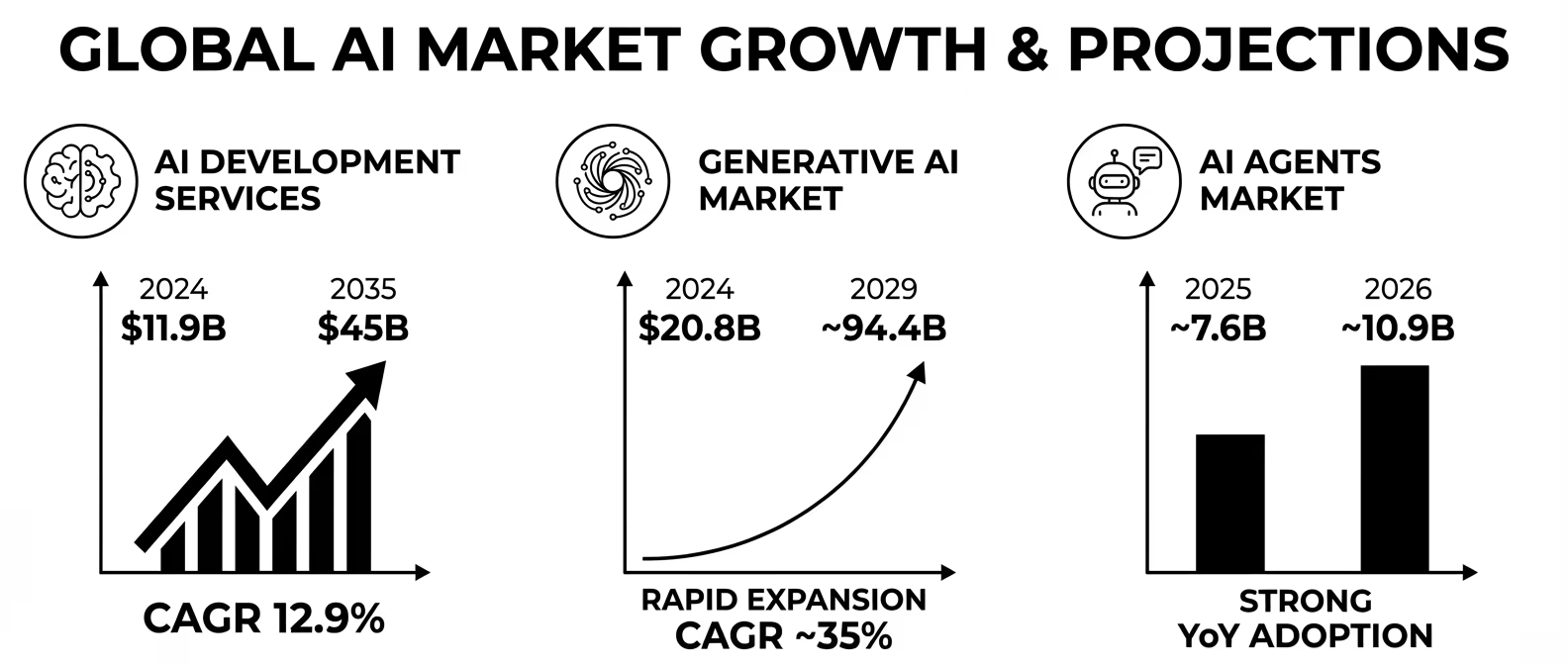
The Agentic AI market is growing very fast across the world. In 2025, the global market size was valued at USD 7.29 billion. It is expected to grow from USD 9.14 billion in 2026 to USD 139.19 billion by 2034. This means the market will grow at a strong CAGR of 40.50% during the forecast period.
In 2025, North America led the market with a 33.60% share. Many enterprises in this region are investing heavily in automation, intelligent systems, and AI-powered decision-making tools.
Agentic AI refers to intelligent systems that can make decisions on their own and execute tasks across complex digital environments like hybrid cloud, multi-cloud, and edge systems. As businesses deal with more data and complex workflows, the demand to build an Agentic AI System is increasing rapidly.
Organizations are using these systems to:
- Automate knowledge work
- Improve operational efficiency
- Enable real-time decision-making
- Reduce manual intervention
This massive growth shows that building Agentic AI system is no longer optional for forward-thinking companies. It is becoming a strategic advantage.
Challenges & Its Solution of Building Agentic AI
When businesses try to build an Agentic AI system, they often face real-world challenges. Agentic AI is powerful and complex. Below are the most common problems and their practical solutions.
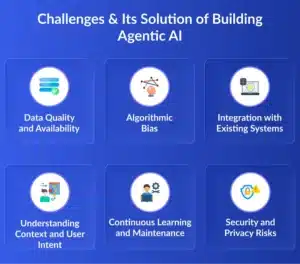
1. Data Quality and Availability
Agentic AI depends heavily on data. But in real life, data is often scattered across systems, incomplete, or poorly organized. If your AI learns from bad data, it may give wrong answers or make poor decisions.
Solution: Start by collecting data only from trusted and relevant sources. Clean it carefully, remove errors, fill missing values, and label it properly. Good data helps you build a robust agentic AI System that makes accurate and reliable decisions.
2. Algorithmic Bias
AI systems learn from historical data. If that data contains bias, the system may treat certain groups unfairly or make one-sided decisions.
Solution: Use diverse and balanced datasets during training. Regularly test your system for fairness and use bias-detection tools. When you develop an Agentic AI system, fairness and ethics must be part of the process from day one.
3. Integration with Existing Systems
Most businesses already use CRMs, ERPs, dashboards, and other software. Integrating a new AI system into these tools can be difficult. Compatibility issues may slow down operations.
Solution: Work with expert AI development services providers who understand integration. Use flexible APIs and modular architecture so the AI fits smoothly into your current ecosystem.
4. Understanding Context and User Intent
People do not always communicate clearly. They use slang, short forms, or incomplete sentences. AI agents may struggle to understand what users really mean.
Solution: Use advanced NLP (Natural Language Processing) models and train them with real conversation data. Add feedback loops so the AI improves over time. This helps when building Agentic AI system for customer-facing applications.
5. Continuous Learning and Maintenance
Markets change. Customer behavior changes. Data keeps growing. If your AI system does not adapt, it becomes outdated.
Solution: Set up regular retraining schedules. Add performance tracking and automated updates. Continuous learning helps you develop Agentic AI system that stays useful and accurate.
6. Security and Privacy Risks
Agentic AI often handles sensitive data like customer details and financial records. A security breach can damage trust and reputation.
Solution: Encrypt data during storage and transfer. Implement strict access control. Follow privacy regulations like GDPR. Strong security measures are essential when you create Agentic AI system for enterprise use.
Applications of Agentic AI System
Agentic AI is effective for multiple industries by automating workflows and improving efficiency.
1. Healthcare
In healthcare, AI agents monitor patient health in real time using data from medical devices and hospital systems. They can alert doctors about unusual patterns, suggest possible treatments, and support faster diagnosis.
In advanced settings, AI also assists in robotic surgeries by guiding precision movements. This improves patient safety, reduces human error, and enhances overall care quality.
2. Logistics & Supply Chain
Agentic AI helps logistics companies manage delivery routes, warehouse systems, and inventory automatically. AI agents analyze traffic data, weather conditions, and demand forecasts to optimize delivery schedules.
In warehouses, smart robots pick, pack, and move goods with minimal mistakes. This increases speed, reduces operational costs, and improves supply chain efficiency.
3. Finance
In the finance industry, AI-powered agents manage investment portfolios, track market trends, and detect suspicious transactions. They can analyze huge amounts of financial data much faster than humans.
These AI systems also provide personalized financial advice based on customer behavior and goals. This helps institutions improve decision-making while reducing fraud risks.
4. Education
Agentic AI supports personalized learning by adjusting lessons according to each student’s pace and performance. AI agents track progress and recommend suitable study materials automatically.
Teachers also benefit from automated grading and student performance insights. This improves learning outcomes and makes education more efficient and engaging.
Use Cases and Real-World Applications of Agentic AI
Implementing agentic AI allows businesses to automate complex processes and operate at scale. Below are real-world applications across industries.
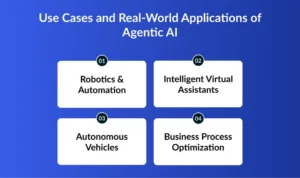
1. Robotics & Automation
Manufacturing companies use AI agents to control robotic assembly lines and monitor machine performance. These agents can predict equipment failures before they happen.
By enabling predictive maintenance, businesses reduce downtime and increase productivity. This makes it easier to build a robust agentic AI System for industrial automation.
2. Intelligent Virtual Assistants
Enterprises deploy NLP-based AI agents as virtual assistants to handle customer queries and provide personalized responses. These assistants understand context and respond naturally.
They work 24/7, reducing wait times and improving customer satisfaction. Many companies develop agentic AI system solutions to automate support operations effectively.
3. Autonomous Vehicles
Self-driving vehicles use cognitive AI agents to analyze surroundings, detect obstacles, and make quick driving decisions. These systems process real-time traffic data to choose the safest and fastest routes.
Agentic AI helps continuous learning from road conditions, improving safety and navigation accuracy over time.
4. Business Process Optimization
Companies use AI agents to automate internal processes such as invoicing, approvals, HR management, and workforce scheduling. These systems reduce manual errors and speed up daily operations.
By automating repetitive tasks, businesses save time and focus on strategic growth. This is one of the main reasons organizations aim to create Agentic AI system for enterprise workflows.
Global companies often collaborate with international AI development teams to scale deployment efficiently and manage the agentic AI system development cost-effectively.

Examples of Building AI Agent Systems
Below are a few real-world examples of how developers and data scientists create Agentic AI systems using powerful tools and frameworks.
1. Building AI Agents with LangChain
LangChain is a strong framework used for building structured AI agents. It helps developers connect large language models like GPT-4 into workflows that can plan, reason, and act.
One popular example is the GPT Engineer repository. This shows how an AI agent can work:
- Take a high-level prompt
- Ask clarification questions
- Generate a complete codebase
- Improve based on feedback
LangChain also includes memory modules. These allow AI agents to remember past interactions and refine their responses over time. Developers can modify pre-built modules to develop an Agentic AI system tailored to specific use cases like code generation or data analysis.
This example shows how structured workflows help businesses build robust Agentic AI system efficiently.
2. Building AI Agents in Python
Python is one of the best programming languages for creating AI agents. It is simple, flexible, and supported by powerful libraries like TensorFlow, PyTorch, and Scikit-learn.
A great example is the uAgents library by Fetch.ai. This framework allows developers to build secure and autonomous AI agents easily.
With simple Python code, developers can:
- Assign tasks to agents
- Trigger actions based on events
- Schedule automated activities
- Connect agents to decentralized networks
Security is handled through cryptographic methods, which protect identities and data. This makes it easier for companies to develop an Agentic AI system that operates safely across distributed environments.
3. Building AI Agents with ChatGPT
Large language models like GPT provide a strong base for intelligent AI agents. These agents can understand context, generate natural responses, and automate workflows.
A practical example is Aider, an AI pair programmer that works with GPT-4 or Claude 3.5. It helps developers:
- Debug code
- Refactor projects
- Add new features
- Commit changes with proper messages
Aider reads entire repositories and works in real time. This shows how GPT-powered tools can help businesses create an Agentic AI system for software automation and collaboration.
These examples prove that with the right tools and strategy, companies can successfully build an Agentic AI system for different use cases.
Cost to Develop Agentic AI System
The Cost to build Agentic AI system depends on many factors like complexity, customization, and integrations. On average, the cost ranges between $50,000 and $300,000+.
| Project Type | Estimated Cost | Description |
| Basic Agentic AI Solution | $50,000 – $80,000 | Simple task automation, limited integrations, small datasets |
| Mid-Level Agentic AI System | $80,000 – $130,000 | Advanced workflows, multiple integrations, moderate customization |
| Enterprise-Grade Agentic AI | $130,000 – $300,000+ | Complex decision-making, hybrid/multi-cloud setup, large-scale automation |
Factors That Affect Agentic AI System Development Cost
- Complex objectives
- Level of customization
- Location of your development team
- Amount of data to be processed
- Tools and API integrations
- Ongoing maintenance and updates
Understanding the full agentic ai system development cost helps businesses plan budgets wisely. Working with professional AI development services assists in better cost control and higher ROI.
How to Choose Agentic AI Development Company?
Choosing the right partner is very important when you want to develop an Agentic AI system. A good development company can make the process smooth and successful.
Here are key factors to consider:
1. Experience in AI and Automation
Choose a company that has real experience in building AI agents and automation systems. Check their portfolio and past projects.
2. Strong Technical Expertise
They should understand:
- Large language models
- Machine learning
- Cloud infrastructure
- API integrations
- Data security
3. Customization Capabilities
Your business is unique. The company should offer tailored agentic AI development services instead of one-size-fits-all solutions.
4. Transparent Cost Structure
Confirm the clear cost to build Agentic AI system. Make sure there are no hidden charges.
5. Post-Deployment Support
AI systems require monitoring and updates. Choose a company that offers long-term AI development services, including maintenance and optimization.
6. Security and Compliance
Agentic AI systems often handle sensitive data. It helps the company follow strong security standards and compliance practices.
Future Trends and Research Directions
The future of agentic AI is evolving rapidly. Businesses planning to develop an Agentic AI system in 2026 and beyond should monitor the following trends.
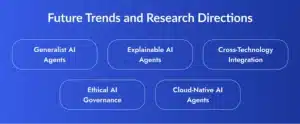
1. Generalist AI Agents
Future AI agents will not be limited to one task. Instead, they will handle multiple responsibilities across industries. These generalist agents will combine reasoning, planning, and execution skills, making it easier for businesses to build an Agentic AI system that performs diverse tasks.
2. Explainable AI Agents
Transparency is becoming more important. Businesses and regulators want AI systems to clearly explain how they make decisions. Explainable AI agents will improve trust, ensure compliance and help organizations maintain accountability.
3. Cross-Technology Integration
Agentic AI systems will integrate with technologies like IoT, blockchain, and edge computing. This combination will enable smarter automation and real-time processing. Such integration will support advanced applications in smart cities, connected devices, and secure digital ecosystems.
4. Ethical AI Governance
Responsible AI development will focus on fairness, privacy, and compliance with regulations. Companies must assist their AI systems do not create bias or misuse data. Strong governance frameworks will become essential when businesses develop an Agentic AI system for large-scale use.
5. Cloud-Native AI Agents
Cloud-based AI systems allow businesses to scale operations easily without investing heavily in physical infrastructure. Cloud-native agentic AI supports modular design, faster updates, and global accessibility, helping reduce the cost to build Agentic AI system.
Why Choose Developer Bazaar Technologies for Agentic AI Solution?
Developer Bazaar Technologies is a trusted AI development company with over 10 years of experience delivering end-to-end AI solutions.
Our team of skilled professionals understands business challenges and provides tailored AI development services to meet specific goals. From planning and architecture design to deployment and maintenance, we help you building strong Agentic AI system that works in real-world conditions.
We focus on:
- Custom AI strategy
- Secure infrastructure
- Scalable architecture
- Continuous support
Conclusion
Agentic AI is changing the way businesses operate. It is about creating intelligent systems that can think, act, and improve independently.
While challenges like data quality, cost, integration, and security exist, they can be managed with the right strategy and expert support. Understanding the development costs of Agentic AI systems, best practices, and future trends helps you make informed decisions.
If you are ready to create Agentic AI system for your business, connect with a trusted partner offering professional Agentic AI Development services.
FAQS
1. What does the future of AI look like in 2026?
AI systems will become more autonomous. Agentic AI will plan, decide, and execute tasks independently without constant human guidance.
3. What is an example of Agentic AI?
An AI system that reads support tickets, understands the issue, replies to the customer, updates records, and learns from feedback automatically is a strong example.
4. How long does it take to build an Agentic AI?
Generally, it takes 6 to 8 months. The timeline depends on complexity, data availability, and customization needs.
5. What makes Agentic AI different from conventional AI?
Traditional AI waits for instructions. Agentic AI understands goals, creates multi-step plans, executes tasks, and improves over time.
6. Is Agentic AI suitable for small businesses?
Yes. Small businesses can start with one simple automation use case and expand gradually. It is not limited to large enterprises.