
Building custom Generative AI solutions is a strategic move any startup can make to succeed. The rapid adoption of generative AI products clearly reflects this shift.
In 2022, ChatGPT was released, and in just three years, it has become one of the most popular and used generative AI solutions worldwide.
Following the same trajectory, several startups built different generative AI applications for various targeted audiences and use cases. We have Midjourney for image generation, Eleven Labs for voice, Cursor and Codeium for coding, and the list goes on.
While the generative AI market may seem crowded, it continues to offer significant opportunities. The thing is, you need to come up with a solution that solves a clearly defined problem for a specific niche market.
Startups that prioritize value, specialization, and usability can still carve out a strong position in this evolving ecosystem.
So, this blog tells you how you can develop a custom generative AI solution. And not just the development, also read about how you can monetize it, a few quick tips for successful development, and future-ready genAI app ideas you can opt for.
Why Generative AI Solution Development is a Proven Strategic Move for Startups
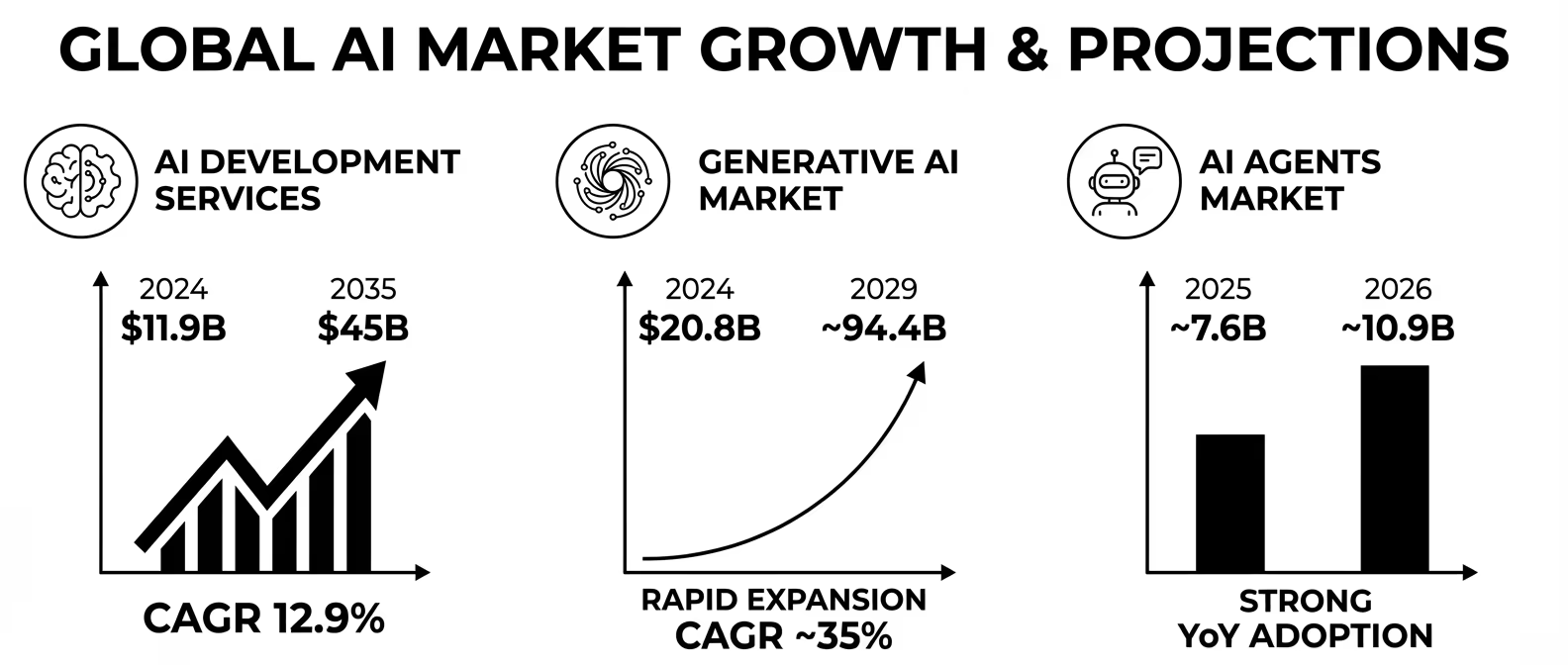
As both businesses and individual consumers are increasingly adopting generative AI apps for content creation, automation, personalization, and decision-making, the demand for such solutions is at an all-time high.
And, a startup can position itself at the center of the next major technology shift by fulfilling this demand.
You can develop a generative AI solution, capture niche markets, establish thought leadership, and scale rapidly without proportional increases in operational costs. Developing a custom generative AI solution gives the following benefits.
1. Strong Product Differentiation
You can build A Generative AI solution for a niche market that offers adaptive features that no other solution has or can replicate easily. This gives you a strong production differentiation.
2. Scalable Business Model
Generative AI-powered solution development is a scalable business idea. You can scale your product efficiently through APIs, subscriptions, and usage-based pricing without linear cost growth.
3. Higher Valuation Potential
These days, AI-first startups are attracting stronger investor interest due to proprietary models, data assets, and defensible IP.
4. Recurring Revenue Opportunities
You can develop generative AI for businesses to open new doors for revenue. You can monetize your solution through API licensing, enterprise contracts, and other ways, and ensure predictable income streams.
5. Faster Global Adoption
Cloud-based generative AI products can reach international markets quickly with minimal localization effort. You can cater to a larger user base beyond boundaries.
How to Develop a Custom GenAI Solution: Step-by-Step Process
Now that you know the benefits, let’s jump straight into the generative AI solution development process.
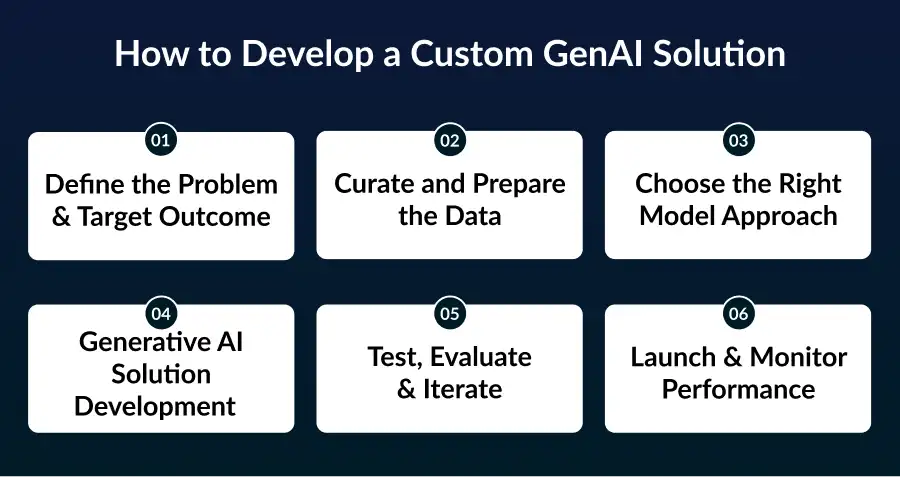
1. Define the Problem & Target Outcome
Every successful generative AI app starts with a clearly defined problem, not a model. You need to first focus on what problem your solution is solving and for whom. You need to determine:
- What problems does my targeted audience face?
- Is there already any tool, and if so, then why does it fail to solve this problem effectively?
- How will my generative AI solution deliver measurable value compared to existing software?
Once the problem is clear, define target outcomes and success metrics. These KPIs can be reduced turnaround time, higher user engagement, improved accuracy, increased conversions, or direct revenue impact.
Defining these goals clearly beforehand will guide your further technical decisions and prevent overengineering.
2. Curate and Prepare the Data
Data is the foundation of any generative AI solution. If the data is poor, irrelevant, or inconsistent, even the most advanced model will fail.
Hence, you need to prepare high-quality data. But, before that, identify what type of data your generative AI needs. Is it text, images, video, audio, code, or any other?
Afterwards, you can partner with an AI development company to clean, organize, and format the data. Remember to ensure compliance with data privacy regulations when your generative AI solution deals with user data.
3. Choose the Right Model Approach
Once the data is ready, you need to select the right AI model on which your solution will be based. Typically, you have three major options:
- Pre-trained models, such as GPT, LLaMA, or Claude. These offer fast development and lower upfront cost. Ideal for MVPs and general-purpose use cases.
- Fine-tuned models that are customized using domain-specific data. These are more accurate and relevant for niche problems.
- Hybrid models that combine pre-trained models with prompt engineering, retrieval systems, or business rules to improve accuracy without full retraining.
4. Generative AI Solution Development
At this stage, you develop your generative AI solution. Developers will design the backend system, APIs, and the frontend interface.
During the development, you need to ensure the architecture is scalable, meaning it can handle increasing users without breaking or becoming expensive. For this, you can leverage cloud infrastructure, caching responses, or set usage limits.
5. Test, Evaluate & Iterate
Before launching your generative AI app, test it rigorously for accuracy, relevance, tone, bias, and hallucinations in its outputs.
You can also use Beta version testing, in which users give feedback on how the AI behaves in unexpected ways.
Based on results, refine prompts, improve data quality, or retrain models to make it right.
6. Launch & Monitor Performance
Once the testing is done, launch your generative AI solution in the market. After release, actively monitor its usage patterns, response quality, latency, cost per request, and user satisfaction.
These metrics will help you identify performance issues and opportunities for making improvements. Also, update the models with fresh data to maintain the accuracy and relevance.
Technology Stack to Develop a Generative AI Solution
Here is the technology stack that you can use to build your genAI app or solution.
| Purpose | Tools & Technologies |
|---|---|
| Generative AI Models | GPT, Claude, LLaMA |
| AI Model Access | OpenAI API, Anthropic API |
| Backend Development | Python, Node.js |
| Frontend Development | React.js, Next.js |
| Database | PostgreSQL, MongoDB |
| Cloud Platform | AWS, Google Cloud, Microsoft Azure |
| AI Integration Layer | REST APIs |
| Hosting & Deployment | Cloud servers, managed hosting |
| Security & Authentication | Login systems, API keys, basic encryption |
| Analytics & Monitoring | Usage analytics, error tracking tools |
* These are recommendations only. You can use other tools also.
Monetization Strategies for Custom Generative Solution
For long-term success and growth, it is crucial that you monetize your generative AI app the right way. You need to choose the right monetization model that aligns with your user behavior, usage intensity, and operational costs.
Below, we have listed the most effective monetization strategies for custom generative AI solutions.
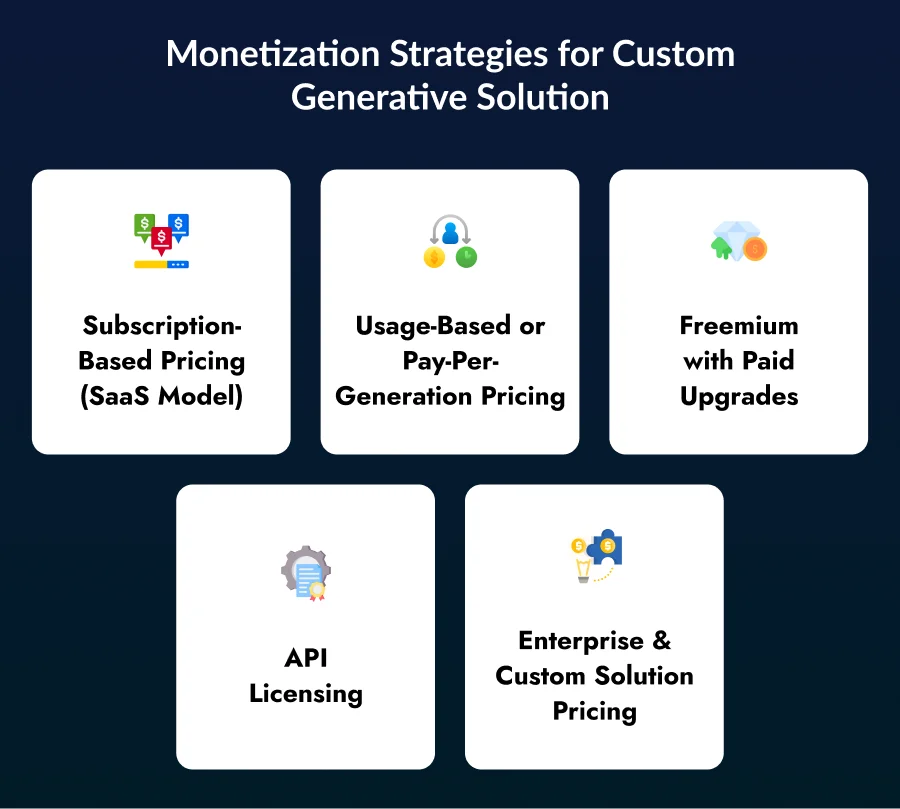
1. Subscription-Based Pricing (SaaS Model)
This is the most common monetization approach. Users pay a monthly or annual fee to access your GenAI solution. It is best for genAI apps like content generation tools, AI assistants, and productivity platforms.
2. Usage-Based or Pay-Per-Generation Pricing
In this generative AI solution monetization model, your users pay for how much they use your solution, such as per prompt, per generated word, per image, or per minute of processing. This strategy is best for generative AI APIs, developer tools, and others.
3. Freemium with Paid Upgrades
Users can access limited AI capabilities for free while paying for advanced features like higher limits, faster responses, better models, or export options. This genAI monetization model is best for early-stage products and mass-market tools.
4. API Licensing
Instead of selling a full product, you can monetize your GenAI capabilities by offering them as APIs. Businesses and individuals integrate these APIs into their own applications. This is the ideal model for Infrastructure-focused or vertical AI startups.
5. Enterprise & Custom Solution Pricing
You develop a custom genAI solution for businesses with specific needs and offer custom integrations, private deployments, and dedicated support. For monetization, you keep the pricing contract-based.
Tips for Successful Gen AI Solution Development
We have provided you with some tips that you must consider to create a generative AI solution and ensure its success post-launch.
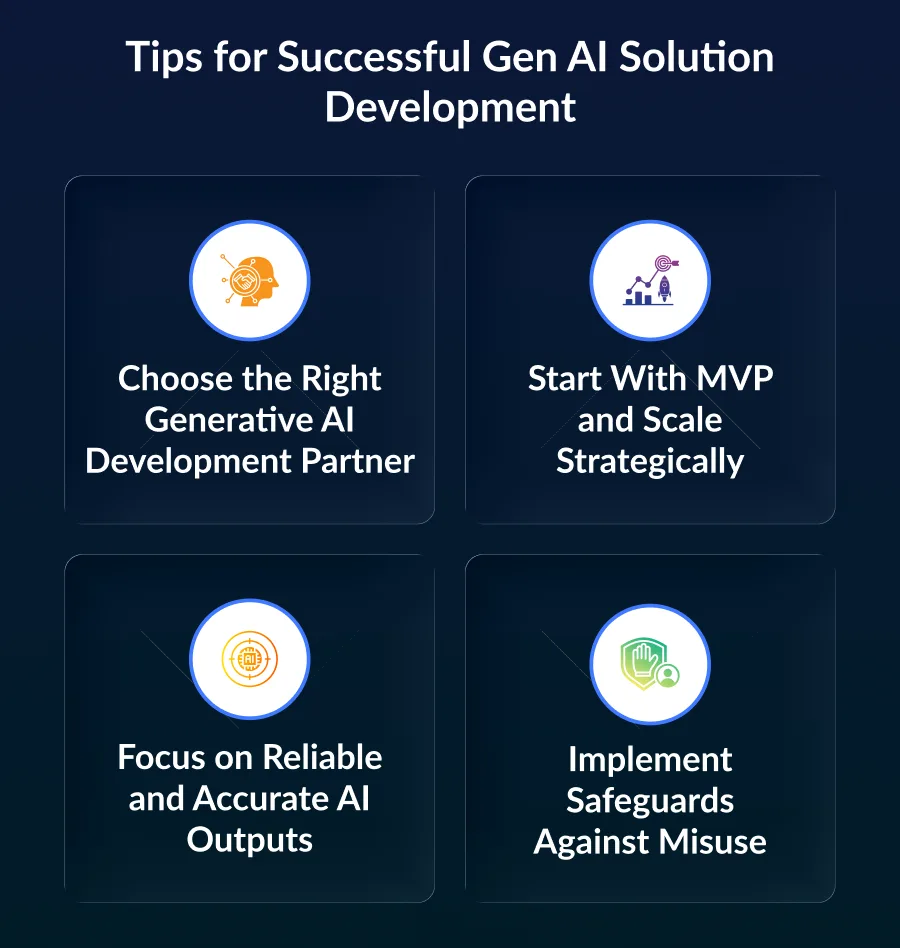
1. Choose the Right Generative AI Development Partner
As a founder, you must look for a generative AI development company with proven experience in building custom and scalable solutions and apps.
A capable development partner can significantly reduce time-to-market and technical risks, align the product with your goals.
2. Start With MVP and Scale Strategically
You don’t need to develop a full-fledged generative AI app or solution initially. You can develop an MVP (minimum viable product) to validate use cases and user demand without overspending.
Once traction is proven, you can expand with new features and model capabilities.
3. Focus on Reliable and Accurate AI Outputs
Your generative AI solution will succeed only if it delivers consistent, relevant, and context-aware responses.
Hence, you need to use high-quality data, refine prompts, and continuously test outputs to reduce incorrect or misleading responses.
4. Implement Safeguards Against Misuse
Generative AI solutions must be designed with responsible usage in mind. You must ensure that users cannot misuse it for generating fake images, deepfakes, misleading content, or harmful material.
For prevention, you can implement safeguards like content filters, moderation layers, usage policies, and watermarking.
Innovative Generative AI Solution Development Ideas for Startups
Here are some bold ideas that you can use to build your next generative AI solution for your startup.
1. Generative AI “Co-Founder”
A generative AI solution that can create everything end-to-end, from business models, MVP feature lists, to pricing strategies, pitch decks, go-to-market plans, and much more. Also, it improves based on feedback and market signals.
2. GenAI-Powered Validator
A generative AI solution that doesn’t just generate content, but also verifies reality. It checks whether text, images, videos, or voice are real, altered, or AI-generated, and explains how it knows. The best time to develop it as deepfakes are exploding.
3. Conversation-Based Software Developer
A conversational GenAI that listens to non-technical conversations and turns them into working software, such as features, workflows, database logic, and APIs, without users ever writing specs.
4. Generative AI-Driven Decision Maker
Think of a Generative AI that generates decisions, such as “Hire / Don’t hire”, “Expand / Hold”, “Increase budget / Cut spend”, and explains the reasons by using company data, industry trends, business objectives, and other factors.
5. Agentic GenAI Solution
A custom solution powered by AI agents and generative AI that plans, executes, and optimizes tasks independently, from marketing campaigns to sales outreach to internal operations.
Conclusion
To become successful, startups need to focus on building custom generative AI solutions that solve a specific problem.
By following this blog, ‘How to Build a Generative AI Solution: A Founder’s Guide’, you can develop a generative solution that provides you with recurring revenue, strong product differentiation in the market, high valuations, and many other benefits.
Also, we have listed the proven monetization strategies that you can use, based on your user base and solution type, to generate income.
Not only this, but we have also provided some proven tips for successful generative AI solution development and innovative ideas that might help you build the next disruptive generative AI solution.
You can reach out to a generative AI development company for more information or start developing your generative AI app.
Frequently Asked Questions
Q1. Which is a trusted generative AI development company for startups?
Developer Bazaar Technologies is a trusted generative AI solution development company that builds custom generative AI apps and solutions for startups.
Q2. How much does it cost to develop a generative AI solution?
The cost depends on what type of solution you want to develop, its technology stack, backend infrastructure, development team, and many other factors. For an idea, it starts from $20,000 and goes up to $70,000, or more. For the right estimates, you can contact us and share your requirements.
Q3. How long will it take to develop a generative AI solution?
Our AI developers can build your generative AI solution in 3 to 6 months, or more, depending on your requirements and goals.

Arpit Vaishnav
CTO
Developer Bazaar technologies