

Artificial Intelligence (AI) is now a future investment plan. It is already influencing the business’s work today. From automating daily tasks to helping companies make smarter decisions, AI is becoming an essential part of modern business growth.
Many organizations now want to develop an AI solution, but the first question they ask is: How much does AI development cost? The answer depends on many factors like app complexity, data quality, features, and technology choices.
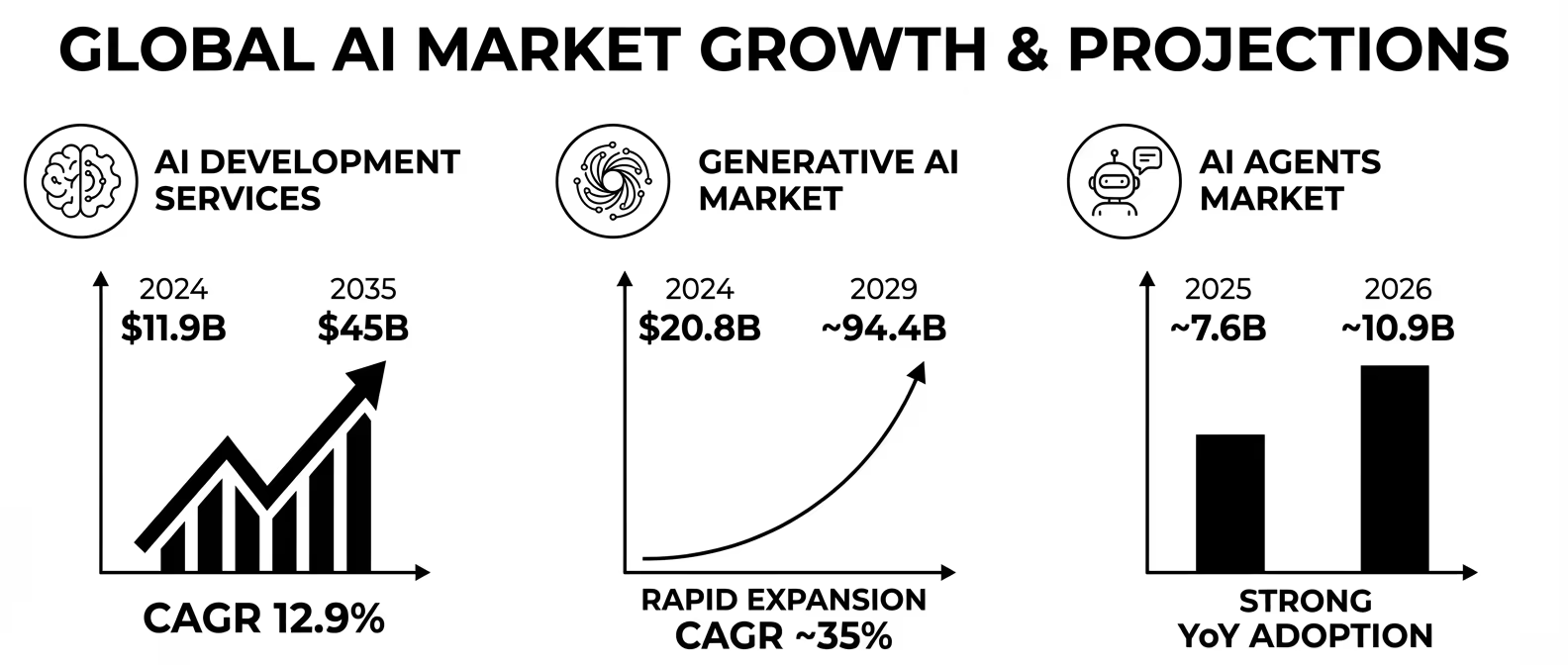
According to a 2025 McKinsey survey, 78% of organizations are already using AI in at least one business area, up from 72% in 2024. This shows how fast AI adoption is growing. However, understanding the AI development cost breakdown is important before investing.
On average, the cost of AI development ranges from $50,000 to $500,000+. Simple AI apps cost less, while advanced systems using machine learning, deep learning, or natural language processing cost more. Businesses also need to consider ongoing costs like cloud hosting, data storage, and model updates.
In this blog, we explain everything from AI development cost estimation to the factors that affect pricing, so you can plan your AI investment with confidence.

Why Should You Invest in AI?
Investing in AI is not an optional choice but a business necessity.
Earlier, companies used AI only for experiments. Now, businesses use AI to improve customer service, predict demand, reduce costs, and increase productivity. AI helps companies work faster and smarter.
McKinsey estimates that AI can create $2.6 to $4.4 trillion in economic value every year. AI can improve more than 63 core business processes, including marketing, logistics, finance, and research.
Big companies like Google show how AI creates real value. Google uses AI across Search, Cloud, and Workspace, which helps increase revenue and user engagement. This proves one important thing, AI gives results only when businesses fully implement it, not when they just test it.
When companies build an AI solution with clear goals, strong data, and skilled developers, AI becomes a long-term asset. It keeps improving over time and delivers higher returns.
This is the reason why many businesses first focus on choosing the right AI development company before starting a project.
AI Development Cost Breakdown: A Complete Overview
The artificial intelligence development cost depends on what kind of AI solution you want to build. A simple AI automation solution costs much less than an AI-driven recommendation solution or an AI-powered demand forecasting solution.
AI development includes many parts such as planning, design, data preparation, model training, testing and maintenance. Each stage adds to the total cost.
Below is an AI development cost breakdown to help you understand where your money is spent.
Cost Breakdown by Levels of Complexity
AI solutions are divided into three main levels based on how advanced your solution requirements are.
| AI App Type | Estimated Cost (USD) |
|---|---|
| Basic AI Solutions | $40,000 - $50,000 |
| Mid-Level AI Solutions | $75,000 - $150,000 |
| Enterprise AI Solutions | $200,000 - $450,000 |
1. Basic AI Solutions
Basic AI solutions are simple and easy to build. They follow fixed rules and do not learn deeply from data.
Examples:
- Chatbots with predefined answers
- Rule-based automation solutions
- Simple prediction solutions
These solutions:
- Use less data
- Require less training
- Take less time to develop
That’s why their custom AI development cost is the lowest.
2. Mid-Level AI Solutions
Mid-level AI solutions are smarter and more powerful.
Examples:
- AI solutions in travel platforms (ticket pricing, route suggestions)
- AI recommendation solutions (product or content suggestions)
- Data analytics solutions
These solutions:
- Learn from user behavior
- Process more data
- Need better algorithms
Due to this, the cost of AI development increases.
3. Enterprise AI Solutions
Enterprise AI solutions are large and complex systems used by big companies.
Examples:
- AI in demand forecasting
- Real-time analytics platforms
- Deep learning systems
These apps:
- Handle huge amounts of data
- Use advanced AI models
- Need strong security and scalability
This makes them the most expensive in the AI development cost breakdown.

Ongoing Operational Costs in AI Systems
Deploying an AI System is only the beginning. Once an AI system is live, it requires continuous investment to remain accurate, secure and aligned with business requirements. Unlike traditional software, AI solutions depend heavily on data infrastructure and ongoing optimization.
Below are the key ongoing operational cost factors:
1. Cloud Compute and API Usage
AI Systems rely on cloud infrastructure to process large volumes of data, run model inference and support real-time decision-making. As usage increases, so does the demand for compute power, strage and API calls. High- frequency requests such as real-time recommendations, predictive analysis or conversational AI interactions can significantly increase operational costs.
Additionally, low-latency requirements and always-on availability across enterprise applications further raise cloud consumption. As AI systems rise with user demand, cloud computing and API usage become one of the most substantial recurring expenses in AI operations.
2. Prompt Optimization and Fine-Tuning
To maintain accuracy and relevance, AI models powered by large language models require continuous prompt optimization and fine-tuning. This process involves refining prompts, testing variations, and adjusting parameters to improve contextual understanding and output quality.
Such optimization is continued in an ongoing effort. It requires skilled AI engineers, experimentation and testing across different use cases. Over time, these efforts add to operational budgets, but they are essential for consistent performance, reduced hallucinations, and reliable outputs aligned with business objectives.
3. Data Labeling and Preprocessing
High-quality data is the backbone of any successful AI solution. Preparing this data involves labeling, cleaning, normalization and formatting to make it suitable for training models. In many cases, this work includes manual intervention or outsourced labeling services, both of which contribute to increased costs.
As data volumes grow and new data sources are introduced, pre-processing becomes an ongoing task. Poor data quality directly impacts model performance, making continuous investment in data preparation a critical operational requirement.
4. Model Retraining and Drift Correction
AI models naturally degrade over time as data patterns change, this phenomenon is known as model drift. User behavior evolves, market conditions shift, and new trends emerge, all of which can reduce prediction accuracy if models are not updated regularly.
To address this, organizations must invest in periodic model retraining, drift detection mechanisms, and performance monitoring. This often requires dedicated AI developers and data scientists to manage updates, validate outputs, and ensure long-term reliability.
5. Integration and Deployment Overhead
AI systems rarely operate in isolation. Integrating them into existing enterprise workflows, platforms, and legacy systems requires custom APIs, system modifications, and extensive testing. Each integration introduces technical complexity and additional development time.
Deployment overhead becomes even more significant in multi-platform environments where AI must function seamlessly across web, mobile, and internal enterprise tools. Ongoing maintenance, updates, and compatibility testing further add to operational costs, particularly in large-scale or legacy-heavy organizations.
6. Compliance and Ethical Audits
Compliance and ethical governance are non-negotiable in modern AI systems. Regular audits are essential for data privacy, security, and adherence to regional and industry-specific regulations. Skipping these checks can result in severe penalties, legal exposure, and reputational damage.
Ongoing compliance efforts involve documentation, monitoring model behavior, bias testing and security assessments. While these activities add to operational expenses, they are critical for building trust, accountability and maintaining regulation-ready AI systems in highly regulated industries.
Strategies to Optimize AI Development Cost
Developing an AI model or solution can be expensive, but smart planning can reduce costs without reducing quality. With the right strategies, businesses can control the custom AI development cost and improve ROI.
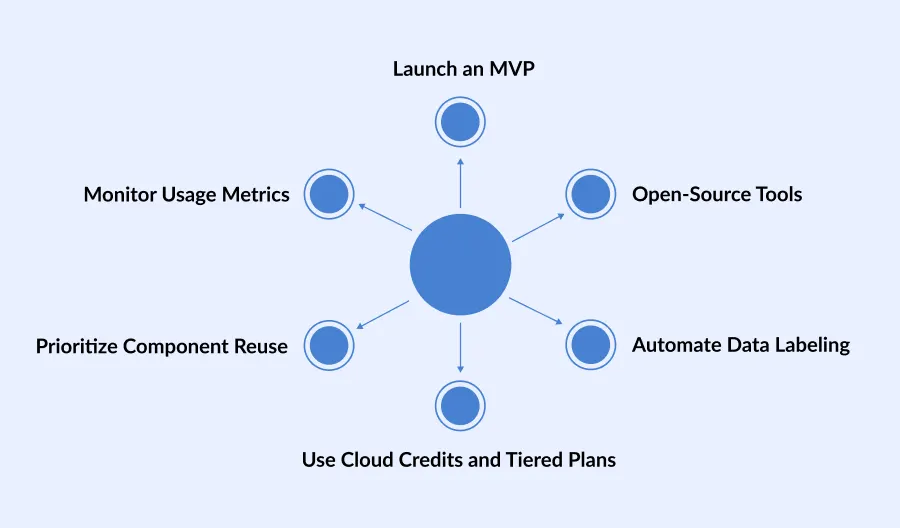
1. Launch an MVP
Instead of building a big AI system all at once, start with a small version called an MVP (Minimum Viable Product). An MVP helps you test whether your idea works and if it is worth investing more money.
It allows teams to spot problems early, understand real costs, and improve the AI step by step. This way, businesses spend wisely before expanding AI solutions across more users or departments.
2. Open-Source Tools
Open-source tools are free software tools made by developers around the world. Using these tools helps businesses save money on licenses and speed up development.
These tools are flexible, reliable, and well-tested by large communities. They are a great choice for teams that want to build powerful AI solutions without spending too much money.
3. Use Cloud Credits and Tiered Plans
Cloud providers often offer free credits or lower-cost plans, especially for startups or early projects. These options help reduce infrastructure costs during the first stages of AI development.
With tiered plans, businesses pay only for what they use. This makes it easier to grow slowly, avoid high upfront costs, and access advanced tools when needed.
4. Automate Data Labeling
Data labeling means adding tags or names to data so AI can learn from it. Doing this by hand takes a lot of time and money.
By using AI tools to label data automatically, teams can train models faster and at a lower cost. This also improves accuracy and makes it easier to handle large amounts of data without extra effort.
5. Prioritize Component Reuse
Instead of building everything from scratch, reuse parts like APIs, prompts, and model templates. This saves time and reduces development costs.
Reusable components help teams work faster, keep systems consistent, and make future AI projects easier and cheaper to build.
6. Monitor Usage Metrics
High costs usually happen when usage is not tracked properly. By watching usage metrics like compute power, API calls, and storage, teams can see where money is being spent.
This real-time tracking helps stop waste, fix inefficiencies, and keep AI systems running smoothly without sudden cost increases.
What Determines the Cost of AI Development?
Before starting an Artificial Intelligence project, it is important to know why AI development costs can be different for every business. Many people think building AI is like buying a ready-made software product.
Choose a plan → Pay a fixed price → Start using it
But AI development does not work like this. The total cost depends on what is the complexity of the AI System, what technology is used, how much data is needed, and how smart the AI solution you are looking for.
Below are the main factors that decide how much AI software development will cost.
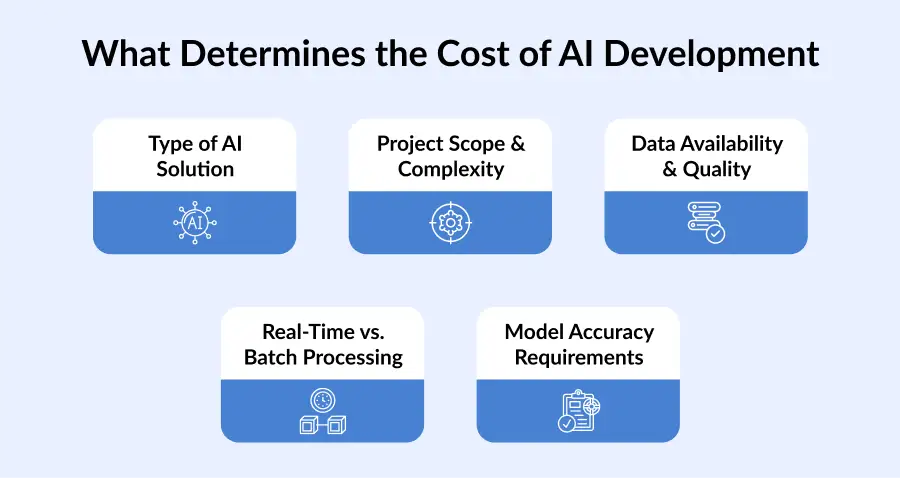
1. Type of AI Solution
The type of AI solution you want to build decides the starting cost. A simple chatbot that follows rules costs much less than an advanced AI system that can understand text, images, or voice together.
Different AI solutions need different work behind the scenes, such as data preparation, model training, testing, and performance checks. More advanced AI needs more time and expert skills, which increases the cost.
2. Project Scope & Complexity
Project scope means how big and detailed the AI system is. The more features you add, the more it costs.
Things like automation level, accuracy goals, system integrations, security rules, device support, and language support all increase the work. Even small changes in features can take extra weeks of development and raise the total cost.
3. Data Availability & Quality
Data is the most important part of AI. If a business already has clean and labeled data, development is faster and cheaper.
But if data is unorganized or not labeled, teams must clean and tag it first. This takes time and money and increases the AI development cost.
4. Real-Time vs. Batch Processing
AI systems can work in two ways: real-time or batch processing.
Real-time AI gives instant results, like fraud detection or voice assistants. These systems need fast servers, special models, constant monitoring, and more computing power. That is why they cost more.
Batch processing AI works on data later, not instantly. These systems use simpler setups and less power, making them cheaper to build.
5. Model Accuracy Requirements
Higher accuracy means more work. Reaching basic accuracy may take a few training rounds, but reaching very high accuracy takes much more time and effort.
This includes more training, better data, more testing, and higher computing use. All of these steps increase the total AI development cost.
Expert Advice: Businesses in regulated industries like healthcare or finance need very high accuracy. This helps build trust and meet legal rules, but it also increases costs.
How to Develop AI Solutions: Step-by-Step Process Explained
Developing an AI solution follows a clear step-by-step process. Each step plays an important role in helping businesses build an AI solution that works smoothly, stays within budget, and delivers real value.
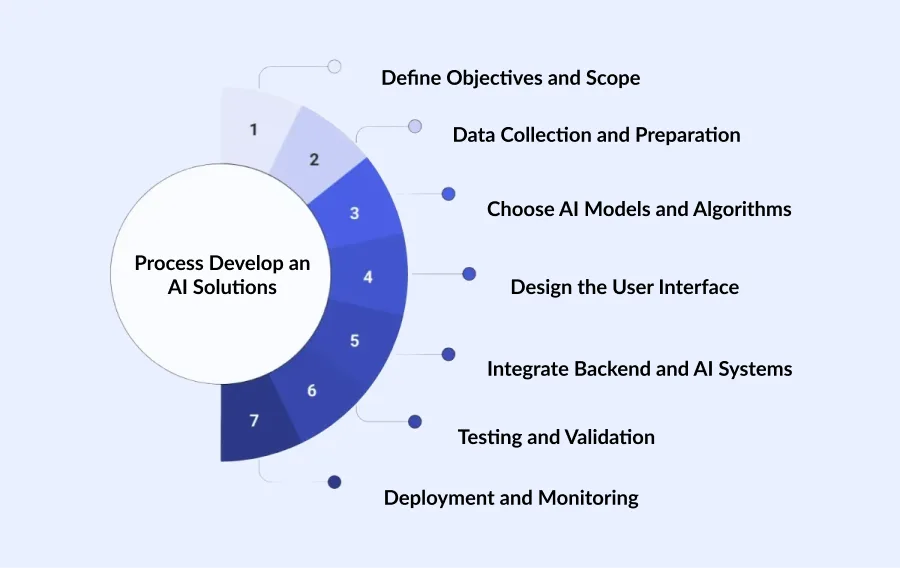
Step 1: Define Objectives and Scope
The first step focuses on deciding what the AI Solution should do and who will use it. Teams clearly outline goals, features, and expected results. Clear planning avoids confusion and helps control the overall AI development cost.
Step 2: Data Collection and Preparation
Teams gather useful data, remove errors, and organize it for training. Clean data improves AI accuracy and reduces future costs related to fixes and updates.
Step 3: Choose AI Models and Algorithms
Developers select the right machine learning or deep learning models based on the AI solutions’ requirements. Simple models cost less and are faster to build, while complex models increase the artificial intelligence development cost but offer advanced results.
Step 4: Design the User Interface
Designers create easy-to-use screens that help users understand AI outputs. A clean and simple design improves user experience and encourages adoption. Good UI design also reduces user confusion and support costs.
Step 5: Integrate Backend and AI Systems
In this step, AI models are connected with backend systems, databases, and APIs. Proper integration is required for smooth data flow and reliable performance. It also helps the AI system scale as the number of users grows.
Step 6: Testing and Validation
Testing your AI solution that it works accurately in real situations. Teams test different scenarios, including edge cases, to find and fix errors. Strong testing improves reliability and prevents costly issues after launch.
Step 7: Deployment and Monitoring
Once testing is complete, your AI Solutions are ready to use for your business or users. Teams monitor performance, track results, and improve the system over time. Continuous monitoring keeps the AI solution efficient, accurate, and useful.

Get Scalable AI Solutions With Developer Bazaar Technologies
Understanding the AI development cost is the first step toward building a successful AI product. At Developer Bazaar Technologies, we handle everything from idea to launch, helping businesses create an AI solution tailored to their needs.
As a trusted AI development company, we use advanced technologies like machine learning, natural language processing, and predictive analytics to turn complex tasks into smart, automated systems.
We focus on building AI apps, AI agents, or whatever AI solutions you require. It delivers real business results, whether it’s AI in travel, AI in demand forecasting, or an AI recommendation system. If you’re ready to develop an AI application that drives growth and efficiency, connect with us today.
FAQs
1. How much does it cost to build an AI system?
The cost to build an AI system usually ranges from $50,000 to $500,000 or more. The final price depends on project complexity, data needs, AI models, and team expertise. Simple AI apps cost less, while advanced systems using deep learning or NLP increase the artificial intelligence development cost.
2. What factors influence the cost of AI development for businesses?
Key factors include project scope, data requirements, AI expertise, technology stack, and ongoing integration and maintenance. Each factor directly affects the AI development cost breakdown.
3. What types of AI solutions affect development cost?
Different AI solutions have different cost levels. Machine learning systems are usually affordable, NLP systems cost more, computer vision solutions are resource-heavy, and reinforcement learning systems are the most expensive.
4. How long does it take to develop an AI solution?
Simple AI solutions may take a few months, while advanced systems can take 6 months to 1 year or more. Testing, training, and deployment also impact timelines and costs.
5. How does Developer Bazaar Technologies help manage AI development costs?
We help businesses reduce AI costs by offering scalable solutions, efficient development processes, pre-built frameworks, and cost-efficient AI strategies that maximize value and minimize waste.

Arpit Vaishnav
CTO
Developer Bazaar technologies