

Why AI Face Recognition Systems Are Gaining Popularity?
The answer lies in accuracy, speed, and versatility. Modern businesses need solutions that can verify identities in milliseconds, work across various lighting conditions, and integrate seamlessly with existing security infrastructure.
AI face recognition systems play a vital role in meeting these demands. These systems leverage deep learning algorithms, neural networks, and computer vision to detect, analyze, and recognize human faces with 99.97% accuracy, making them indispensable for security-critical applications, contactless authentication, and personalized customer engagement.
Moreover, AI facial recognition technology offers real-time processing, multi-face detection capabilities, liveness detection to prevent spoofing, and seamless API integration that enhances operational efficiency. As a result, more organizations are embracing these systems, driving consistent growth in the AI face recognition market.
Benefits of Implementing AI Face Recognition Technology in Businesses
When you develop an AI face recognition system, it provides various advantages to organizations. The top benefits are as follows:
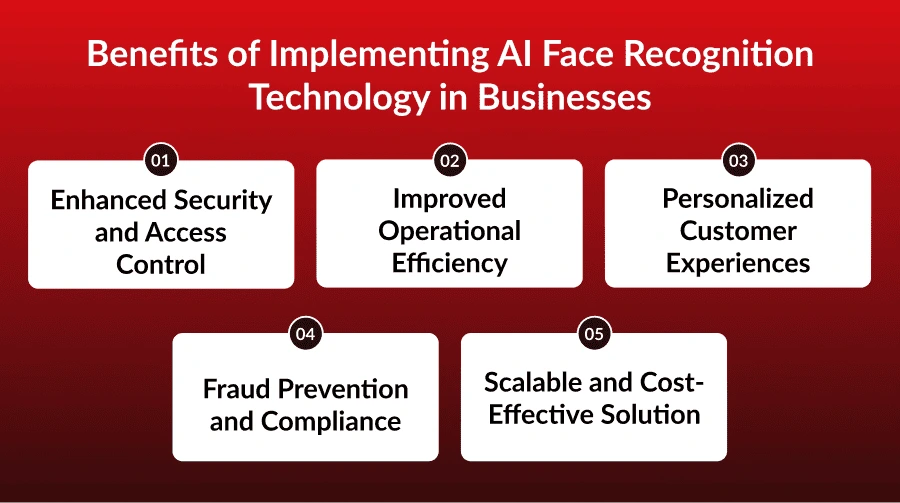
1. Enhanced Security and Access Control
2. Improved Operational Efficiency
3. Personalized Customer Experiences
4. Fraud Prevention and Compliance
5. Scalable and Cost-Effective Solution
Once deployed, AI face recognition technology operates with minimal ongoing costs, processing thousands of authentication requests simultaneously without additional personnel, making it highly scalable for growing organizations.

How to Develop an AI Face Recognition System
Now that you understand the benefits, let’s explore the step-by-step process to develop an AI face recognition system.
Step 1: Define Use Cases and Requirements
Before you build an AI face detection system, clearly define your specific use cases. Determine whether you need the system for access control, time and attendance tracking, customer identification, security surveillance, or payment authentication.
Identify technical requirements including accuracy thresholds, processing speed, database size, environmental conditions, and integration needs. Understanding these parameters ensures your AI face recognition software meets actual business requirements and delivers measurable ROI.
Step 2: Assemble Your AI Development Team
To develop an AI face recognition system successfully, you need specialized expertise in computer vision, deep learning, neural networks, and image processing. The complex nature of facial recognition demands developers experienced in AI model training, optimization, and deployment.
We recommend hiring AI specialists with proven experience in computer vision projects or partnering with a reputable AI development company and software development company specializing in generative AI development and machine learning solutions.
Step 3: Data Collection and Preparation
The foundation of any AI facial recognition technology is high-quality training data. Collect diverse facial datasets representing various ages, ethnicities, lighting conditions, angles, and facial expressions to ensure unbiased and accurate recognition.
Consider using publicly available datasets like LFW (Labeled Faces in the Wild), CelebA, or VGGFace2 combined with custom data specific to your use case. Implement proper data preprocessing including face detection, alignment, normalization, and augmentation to improve model performance.
Step 4: Select and Train AI Models
Choose appropriate deep learning architectures for your AI face recognition system. Popular models include FaceNet, DeepFace, ArcFace, and OpenFace based on your accuracy, speed, and resource requirements.
Train your AI face detection system using transfer learning or train from scratch depending on your dataset size and computational resources. Implement data augmentation techniques to improve model robustness and generalization across diverse conditions.
Step 5: Implement Face Detection and Recognition Pipeline
Develop a complete pipeline when you create your AI image recognition system. Begin by implementing face detection algorithms like MTCNN, Haar Cascades, or RetinaFace to accurately locate faces in images or video streams.
Once faces are detected, normalize them by aligning facial landmarks to standard positions for consistent feature extraction. Next, use deep learning models to extract high-dimensional facial embeddings that represent unique facial characteristics of each individual.
Finally, compare these extracted features against your database using similarity metrics like cosine similarity or Euclidean distance to identify or verify individuals with precision.
Step 6: Integrate Liveness Detection
To prevent spoofing attacks using photographs or videos, implement robust liveness detection in your AI face recognition software. Deploy techniques like blink detection, facial movement analysis, texture analysis, or 3D depth sensing to ensure the system authenticates only live individuals.
Liveness detection serves as a critical security layer, preventing unauthorized access through presentation attacks. This ensures that only genuine, present users can authenticate through your AI facial recognition technology.
Step 7: Testing and Optimization
Extensively test your AI facial recognition technology across diverse scenarios including varying lighting conditions, angles, occlusions such as glasses or masks, and different demographic groups. This comprehensive testing ensures unbiased performance across all user populations.
Measure key performance metrics including False Acceptance Rate (FAR), which represents the percentage of unauthorized individuals incorrectly granted access, and False Rejection Rate (FRR), indicating the percentage of authorized individuals incorrectly denied access. Additionally, track overall accuracy representing the correct identification rate and processing speed measuring the time required for detection and recognition.
Once baseline metrics are established, optimize your AI face recognition system through hyperparameter tuning, model compression techniques, and hardware acceleration using GPU optimization to achieve optimal performance without compromising accuracy.
Step 8: Deployment and Integration
Deploy your AI face recognition system on appropriate infrastructure—cloud platforms like AWS, Google Cloud, or Microsoft Azure, edge devices, or on-premises servers based on your security and latency requirements.
Integrate the system with existing security infrastructure, access control systems, or business applications through RESTful APIs or SDKs for seamless operation.
Step 9: Compliance and Privacy Management
Ensure your AI face recognition technology complies with privacy regulations including GDPR, CCPA, BIPA, and industry-specific standards to protect user privacy and avoid legal complications. Compliance is critical for building user trust and ensuring legal operation across jurisdictions.
Implement transparent data collection policies that obtain explicit user consent before capturing facial data, secure data storage with end-to-end encryption to protect biometric information, and clearly defined data retention and deletion procedures that respect user rights. Conduct regular security audits and compliance reviews to maintain ongoing regulatory adherence.
Step 10: Continuous Monitoring and Improvement
Post-deployment, continuously monitor your AI face detection system’s performance using comprehensive analytics dashboards that track accuracy metrics, response times, and overall system health in real-time. This ongoing monitoring ensures your system maintains optimal performance as it scales.
Establish a regular update schedule that includes model retraining with new data to improve accuracy and adapt to evolving use cases, timely security patches and vulnerability fixes to protect against emerging threats, and feature enhancements based on user feedback and business requirements. Performance optimization ensures your AI face recognition system maintains peak efficiency as your organization grows.
This continuous improvement cycle keeps your AI facial recognition technology competitive, secure, and aligned with business objectives over time.
Key Features of AI Face Recognition Systems
The following are essential features to integrate when you develop an AI face recognition system:
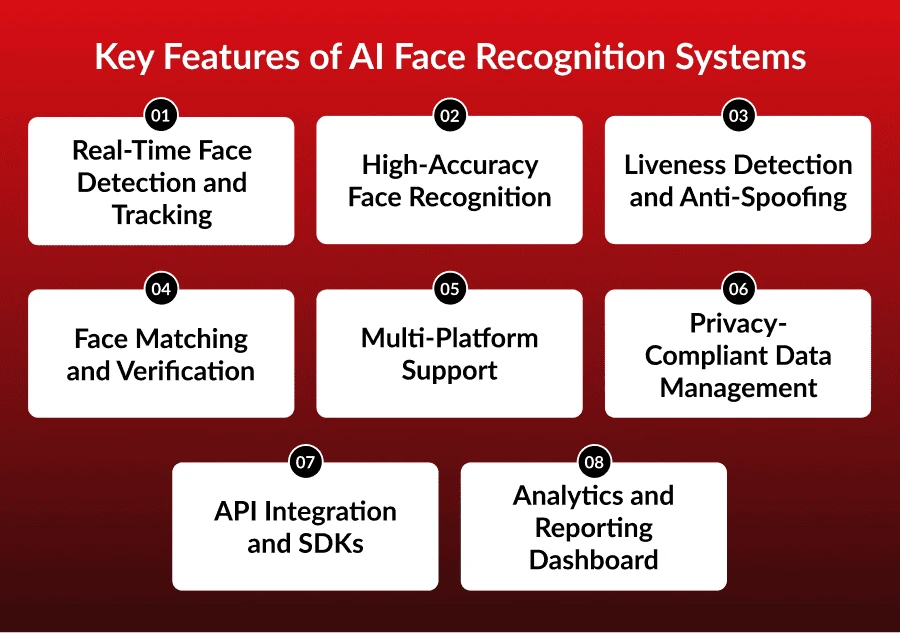
Real-Time Face Detection and Tracking
Multi-face detection capabilities processing video streams in real-time, tracking multiple individuals simultaneously with bounding boxes and confidence scores.
High-Accuracy Face Recognition
Deep learning-powered recognition achieving 99%+ accuracy through advanced neural networks and feature extraction algorithms trained on diverse datasets.
Liveness Detection and Anti-Spoofing
Advanced algorithms detecting presentation attacks including photographs, videos, masks, and 3D models to ensure authentication of live individuals only.
Face Matching and Verification
One-to-one verification comparing captured face against stored template, or one-to-many identification searching entire database for matches.
Multi-Platform Support
Cross-platform compatibility working seamlessly across mobile devices (iOS, Android), web applications, surveillance cameras, and access control hardware.
Privacy-Compliant Data Management
Encrypted storage, secure data handling, consent management, and compliance with GDPR, CCPA, BIPA, and other privacy regulations.
API Integration and SDKs
RESTful APIs and software development kits enabling seamless integration with existing applications, security systems, and business workflows.
Analytics and Reporting Dashboard
Comprehensive dashboards providing insights into authentication patterns, security events, system performance, and usage statistics.
| Component | Technology Stack |
|---|---|
| Programming Languages | Python, C++, Java |
| Deep Learning Frameworks | TensorFlow, PyTorch, Keras, MXNet |
| Computer Vision Libraries | OpenCV, Dlib, Face Recognition |
| Pre-trained Models | FaceNet, DeepFace, ArcFace, VGGFace |
| Face Detection | MTCNN, RetinaFace, Haar Cascades |
| Database | PostgreSQL, MongoDB, MySQL, Redis |
| Cloud Platforms | AWS Rekognition, Google Cloud Vision, Azure Face API |
| API Framework | Flask, FastAPI, Django REST |
| Model Deployment | TensorFlow Serving, TorchServe, ONNX Runtime |
| Edge Deployment | TensorFlow Lite, NVIDIA Jetson, Intel OpenVINO |
| GPU Acceleration | CUDA, cuDNN, TensorRT |
*This is the technology stack that you can use to develop an AI face recognition system. However, please make sure that the table above is for recommendation purposes only. You can use different technologies and tools to build your system.

Cost to Develop an AI Face Recognition System
The cost to develop an AI face recognition system depends on multiple factors, such as system complexity, accuracy requirements, deployment infrastructure, custom model development versus pre-trained models, hardware requirements, integration complexity, and whether you’re building from scratch or using cloud APIs.
| System Type | Estimated Development Costs (in $) |
|---|---|
| Basic System (Cloud API Integration) | $20,000 to $40,000 |
| Advanced System (Custom Models) | $35,000 to $60,000 |
| Enterprise System (Full Custom Solution) | $60,000 to $80,000 |
Please note that these are only estimations. Actual costs may vary based on specific requirements and chosen approach.
Real-World Applications of AI Face Recognition Technology in Businesses
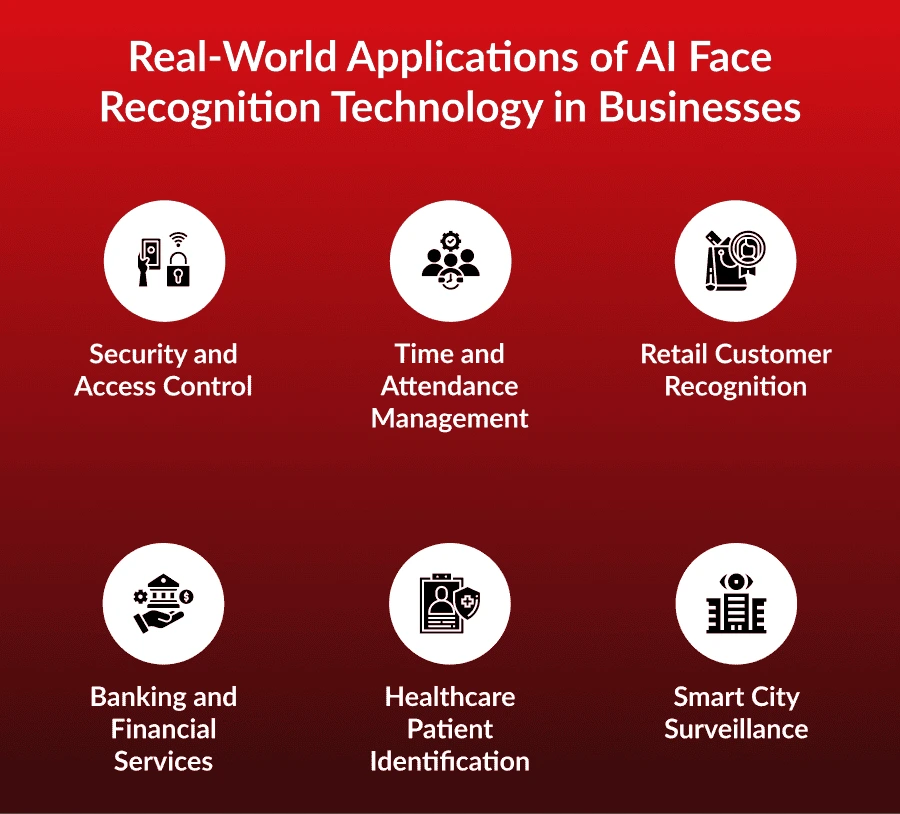
1. Security and Access Control
Organizations implement AI face recognition systems for secure facility access, replacing traditional keycards with contactless biometric authentication that eliminates security vulnerabilities.
2. Time and Attendance Management
Businesses deploy AI face detection systems for automated employee attendance tracking, eliminating time theft and buddy punching while simplifying payroll processing.
3. Retail Customer Recognition
Retail stores use AI facial recognition technology to identify VIP customers, deliver personalized experiences, analyze foot traffic patterns, and prevent retail theft.
4. Banking and Financial Services
Financial institutions leverage AI face recognition software for secure customer authentication, fraud prevention, KYC compliance, and streamlined account access.
5. Healthcare Patient Identification
Hospitals implement AI image recognition systems for accurate patient identification, preventing medical errors, streamlining check-ins, and ensuring secure access to medical records.
6. Smart City Surveillance
Law enforcement agencies deploy AI face detection systems for public safety, criminal identification, missing person searches, and crowd monitoring in public spaces.
Conclusion
So, this is your complete guide to develop an AI face recognition system. As businesses increasingly prioritize security, personalization, and operational efficiency, now is the perfect time to build an AI facial recognition technology solution.
When you develop an AI face recognition system, you unlock various benefits including enhanced security with 95% reduction in unauthorized access, improved operational efficiency, personalized customer experiences, fraud prevention capabilities, and scalable authentication that grows with your business.
The facial recognition market’s projected growth to $12.92 billion by 2028 demonstrates exceptional opportunities for well-executed implementations. With proper model selection, diverse training data, robust liveness detection, and privacy-compliant deployment, your AI face recognition software can deliver transformative business value.
So, what are you waiting for? Follow this guide to develop an AI face recognition system today. Moreover, if you want professional assistance, reach out to Developer Bazaar Technologies, a top-rated AI development company and software development company specializing in generative AI development and computer vision solutions.
We have developed numerous AI-powered recognition systems for enterprises across security, retail, healthcare, and financial services, helping them achieve enhanced security and operational excellence. You can get more details on our portfolio page.

FAQs
Q1. What is an AI face recognition system?
An AI face recognition system is a biometric technology that uses artificial intelligence, deep learning, and computer vision to identify or verify individuals by analyzing and comparing facial features from images or video streams against a database.
Q2. How accurate are AI face recognition systems?
Modern AI facial recognition technology achieves 99.97% accuracy under optimal conditions according to NIST evaluations. However, accuracy varies based on image quality, lighting conditions, angles, and diversity of training data.
Q3. What are the main applications of AI face recognition technology in businesses?
Key applications include security and access control, time and attendance management, customer identification in retail, fraud prevention in banking, patient identification in healthcare, and public safety in smart city surveillance systems.
Q4. Is AI face recognition technology compliant with privacy regulations?
When properly implemented, AI face recognition systems can comply with GDPR, CCPA, BIPA, and other privacy regulations through transparent consent mechanisms, secure data handling, encryption, and proper retention policies. Compliance requires careful design and ongoing governance.
Q5. How can I start developing my AI face recognition system with Developer Bazaar Technologies?
You can contact our AI development company by clicking here or emailing us at [email protected] to start developing your AI face recognition system with our expert team.

Arpit Vaishnav
CTO
Developer Bazaar technologies