
What You'll Discover in This Guide:
- A transparent, weighted ranking methodology based on 8 critical evaluation factors
- Detailed profiles of the top generative AI companies, including technical expertise and pricing
- A practical decision framework to match your project requirements with the right partner
- Insights into the GenAI development process, from discovery to deployment
- Real-world pricing benchmarks and ROI optimization strategies
By the end of this article, you’ll have the knowledge needed to confidently select a GenAI development partner that aligns with your budget, timeline, and technical requirements.
Our Ranking Methodology: 8 Critical Evaluation Factors
To ensure objectivity and transparency, we evaluated generative AI development companies based on a weighted scoring system. Each factor was assigned a weight based on its impact on project success:
- Technical Expertise - LLM proficiency, GenAI frameworks, vector databases, AI agent development, cloud platform expertise
- Projects Delivered & Success Rate - Total projects completed, success percentage, client retention, complexity of deployments
- Years of Experience - Company longevity, evolution with GenAI technology, team stability
- Client Testimonials & Reviews - Clutch/Manifest reviews, case study depth, Net Promoter Score
- Industry Coverage - Number of verticals served, sector-specific solutions, regulatory compliance knowledge
- Transparent Communication - Communication protocols, project management tools, reporting practices
- Timely Delivery - On-time completion rates, realistic timeline estimation
- Post-Delivery Support - Maintenance offerings, knowledge transfer, scalability assistance
Top 12+ Generative AI Development Companies in 2026
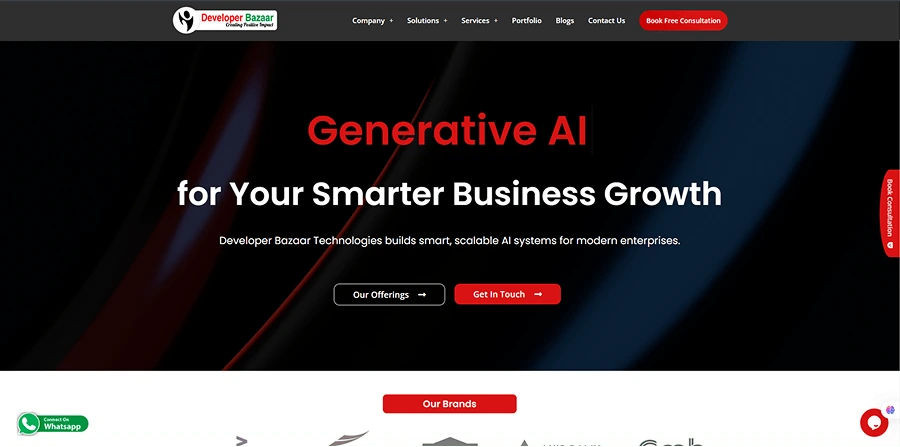
Rating: 4.9/5
Developer Bazaar Technologies stands out among generative AI development companies as a comprehensive GenAI development firm combining specialized GenAI expertise with full-stack mobile and web development. Founded in 2016, DB Tech has delivered 890+ projects across diverse industries with a 95% on-time delivery rate and 100% communication score.
Key Differentiator: Unlike narrow GenAI boutiques, DB Tech offers end-to-end development—from intelligent chatbots to complete mobile applications with embedded AI features. This integrated approach eliminates vendor coordination complexity and accelerates time-to-market, making it one of the best generative AI companies for comprehensive solutions.
Track Record: 890+ projects delivered | 850+ satisfied clients | 1.2M+ app downloads | 8 years operational excellence
Industries Served: Healthcare, eCommerce, Education, Manufacturing, Travel, Fintech, Sports & Gaming, Government
Competitive Pricing:
- Hourly rates: $15-35/hour
- Average project: $35,000-$60,000
- Transparent milestone-based billing with flexible engagement models
Best For: Startups and mid-market companies seeking cost-effective GenAI integration within broader application development; businesses requiring mobile/web + AI combined expertise; clients prioritizing transparent communication and predictable budgets.
2. Master of Code Global
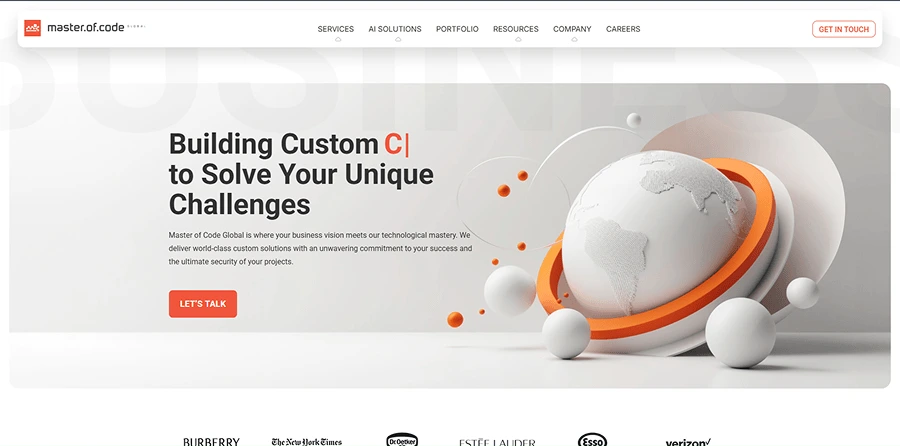
Rating: 4.7/5
Founded in 2004, Master of Code Global is among the leading generative AI development companies specializing in conversational AI with over 20 years of experience. The firm has delivered 500+ projects impacting more than one billion users globally, establishing itself as one of the top generative AI companies for chatbot development and AI agent creation.
Technical Expertise: Conversational AI and chatbot development, AI agent development, custom LLM fine-tuning, LOFT Framework (proprietary LLM-Orchestrator), Generative AI integration, Machine Learning, NLP, Deep Learning, predictive modeling, RPA, and computer vision. ISO 27001 certified.
Track Record:
- 500+ projects completed across two decades
- 1 billion+ users impacted through deployed solutions
- Strong enterprise client base across 11 industries
Industry Coverage: eCommerce, finance, education, airports, travel & hospitality, HR & recruiting, retail, healthcare, insurance, telecom, automotive, and banking.
Pricing:
- Hourly rates: $75-150/hour
- Average project cost: $75,000-$200,000+
- Enterprise-focused with premium positioning
Advantages: Deep conversational AI specialization with proprietary frameworks, agile methodology, end-to-end services from consulting to continuous support, extensive CX enhancement experience, and tailored scalable solutions.
Best For: Large enterprises requiring sophisticated conversational AI platforms; companies needing proprietary LLM orchestration frameworks; organizations with substantial budgets ($150K+) for comprehensive AI agent ecosystems.
3. DataRoot Labs
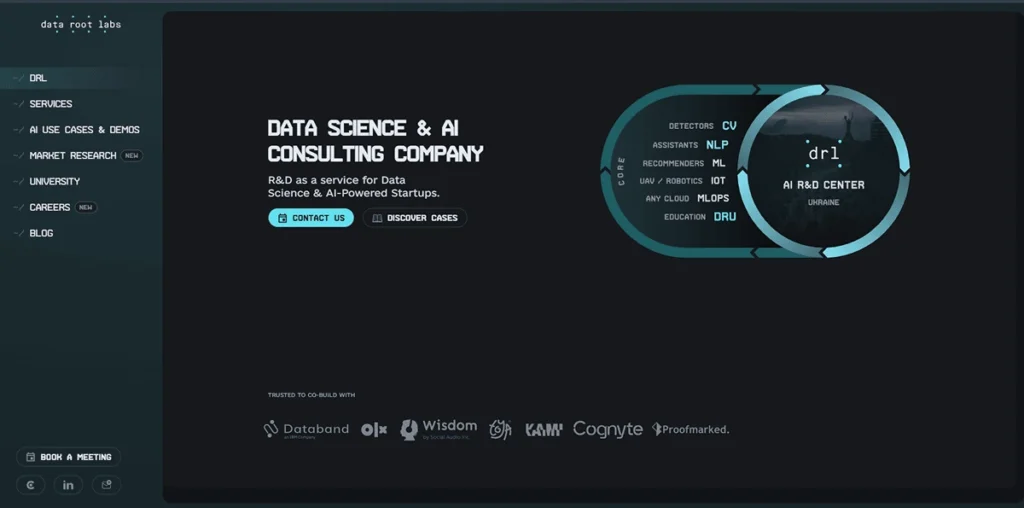
Rating: 4.6/5
DataRoot Labs positions itself as a full-cycle AI R&D center among best generative AI development companies with over eight years of specialized experience. The company has built a reputation working with prominent clients including IBM and Noom, focusing on co-developing AI solutions from concept through monitoring.
Technical Expertise: LLM training and tuning, multimodal LLMs with visual capabilities, vector database design for conversational AI, reinforcement learning for robotics, AI interfaces for startups and enterprises, and RAG implementations.
Track Record:
- 8+ years of AI development experience
- 50+ professionals in agile teams
- Notable clients: IBM, Noom
- MVP delivery: 8-12 weeks
- Full IP transfer guaranteed
Industry Coverage: Automotive, healthcare, retail, energy & natural resources, gaming, and education.
Pricing:
- Hourly rates: $60-120/hour
- Average project cost: $50,000-$150,000
- Includes free consulting session and detailed roadmap
Advantages: Specialized LLM training and multimodal expertise, fast MVP delivery with detailed roadmaps, support for fundraising and investor outreach, tailored solutions from MVP to full-scale implementation, and strong R&D capabilities.
Best For: AI-native startups requiring custom LLM training; companies seeking fundraising support alongside development; organizations prioritizing R&D innovation over rapid deployment.
4. BotsCrew
Track Record:
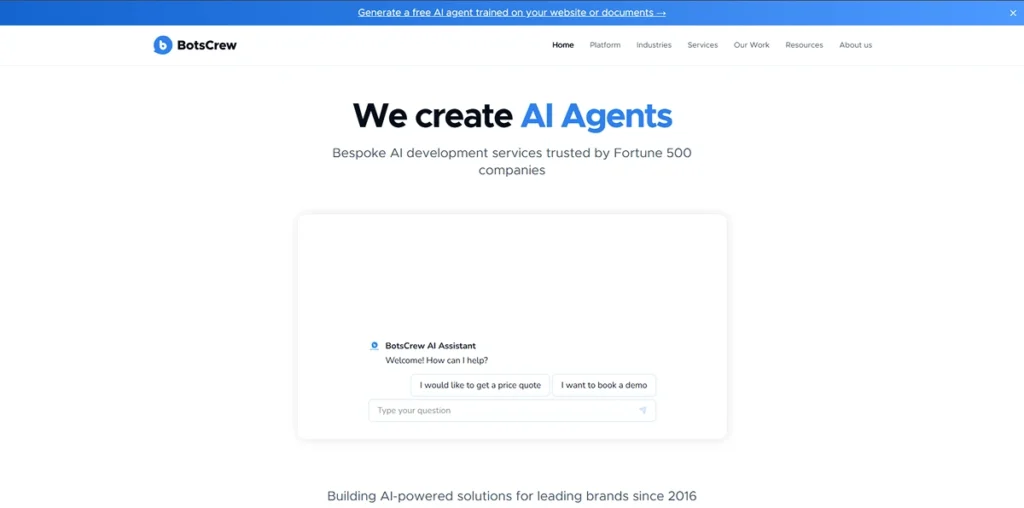
- 150+ successful projects delivered since 2016
- Library of case-proven accelerators reducing development time
- Enterprise-grade deployments for Fortune 500 brands
- Discovery-led approach with clear KPIs
Industry Coverage: Healthcare, customer service, marketing & digital agencies, travel & hospitality, retail & eCommerce, logistics, banking & financial services, and public sector.
Pricing:
- Hourly rates: $70-140/hour
- Average project cost: $80,000-$180,000
- Enterprise-focused with SLA-backed support
Advantages: Discovery-first methodology with transparent roadmaps, enterprise-grade compliance (GDPR, HIPAA), white-label and on-premises deployment options, seamless integration with unlimited third-party systems, and end-to-end lifecycle management.
Best For: Healthcare organizations requiring HIPAA compliance; financial institutions needing stringent security protocols; enterprises seeking white-label AI solutions with on-premises deployment.
5. SoftKraft
Rating: 4.3/5
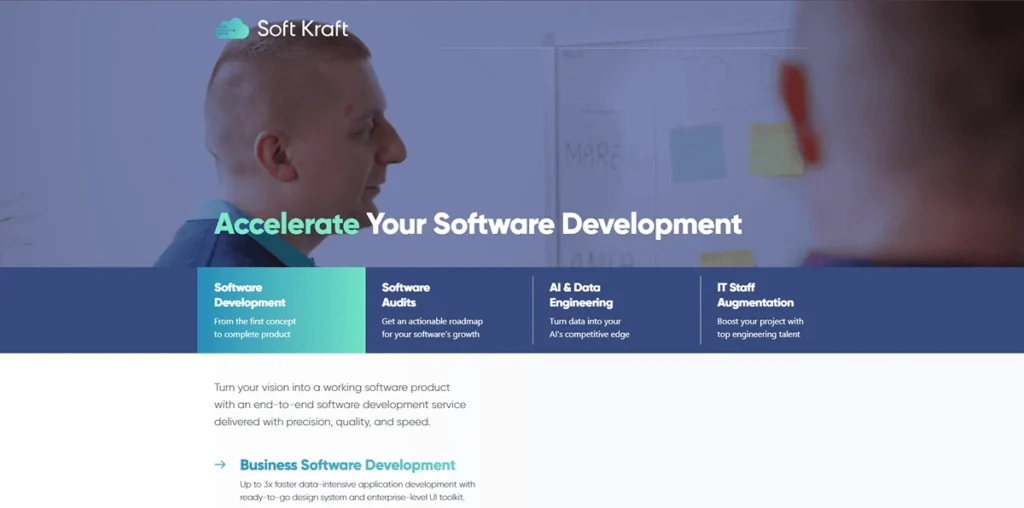
SoftKraft is an IT company among generative AI companies focused on helping businesses leverage AI to solve complex challenges through custom software creation and automation. With ISO 27001 certification, they craft bespoke smart tools optimized for performance, safety, and scalability.
Technical Expertise: AI solution design for business problem-solving, customized intelligent software development, workflow optimization, data intelligence through ML and NLP, and cloud-based smart applications (AWS, Google Cloud).
Track Record: Proven experience developing MVPs to full-scale enterprise programs with certified security standards.
Industry Coverage: IT, advertising & marketing, education, financial services, and real estate.
Pricing:
- Hourly rates: $50-100/hour
- Average project cost: $45,000-$120,000
Strengths: Tailored AI solutions for business process optimization, end-to-end development from concept to deployment, cost-efficient scalable systems, and strategic data-driven guidance.
Best For: European businesses seeking ISO-certified AI development; companies in advertising and marketing requiring workflow automation.
6. Fluper
Rating: 4.1/5
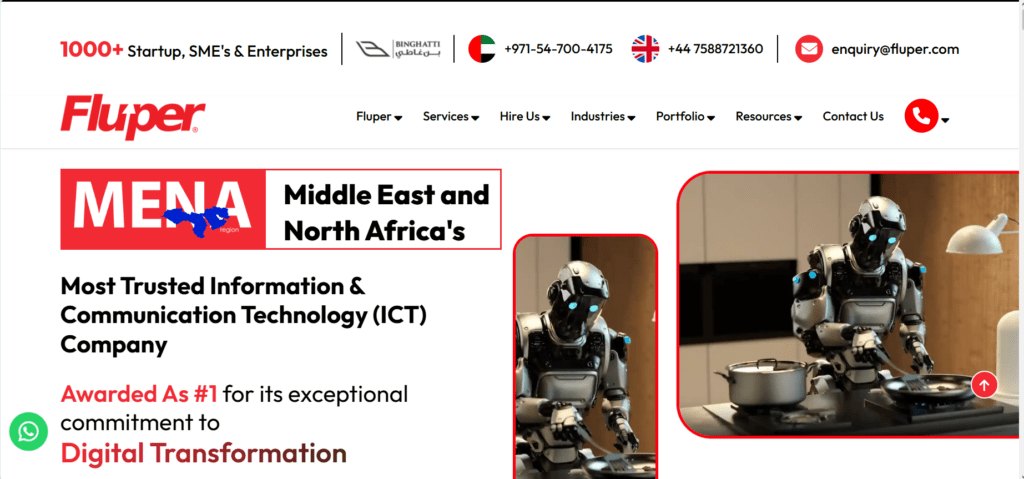
Fluper is a digital transformation and AI consulting company with 120+ professionals dedicated to helping businesses accelerate growth through technology. As one of the best generative AI companies, the firm emphasizes aligning business objectives with technological solutions.
Technical Expertise: AI & ML development, data analytics & business intelligence, data warehousing solutions, digital product engineering, and DevOps with mobile/web app development.
Track Record: Team of 120+ professionals with experience scaling AI adoption for enterprise implementations.
Industry Coverage: Not specifically disclosed, but serves startups to established enterprises.
Pricing:
- Hourly rates: $40-90/hour
- Average project cost: $40,000-$110,000
Strengths: Thorough audit and re-engineering services, end-to-end digital product creation, flexible tailored tools for various business sizes, and strong focus on business advancement.
Best For: Companies requiring comprehensive digital transformation beyond AI; businesses seeking data warehousing alongside AI development.
7. AtliQ Technologies
Rating: 4/5
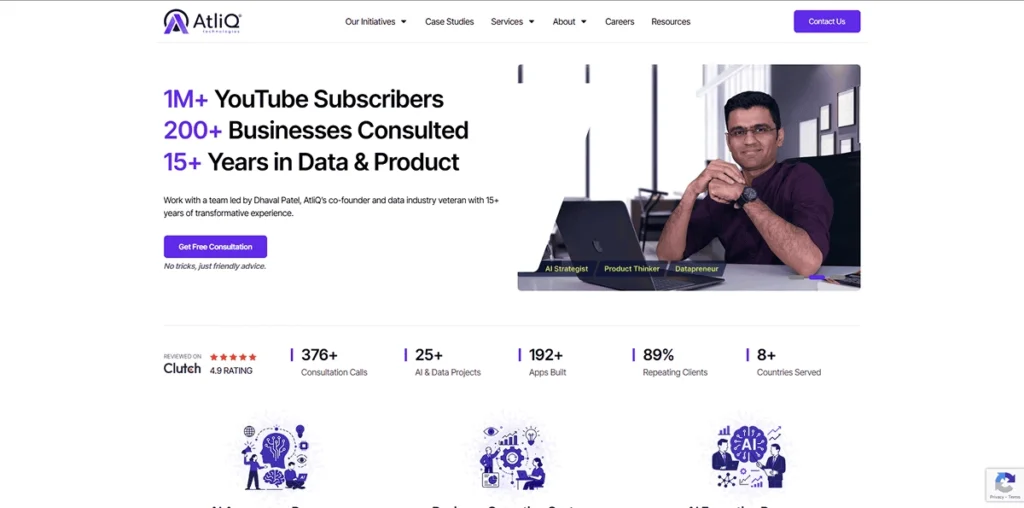
AtliQ is a growing software development company focused on integrating AI smoothly into client infrastructures to enhance customer engagement, reduce errors, and improve profitability. The company emphasizes rapid prototyping and open communication.
Technical Expertise: Open-source and commercial LLMs, AI strategy and implementation, machine learning model development and training, AI product and platform creation, and MLOps with AWS and Azure.
Track Record: Quick prototyping capabilities with transparent, result-driven processes and full ownership transfer.
Industry Coverage: Consumer products & services, education, financial services, government, and hospitality & leisure.
Pricing:
- Hourly rates: $35-80/hour
- Average project cost: $40,000-$100,000
Strengths: AI integration into existing business systems, sector-specific programs, full ownership and post-launch support, and rapid prototyping.
Best For: Government sector projects requiring compliance; hospitality businesses seeking quick AI prototypes.
8. Upsilon
Rating: 4.8/5
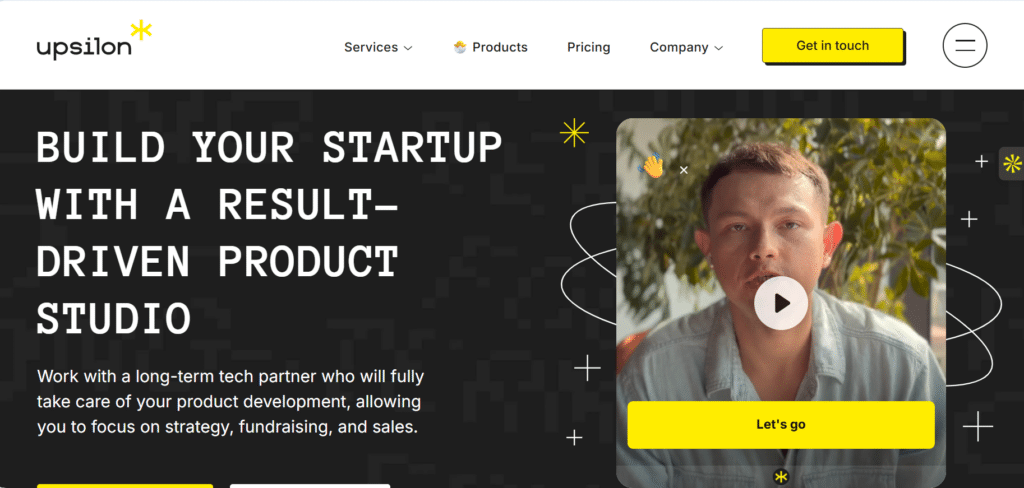
Upsilon specializes in generative AI and fast MVP development for startups and scaling companies. From idea validation to AI model integration and scaling, Upsilon supports clients through the entire product journey. Acting as a long-term tech partner, the company offers flexible collaboration, dedicated teams, and transparent processes to help businesses quickly bring innovative, AI-powered products to market.
Technical Expertise: generative AI app development, AI MVP development, AI integration into apps, AI-powered chatbots.
Track Record: The team with 10+ years of experience and 25+ launched products
Industry Coverage: Healthcare, Finance, E-commerce, Retail, Manufacturing
Pricing:
- Hourly rates: $35-60/hour
- Average project cost: $50,000-$100,000
Advantages: expertise in launching AI startups, MVP time-to-market – 3 months, full-cycle AI development and team augmentation, comprehensive support post-launch.
Best For: Startups and scaling companies building products that need rapid AI MVP development.
9. Xorbix Technologies, Inc.
Rating: 3.9/5
With over 25 years of experience, Xorbix Technologies simplifies complex software and IT transformations for organizations of all sizes. The company emphasizes making technology accessible and scalable with a culture of teamwork and continuous improvement.
Technical Expertise: Custom AI development, strategy consulting, intelligent process automation (IPA), advanced analytics, and AI integration and deployment.
Track Record: 25+ years in business with proven ability to optimize business operations through automation and long-term partnerships.
Industry Coverage: Not specifically disclosed, serves organizations of all sizes.
Pricing:
- Hourly rates: $55-110/hour
- Average project cost: $50,000-$130,000
Strengths: Tailored smart applications with end-to-end support, rapid proof-of-concept development, AI education and hands-on training, and long-term partnerships built on trust.
Best For: Enterprises seeking intelligent process automation; organizations requiring extensive AI training programs alongside development.
10. SPUNCH
Rating: 3.8/5
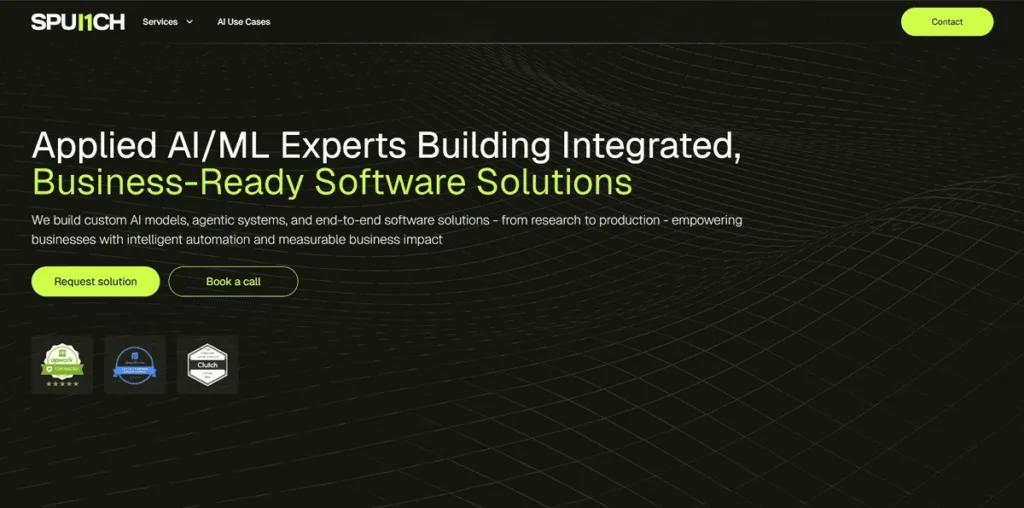
SPUNCH delivers intelligent applications focused on optimizing operations and driving growth. The agency emphasizes understanding unique client pain points and crafting custom solutions with creativity and precision.
Technical Expertise: Chatbot creation, MVP development, dedicated AI/ML team integration, and ERP/CRM incorporation.
Industry Coverage: Not specifically disclosed, serves businesses at various stages of technological journey.
Pricing: $40-85/hour | Average project: $38,000-$95,000
Strengths: Flexibility to adjust project scope and resources, transparent time & materials pricing model, tailored AI solutions for specific challenges.
Best For: Small businesses requiring flexible engagement models; companies preferring time and materials billing structures.
11. SpellSystems
Rating: 4.1/5
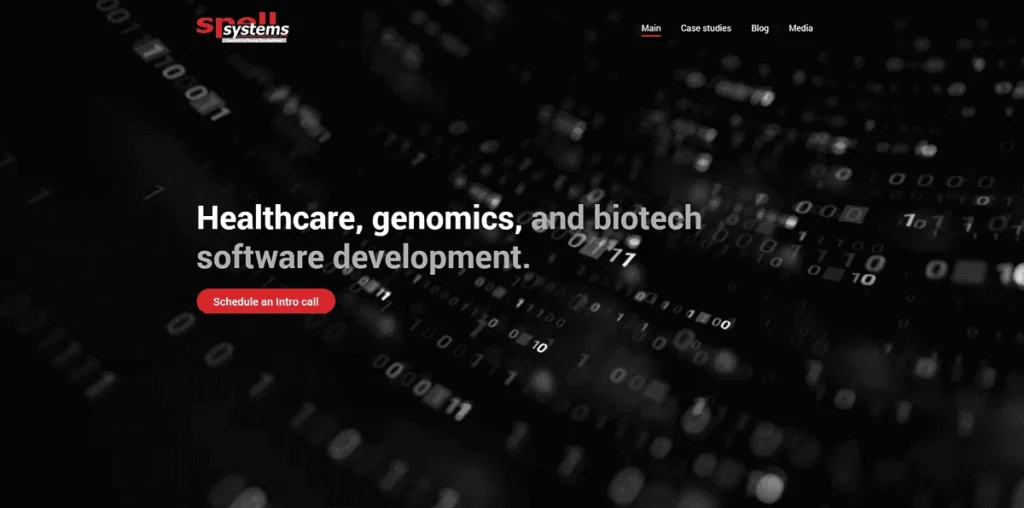
Based in Dubai, SpellSystems specializes in AI integration, self-hosted models deployment, fine-tuning, robotic process automation, and business process automation. They focus on Fintech, Biotech, and Commodity Trading sectors with an MVP approach for quick, budget-friendly engineering.
Technical Expertise: AI-powered custom program creation, blockchain and smart contracts, business intelligence and big data solutions, healthcare software including telemedicine and genomics, payment processing and fintech automation.
Industry Coverage: Commodity trading, healthcare, biotech, agriculture, sports betting, casinos, fintech, government, commerce, and transport.
Pricing: $45-95/hour | Average project: $42,000-$105,000
Strengths: AI-enhanced development for faster releases, complete IP transfer and source code ownership, in-house teams for risk-free delivery, proven R&D capabilities across multiple industries.
Best For: Fintech startups requiring blockchain integration; biotech companies needing specialized healthcare software; Middle East-based businesses.
12. Kodexo Labs Global
Rating: 3.9/5
Kodexo Labs is a global AI development company serving startups to large enterprises with experienced AI engineers, data scientists, and solution architects. They deliver tailored solutions combining innovation, scalability, and security.
Technical Expertise: AI-driven application and custom software development, machine learning, NLP, and predictive analytics solutions, workflow automation and process optimization, AI-powered MVPs and enterprise-scale deployments, cloud-native AI integration (AWS, Google Cloud, Azure).
Industry Coverage: Healthcare, education, automotive, marketing & advertising, energy, fintech, retail & eCommerce, logistics, real estate, and enterprise solutions.
Pricing: $50-105/hour | Average project: $48,000-$125,000
Strengths: End-to-end AI development from consulting to deployment, scalable and cost-efficient solutions, strong emphasis on security and compliance, strategic insights for ROI maximization.
Best For: Real estate tech companies; energy sector businesses requiring predictive analytics; logistics firms needing workflow automation.
13. Clarion Tech
Rating: 3.7/5
Clarion Tech enables businesses to operate with better efficiency and creativity through AI solutions. Their experts specialize in machine learning, automation, and analytics, working closely with clients from initial consultation to post-launch support.
Technical Expertise: AI-powered custom software development, machine learning and predictive analytics, natural language understanding and conversational AI, computer vision solutions, generative AI development, large enterprise integration and automation.
Industry Coverage: Manufacturing, healthcare, financial services, retail, travel & hospitality, education, and technology.
Pricing: $45-100/hour | Average project: $45,000-$115,000
Strengths: Customized engagement models for startups and enterprises, fast transparent processes, maximum data security and compliance (ISO standards), dedicated AI Center of Excellence, full-fledged end-to-end services.
Best For: Manufacturing companies requiring computer vision; enterprises needing dedicated AI Centers of Excellence; technology firms seeking research-backed solutions.
How to Choose the Right GenAI Development Partner
Selecting from the best generative AI development companies requires balancing technical capabilities, budget constraints, timeline expectations, and long-term partnership potential. The decision impacts not just immediate project success but future scalability and maintenance costs.
● Define Your Project Scope and Budget
Start by defining your project scope with clarity. Understanding whether you need a simple chatbot integration, custom LLM fine-tuning, or enterprise-wide AI transformation determines which generative AI companies match your requirements. Startups building MVPs have different needs than established enterprises deploying mission-critical systems. Budget allocation matters significantly, with hourly rates ranging from $15 to $150 across GenAI development companies, translating to project costs between $35,000 and $200,000 for similar deliverables.
● Evaluate Technical Expertise
Technical expertise evaluation goes beyond marketing claims when selecting top generative AI development companies. Examine case studies for projects resembling yours, focusing on specific technologies used, challenges overcome, and quantifiable results achieved. Companies listing “AI development” generically differ vastly from those detailing LLM orchestration, vector database optimization, or multimodal implementations. Request technical architecture diagrams and ask pointed questions about model selection, training approaches, and integration methodologies during initial consultations.
● Validate Track Record Through Third-Party Sources
Track record validation through third-party sources provides unbiased insights into best generative AI companies. Clutch and Manifest reviews offer verified client feedback, while industry awards indicate peer recognition. Look beyond total years in business to assess relevant AI experience, particularly with generative models emerging prominently after 2022. A company founded in 2000 may have less GenAI expertise than one established in 2017 if the latter focused specifically on modern AI development.
● Prioritize Communication Transparency
Communication transparency often predicts project success more accurately than technical prowess when working with generative AI development companies. During initial discussions, evaluate response times, clarity of explanations, and willingness to discuss potential challenges openly. Companies promising unrealistic timelines or avoiding detailed cost breakdowns typically create problems later. Request sample project plans, reporting templates, and communication protocols to understand how you’ll stay informed throughout development.
● Compare Pricing Models and Hidden Costs
Pricing models vary significantly across GenAI development companies. Fixed-price contracts suit well-defined projects with stable requirements, while time-and-materials arrangements offer flexibility for evolving scopes. Dedicated team models work best for long-term engagements requiring ongoing development. Compare not just hourly rates but what’s included—project management, testing, deployment, and documentation. Hidden costs for revisions, support, or third-party API usage can dramatically inflate budgets.
● Assess Post-Delivery Support and Knowledge Transfer
Post-delivery support distinguishes partners from vendors among top generative AI companies. Clarify maintenance offerings, response time commitments, and costs for updates or bug fixes before signing contracts. Companies charging premium rates for basic support create long-term financial burdens. Examine knowledge transfer processes, documentation quality, and training provisions to ensure your team can manage the solution independently if needed.
● Consider Industry-Specific Experience
Industry-specific experience accelerates development and reduces risks when choosing best generative AI development companies. Healthcare projects require HIPAA compliance understanding, fintech demands robust security protocols, and education needs accessibility considerations. Generalist firms may struggle with domain-specific regulations and best practices that specialized teams navigate effortlessly. Review portfolios for projects in your sector and request references from similar clients.
● Ensure Cultural Fit and Time Zone Alignment
Cultural fit and time zone alignment impact daily collaboration quality with generative AI development companies. Companies operating in compatible time zones enable real-time communication, while significant differences create delays. Development methodologies—Agile, Scrum, Waterfall—should align with your organizational processes. Assess team stability by asking about developer retention rates and whether you’ll work with dedicated resources or rotating staff.
The GenAI Development Process: From Concept to Deployment
Generative AI companies follow structured phases that transform initial concepts into production-ready systems. Understanding this process helps set realistic expectations and identify potential bottlenecks early.
● Discovery and Requirements Gathering
Discovery and requirements gathering establish project foundations. Development teams conduct stakeholder interviews, analyze existing systems, and document technical requirements. This phase identifies business objectives, target users, success metrics, and integration points with current infrastructure. Thorough discovery prevents scope creep and misaligned expectations that derail projects later. Teams should produce detailed specifications including data requirements, expected model behaviors, and performance benchmarks.
● Solution Architecture and Technology Selection
Solution architecture and technology selection determine the technical approach. Teams evaluate whether pre-trained models like GPT-4 or Claude suit needs versus custom fine-tuning requirements. Architecture decisions cover cloud platforms, vector databases for retrieval-augmented generation, API structures, and security implementations. This phase produces technical design documents, data flow diagrams, and infrastructure plans. Choosing inappropriate technologies here creates expensive refactoring requirements during development.
● Data Preparation and Model Selection
Data preparation and model selection consume significant effort in GenAI projects. Top generative AI development companies audit available data for quality, relevance, and compliance with privacy regulations. Data cleaning, labeling, and augmentation prepare training sets for custom models or context databases for RAG implementations. Model selection balances performance requirements, latency constraints, and cost considerations. Smaller models deployed on-premise may suit privacy-sensitive applications, while API-based solutions offer scalability without infrastructure management.
● Development and Integration
Development and integration bring designs to life through iterative sprints. Frontend interfaces, backend APIs, and AI model integrations progress simultaneously with regular synchronization. Teams implement prompt engineering strategies, fine-tune model responses, and build error handling for edge cases. Integration with existing systems requires careful API design and thorough testing to prevent disruptions. Agile methodologies enable continuous feedback and course corrections as capabilities emerge.
● Testing and Quality Assurance
Testing and quality assurance validate functionality, performance, and reliability. Beyond standard software testing, GenAI applications require evaluating response accuracy, handling ambiguous inputs, and preventing harmful outputs. Load testing ensures systems handle expected user volumes without degradation. Security testing addresses prompt injection attacks, data leakage, and unauthorized access. User acceptance testing with real stakeholders confirms the solution meets business needs before full deployment.
● Deployment and Monitoring
Deployment and monitoring transition projects from development to production environments. Best generative AI development companies implement gradual rollouts, A/B testing, or canary deployments to minimize risks. Monitoring systems track model performance, latency, error rates, and user satisfaction metrics. Logging conversation flows and user interactions enables continuous improvement. Documentation covering system architecture, API specifications, and troubleshooting guides supports long-term maintenance.
● Post-Launch Optimization
Post-launch optimization refines systems based on real-world usage. Teams analyze user feedback, identify common failure patterns, and adjust prompts or model parameters accordingly. Regular updates incorporate new model versions, security patches, and feature enhancements. Scalability adjustments respond to growing user bases or expanding use cases. Ongoing support ensures systems remain effective as business needs evolve.
Benefits of Partnering with Expert GenAI Development Companies
Professional generative AI development companies deliver advantages that extend beyond technical implementation. Their expertise accelerates timelines, reduces risks, and maximizes return on investment through proven methodologies and specialized knowledge.
1. Access to Specialized Talent
Access to specialized talent represents the primary benefit of working with top generative AI development companies. Building in-house GenAI teams requires recruiting rare specialists commanding premium salaries, lengthy hiring processes, and ongoing training investments. Development companies maintain teams of AI engineers, data scientists, and ML specialists already proficient in latest technologies. This expertise covers model selection, prompt engineering, fine-tuning strategies, and integration best practices accumulated across dozens of projects.
2. Accelerated Time-to-Market
Accelerated time-to-market provides competitive advantages in fast-moving markets when partnering with best generative AI companies. Experienced teams navigate common pitfalls efficiently, leveraging pre-built frameworks, proven architectures, and established workflows. Where in-house teams might spend months on foundational research and experimentation, professional developers deliver working prototypes in weeks. This speed enables faster market validation, investor demonstrations, and revenue generation.
3. Cost Efficiency Through Multiple Channels
Cost efficiency materializes through multiple channels with GenAI development companies. Hourly rates of $15-150 seem expensive until compared against full-time employee costs exceeding $150,000 annually plus benefits, infrastructure, and training. Project-based engagements eliminate overhead for recruiting, management, and retention. Companies absorb risks of technical dead-ends and failed approaches that would waste internal resources. Predictable budgets prevent the cost overruns common in exploratory AI projects.
3. Cost Efficiency Through Multiple Channels
Risk mitigation stems from experience with diverse projects and failure modes. Professional top generative AI development companies anticipate data quality issues, model performance limitations, and integration challenges before they become critical problems. Their testing methodologies catch edge cases and security vulnerabilities that inexperienced teams miss. Established development processes with code reviews, documentation standards, and quality gates reduce bugs and technical debt.
4. Scalability and Flexibility
Scalability and flexibility adapt to changing needs without restructuring teams. Projects can scale up during intensive development phases and scale down during maintenance periods. Generative AI companies provide diverse skill sets—frontend developers, backend engineers, DevOps specialists—coordinated effectively without complex management overhead. This elasticity proves especially valuable for startups with fluctuating cash flows and uncertain growth trajectories.
5. Ongoing Support and Maintenance
Ongoing support and maintenance ensure long-term success beyond initial deployment. Technology updates, security patches, and performance optimization require continuous attention. Professional best generative AI development companies offer structured support packages with defined response times and service level agreements. Their broad client bases mean your system benefits from improvements and lessons learned across multiple implementations.
Challenges in GenAI Development and How to Overcome Them
Generative AI projects face unique challenges that differ from traditional software development. Understanding these obstacles and mitigation strategies improves success probabilities significantly.
1. Data Quality and Availability
Data quality and availability often limit model effectiveness. GenAI systems require substantial high-quality data for training or context retrieval, but many businesses lack organized, clean datasets.
Solution: Conduct dedicated data audits and cleaning processes, potentially leveraging synthetic data generation. Start with smaller scopes using available data, then expand as data infrastructure improves.
2. Cost Management with API-Based Models
Cost management becomes challenging with API-based models where usage directly impacts expenses. ChatGPT or Claude API costs scale with conversation volumes, potentially reaching thousands of dollars monthly for active applications.
Solution: Implement response caching, optimize prompt lengths, use smaller models for simple tasks, and set usage limits. Consider self-hosted open-source models to eliminate per-request costs if infrastructure investment is feasible.
3. Model Accuracy and Hallucinations
Model accuracy and hallucinations present persistent concerns. Language models confidently generate plausible-sounding but factually incorrect information, creating risks for applications requiring high accuracy.
Solution: Build robust validation layers, implement retrieval-augmented generation with verified sources, and include clear uncertainty indicators. Educate users about AI limitations and establish human review processes for critical outputs.
4. Integration Complexity with Legacy Systems
Integration complexity with legacy systems creates technical hurdles. Existing architectures built before AI considerations lack APIs, data access patterns, or scalability for AI workloads.
Solution: Design careful API architectures, construct proper data pipelines, and consider system modernization where needed. Start with isolated use cases to reduce disruption while demonstrating value.
5. Integration Complexity with Legacy Systems
Regulatory compliance and ethical considerations demand attention, especially in healthcare, finance, and government sectors. GDPR, HIPAA, and industry-specific regulations govern data handling, privacy, and transparency, while bias and fairness concerns require vigilance.
Solution: Partner with developers experienced in regulated industries and implement comprehensive governance frameworks. Establish proactive policies and testing protocols for ethical AI use.
6. User Adoption and Change Management
User adoption and change management often determine success more than technical excellence. Employees resistant to AI tools or customers uncomfortable with automated interactions limit value realization.
Solution: Involve stakeholders throughout development, provide comprehensive training programs, and communicate clearly about AI roles and limitations. Deploy gradual rollouts that build user confidence over time.
Conclusion
The generative AI landscape continues evolving rapidly with multimodal models combining text, images, and audio becoming standard. Autonomous AI agents handling complex multi-step workflows will transform business processes, while smaller, more efficient models enable edge deployment and reduced costs. Regulatory frameworks will mature, establishing clear guidelines for responsible AI development.
Choosing the right development partner becomes increasingly critical as organizations recognize AI’s transformative potential. The companies profiled represent diverse approaches—from specialized GenAI boutiques to versatile full-stack developers—each serving distinct market segments effectively.
Developer Bazaar Technologies emerges as an exceptionally balanced choice, delivering specialized AI capabilities with comprehensive development services at competitive rates. The combination of technical expertise, transparent communication, rapid MVP delivery, and cost efficiency positions DB Tech ideally for startups and mid-market companies seeking maximum value.
Success in GenAI implementation requires clear objectives, realistic budgets, and partners committed to long-term success. Whether choosing specialized firms for cutting-edge R&D or versatile developers for integrated solutions, thorough evaluation using the frameworks presented here improves outcomes significantly. The generative AI revolution offers tremendous opportunities for businesses willing to invest strategically in the right partnerships.
FAQs
1. What's the typical cost range for GenAI development projects?
GenAI projects range from $35,000 for basic implementations to $200,000+ for enterprise deployments. Costs depend on complexity, customization, data preparation, and technology choices. Hourly rates span $15-150 based on provider expertise and location.
2. How long does it take to develop a GenAI application?
MVP development takes 3-12 weeks, with simpler integrations completing faster. Full-scale enterprise applications require 3-6 months. Developer Bazaar’s 25-day MVP delivery represents the faster end, while custom model training extends timelines significantly.
3. Should I use pre-trained models or develop custom solutions?
Pre-trained models like GPT-4 or Claude suit most use cases with faster deployment and lower costs. Custom models make sense for highly specialized domains, privacy-sensitive on-premise requirements, or when pre-trained models underperform. Most projects start with pre-trained models and customize only if necessary.
4. What's the difference between API-based and self-hosted AI models?
API-based models offer easy integration with pay-per-use pricing but create ongoing costs and data privacy considerations. Self-hosted models require infrastructure investment and expertise but eliminate per-request fees and keep data on-premise. Choose based on budget, privacy needs, and technical capabilities.
5. How do I ensure regulatory compliance?
Work with developers experienced in your industry’s regulations. Implement data governance frameworks, audit trails, and transparent AI decision-making. For healthcare choose HIPAA-compliant partners, for finance ensure SOC 2 certification, and for European markets verify GDPR expertise.
6. What ROI can I expect from GenAI implementations?
Typical returns include 30-50% reduction in customer service costs, 20-40% productivity improvements in content creation, and 15-30% efficiency gains in data analysis. Specific ROI depends on use cases, implementation quality, and adoption rates. Most businesses see positive ROI within 6-12 months.
7. How important are post-launch support and maintenance?
Critical for long-term success. GenAI systems require monitoring for accuracy, prompt updates, security patches, and scaling. Budget 15-20% of initial development costs annually or negotiate structured support packages upfront.
8. Can GenAI solutions integrate with existing business systems?
Yes, modern GenAI applications integrate with CRM, ERP, helpdesk, and custom systems through APIs. Integration complexity depends on legacy architecture and available APIs. Experienced developers assess infrastructure during discovery, though older systems may require modernization for optimal results.

Arpit Vaishnav
CTO
Developer Bazaar technologies