
AI agents are becoming part of everyday business systems. According to Gartner, 40% of enterprise applications will include AI agents by the end of 2026, up from less than 5% in 2025.
But there is a problem. Many companies still fail to turn AI ideas into real business value. In fact, over 40% of agentic AI projects may be cancelled by 2027 due to poor planning, lack of control, and unclear ROI.
This is where AI agent orchestration frameworks play a crucial role. These tools help you connect, control, and manage AI agents so they work together smoothly.
In this blog, you will learn:
- What AI agent orchestration means
- The Top AI agent orchestration frameworks in 2026
- Their strengths and limitations
- How to choose the right one
What Is AI Agent Orchestration?
AI agent orchestration is the system that manages how different AI agents, tools, and workflows work together. Instead of one AI doing everything, multiple agents handle different tasks. Orchestration makes sure these agents communicate properly, follow the right order, and complete the task successfully.
Think of it like a school group project. Each student has a role, but someone needs to coordinate so the project is completed correctly. That “someone” is orchestration in AI systems.
It mainly handles things like:
- Deciding which agent should do a task
- Managing step-by-step workflows
- Handling errors and retries
- Storing memory and past actions
Without orchestration, AI systems become confusing and unreliable.
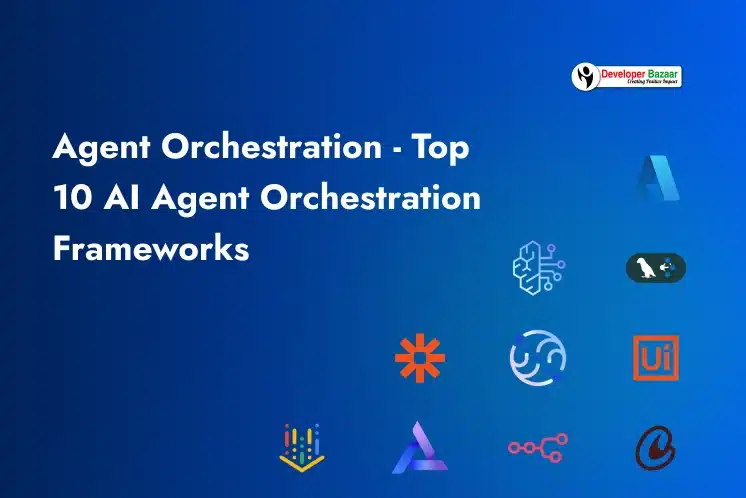
Top 10 AI Agent Orchestration Frameworks in 2026
The AI orchestration ecosystem is divided into different categories because not all tools solve the same problem. Some tools focus on infrastructure and security, while others focus on building logic and workflows.
At a high level, these tools fall into four main groups:
- Enterprise Managed Platforms: These provide model access, hosting, and strong security. They are best for large organizations.
- Developer Frameworks: These allow engineers to build custom AI logic and workflows using code.
- Enterprise Automation (RPA): These tools connect AI with existing business processes.
- Workflow Automation Tools: These tools help automate tasks across apps with simple setups.
Understanding this scenario helps businesses pick the right AI agent orchestration frameworks in 2026 based on their needs.
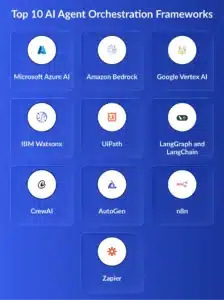
1. Microsoft Azure AI
Microsoft Azure AI Foundry is a complete platform that brings together AI tools, cloud services, and automation in one place. It is mainly built for large companies that already use Microsoft products. This platform helps teams create, manage, and deploy AI agents in a secure and controlled environment. It also connects easily with tools like Microsoft 365 and business applications, making it easier to integrate AI into daily operations.
Key highlights:
- Strong security and compliance features help protect sensitive business data
- Easy integration with Microsoft tools reduces setup time
- Reliable support makes it suitable for large-scale enterprise applications
Challenges:
- High dependency on the Azure ecosystem makes switching difficult
- Costs can increase significantly as usage grows
2. Amazon Bedrock
Amazon Bedrock is a managed service that allows businesses to build AI agents without worrying about infrastructure. It provides access to multiple AI models from different providers, which gives teams flexibility in choosing the right model for their needs. It works best for companies already using AWS, as it integrates smoothly with existing cloud services.
Key benefits:
- Access to multiple AI models allows flexibility in building solutions
- Smooth integration with AWS services like Lambda and S3 simplifies workflows
Limitations:
- Debugging agent behavior can be complex and time-consuming
- Strong dependency on AWS makes migration difficult
3. Google Vertex AI
Google Vertex AI is designed for businesses that depend heavily on data. It connects AI agents directly with data tools like BigQuery and uses powerful models such as Gemini. This makes it very effective for real-time data processing and analytics-driven decisions.
Key advantages:
- Excellent data integration helps in building data-driven AI systems
- Strong performance in handling real-time and structured data
Challenges:
- Less flexibility compared to developer-focused frameworks
- Dependency on Google Cloud infrastructure
4. IBM Watsonx
IBM WatsonX is focused on governance, security, and explainability. It is mainly used in industries like healthcare, banking, and government, where strict rules must be followed. The platform tracks how AI models behave and ensures that every decision can be audited and explained.
Main strengths:
- Advanced compliance tools help meet strict regulatory requirements
- Transparent tracking of AI decisions improves trust and accountability
Limitations:
- Expensive and complex to implement
- Not ideal for fast-moving teams that need quick deployment
5. UiPath
UiPath started as a robotic process automation (RPA) tool and has now added AI agent capabilities. It helps businesses connect AI with their existing automated processes. This makes it useful for companies that want to upgrade their current systems without rebuilding everything from scratch.
Key benefits:
- Works well with legacy systems already in place
- Supports human approvals, making workflows more reliable
Limitations:
- Not designed for advanced AI reasoning or complex logic
- Limited flexibility when building new AI-first systems
6. LangGraph and LangChain
LangGraph and LangChain are powerful frameworks designed for developers who want full control over AI workflows. They allow teams to build complex, stateful systems where every step of the process is clearly defined. These tools are widely used in production environments where reliability and control are critical.
Key strengths:
- Highly customizable workflows allow precise control over agent behavior
- Strong debugging and observability tools help track and fix issues
Limitations:
- Requires strong technical knowledge to use effectively
- Setup and development can take more time compared to simpler tools
7. CrewAI
CrewAI is built for creating multi-agent systems where each agent has a specific role and responsibility. It is simple to use and helps teams quickly build systems where agents work together like a team to achieve a goal.
Key highlights:
- Quick and easy setup makes it ideal for fast development
- Role-based design helps organize tasks clearly
Limitations:
- Still growing and less mature compared to other frameworks
- Limited control when handling complex workflows
8. AutoGen
AutoGen is a framework focused on communication between AI agents. Agents interact with each other through conversations to complete tasks. It is mainly used for research and experimentation rather than production systems.
Key benefits:
- Flexible agent interactions allow creative and experimental setups
- Strong research foundation supports advanced use cases
Limitations:
- Not fully ready for production environments
- Requires additional engineering to build reliable systems
9. n8n
n8n is a workflow automation platform that includes AI capabilities. It allows users to create workflows visually while also giving developers the option to add custom code. This makes it a good choice for teams that want both flexibility and ease of use.
Key strengths:
- Self-hosting option gives better control over data and security
- Developer-friendly features allow customization
Limitations:
- Not designed for deep AI orchestration
- Limited advanced features for complex AI systems
10. Zapier
Zapier is one of the simplest tools for automating tasks between different apps. It now includes AI features that help users automate more complex workflows without needing technical knowledge.
Key benefits:
- Very easy to use, even for non-technical users
- A large number of app integrations makes it highly versatile
Limitations:
- Limited capabilities for complex AI systems
- Not suitable for advanced agent orchestration
Common AI Agent Orchestration Frameworks Limitations You Should Know
Even though these are the best AI orchestration tools 2026, they are not perfect. Every framework has its own strengths and weaknesses. Understanding these limitations helps you avoid mistakes and choose the right tool for your business.
1. Custom Logic Issues
Many frameworks are built using standard patterns like simple workflows or predefined logic. But in real business cases, you may need very specific or unique logic. For example, if your system requires complex decision-making or custom workflows, frameworks may not support it easily. In such cases, developers may need to write extra code or even build custom solutions from scratch.
2. Performance Concerns
AI orchestration frameworks add an extra layer between your system and the AI models. While this is useful, it can also slow things down. In high-speed systems like fraud detection or trading, even a small delay can cause problems. So, if performance and speed are critical, you need to carefully evaluate the framework.
3. Integration Problems
Not all frameworks support every tool, API, or database. If your system uses special technologies or custom-built tools, integration can become difficult. This may require additional development work, which increases time and cost.
4. Security Restrictions
Some industries, like banking, healthcare, or government, have very strict security rules. They may not allow external tools or cloud-based frameworks due to data privacy concerns. In such cases, companies may need self-hosted or highly secure solutions, which not all frameworks provide.
Conclusion
AI agents are changing how businesses work, but building them is not enough for now on. The real success comes from managing them properly. This is why agent orchestration frameworks are so important, they bring structure, control, and reliability to AI systems.
The tools we discussed are among the top AI agent frameworks in 2026, and each one is designed for different use cases. Some are better for enterprises, some for developers, and others for simple automation. Choosing the right one depends on your goals, team skills, and technical environment.
In the end, the biggest risk is not choosing the wrong tool. The real risk is delaying your decision and missing out while competitors move ahead.
FAQs
1. What are AI agent orchestration frameworks?
AI agent orchestration frameworks are tools that help manage multiple AI agents working together. Instead of running each agent separately, these frameworks coordinate tasks, manage workflows, and ensure smooth communication between agents. This makes the entire system more reliable and efficient.
2. Which is the best AI orchestration tool in 2026?
There is no single “best” tool for everyone. The right choice depends on your business needs, the size of your project, and your technical setup. For example, large enterprises may prefer platforms like Azure or AWS, while developers may choose frameworks like LangGraph for more control.
3. How to choose an AI agent orchestration framework?
Choosing the right framework requires careful thinking. You should look at your business goals, the complexity of your use case, and your team’s technical skills. It is also important to check if the framework supports your existing tools, meets security requirements, and can scale as your business grows.
4. Are these frameworks necessary?
Yes, they are very important for building reliable AI systems. Without orchestration frameworks, managing multiple agents becomes difficult and error-prone. These tools help organize workflows, reduce failures, and make it easier to scale AI solutions.
5. What services help in building AI agents?
Businesses often use services like AI agent orchestration services, AI Agent development services, and AI development services. These services provide expert support in designing, building, and managing AI systems. They help reduce risks, speed up development, and ensure that your AI solution works effectively in real-world conditions.