

In today’s fast-paced digital world, businesses rely on real-time voice AI to deliver smooth and natural conversations. From customer support chatbots to virtual assistants like Alexa and Google Assistant, voice technology is transforming how companies interact with users.
However, for voice AI systems to be effective, they must respond instantly. Even a slight delay can frustrate users and disrupt the experience. This delay, known as voice AI latency, directly affects performance and customer satisfaction. Reducing voice AI latency helps businesses provide faster, smoother, and more efficient interactions. It also enhances operational efficiency, reduces costs, and improves user engagement.
What Is Latency in Voice AI?
Voice AI latency refers to the time it takes for a system to process a user’s spoken input and deliver a response. It is measured in milliseconds and determines how natural and responsive a conversation feels.
A typical voice AI interaction includes the following stages:
- Speech Recognition (Automatic Speech Recognition – ASR): The system converts spoken words into text. Delays may occur due to background noise, accents, or poor audio quality.
- Language Processing (Natural Language Processing – NLP): The AI interprets the user’s intent and understands the context of the request.
- Decision-Making and Response Generation: The system determines the appropriate response using predefined logic, databases, or AI models.
- Speech Synthesis (Text-to-Speech – TTS): The generated response is converted into natural-sounding speech and delivered to the user.
Latency can occur at any stage due to network delays, heavy AI models, or inefficient system architecture. Optimizing each step is essential to reducing speech AI delay and ensuring real-time communication.
Why Latency Matters in Voice AI for Business Performance?
Latency in voice AI refers to the delay between a user’s spoken input and the system’s response. In today’s digital-first economy, customers expect instant interactions. High latency disrupts communication, while low latency enables real-time engagement.
A study shows that humans face a 200-millisecond delay, and anything slower than 500 milliseconds feels disruptive to conversational flow. Each additional second of latency can increase call abandonment rates by up to 7%.
Reducing voice AI latency is not just a technical improvement, it is a strategic business investment that improves customer experience, operational efficiency, and brand reputation. Organizations that prioritize faster voice assistant response time gain a competitive advantage and deliver superior service.
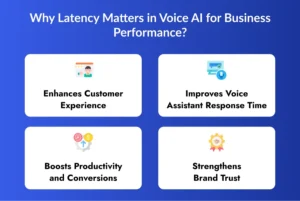
1. Enhances Customer Experience
A fast and responsive voice AI system helps in smooth and natural conversations. When users receive instant replies, they feel heard and valued, leading to greater satisfaction and engagement.
Low voice AI latency enables:
- Real-time, human-like interactions.
- Reduced frustration and fewer abandoned conversations.
- Simple user journeys across platforms such as call centers and mobile apps.
For example, in customer support, delays of even a few seconds can frustrate users. By reducing speech AI delay, businesses create intuitive and pleasant experiences that foster long-term customer loyalty.
Business Impact:
- Higher customer satisfaction (CSAT)
- Improved retention rates
- Enhanced user engagement
2. Improves Voice Assistant Response Time
Voice assistants are designed to provide quick and accurate information. Optimizing voice assistant response time makes sure efficient communication and boosts usability across industries.
Reduced latency benefits:
- Customer Support: Enables instant issue resolution.
- Banking & Finance: Facilitates quick balance checks and secure transactions.
- Healthcare: Supports timely appointment scheduling and patient queries.
- E-commerce: Provides real-time order updates and product recommendations.
By implementing real-time voice AI solutions, businesses deliver prompt services that align with modern customer expectations.
Business Impact:
- Faster decision-making
- Increased operational efficiency
- Enhanced user convenience
3. Boosts Productivity and Conversions
Efficient Voice AI systems streamline operations by automating repetitive tasks and minimizing waiting times. When latency is reduced, businesses can handle more interactions simultaneously without compromising quality.
Key advantages include:
- Increased call-handling capacity.
- Faster resolution of customer queries.
- Reduced workload for human agents.
- Improved scalability during peak hours.
For instance, an e-commerce platform with optimized voice bot speed can assist customers instantly, increasing the likelihood of completing purchases.
Business Impact:
- Higher conversion rates
- Increased revenue
- Lower operational costs
- Improved return on investment (ROI)
4. Strengthens Brand Trust
A reliable and responsive Voice AI system enhances a company’s reputation. Customers associate fast, accurate responses with professionalism and technological excellence.
Low latency contributes to:
- Consistent and dependable service delivery.
- Stronger customer confidence in automated systems.
- A perception of innovation and digital leadership.
In contrast, slow or unresponsive systems can damage credibility and discourage users from engaging with the brand.
Business Impact:
- Enhanced brand loyalty
- Positive customer perception
- Competitive market advantage
How Voice AI Processing Works?
Voice AI systems follow a structured pipeline to understand and respond to human speech. Each stage contributes to the overall voice assistant response time, making optimization essential for delivering real-time experiences.
1. Speech Input
Speech input is the first stage of a Voice AI interaction, where a user speaks into a device such as a smartphone, smart speaker, or call center system. The system captures the voice through a microphone and converts it into digital audio signals. The quality of this input significantly affects the overall voice assistant response time. Clear and noise-free audio enables faster and more accurate processing, enabling real-time voice AI experiences.
Key Aspects:
- Captures user speech through microphones and audio sensors.
- Converts analog sound into digital signals.
- Uses noise cancellation and echo reduction to enhance clarity.
- Impacts the efficiency of downstream AI processing.
2. Automatic Speech Recognition (ASR)
Automatic Speech Recognition (ASR) converts spoken language into text. This stage allows the system to understand what the user has said. ASR models analyze speech patterns, accents, and phonetics to generate accurate transcripts. Optimizing ASR plays a critical role in reducing voice AI latency and ensuring fast and precise interpretations.
Key Aspects:
- Transcribes spoken words into text.
- Supports multiple languages and accents.
- Uses deep learning models for accuracy.
- Helps reduce speech AI delay and improve voice bot speed.
3. Natural Language Processing (NLP)
Natural Language Processing (NLP) enables the system to interpret the meaning behind the transcribed text. It identifies user intent, extracts relevant data, and understands context to generate meaningful responses. Efficient NLP models are essential for voice AI performance optimization and delivering human-like interactions.
Key Aspects:
- Detects user intent and context.
- Extracts entities such as names, dates, and locations.
- Enables personalized and intelligent responses.
- Improves how to improve voice assistant response time.
4. Decision Engine
The decision engine acts as the brain of the Voice AI system. Based on the interpreted intent, it determines the most appropriate response. This component may use predefined rules, APIs, databases, or advanced AI models. A well-optimized decision engine is crucial for building custom AI agent solutions that deliver accurate and instant results.
Key Aspects:
- Applies business logic and workflows.
- Fetches data from databases and APIs.
- Integrates with enterprise systems like CRM and ERP.
- Fast and relevant responses.
5. Text-to-Speech (TTS) Output
Text-to-Speech (TTS) is the final stage, where the generated response is converted into natural-sounding speech. Modern TTS engines use neural voice synthesis to produce human-like tones, enhancing user engagement. Efficient TTS systems help reduce voice AI latency and improve the overall conversational experience.
Key Aspects:
- Converts text into lifelike speech.
- Adjusts tone, pitch, and pronunciation.
- Delivers responses in real time.
- Enhances accessibility and user satisfaction.
Key Practices to Reduce Latency in Voice AI
Implementing the right strategies helps in fast and reliable voice interactions. These voice AI latency optimization techniques help reduce voice AI latency and improve system performance.
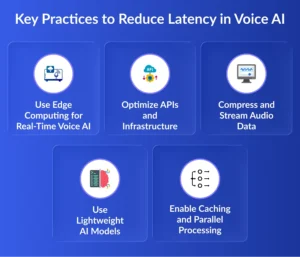
1. Use Edge Computing for Real-Time Voice AI
Edge computing processes data closer to the user instead of relying entirely on centralized cloud servers. This significantly minimizes network delays and enables faster responses.
Benefits:
- Reduces data transmission time.
- Enhances system reliability and speed.
- Supports real-time voice AI applications.
- Improves user experience in low-connectivity environments.
2. Optimize APIs and Infrastructure
Efficient APIs and scalable infrastructure help in smooth communication between different components of the Voice AI system. Poorly optimized APIs can slow down performance and increase response times.
Best Practices:
- Minimize redundant API calls.
- Use load balancing and auto-scaling.
- Deploy low-latency cloud services.
- Monitor performance continuously.
3. Compress and Stream Audio Data
Audio compression and streaming reduce the size of transmitted data, enabling faster processing and real-time interactions. Streaming allows the system to process speech as it is spoken, minimizing delays.
Benefits:
- Reduces bandwidth usage.
- Accelerates speech recognition.
- Supports faster responses.
- Enables easy real-time conversations.
4. Use Lightweight AI Models
Lightweight AI models are optimized for speed and efficiency without compromising accuracy. They are particularly beneficial for mobile devices and edge environments.
Advantages:
- Faster inference times.
- Lower computational requirements.
- Reduced operational costs.
- Improved voice assistant response time.
5. Enable Caching and Parallel Processing
Caching stores frequently used responses, while parallel processing allows multiple tasks to run simultaneously. Together, they significantly improve system efficiency.
Benefits:
- Reduces repeated computations.
- Speeds up response generation.
- Improves scalability and performance.
- Enhances overall voice AI performance optimization.
These voice AI latency optimization techniques help reduce speech AI delay and improve voice bot speed.
Common Mistakes That Increase Latency and How To Overcome
Avoiding these common pitfalls is essential for maintaining high-performing and responsive Voice AI systems. Identifying and resolving these issues helps businesses reduce voice AI latency, improve voice assistant response time and deliver real-time interactions.
1. Overloading Models with Unnecessary Data
Using overly complex models or processing excessive data significantly increases computation time, leading to slower system responses. When AI models are burdened with irrelevant inputs or redundant parameters, they require more processing power and memory, which negatively impacts performance. This not only delays responses but also increases operational costs and reduces system efficiency. Simplifying models and focusing only on essential data for faster processing and improved voice bot speed.
Consequences:
- Higher Processing Delays: Large datasets and heavy models take longer to analyze, increasing response time.
- Increased Operational Costs: Complex models consume more computational resources and cloud infrastructure.
- Reduced Efficiency: Excessive data processing slows down workflows and affects system productivity.
Solution:
- Use Optimized and Task-Specific AI Models: Lightweight and purpose-built models deliver faster and more accurate results.
- Eliminate Redundant Data Processing: Filter unnecessary inputs and streamline datasets to enhance performance.
2. Poor Network Connectivity
Network connectivity plays a critical role in Voice AI performance. Issues such as low bandwidth, high latency, and unstable connections can disrupt communication between servers, APIs, and AI components. These disruptions lead to delays in speech recognition, processing, and response delivery. Reliable and high-speed networks are essential for enabling real-time voice AI interactions and ensuring user experiences.
Consequences:
- Slow Voice Interactions: Delayed data transmission results in sluggish responses.
- Interrupted Conversations: Connectivity disruptions may cause dropped or incomplete interactions.
- Decreased User Satisfaction: Poor performance frustrates users and reduces engagement.
Solution:
- Implement Edge Computing and CDNs: Processing data closer to the user minimizes transmission delays and enhances speed.
- Optimize Data Transfer Protocols: Efficient protocols such as WebRTC and gRPC for faster and more reliable communication.
3. Lack of System Optimization
Without proper system optimization, Voice AI solutions struggle to maintain speed, accuracy, and scalability. Outdated infrastructure, inefficient workflows, and poorly configured algorithms can significantly increase latency. A lack of continuous monitoring and updates results in performance hurdles that obstruct smooth operations. Regular optimization helps in voice AI performance optimization and supports scalable, high-quality interactions.
Consequences:
- Slow Response Times: Inefficient systems delay processing and degrade user experience.
- Poor Scalability: Unoptimized platforms fail to handle increased workloads during peak demand.
- Inefficient Resource Utilization: Systems consume excessive computing power, increasing operational expenses.
Solution:
- Regularly Monitor and Upgrade Infrastructure: Make sure systems remain modern, scalable, and reliable.
- Optimize Algorithms and Workflows: Streamline processes to reduce computational delays.
- Conduct Continuous Performance Testing: Use analytics and benchmarking tools to identify and eliminate bottlenecks.
How to Solve Latency Challenges?
Solving voice AI latency challenges requires a strategic blend of advanced technologies, optimized infrastructure, and expert implementation. Partnering with an experienced AI agent development company helps businesses deploy efficient and high-performing voice solutions tailored to their needs. These experts specialize in delivering end-to-end AI development services and building custom systems that minimize delays and enhance responsiveness.
By focusing on building custom AI agent solutions, organizations can streamline workflows, optimize processing pipelines and integrate cutting-edge technologies such as edge computing, lightweight AI models, and real-time streaming. This approach makes smooth interactions and faster responses.
Key Benefits of Partnering with Experts:
- Customized solutions designed for specific business requirements.
- Advanced voice AI performance optimization strategies.
- Smooth integration with existing enterprise systems.
- Scalable and secure architecture for long-term growth.
- Continuous monitoring, testing, and performance enhancement.
Collaborating with professionals helps businesses reduce voice AI latency, improve voice assistant response time, and achieve real-time, human-like interactions.
Conclusion
Reducing voice AI latency is essential for delivering fast, intelligent, and reliable digital experiences. These days, when customers expect instant responses, optimizing voice technologies is a business necessity. Faster response times enhance operational efficiency, boost customer satisfaction, and strengthen brand reputation.
By adopting advanced technologies such as edge computing, lightweight AI models, and optimized APIs, organizations can significantly improve voice bot speed and reduce speech AI delay. Implementing effective voice AI latency optimization techniques enables businesses to offer natural conversations powered by real-time voice AI.
Investing in voice AI performance optimization enables companies to stay competitive, scale efficiently, and provide exceptional customer experiences in a rapidly evolving digital landscape.

FAQs
1. How to improve voice assistant response time?
To improve voice assistant response time, organizations should implement caching mechanisms, audio streaming, and scalable cloud infrastructure. Parallel processing and optimized algorithms further accelerate data processing and response delivery. Continuous monitoring and performance tuning to operate the system efficiently under varying workloads.
2. What causes delays in voice AI systems?
Delays in voice AI systems are typically caused by network latency, heavy AI models, and inefficient processing pipelines. Other contributing factors include poor audio quality, slow APIs, and outdated infrastructure. Identifying and addressing these bottlenecks through proper optimization for faster and more reliable voice interactions.
3. Why is voice AI performance optimization important?
Voice AI performance optimization is crucial for delivering accurate, real-time, and engaging user experiences. It enhances customer satisfaction, reduces operational costs, and improves system scalability. Optimized systems also increase efficiency, strengthen brand credibility, and provide a competitive advantage in today’s technology-driven market.
4. Who can help implement these solutions?
A professional AI development company specializing in building ai agent can help implement and optimize voice AI solutions. These experts design and deploy tailored systems aligned with business goals and industry standards. Their expertise in building custom AI agent solutions for improved performance, scalability, and reduced latency.
5. How do you optimize latency for conversational AI?
Latency in conversational AI can be optimized by streamlining each stage of the processing pipeline. This includes using lightweight AI models, enabling real-time audio streaming, and implementing edge computing to process data closer to users. Additionally, optimizing APIs, leveraging caching, and using parallel processing help reduce delays and improve overall system responsiveness.
6. Is 40 ms latency good or 50 ms?
Yes, both 40 ms and 50 ms latencies are considered excellent for conversational AI systems. Such low latency makes for near-instant responses and smooth, human-like interactions. While 40 ms is slightly faster than 50 ms, the difference is barely noticeable to users, and both deliver an outstanding user experience.