

Key Takeaways:
- The cost of developing an NDIS mobile app or website depends on factors such as platform type, feature complexity, accessibility requirements, integrations, security, and the development team you choose.
- A basic NDIS website typically starts from AUD 10,000+, while enterprise-level mobile apps can exceed AUD 90,000, depending on business requirements.
- Investing in WCAG 2.1 AA accessibility, strong security, and Australian privacy compliance is essential for creating an inclusive and legally compliant platform.
- Prioritising core features for the initial launch and adding advanced functionality later is one of the most effective ways to control development costs.
- While off-the-shelf NDIS software works for basic needs, custom-built platforms provide greater flexibility, scalability, and full ownership of your data and user experience.
- Beyond development costs, plan for ongoing expenses such as hosting, maintenance, security updates, and future feature enhancements to ensure long-term success.
NDIS service providers across Australia are rapidly moving from paper-based processes to custom digital platforms, and for good reason. A well-built NDIS mobile app or website can simplify participant management, automate invoicing, and ensure compliance with the National Disability Insurance Agency (NDIA) reporting requirements, all in one place.
But the most common question before any development project begins is: how much does it actually cost?
This guide breaks down the real numbers, NDIS mobile app development costs, NDIS website development costs, what features each tier includes, and the exact factors that will influence your final budget. If you are a service provider evaluating your options in 2025, this is the only resource you will need.
According to IBISWorld, the National Disability Insurance Scheme (NDIS) Providers industry is projected to grow at an annualised 4.3% over the next five years, reaching $33.6 billion. The number of NDIS providers is also expected to increase steadily, driven by rising participation in the scheme and growing demand for disability support services. This continued growth is encouraging more providers to invest in dedicated websites and mobile apps to improve service delivery and remain competitive.
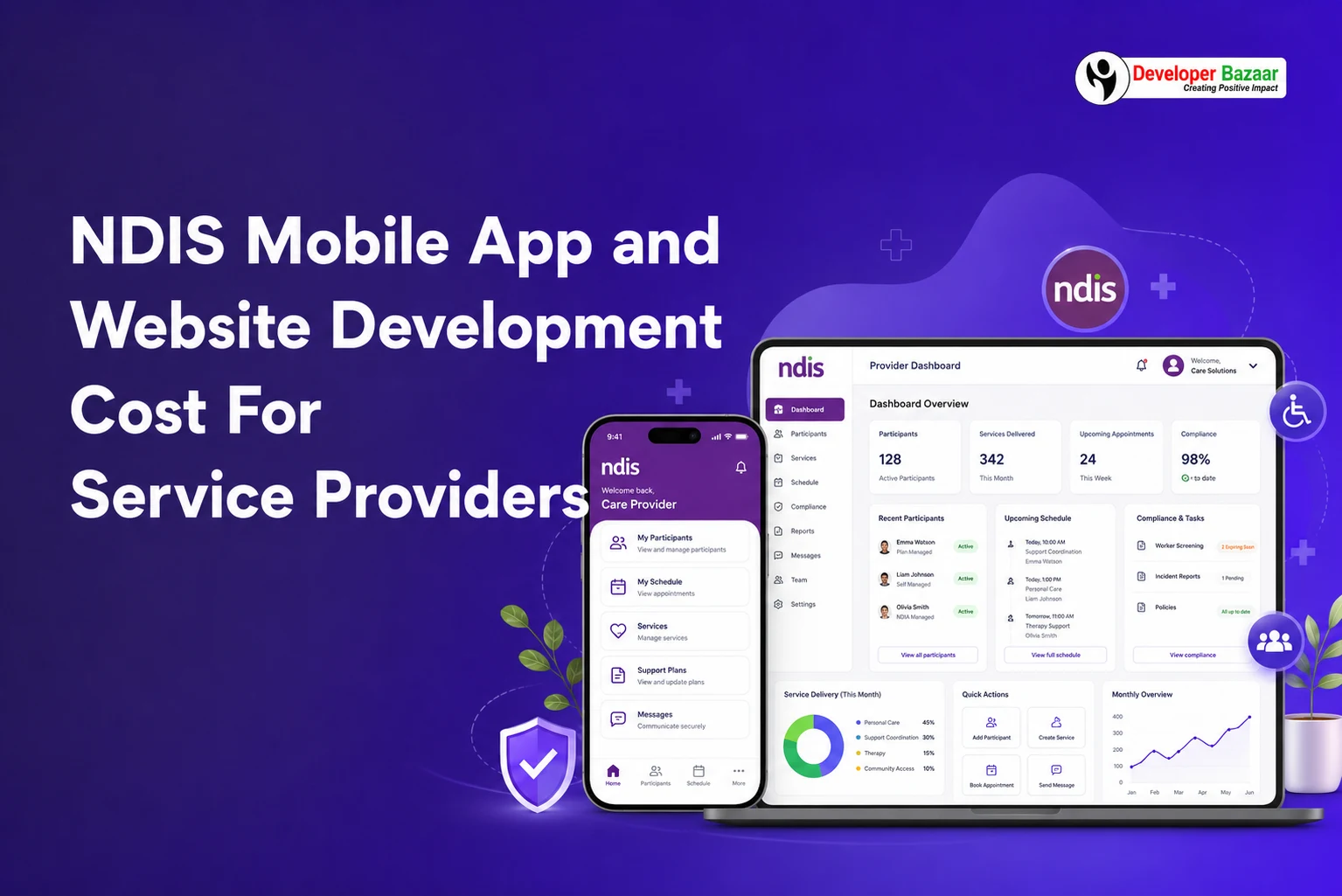
NDIS websites and mobile apps help streamline day-to-day operations by simplifying appointment booking, staff management, participant progress tracking, and real-time communication. They also improve accessibility, transparency, and operational efficiency while ensuring compliance with accessibility standards, making services easier for people with disabilities to access and use.
However, one crucial question arises whenever service providers consider developing an app or website: how much does it cost to build an NDIS mobile app or website?
Let’s discuss the cost of developing an NDIS mobile app and website, along with the factors that affect the total development cost. Let’s begin.
Why Do NDIS Service Providers Need a Dedicated App or Website?
Before diving into costs, it is worth understanding what you are actually getting and why a generic off-the-shelf tool often falls short for NDIS operations.
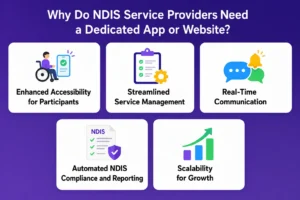
1. Enhanced Accessibility for Participants
NDIS participants often live with physical, cognitive, or sensory disabilities. A purpose-built platform can include screen reader compatibility, voice command support, high-contrast modes, and simplified navigation, meeting WCAG 2.1 AA accessibility standards that generic tools rarely support out of the box.
2. Streamlined Service Management
Staff rostering, participant profile management, shift handover notes, progress tracking, and NDIS-compliant invoicing, a custom platform puts everything in one place, cutting down on manual admin and reducing the risk of compliance errors.
3. Real-Time Communication
Push notifications, in-app messaging, and support ticket systems let participants reach support workers and administrators instantly. This reduces response lag and directly improves participant satisfaction scores.
4. Automated NDIS Compliance and Reporting
NDIS providers must maintain detailed records, submit reports, and comply with Australian Privacy Principles (APPs). A well-designed platform automates data collection, flags compliance gaps, and keeps you audit-ready at all times.
5. Scalability for Growth
As your NDIS business grows, adding new participants, staff, or service regions, a custom-built platform scales with you. Off-the-shelf tools typically hit limits that require expensive workarounds.
Cost of Developing an NDIS Mobile App and Website
Below is a detailed cost breakdown based on project complexity. All costs are in Australian Dollars (AUD) and are estimated ranges. Actual costs will vary based on your specific requirements and the development partner you choose.
| Complexity | Mobile App (AUD) | Website (AUD) | Typical Timeline | Best For |
| Basic | AUD 25,000 – 40,000+ | AUD 10,000 – 20,000+ | 3 – 4 months | Solo providers / small teams |
| Advanced | AUD 40,000 – 65,000+ | AUD 30,000 – 50,000+ | 4 – 6 months | Mid-size NDIS organisations |
| Complex / Enterprise | AUD 70,000 – 90,000+ | AUD 60,000 – 80,000+ | 6 – 12 months | Large providers, multi-branch operations |
What Each Complexity Tier Includes
- Basic NDIS App / Website: Core functionality, user registration, service listing, appointment booking, and basic participant profiles. Ideal for sole traders and small providers just getting started digitally.
- Advanced NDIS App / Website: Full operational suite, staff management, real-time chat, invoice generation, NDIS payment gateway, participant progress tracking, and role-based access control. Suitable for mid-size providers.
- Complex / Enterprise NDIS App / Website: Everything in Advanced, plus AI-powered care plan recommendations, telehealth integration, multi-branch management, custom analytics dashboards, and deep third-party integrations (CRM, EHR, government portals). For large organisations managing hundreds of participants.
Factors Influencing the Development Costs for NDIS Mobile Apps and Websites
The following are the top factors that affect the cost to develop a mobile app and website for the NDIS services.
1. Choose the Right Platform: Mobile App, Website, or Both
The platform you choose has a big impact on your development cost.
- Native apps (separate apps for iOS and Android) offer the best performance but cost the most.
- Cross-platform apps (using Flutter or React Native) use one codebase for both platforms, reducing development time and costs by around 30 – 40%.
- For websites, custom development (Laravel, Next.js) gives you greater flexibility but is more expensive. WordPress is a more affordable option for simple to medium-sized NDIS websites.
If most of your users access services through smartphones, invest in a mobile app first. A responsive website can support your online presence while the app manages day-to-day operations.
2. Features You Include
The more features you add, the higher your app development cost.
Simple features like user login take relatively little time, while advanced features such as AI-based care recommendations or real-time tracking require much more development effort.
Before starting your project, divide your features into:
- Must-have
- Nice-to-have
- Future upgrades
This helps you stay within budget and launch faster.
3. Accessibility Compliance
NDIS platforms should be easy for everyone to use, including people with disabilities.
This means adding features such as:
- Screen reader support
- Keyboard navigation
- Clear colour contrast
- Image alt text
- Visible focus indicators
Making your platform compliant with WCAG 2.1 AA usually increases development costs by 10 – 20%, but it improves usability and helps meet legal accessibility requirements.
4. Third-Party Integrations
Many NDIS platforms connect with external systems such as payment gateways, scheduling tools, CRMs, telehealth platforms, or accounting software.
Each integration requires additional development and testing, which increases the overall project cost. More integrations generally mean a larger budget.
5. Development Team You Hire
Developer rates vary depending on where your team is located.
- Australia/New Zealand: Highest cost, strong local expertise.
- India/South Asia: Lower cost with experienced development agencies.
- Eastern Europe: Mid-range pricing with strong technical skills.
- Southeast Asia: Budget-friendly for smaller projects.
Many businesses choose a blended team model that combines local project management with offshore development to balance quality and cost.
6. Testing and Quality Assurance
Thorough testing ensures your platform works properly before launch.
This includes checking:
- Features and functionality
- Accessibility
- Performance
- Security
Quality assurance usually adds 15 – 20% to development costs but helps prevent costly issues after launch.
7. Security and Privacy
NDIS platforms store sensitive participant information, so strong security is essential.
Common security measures include:
- Data encryption
- Secure login and multi-factor authentication
- Audit logs
- Secure payment processing
Adding these security features typically increases development costs but helps meet Australian privacy and compliance requirements.
8. Hosting and Ongoing Maintenance
Building your platform is only the beginning.
You’ll also need to budget for:
- Cloud hosting
- Software updates
- Security patches
- Bug fixes
- New feature improvements
Most businesses set aside 15 – 20% of the initial development cost each year for ongoing maintenance to keep the platform secure and up to date.
How to Start Your NDIS App or Website Development Project
Launching an NDIS app or website becomes much easier when you follow a clear plan. Here are the key steps:
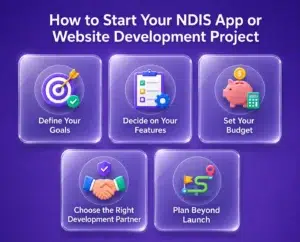
1. Define Your Goals
Start by identifying the purpose of your platform. Think about who will use it, participants, support workers, providers, or administrators, and the problems it should solve.
2. Decide on Your Features
List the features your platform needs. Prioritize the essentials for launch and keep advanced features for future updates. This helps control costs and speeds up development.
3. Set Your Budget
Estimate your budget based on the features you need. It’s also a good idea to keep an extra 15 – 20% aside for unexpected changes or additional requirements.
4. Choose the Right Development Partner
Work with a team that has experience building NDIS solutions. Check their portfolio, accessibility expertise, communication process, and pricing before making a decision.
5. Plan Beyond Launch
Your project doesn’t end when the platform goes live. Budget for ongoing maintenance, hosting, security updates, and future improvements to keep your app or website running smoothly.
Should You Build Custom or Buy an Off-the-Shelf NDIS Platform?
Several ready-made NDIS management platforms exist in the Australian market (such as ShiftCare, Lumary, and Caremaster). Here is how they compare to a custom-built solution:
| Factor | Off-the-Shelf Platform | Custom-Built Platform |
| Upfront cost | Low (AUD 50–300/month SaaS) | Higher (AUD 10,000–90,000+) |
| Customisation | Limited to vendor roadmap | Fully tailored to your needs |
| Branding | Vendor-branded or limited | Your brand, your UX |
| Data control | Vendor-held | You own all data |
| Long-term cost | Grows with users/features | Fixed + low maintenance |
| NDIS-specific fit | Generic workflows | Built around your exact processes |
Custom development makes the most sense when your workflows are complex, you need specific NDIS integrations, or you are building a competitive differentiator. Off-the-shelf tools are a reasonable starting point for new, small providers with simple needs.
How Developer Bazaar Technologies Can Help You!
Also, choosing the right development partner, like Developer Bazaar Technologies, can help you develop your mobile app and website at the lowest costs possible, without compromising quality.
We are the top mobile app development company with 10+ years of experience in developing NDIS-tailored mobile apps and websites for leading service providers in Australia.
By partnering with us, you can develop a digital platform that doesn’t just improve internal efficiency but also elevates the quality of care and services offered. So, what are you waiting for? Contact us today and get your NDIS app and website development started.
Conclusion
With the growing demand for accessible, efficient, and user-centric NDIS mobile apps and websites, today is the right time to invest in custom mobile app or website development for the NDIS services.
With a tailored digital platform, it will be easy for you to streamline your operations, enhance participant engagement, and stay compliant with NDIS standards.
Building a dedicated NDIS mobile app or website is one of the highest-ROI investments a service provider can make in 2026 and beyond. It cuts administrative overhead, improves participant outcomes, and positions your organisation for growth as the NDIS sector continues to expand.
To summarise the key cost figures:
- Basic NDIS mobile app: AUD 25,000 – AUD 40,000+
- Basic NDIS website: AUD 10,000 – AUD 20,000+
- Advanced NDIS mobile app: AUD 40,000 – AUD 65,000+
- Advanced NDIS website: AUD 30,000 – AUD 50,000+
- Complex / Enterprise NDIS mobile app: AUD 70,000 – AUD 90,000+
- Complex / Enterprise NDIS website: AUD 60,000 – AUD 80,000+
The right development partner will help you navigate these costs, prioritise features, and build a platform that serves your participants well while keeping your organisation compliant and competitive.
Frequently Asked Questions
Q1. What is NDIS?
The NDIS (National Disability Insurance Scheme) is an initiative of the Australian government that focuses on providing funding and support to people with disabilities. With this funding, the latter can access essential services, helping them to live more independently.
Q2. Why is developing an app or website for NDIS important?
Developing an NDIS mobile app and website can help NDIS service providers improve accessibility of the services, streamline their daily operations, offer real-time support to the participants, and ensure NDIS compliance.
Q3. How much does it cost to develop an NDIS mobile app and website?
The cost to develop an NDIS mobile app and website starts from AUD 10,000 and goes up to AUD 90,000+, depending on factors like complexity, features, development team, security, and more.
Q4. How long will it take to develop a website and mobile app for NDIS services?
Development timelines for NDIS mobile apps and websites usually range from 3 to 6 months, depending on project scope, features, and testing requirements. Also, complex platforms with custom integrations may even take longer.
Q5. How can I start developing an NDIS mobile app and website?
Start by defining your goals, features, and budget. Then, consult with us, Developer Bazaar Technologies, a trusted mobile app and website development company experienced in NDIS and accessibility standards, to plan, design, and build your platform.