

AI is growing very fast, and many companies want to use it to improve their business. But the fact is, jumping into AI without a plan can be risky.
What if your AI system becomes a security problem instead of a solution? Reports show that the average data breach now costs around $4.88 million. Poorly planned AI systems can open new doors for cyber attacks. At the same time, many companies fail to get good results because they don’t plan their AI budgets or goals properly.
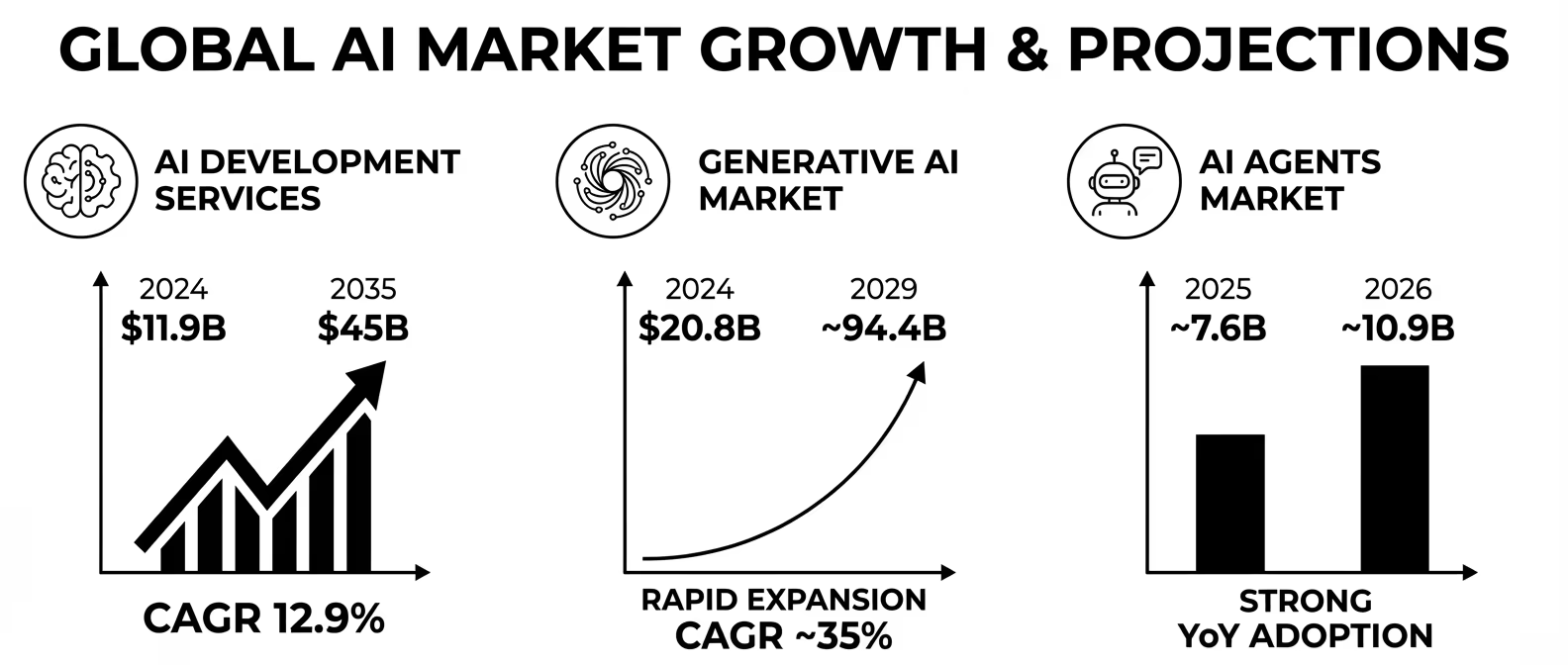
The AI market is expected to grow massively in the coming years. This means more opportunities and more risks.
That’s why Building an AI roadmap is so important. It helps you move from idea to real results in a safe, smart, and structured way. A clear AI roadmap gives you direction, protects your data, and ensures your investment actually pays off.
Why Many AI Projects Fail Early in Enterprises?
Most companies think AI projects fail during development. But they fail much earlier, at the planning stage only.
When businesses try to build AI roadmap for enterprises without clear thinking, problems start from day one.
Here are the most common reasons:
1. No Clear Problem to Solve
Many companies choose AI first and then try to find a problem for it. This is the wrong way. AI should solve a real business issue like improving sales, reducing costs, or saving time.
2. Weak Data Foundation
AI needs good data to work properly. If your data is messy, incomplete or not organized, your AI system will fail. That’s why strong data systems are a key part of any enterprise’s AI roadmap.
3. Unrealistic Expectations
Some companies expect instant results. But AI takes time to show value. Without patience and proper planning, teams lose confidence quickly.
4. Poor Budget Planning
Many businesses don’t estimate costs correctly. They either overspend or stop midway due to lack of funds. A well-planned AI roadmap avoids this problem.
5. No Expert Support
Trying to build everything alone can slow down progress. Using the right AI development services and AI integration services helps avoid mistakes and speeds up success.
All these problems can be avoided with the right AI roadmap for enterprises. When you have a clear plan, you can start with well-defined goals, use the right and reliable data, and smartly manage your budget. It also helps you build AI systems step by step instead of rushing the process. In simple terms, a strong roadmap makes your entire AI journey smooth, organized, and more likely to succeed.
What is an AI Roadmap and Why It Matters?
An AI roadmap is a clear and structured plan that explains how your business will use artificial intelligence, from the initial idea to full implementation. It acts like a step-by-step guide that helps your team understand what needs to be done, when it should be done, and how to achieve the desired results.
Instead of using AI randomly, an AI roadmap connects your business goals with the right technology decisions. It makes everything simple by answering three important questions:
- What are we building?
- Why are we building it?
- How will we build and use it?
When you are developing an AI roadmap, you are creating a clear direction for your entire team. This helps everyone stay aligned, avoid confusion and work towards the same goal.
What Does an AI Roadmap Include?
A well-structured AI roadmap is usually divided into three main parts. Each part plays an important role in making your AI journey successful.
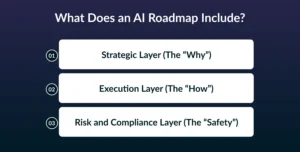
1. Strategic Layer (The “Why”)
This is the foundation of your entire roadmap. It focuses on understanding the purpose of using AI in your business.
In this stage, you clearly define:
- What problems AI will solve in your business
- How AI will help improve growth, efficiency, or revenue
- Where AI fits into your current business processes
This step makes sure that AI in your roadmap is not used just because it is trending. Instead, it is used with a clear purpose that brings real value to your business.
2. Execution Layer (The “How”)
Once your goals are clear, the next step is to focus on execution. This is where your plan turns into action.
In this layer, you define:
- A clear timeline with phases and milestones
- Budget planning and resource allocation
- Roles and responsibilities of your team
- Selection of the right tools and technologies
This is the stage where you actually start to build AI systems for enterprises in a structured and step-by-step manner. It ensures that your project moves forward smoothly without delays or confusion.
3. Risk and Compliance Layer (The “Safety”)
AI systems can bring risks if they are not properly managed. That’s why this layer focuses on keeping your AI implementation safe and secure.
It includes:
- Data security checks to protect sensitive information
- Legal and compliance requirements that your business must follow
- Risk management strategies to handle unexpected issues
This layer helps that your AI system is effective, secure and trustworthy.
Why Does Your Enterprise Need an AI Roadmap Now?
Without a proper plan, AI can quickly become confusing, costly, and difficult to manage. That’s why creating AI roadmap for enterprises is so important, it gives clarity, direction and control over your AI journey.
Here’s why your business needs it:
1. Better Focus
An AI roadmap helps you avoid chasing every new trend in the market. Instead, you focus only on AI solutions that truly solve your business problems and add real value.
2. Clear Responsibility
With a roadmap in place, every team member knows their role and responsibilities. This reduces confusion and helps teams work more efficiently and collaboratively.
3. Measurable Results
A well-defined roadmap sets clear goals and success metrics. This makes it easier to track progress and understand whether your AI investment is delivering the expected results.
4. Smarter Investment
Rather than guessing your budget, an AI roadmap helps you plan costs. This leads to better financial decisions, improved ROI, and reduced chances of overspending.
5. Faster Implementation
With a structured plan, your team can move quickly from idea to execution. By using expert AI Integration Services, you can speed up development and launch your AI solutions more efficiently.
Simple Steps to Create an AI Roadmap in 2026
Building an AI roadmap in 2026 is about solving real business problems in a smart and structured way. When you build AI roadmap for enterprises, you need a clear plan that connects your ideas to real results.
Here are simple steps to help you create the right AI roadmap for enterprises:
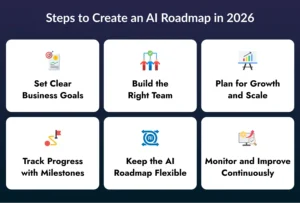
1. Set Clear Business Goals
Start with a clear and specific goal before using AI. Think about what you want to achieve, such as saving time, reducing costs, improving customer service, or increasing sales. Avoid vague ideas like “we want to use AI” and focus on real problems.
When your goals are clear, it becomes easier to decide where AI fits in your business. This also helps you measure success later and ensures your AI roadmap delivers real value instead of just experiments.
2. Build the Right Team
A successful AI project needs the right people working together. You need a mix of developers, data experts, and business professionals who understand both technology and your business goals.
If your internal team lacks experience, you can use expert AI development services to fill the gap. A strong team ensures better decision-making, faster development, and fewer mistakes during implementation.
3. Plan for Growth and Scale
Always think long-term when creating AI roadmap for enterprises. Your AI system should not only solve today’s problems but also handle future growth. This includes more users, larger data volumes, and advanced features.
Planning for scale from the beginning helps you avoid rebuilding systems later. It ensures your AI solution grows smoothly with your business without causing delays or extra costs.
4. Track Progress with Milestones
Break your roadmap into small and manageable steps. Start with a pilot project, test it, and then slowly expand it across teams or departments.
Setting clear milestones helps you track progress and identify issues early. It also keeps your enterprise’s AI roadmap organized and ensures that every stage is completed successfully before moving forward.
5. Keep the AI Roadmap Flexible
Business needs and market conditions can change quickly. That’s why your roadmap should not be too rigid. While developing an AI roadmap, always leave room for updates and improvements.
A flexible roadmap allows you to adjust your strategy based on new opportunities, technologies, or challenges. This keeps your AI efforts relevant and effective over time.
6. Monitor and Improve Continuously
AI systems need regular monitoring to perform well. After deployment, you should track performance, check accuracy, and gather user feedback.
Continuous improvement helps you fix issues, update models, and adapt to new data. This ensures that when you build AI system for enterprises, it keeps delivering better results and long-term value for your business.
How to Align Your AI Roadmap With Business Goals?
AI works best when it directly supports your business goals. Without alignment, it becomes expensive and useless experimentation. To align AI in your roadmap with your business:
Start by identifying your top 3 – 5 business goals for the next year. These could be:
- Increasing revenue
- Reducing operational costs
- Improving customer experience
Now ask a simple question for each goal:
Can AI help us achieve this faster, cheaper, or better?
If the answer is yes, include it in your AI roadmap. If not, remove it.
This simple approach makes sure that every step in your roadmap has a purpose. It also helps you avoid wasting time and money on ideas that do not bring real value. Enterprises that follow this method see faster results because they focus only on what truly matters.
How to Choose the Right AI Partner for Your Enterprise Projects?
Choosing the right partner is one of the most important decisions when you build AI system for enterprises. A wrong choice can lead to wasted budget, missed deadlines, and AI solutions that do not work as expected. That’s why selecting the right partner is not about cost but for long-term success.
Here’s what you should carefully look for when selecting an AI partner:
1. Proven Enterprise Experience
Always choose a company that has real experience working with enterprise-level projects. Many vendors showcase small demos, but enterprise AI requires handling complex systems, large data, and real business challenges.
An experienced partner understands these complexities and can deliver practical solutions. For example, Developer Bazaar Technologies brings years of experience in delivering scalable AI solutions across different industries, which helps businesses avoid common mistakes.
2. End-to-End Services
A good AI partner should support you at every stage of your journey. This includes planning, designing, developing, deploying and post-launch support.
Look for companies that offer complete AI development Services and AI integration services. This ensures smooth execution of your AI roadmap without needing multiple vendors, saving both time and cost.
3. Industry-Specific Knowledge
AI solutions are not one-size-fits-all. Every industry has unique challenges and requirements. That’s why your partner should understand your specific business domain.
Companies like Developer Bazaar Technologies have worked across industries like healthcare, finance, logistics, and retail. This experience helps them build solutions that are practical, relevant, and aligned with your business goals.
4. Transparent Communication
Clear and honest communication is essential for project success. Your AI partner should provide realistic timelines, regular updates, and clear explanations of what is possible.
Avoid vendors who overpromise results or hide challenges. A reliable partner keeps you informed at every step while developing an AI roadmap, ensuring there are no surprises later.
Why Choosing the Right Partner Matters
The right AI partner builds technology they help you execute your entire enterprises AI roadmap successfully. From identifying the right use cases to deploying and improving AI systems, they guide you at every step.
With a trusted partner Developer Bazaar Technologies, you get access to experienced AI experts, proven strategies, and industry knowledge. This not only reduces risks but also ensures your AI journey is smooth, efficient, and delivers real business results.
Common AI Mistakes Enterprises Should Avoid
While building an AI roadmap, many enterprises make simple mistakes that lead to poor results. The good news is that these mistakes can be avoided with proper planning and awareness. If you want to build AI roadmap for enterprises successfully, make sure you stay away from the following:
1. Building Without a Clear Problem Statement
One of the biggest mistakes is starting with technology instead of a problem. Many companies jump into AI because it is trending, not because they have a real need.
Before adding AI in your roadmap, clearly define the problem you want to solve. Whether it is reducing costs or improving customer service, your AI solution should always have a clear purpose. Without this, your project will struggle to deliver value.
2. Underestimating Data Readiness
AI depends heavily on data. If your data is incomplete, unorganized, or stored in different systems, your AI model will not perform well.
While creating AI roadmap for enterprises, make sure your data is clean, structured, and ready to use. Investing time in data preparation is essential to ensure your AI system works correctly and delivers accurate results.
3. Skipping Change Management
Many companies focus only on technology and forget about people. When AI is introduced without proper training or communication, employees may resist or misuse it.
While developing an AI roadmap, include training sessions and support for your team. Help them understand how AI will make their work easier. This ensures smooth adoption and better results.
4. Measuring the Wrong Outcomes
Some enterprises track only technical metrics like model accuracy. But these do not show real business value.
Instead, your Enterprise AI roadmap should focus on business outcomes such as cost savings, time efficiency, or revenue growth. Measuring the right metrics helps justify your investment and guides future decisions.
Avoiding these mistakes puts your business ahead of many others. A well-planned AI roadmap reduces risks and increases your chances of success.
How to Measure ROI on Your AI Investment for First 90 Days?
Many businesses think AI takes years to show results. But if you plan properly, you can measure ROI within the first 90 days.
The key is to set clear benchmarks before you start building an AI roadmap. This allows you to compare results after implementation.
Here’s what you should measure:
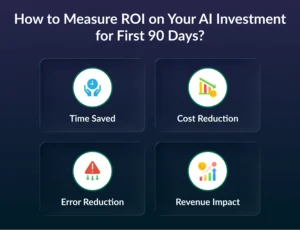
1. Time Saved
Check how long tasks took before and after AI implementation. AI often automates repetitive work, saving hours of manual effort.
For example, if a process that took 5 hours now takes 2 hours, that is a clear improvement. This shows your AI roadmap is delivering efficiency.
2. Cost Reduction
Track how much money you are saving in operations. AI can reduce labor costs, improve resource usage, and minimize waste.
When you build AI system for enterprises, cost savings become one of the strongest indicators of success.
3. Error Reduction
Measure how AI improves accuracy in tasks like data entry, predictions, or decision-making.
Fewer errors mean better performance and higher reliability. This is particularly crucial in sectors such as finance and healthcare.
4. Revenue Impact
AI can also increase revenue by improving customer experience, boosting conversions, or enabling better decision-making.
Track metrics like sales growth, customer retention, or upsell rates. This helps you understand the real business impact of your enterprises AI roadmap.
Conclusion
Building an AI roadmap is the most important step in turning your AI ideas into real business results.
A well-structured AI roadmap gives you clarity, focus, and direction. It helps you avoid common mistakes, align AI with business goals, and use your resources wisely. By following a step-by-step approach and continuously improving your systems, you can unlock the full potential of AI.
If you want long-term success, focus on creating AI roadmap for enterprises that is practical, scalable, and aligned with your business needs. With the right strategy and support, AI can make your business smarter, faster, and more competitive.
FAQs
Q1: How long does it take to create an enterprise AI roadmap?
Creating an enterprise AI roadmap usually takes around 2 to 4 months. This includes planning sessions, data evaluation, and discussions with your leadership team. The time may vary depending on your business size and complexity.
Q2: What’s the biggest mistake companies make when starting their AI journey?
The biggest mistake is focusing on technology instead of the problem. Many companies adopt AI tools without knowing what they want to solve. A successful AI roadmap always starts with a clear business goal.
Q3: Do we need a full team of data scientists to build an AI roadmap?
No, you do not need a full team in the beginning. developing an AI roadmap is more about strategy than technical work. You can always take help from external experts or AI development services when needed.
Q4: How often should we update our AI roadmap?
Your AI roadmap should be updated regularly. It is best to review it once a year or whenever there are major changes in your business or technology.
Q5: How do we ensure our AI roadmap is ethical and responsible?
You should include clear rules and guidelines for using AI responsibly. This includes fairness, transparency, and regular checks to avoid bias. A proper governance system helps maintain trust and compliance.
Q6: What is the first step to building an AI implementation plan?
The first step is to create a team of leaders from different departments like business, IT, and data. This team will guide the process and ensure your roadmap aligns with overall business goals.
Q7: What is the real ROI of building an AI roadmap?
The biggest benefit of an AI roadmap is that it reduces risks and avoids wasted investment. It helps you focus on the right projects, leading to better results like increased revenue, lower costs, and improved customer experience.