
Artificial Intelligence (AI) is evolving rapidly, and one of the most exciting innovations is the multi-agent system. Instead of relying on a single AI to perform all tasks, multiple intelligent agents collaborate to solve complex problems efficiently.
This guide explains how to build a multi-agent system in simple and easy language. You will learn what a multi-agent system is, why it is important, its core components, and how it differs from a single-agent approach.
Whether you’re a developer, business owner, or tech enthusiast, this comprehensive guide will help you understand and create a powerful AI solution and the cost to build a multi-agent AI system.
What is a Multi-Agent System?
A Multi-Agent System (MAS) is a group of intelligent AI agents that work together to complete tasks. Each agent acts independently but communicates and collaborates with others to achieve a common goal.
Think of it like a school project. Instead of one student doing everything, each student takes responsibility for a specific task, such as research, writing, designing, or presenting. Together, they produce a better result. Similarly, AI agents collaborate to deliver accurate and efficient outcomes.
Key Characteristics of Multi-Agent Systems
- Autonomy: Each agent works independently.
- Collaboration: Agents communicate and cooperate.
- Specialization: Every agent focuses on a specific task.
- Adaptability: Agents adjust to new information and environments.
- Intelligence: They use data and algorithms to make decisions.
Take an Example
Imagine building a content creation system:
- A Research Agent gathers information.
- A Writing Agent creates the article.
- An Editing Agent checks grammar and clarity.
- A SEO Agent optimizes the content for search engines.
Together, they create high-quality content quickly and efficiently. This is how you create a multi-agent AI system in practice.
Why Use Multiple Agents?
Using multiple agents makes AI systems more efficient, scalable, and reliable. Businesses and developers increasingly prefer this approach to build advanced AI solutions.
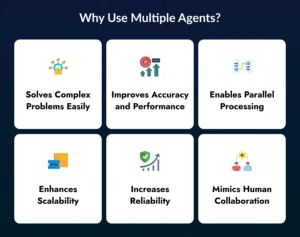
1. Solves Complex Problems Easily
Large tasks are divided into smaller parts, making them easier to manage. This simplifies the process of building multiple agent systems for real-world applications.
2. Improves Accuracy and Performance
Each agent focuses on a specific task, delivering more precise and high-quality results than a single AI.
3. Enables Parallel Processing
Multiple agents work at the same time, reducing execution time and boosting overall productivity.
4. Enhances Scalability
New agents can be added as needs grow, making it easier to develop multiple agent AI systems for evolving requirements.
5. Increases Reliability
If one agent fails, others continue the work, ensuring stability and minimizing downtime.
6. Mimics Human Collaboration
Multi-agent systems function like real-world teams, promoting cooperation and efficient problem-solving.
Multi-Agent System (MAS) Market Overview
The global Multi-Agent System (MAS) market is witnessing rapid growth, driven by the increasing demand for intelligent automation and decentralized decision-making. Valued at USD 7.2 billion in 2024, the market is projected to expand from USD 10.6 billion in 2025 to approximately USD 375.4 billion by 2034, registering an impressive CAGR of 48.6%. In 2024, North America dominated the landscape, accounting for over 46.7% of the global share, with USD 3.3 billion in revenue.
This growth is fueled by the rise of distributed AI, autonomous systems, and intelligent automation across industries such as manufacturing, logistics, finance, and smart infrastructure.
With advancements in cloud computing, edge technologies, and AI reasoning, multi-agent systems are enabling organizations to automate complex workflows, enhance real-time decision-making, and optimize operational efficiency.
Fundamental Components of Multi-Agent Architectures
To successfully create a multi-agent AI system, you must understand its essential components. These elements form the backbone of an efficient multi-agent architecture AI, enabling intelligent collaboration and smooth automation.
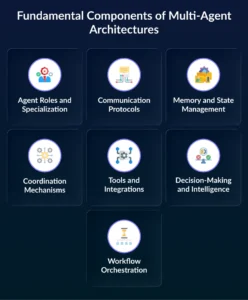
1. Agent Roles and Specialization
Each agent in a multi-agent system is assigned a specific responsibility based on its expertise. This division of work allows agents to focus on tasks they perform best, improving accuracy and efficiency.
For example, a research agent gathers data, a planning agent designs workflows, a coding agent builds solutions, a testing agent makes sure quality, and a review agent refines outputs. Specialization allows faster execution and high-quality results when you build multiple agent systems.
2. Communication Protocols
Communication protocols define how agents exchange information and coordinate tasks. These protocols make sure that messages are structured, clear, and easily understood by all agents in the system.
Common communication methods include APIs, message queues, structured prompts, and natural language instructions. Effective communication prevents misunderstandings and enables smooth collaboration across the entire system.
3. Memory and State Management
Memory allows agents to store, retrieve, and use information during task execution. Short-term memory handles temporary data, long-term memory preserves knowledge for future use, and shared memory enables collaboration between agents.
Proper state management helps each agent understands the task’s progress and context. This helps avoid duplication, improves decision-making, and enhances overall efficiency.
4. Coordination Mechanisms
Coordination mechanisms determine how agents organize and execute tasks together. In centralized coordination, a main orchestrator controls workflows and assigns responsibilities to each agent.
In decentralized coordination, agents collaborate independently and make decisions collectively. These mechanisms ensure smooth operations, efficient task distribution, and timely completion of complex processes.
5. Tools and Integrations
Agents rely on external tools and integrations to perform tasks more effectively and accurately. These tools include databases for storing data, search engines for retrieving information, code interpreters for development, analytics platforms for insights, and cloud services for scalability.
Integrations enhance the capabilities of the system and enable real-time automation. They play a vital role when organizations develop multiple agent AI systems.
6. Decision-Making and Intelligence
Each agent uses logical reasoning and AI models to make informed decisions. Modern solutions create multi-agent AI using LLM technologies such as GPT-based models to enhance problem-solving and automation.
These models enable agents to analyze data, generate insights, and adapt to changing requirements. Intelligent decision-making enables efficiency, accuracy, and continuous improvement across the system.
7. Workflow Orchestration
Workflow orchestration manages the sequence of tasks for the agents to operate in concord. An orchestrator assigns tasks, monitors progress, and coordinates interactions between agents. It also handles dependencies, error management, and process optimization.
This component is essential when you build multiple agent systems for enterprise applications and complex workflows.
Multi-Agent System vs. Single Agent System: Fundamental Differences
Understanding the differences between single-agent and multi-agent systems helps determine the right approach for your project.
| Feature | Single-Agent System | Multi-Agent System |
| Structure | One AI handles all tasks | Multiple AI agents collaborate |
| Complexity Handling | Limited capability | Handles complex workflows efficiently |
| Performance | Slower for large tasks | Faster through parallel processing |
| Specialization | General-purpose | Task-specific experts |
| Scalability | Difficult to scale | Easily scalable |
| Reliability | Single point of failure | More resilient and fault-tolerant |
| Efficiency | Sequential execution | Parallel execution |
| Flexibility | Limited adaptability | Highly flexible |
| Maintenance | Easier but less powerful | Slightly complex but more efficient |
| Use Cases | Simple automation and chatbots | Advanced enterprise AI solutions |
Cognitive Load and Task Complexity – A single agent handles all tasks and may struggle with complexity, while multi-agent systems divide the workload to improve accuracy and efficiency.
Specialization and Optimization – Single agents act as generalists, whereas multi-agent systems enable each agent to specialize and perform its task with greater precision.
Failure Modes and Resilience – Multi-agent systems isolate failures, allowing other agents to correct errors without restarting the entire process.
Parallel Execution and Efficiency – Multiple agents work simultaneously, significantly reducing processing time and enhancing overall productivity.
Types of Multiagent AI Systems
Multi-agent AI systems come in different forms based on how agents interact and achieve their goals. Understanding these types helps organizations create a multi-agent AI system tailored to their specific needs.
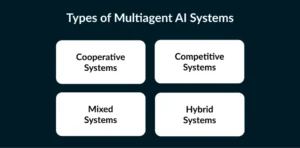
1. Cooperative Systems
In cooperative systems, agents work together to achieve a common objective. Each agent contributes to the overall outcome while coordination mechanisms allows smooth collaboration and conflict resolution.
For example, in search-and-rescue missions, multiple drones collaborate to locate survivors efficiently. This approach is ideal when you build autonomous AI agents designed for teamwork and shared success.
2. Competitive Systems
Competitive multi-agent systems involve agents with opposing goals. Each agent tries to maximize its own benefit, often competing with others for resources or advantages. These systems are commonly used in stock trading platforms and strategic game simulations.
They help organizations develop multiple agent AI systems that can analyze risks, predict outcomes, and make intelligent decisions in dynamic environments.
3. Mixed Systems
Mixed systems combine cooperation and competition. Agents collaborate in certain scenarios while competing in others to achieve optimal results.
For instance, autonomous vehicles share traffic data to avoid congestion but compete to find the fastest routes. This balance makes mixed systems a powerful example of advanced multi-agent architecture AI.
4. Hybrid Systems
Hybrid multi-agent systems integrate rule-based logic with machine learning and adaptive technologies. Agents follow predefined instructions while continuously learning from data to improve performance.
A smart energy grid, for example, uses rules for energy distribution while analyzing consumption patterns to optimize efficiency. Businesses often create multi-agent AI using LLM technologies to enhance these systems with intelligent decision-making capabilities.
Real World Use Cases of Multi- Agent System
Multi-agent systems are changing industries by improving automation, efficiency, and decision-making. Below are some of the most impactful applications.
1. Autonomous Vehicles
Multi-agent systems coordinate fleets of self-driving cars to manage traffic, optimize routes, and prevent accidents. Real-time communication enables decentralized decision-making and enhances road safety.
2. Robotics and Swarm Intelligence
Swarm robotics deploys groups of robots for tasks such as warehouse automation, environmental monitoring, and disaster response. These systems demonstrate how organizations build autonomous AI agents to perform complex operations collaboratively.
3. Healthcare Systems
In healthcare, multi-agent systems assist in patient monitoring, diagnosis, and hospital resource management. They streamline scheduling, improve treatment delivery, and enhance patient outcomes.
4. Distributed Sensor Networks
These systems enable sensors to collaborate and share data for environmental monitoring, surveillance, and disaster management. They play a crucial role in smart cities and climate research.
5. Gaming and Simulations
Multi-agent AI enhances multiplayer games and realistic simulations. Non-player characters (NPCs) behave intelligently, improving user experiences and aiding defense and urban planning training.
6. Financial Systems
Automated trading platforms use multi-agent systems to analyze market trends and execute trades. These competitive environments allow agents to maximize profits and manage financial risks efficiently.
7. Supply Chain Management
Multi-agent systems optimize logistics by coordinating inventory management, demand forecasting, and delivery scheduling. Businesses rely on them to build custom AI agent systems that streamline operations and reduce costs.
While multi-agent systems offer immense benefits, they also present unique obstacles. Understanding these challenges in multi agent systems and their solutions helps developers design efficient, scalable, and reliable AI solutions.
Major Challenges in Multi-Agent Systems And Their Solutions
Various challenges arise in multi-agent systems, understand these challenges and their solutions to overcome them.
1. Scalability
Challenge: As the number of agents increases, communication and computational demands grow significantly. Managing large-scale systems becomes complex and resource-intensive.
Solution: Use scalable cloud infrastructure, distributed computing, and efficient communication protocols. Implement modular designs and optimize agent coordination for smooth performance as the system grows.
2. Dynamic Environments
Challenge: Each agent’s actions influence the environment, making it constantly changing and unpredictable. This makes it difficult to develop consistent strategies and accurate forecasts.
Solution: Incorporate adaptive learning, reinforcement learning, and real-time data processing. These technologies enable agents to adjust to changing conditions and make informed decisions dynamically.
3. Credit Assignment
Challenge: Identifying which agent contributed to success or failure is difficult, especially in cooperative environments where multiple agents work together.
Solution: Use performance tracking, reward distribution models, and contribution analysis techniques. These methods help evaluate individual agent performance and improve system accountability.
4. Communication Disturbance
Challenge: Agents rely on communication to coordinate effectively. Limited bandwidth, high latency, or complex messages can slow down decision-making.
Solution: Adopt lightweight communication protocols, structured messaging formats, and optimized data-sharing mechanisms. Message queues and APIs help in fast and reliable interactions between agents.
5. Evaluation Metrics
Challenge: Measuring the performance of multi-agent systems is complex, as it must account for individual agent goals and overall system efficiency.
Solution: Define clear Key Performance Indicators (KPIs) such as accuracy, response time, collaboration efficiency, and system throughput. Use monitoring dashboards and analytics tools to evaluate and continuously improve performance.
How to Create Multi-Agent AI System?
Many multi-agent initiatives fail because they focus on agents before defining the problem. A structured and practical approach enables success. Below is a step-by-step guide on how to build a multi-agent system effectively.
Step 1: Define the Problem
Start by identifying the real-world challenge you want to solve. Determine whether the task involves distributed workflows such as supply chain management, customer support automation, or risk monitoring.
Break the problem into smaller tasks and assign clear responsibilities to each agent. This clarity lays the foundation to build multiple agent systems that scale efficiently.
Step 2: Design the Multi-Agent Architecture
Designing the right multi-agent architecture AI changes ideas into functional systems. Define agent types such as observer agents, reasoning agents, and action agents. Decide how they will communicate, through APIs, shared memory, or an orchestrator. Choose between centralized orchestration for simplicity or decentralized orchestration for scalability.
Step 3: Enable Tools and Integrations
Agents become powerful when connected to enterprise tools. Integrate them with APIs, databases, ERP systems, CRM platforms, data lakes, and ticketing systems. Proper access control helps in security and efficiency when organizations develop multiple agent AI systems.
Step 4: Implement Orchestration and Governance
Orchestration enables agents to collaborate smoothly and complete tasks in the correct sequence. Governance introduces security, compliance, and human oversight. These controls are essential for organizations aiming to build custom AI agent systems for regulated industries.
Step 5: Testing, Monitoring & Improvement
Thorough testing makes sure that individual agents and their interactions function correctly. Continuous monitoring helps track performance, detect anomalies, and refine workflows. Optimization is ongoing, as agents learn and adapt over time.
Step 6: Scale from Pilot to Production
Transitioning from a pilot project to full-scale deployment requires standardized interfaces, strong governance, and reliable integrations. Scaling successfully depends on measurable business outcomes, making it a crucial step in building multi-agent systems.
Multi-Agent AI System Development Cost Estimation
Building a multi-agent AI system is about technology, it’s about smart planning, the right tools, and long-term success.
You are not creating just another app. You are building a team of digital workers that collaborate, make decisions, and solve complex problems. Like any skilled team, they require proper structure, training, and management.
So, how much does it cost to build a multi-agent AI system that works in the real world?
The short answer: The total cost varies based on how advanced, autonomous, and integrated you want your system to be.
Several factors influence the budget, including the number of agents, system complexity, memory layers, LLM integration, and infrastructure requirements. Understanding these elements helps businesses plan effectively and avoid unexpected expenses.
Whether you aim to build custom AI agent systems or partner with an experienced AI development company, having clear cost expectations for better decision-making and a higher return on investment.
From Basic to Enterprise-Ready
The cost of developing a multi-agent system varies with the solution’s scale and capabilities. Below is a simplified breakdown to help you estimate your investment.
| System Type | What’s Included | Estimated Cost |
| MVP / Prototype | 2-3 agents, rule-based tasks, basic API integrations, and minimal automation. Ideal for testing ideas and validating concepts. | $25,000 – $40,000 |
| Mid-Level System | 4–6 agents with inter-agent communication, shared memory, dashboards, and administrative controls. Suitable for growing businesses. | $45,000 – $75,000 |
| Enterprise System | 7+ agents with orchestration, real-time learning, fault tolerance, monitoring, and secure integrations. Designed for large-scale operations. | $90,000 – $200,000+ |
This structured approach provides a clear estimate of the cost to build multi-agent AI system solutions based on business needs and complexity.
What Drives the Cost?
Understanding the key cost factors helps organizations optimize budgets and learn how to reduce cost in multi agent systems.
1. Agent Count and Complexity
The number of agents directly affects development costs. More agents require additional logic, workflows, and integrations, increasing time and resources.
2. Inter-Agent Communication
Advanced communication between agents—such as task delegation and real-time collaboration—requires APIs, message queues, and orchestration layers, which add to the overall cost.
3. Memory and Learning Capabilities
Adding long-term memory and learning features involves vector databases and AI frameworks. These enhance system intelligence but also increase development and infrastructure expenses.
4. Interface Requirements
Some systems operate in the background, while others require dashboards and control panels. User-friendly interfaces demand skilled UI/UX design and additional development efforts.
5. Security and API Integrations
Enterprise-grade systems must secure data exchange and compliance. Integrating CRMs, ERPs, and third-party APIs increases complexity and development costs.
6. Deployment, Testing, and Support
A production-ready system requires cloud deployment, monitoring tools, logging mechanisms, and ongoing maintenance. These elements provide reliability and scalability.
Endnote
- Multi-agent systems represent the next evolution of artificial intelligence, enabling smarter, faster, and more scalable solutions.
- Organizations can build multiple agent systems to solve complex problems through collaboration, specialization, and automation.
- A well-designed multi-agent architecture AI improves efficiency, resilience, and decision-making across industries.
- Understanding system components, types, and real-world applications helps businesses successfully create multi-agent AI systems.
- Despite the challenges in multi-agent systems, strategic planning, governance, and continuous monitoring, long-term success.
- LLMs allow enterprises to create multi-agent AI using LLM for intelligent and adaptive automation.
- A clear development roadmap simplifies how to build multi-agent systems from prototype to enterprise-scale deployment.
- Evaluating the cost to build a multi-agent AI system helps organizations plan budgets and maximize return on investment.
- Businesses can build autonomous AI agents to streamline operations, enhance productivity, and drive innovation.
- Partnering with an experienced AI development company or utilizing AI agent development services for easy implementation and scalability.
FAQs
1. Which frameworks are best for developing multi-agent AI systems?
Popular frameworks include LangChain, CrewAI, AutoGen, MetaGPT, Ray, and Microsoft Semantic Kernel. These tools simplify agent orchestration, communication, and deployment.
2. How long does it take to develop a multi-agent AI system?
Development timelines vary based on complexity. A basic MVP may take 6–10 weeks, while enterprise-grade solutions can require 4–8 months.
3. Can small businesses benefit from multi-agent AI systems?
Yes, small businesses can use multi-agent systems to automate customer support, marketing, and operations, improving efficiency while reducing operational costs.
4. What industries benefit the most from multi-agent AI solutions?
Industries such as healthcare, finance, logistics, retail, manufacturing, and smart cities benefit significantly from automation, predictive analytics, and intelligent decision-making.
5. Do multi-agent AI systems require continuous maintenance?
Yes, they require regular monitoring, updates, retraining, and optimization for accuracy, security, and long-term performance in dynamic environments.