

Key Takeaways:
- AI is becoming a strategic investment, not just a technology upgrade. Hospitals are using AI to reduce administrative costs, improve patient care, and make better clinical decisions without increasing staff workload.
- Automation delivers measurable cost savings. From clinical documentation and billing to appointment scheduling and fraud detection, AI helps healthcare organizations eliminate repetitive tasks and reduce operational expenses.
- Predictive and personalized healthcare are driving better outcomes. AI enables early disease detection, personalized treatment plans, and proactive patient monitoring, leading to fewer complications and lower long-term healthcare costs.
- AI adoption is accelerating across the healthcare ecosystem. With the market projected to reach USD 194.79 billion by 2031, providers are rapidly investing in AI-powered diagnostics, telehealth, medical imaging, and intelligent hospital management systems.
- Successful AI implementation starts with solving one business problem. Healthcare organizations achieve the best results by beginning with a high-impact use case, measuring ROI, and expanding AI adoption over time.
- Choosing the right AI development partner is critical. Healthcare solutions must comply with regulations, integrate with existing systems, protect patient data, and scale as organizational needs grow.
Introduction: Why Healthcare Costs So Much
Going to a hospital can cost a lot of money. Doctors are busy. Nurses are tired. Paperwork piles up. Bills get mixed up. All of this makes healthcare slow and expensive for everyone.
Now, think about a helper who never gets tired, never forgets, and works very fast. That helper is Artificial Intelligence. AI in Healthcare organisation settings is changing how hospitals and clinics work every single day.
In this blog, we will explain how AI in the healthcare industry saves money. We will also look at real AI functions in healthcare, AI Agents in Healthcare, Digital AI Trends in Healthcare, and how Healthcare app development services help hospitals use AI the right way.
What Is AI in Healthcare?
Artificial Intelligence in Healthcare means using smart computer programs to help doctors, nurses, and hospital staff do their jobs better. AI does not replace doctors. It helps them by doing the slow and repeated work so doctors can spend more time with patients.
Think of AI like a very smart assistant. It reads reports fast. It remembers everything. It finds patterns that humans might miss. This is why AI in the healthcare industry is growing so quickly around the world.
Frost & Sullivan, a research company, says AI and smart computing could cut healthcare costs by more than $150 billion by 2025. Other reports say AI could save up to $360 billion every year in the United States alone. These are huge numbers, and they show why every hospital wants to use AI.
AI in Healthcare Market Insights
Artificial intelligence is rapidly transforming the healthcare industry, helping hospitals, clinics, and healthcare providers improve patient care while reducing operational costs. According to MarketsandMarkets, the global AI in healthcare market is expected to grow from USD 36.67 billion in 2026 to USD 194.79 billion by 2031, expanding at a remarkable CAGR of 39.7% during the forecast period.
The increasing need for healthcare automation, ongoing workforce shortages, and the growing complexity of clinical decision-making are fueling this exceptional growth. Healthcare organizations are investing heavily in AI-powered solutions, including medical imaging, predictive analytics, AI scribes, telehealth platforms, precision medicine, and clinical decision support systems (CDSS), to improve efficiency, accuracy, and patient outcomes.
The adoption of Generative AI, the deeper integration of AI with Electronic Health Records (EHRs), and supportive government regulations are further accelerating market growth. As healthcare providers continue shifting toward value-based care, AI is becoming a critical technology for streamlining workflows, enabling faster diagnoses, personalizing treatments, and improving overall healthcare delivery.
Market Highlights (2026 – 2031)
| Metric | Value |
| Market Size (2026) | USD 36.67 Billion |
| Projected Market Size (2031) | USD 194.79 Billion |
| CAGR (2026 – 2031) | 39.7% |
| Key Growth Drivers | Healthcare automation, AI-powered diagnostics, predictive analytics, GenAI adoption, EHR integration, labor shortages, value-based care |
The strong growth outlook highlights why healthcare organizations are increasingly investing in AI-powered software and intelligent healthcare solutions.
Businesses that adopt AI-driven healthcare technologies today will be better positioned to improve clinical outcomes, optimize operational efficiency, and meet the evolving expectations of both patients and healthcare professionals.
What Functions Does AI Perform in Healthcare?
Before we talk about savings, let’s understand the basic AI functions in healthcare. AI is not just one tool. It is a group of smart tools that each do a different job.
1. Reading and Writing Notes
AI listens to a doctor talking to a patient and writes the notes automatically. This is called Natural Language Processing, or NLP. It saves doctors many hours every week.
2. Looking at Scans and Images
AI can look at X-rays, CT scans, and skin photos. It compares them with millions of other images to spot problems like cancer or infections.
3. Predicting the Future
AI studies old patient data and guesses what might happen next. For example, it can predict if a patient may need to come back to the hospital soon.
4. Talking to Patients
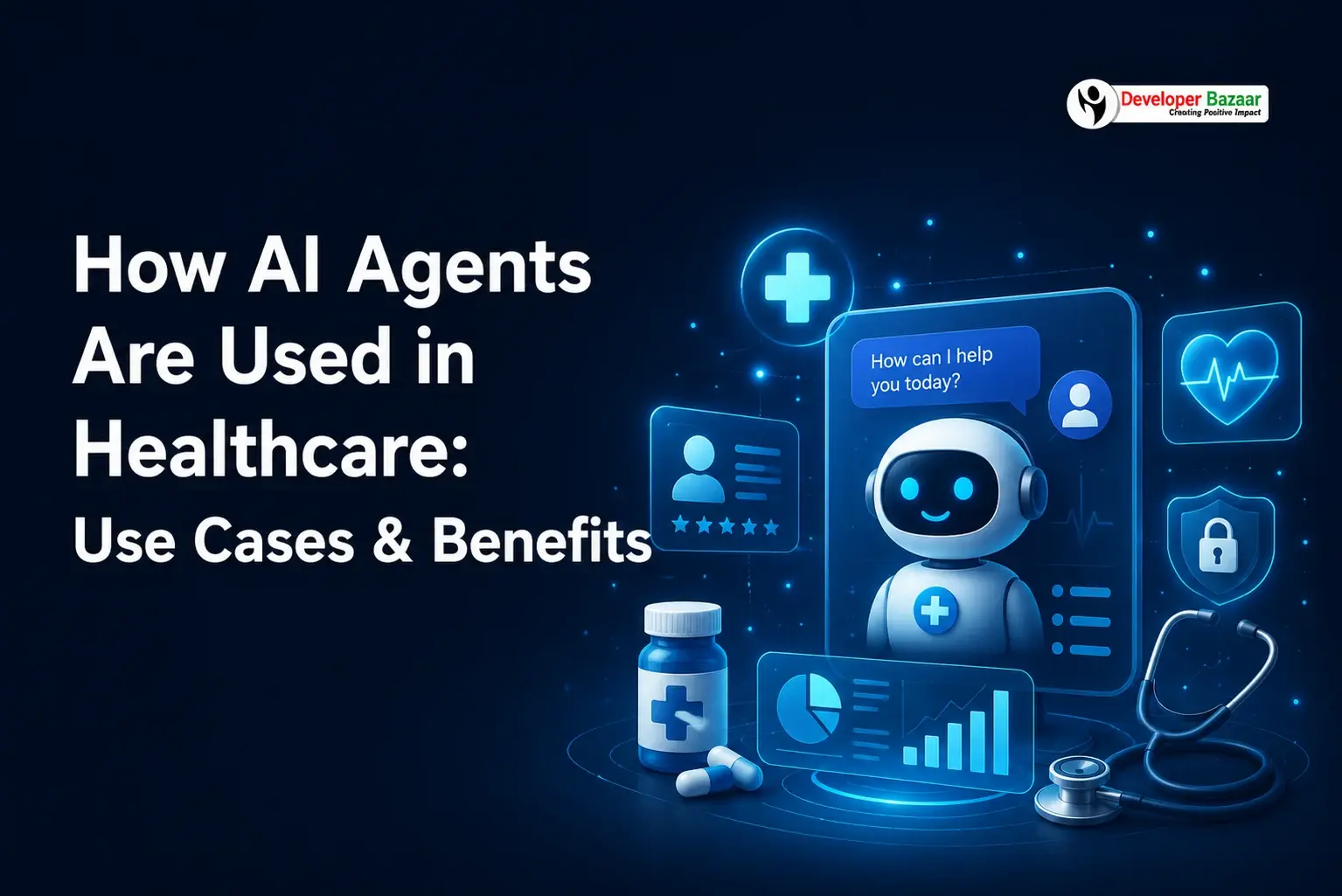
AI chatbots and voice assistants answer patient questions, book appointments, and send reminders. These are known as AI Agents in Healthcare.
5. Checking Bills and Insurance
AI checks thousands of bills in seconds. It finds mistakes, duplicate charges, and fraud that a human might miss.
Together, these AI functions in healthcare form the backbone of every cost-saving story you will read below.
How Does AI Reduce Costs in Healthcare?
Now, answer the big question: how does AI reduce costs in healthcare? We will go through each area, one by one.
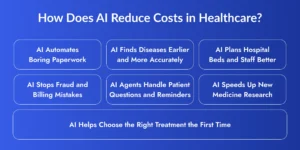
1. AI Automates Boring Paperwork
Paperwork eats up a huge part of every hospital’s budget. In the United States, administrative work like billing, coding, and insurance forms costs more than $1.4 trillion every year.
AI tools read doctor notes and turn them into clean digital records right away. Robotic software fills insurance forms and checks patient bills without any human help.
Real hospitals have seen big results. Some AI note-writing tools cut documentation time by 60 to 75 percent. That means doctors spend less time typing and more time with patients. Less time on paperwork means lower staff costs and fewer errors.
2. AI Finds Diseases Earlier and More Accurately
Missing a disease early is expensive and dangerous. Late treatment costs much more money than early treatment.
AI tools can scan mammograms, skin photos, and eye scans with very high accuracy. In fact, one AI system built by Google Health reached 94.5 percent accuracy in finding breast cancer in scans, which is higher than the average human doctor.
When AI finds a disease early, patients need fewer expensive surgeries and hospital stays later. This is one of the biggest cost benefits of AI in healthcare.
3. AI Plans Hospital Beds and Staff Better
Hospitals must guess how many patients will come each day. Guess wrong, and either beds sit empty (wasting money) or the hospital gets too crowded (unsafe and costly).
AI studies old patient numbers, weather, and even flu season trends to predict how many beds and nurses will be needed. This is where Hospital Management Software with AI becomes very useful.
Some hospitals used AI tools and cut patient stay time by more than a full day. Shorter hospital stays save money on rooms, food, staff time, and medicine.
4. AI Stops Fraud and Billing Mistakes
Healthcare fraud is a massive problem. In the United States, fraud costs the system between $100 billion and $300 billion every year.
AI checks millions of medical bills very fast. It looks for strange patterns, like the same treatment billed twice, or a bill that does not match the patient’s illness. What used to take weeks of manual checking now takes just seconds with AI.
By catching fraud and mistakes early, hospitals keep more money and pass on fewer extra costs to patients.
5. AI Agents Handle Patient Questions and Reminders
Not every question needs a doctor. AI Agents in Healthcare can answer easy questions any time of the day or night, book appointments, and remind patients to take medicine or attend a check-up.
One health chatbot in the United Kingdom handled more than 1.7 million patient conversations, sending cases to self-care and only passing serious cases to real doctors. This saves the doctor time for patients who truly need it.
AI agents also cut missed appointments. When a patient gets a smart reminder, they are far less likely to forget their visit. Fewer missed appointments mean the hospital does not lose money on empty time slots.
6. AI Speeds Up New Medicine Research
Making a new medicine usually takes more than ten years and costs over two billion dollars. Most tries fail along the way.
AI studies huge amounts of science data to guess which new medicines might work before they are even tested in a lab. This means fewer failed experiments and lower research costs.
One company used AI to find a new treatment idea for a lung disease in just 46 days, a process that would normally take years. Faster research means lower costs, and medicines reach patients sooner.
7. AI Helps Choose the Right Treatment the First Time
Sometimes doctors must try a few treatments before finding the right one. This trial-and-error process is slow, uncomfortable for patients, and costly.
AI studies a patient’s health history and matches them with the treatment that is most likely to work. This lowers the chance of side effects, wasted medicine, and repeat hospital visits.
Cost Benefits of AI in Healthcare: Old Way vs. AI Way
Below is a simple table that shows the cost benefits of AI in healthcare compared to the old way of doing things.
| Work Area | Old Way (No AI) | AI-Powered Way |
| Patient paperwork | Staff type notes by hand for hours | AI writes notes in minutes |
| Finding sickness | The doctor checks the scans one by one | AI scans images in seconds and flags risks |
| Hospital bed planning | Guesswork based on experience | AI predicts how many beds are needed |
| Checking bills | Staff review claims manually | AI spots billing mistakes and fraud fast |
| Patient reminders | Staff call each patient | AI agents send automatic reminders |
| New medicine research | Takes 10+ years and billions of dollars | AI shortens research time and cost |
As you can see, the benefits of AI in healthcare touch almost every part of a hospital’s daily work, not just one department.
Digital AI Trends in Healthcare to Watch
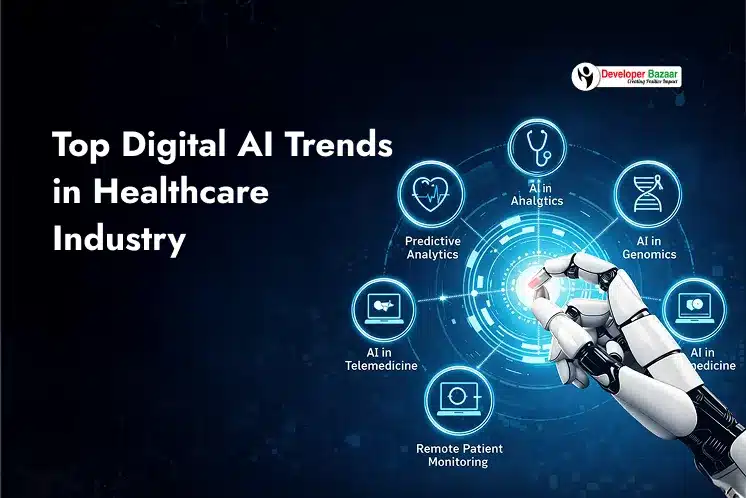
AI in healthcare is not standing still. Here are the biggest Digital AI Trends in Healthcare that hospitals are watching right now.
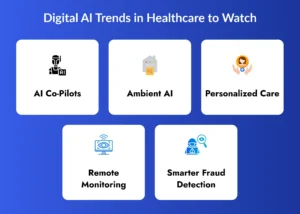
1. AI Co-Pilots
AI co-pilots work alongside doctors and healthcare professionals by providing real-time clinical suggestions during patient consultations. They can summarize patient histories, recommend possible diagnoses, highlight potential risks, and support treatment decisions, allowing clinicians to make faster and more informed choices.
2. Ambient AI
Ambient AI uses voice recognition and natural language processing to automatically capture conversations between doctors and patients. Instead of manually entering notes after every appointment, healthcare providers receive structured clinical documentation, reducing administrative work and allowing them to spend more time with patients.
3. Personalized Care
AI analyzes a combination of medical history, genetic information, lifestyle habits, wearable device data, and test results to create highly personalized treatment plans. This enables healthcare providers to recommend therapies that are more effective for each individual, improving outcomes while reducing unnecessary treatments.
4. Remote Monitoring
AI-powered remote monitoring systems continuously collect health data from wearable devices, smart medical equipment, and mobile health apps. These systems can detect early warning signs of health issues, alert doctors when intervention is needed, and help patients manage chronic conditions without frequent hospital visits.
5. Smarter Fraud Detection
Healthcare fraud is becoming more sophisticated, making traditional detection methods less effective. AI continuously analyzes claims, billing records, and transaction patterns to identify unusual activities, detect fraudulent claims, prevent billing errors, and reduce financial losses before they impact healthcare organizations.
These trends show that AI in healthcare organisation settings will keep growing stronger in the coming years.
How Healthcare Organizations Can Start Using AI
Many hospital leaders ask the same question: Where do we start? The good news is that AI Integration does not have to happen all at once. Hospitals can start small and grow step by step.
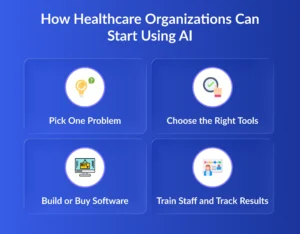
Step 1: Pick One Problem
Choose one costly problem, like slow paperwork or missed appointments, and start there.
Step 2: Choose the Right Tools
Work with a trusted partner that offers AI Development Services and understands healthcare rules like HIPAA and patient data privacy.
Step 3: Build or Buy Software
Some hospitals use ready-made tools. Others use Healthcare app development services to build custom software, such as patient apps, telemedicine platforms, or smart Hospital Management Software that fits their exact needs.
Step 4: Train Staff and Track Results
Staff need training to trust and use new AI tools. Hospitals should also track results, like time saved or money saved, to see if the AI tool is working.
This step-by-step path helps any AI in a healthcare organisation project succeed without confusing staff or patients.
Real Numbers That Prove AI Saves Money
Numbers speak louder than words. Here are some real facts that show the true cost benefits of AI in healthcare.
- AI and smart computing could save more than $150 billion in U.S. healthcare costs.
- AI-based scheduling can reduce patient no-shows, saving thousands of dollars per patient every year.
- AI tools have cut medical note-writing time by up to 75 percent in busy clinics.
- Better AI screening for eye disease shows sensitivity of more than 87 percent, catching problems that might otherwise be missed.
- Automation and smart analytics tools could remove $200 billion to $360 billion of yearly healthcare spending in the United States (McKinsey).
These numbers are not guesses. They come from real hospitals, real research, and real patients whose care improved while costs dropped.
Common Worries About AI in Healthcare
Even with all these benefits, some people worry about using AI in Healthcare Industry settings. Let’s answer a few common worries.
Will AI Replace Doctors?
No. AI helps doctors work faster and smarter. The final decision about patient care still belongs to real doctors and nurses.
Is Patient Data Safe?
Good AI tools follow strict rules like HIPAA to protect patient data. Choosing the right AI Development Services partner is very important to keep data safe.
Is AI Too Expensive to Start?
Many hospitals start small, with one tool, like an AI scheduling app, and grow from there. Small first steps often pay for themselves quickly through saved staff time.
Conclusion
AI in Healthcare is no longer just a future idea. It is already helping hospitals, clinics, and healthtech startups save real money today. From writing notes to catching fraud, from planning beds to speeding up new medicine, AI touches almost every part of patient care.
The cost benefits of AI in healthcare are clear: less waste, fewer mistakes, and faster care for patients. As Digital AI Trends in Healthcare keep growing, hospitals that adopt AI early will save the most money and offer the best care.
If your organization is ready to explore AI Integration, Hospital Management Software, or custom Healthcare app development services, the right technology partner can help you start small, grow smart, and save big.
FAQs
1. Which hospital departments typically see the fastest ROI from AI implementation?
Departments such as radiology, medical billing, patient scheduling, and clinical documentation often experience the quickest return on investment. These areas involve repetitive, high-volume tasks that AI can automate with minimal disruption. Many hospitals recover implementation costs through reduced administrative workload and improved operational efficiency.
2. How can AI improve revenue cycle management without changing the billing system?
AI works alongside existing billing software by identifying coding errors, detecting duplicate claims, predicting denied claims, and flagging unusual billing patterns before submission. This helps healthcare providers reduce claim rejections and accelerate reimbursement without replacing their current revenue cycle platform.
3. What should healthcare organizations evaluate before selecting an AI solution?
Hospitals should evaluate whether the AI solution integrates with their Electronic Health Record (EHR), complies with healthcare regulations such as HIPAA, supports scalability, provides explainable AI outputs, and offers ongoing technical support. Selecting a solution based solely on features may create integration and compliance challenges later.
4. How does AI help reduce physician burnout beyond automating documentation?
AI reduces burnout by summarizing patient histories, prioritizing critical cases, suggesting clinical insights, and minimizing time spent searching through medical records. This allows clinicians to focus more on patient care instead of administrative responsibilities, improving both productivity and job satisfaction.
5. Can AI improve patient retention and long-term engagement?
Yes. AI can personalize appointment reminders, recommend preventive care, send medication notifications, and identify patients who are at risk of missing follow-up visits. Better engagement leads to improved treatment adherence, stronger patient relationships, and higher satisfaction over time.
6. What are the biggest challenges healthcare providers face after deploying AI?
The most common challenges include staff adoption, integrating AI with legacy hospital systems, maintaining high-quality data, and continuously monitoring AI performance. Organizations that provide employee training, establish governance policies, and track performance metrics are more likely to achieve long-term success with AI adoption.