
Is your sales team under constant pressure to close more deals while juggling endless manual tasks?
Today, if you still rely solely on traditional sales processes, you might face slow growth and limited personalization.
Generative AI is transforming modern sales operations by going beyond basic automation. It has been used to create contextual sales content, get customer insights, make predictive analysis, and hyper-personalized engagement at scale.
According to industry research, 54% of businesses are actively using generative AI to create sales content, while 57% leveraging it for customer research and understanding buyer behavior.
These numbers highlight a clear trend. Businesses are no longer experimenting with AI, but they are using it directly for revenue-driving functions.
So, if you also want to learn more about generative AI in sales, then read the blog till the end.
You will explore use cases of generative AI in sales, business benefits, and how you can develop a tailored generative AI solution to automate and optimize your sales processes.
Top Generative AI Use Cases in Sales
Generative AI transforms how sales teams operate. It helps businesses to streamline their tedious tasks and save time to focus on more strategic sales-centric work.
Below are the key use cases of generative artificial intelligence for sales growth.
Pre-Sales Intelligence & Lead Generation
Explore how generative AI helps sales teams to identify, research, and qualify prospects before direct engagement.
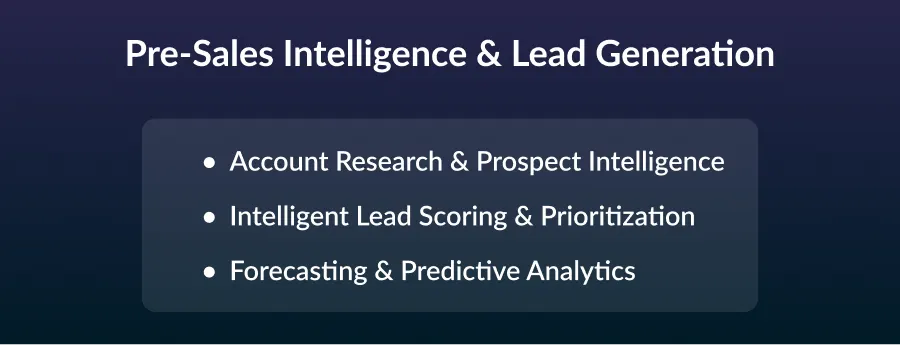
Use Case#1: Account Research & Prospect Intelligence
Generative AI as a sales tool is used for gathering and analyzing data from CRM systems, websites, LinkedIn, industry reports, and public databases.
It generates detailed prospect summaries, highlighting the clients’ background, decision-makers, recent funding rounds, pain points, and potential opportunities.
This allows sales teams to approach leads with well-informed, personalized messaging instead of using generic pitches.
Use Case#2: Intelligent Lead Scoring & Prioritization
Generative AI evaluates engagement signals such as the number of email opens, website visits, content downloads, and buying behavior. It ranks leads based on conversion probability.
Generative AI in sales predicts which prospects are more likely to close. This helps you focus on high-value opportunities.
Use Case#3: Forecasting & Predictive Analytics
Generative AI solutions are used to analyze historical sales data and pipeline trends to predict future revenue outcomes.
Sales representatives use it to identify patterns, seasonal shifts, and potential risks in the deals.
This way, genAI helps sales leaders make data-driven decisions about how to allocate resources effectively, hiring, and quota planning.
Active Selling & Customer Engagement
These use cases of generative AI in sales directly impact how teams interact with prospects and close deals.
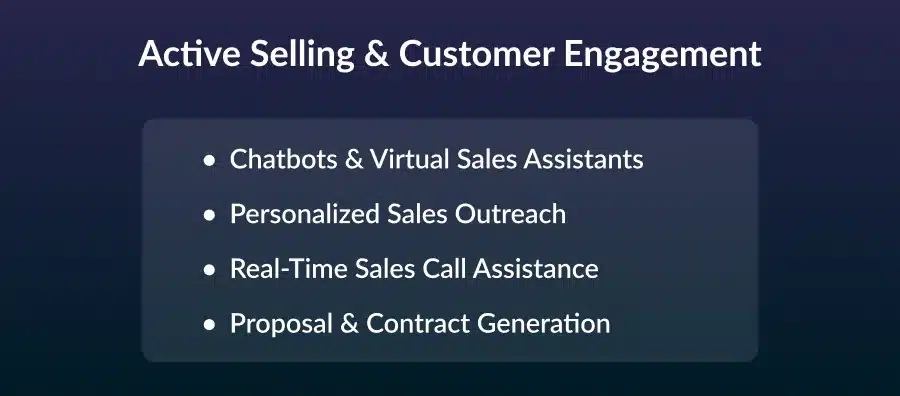
Use Case#4: Chatbots & Virtual Sales Assistants
Businesses use generative AI-powered chatbots to engage website visitors in real time. Moreover, these intelligent chatbots also answer product questions, qualify leads, and schedule demos.
Unlike traditional bots, generative AI understands context and provides human-like conversations. This means your customers will get exactly what they are looking for.
For example, many SaaS companies use virtual assistants powered by generative AI technology to instantly book demos and reduce lead response time from hours to seconds.
Use Case#5: Personalized Sales Outreach
Another use case of generative AI for modern sales is to create customized cold emails, LinkedIn messages, and follow-ups, everything tailored to each prospect’s industry, behavior, and needs.
Instead of sending mass templates, sales teams use generative AI in business to deliver hyper-personalized communication at scale, significantly improving response rates.
Use Case#6: Real-Time Sales Call Assistance
During live sales calls, there are times when sales representatives get stuck on what to do or say next.
For such situations, generative AI can be used to analyze conversations and suggest responses to objections, pricing discussions, or competitor comparisons.
It acts as a virtual coach that helps sales representatives respond confidently and increase closing probability.
Use Case#7: Proposal & Contract Generation
Among the top use cases of generative AI in sales is to create tailored proposals, contracts, and other documents.
Sales teams can use generative AI to create proposals, quotations, and contracts, tailored to customer requirements and pricing models.
This will significantly in reducing manual drafting time and speed up the deal closures.
Sales Operations Automation
The following are the generative AI use cases in sales that improve efficiency and eliminate repetitive administrative tasks.
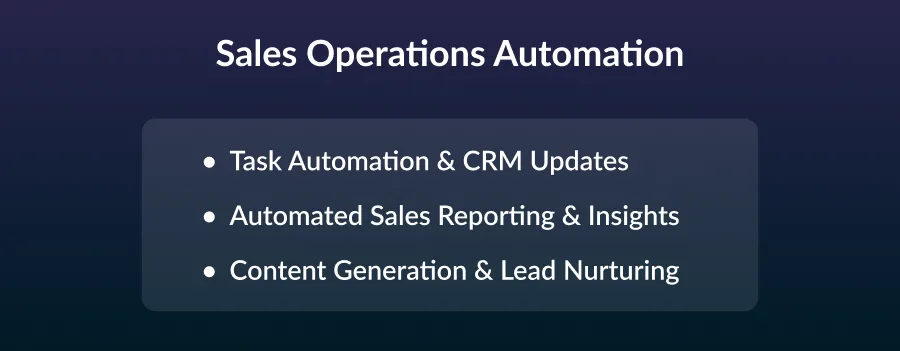
Use Case#8: Task Automation & CRM Updates
Generative AI sales automation helps in streamlining and automating various processes. It helps in
summarizing meetings, drafting follow-up emails, updating CRM entries, scheduling reminders, and more, automatically.
This automation in sales saves hours of manual work every week. Due to this, sales professionals focus more on revenue-generating activities rather than spending time on generic tasks.
Use Case#9: Automated Sales Reporting & Insights
Generative AI solutions help sales teams generate detailed performance reports, pipeline summaries, and revenue forecasts in simple and actionable language.
As the executives receive clear insights instead of raw data dashboards, they make decisions faster.
Use Case#10: Content Generation & Lead Nurturing
Sales professionals use generative AI tools to create tailored pitch decks, brochures, newsletters, product descriptions, and nurturing emails aligned with buyer journey stages.
It ensures consistent messaging while maintaining personalization across campaigns.
Post-Sales Growth & Customer Retention
Generative AI for sales also supports revenue expansion and long-term customer relationships.
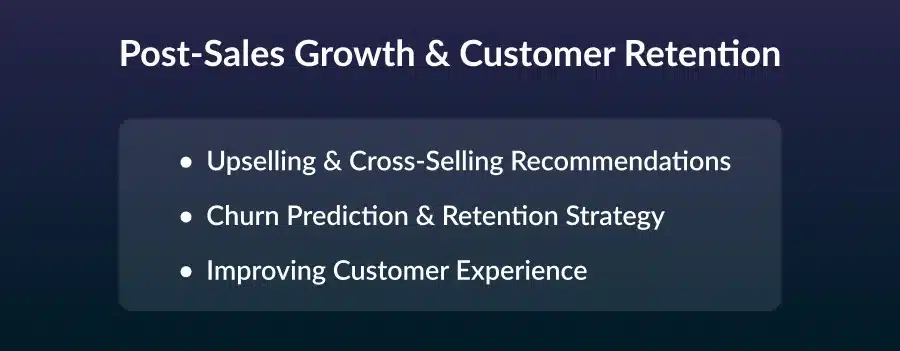
Use Case#11: Upselling & Cross-Selling Recommendations
Generative AI for sales solutions helps teams to offer complementary or premium products to customers.
These tools analyze purchase history and customer behavior and identify opportunities to offer the products at the right time. This increases customer lifetime value without aggressive selling tactics.
Use Case#12: Churn Prediction & Retention Strategy
Generative AI is also used in sales to reduce churn rates and optimize customer retention strategies.
It detects early warning signs of customer disengagement by analyzing usage data and sentiment patterns.
Then, the tool generates targeted retention campaigns or special offers that help in attracting clients and reducing churn.
Use Case#13: Improving Customer Experience
Enhancing customer experiences is among the key applications of generative AI for sales growth.
Generative AI helps sales teams to enable faster responses, personalized communication, and consistent multi-channel engagement.
By developing a custom generative AI sales solution, you can also build stronger relationships and enhance overall customer satisfaction.
Strategic Sales Optimization
The use cases of generative AI in sales mentioned below focus on long-term growth and competitive advantage.
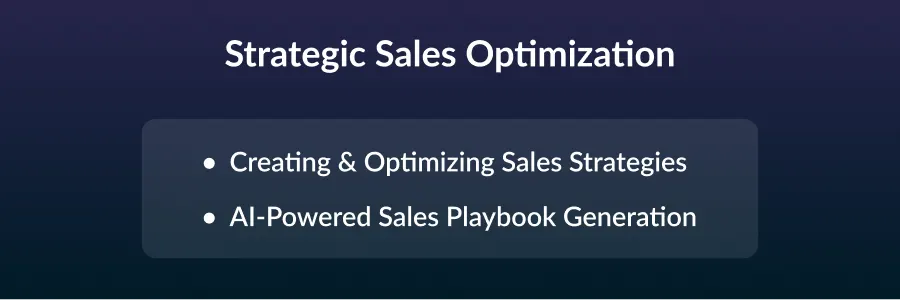
Use Case#14: Creating & Optimizing Sales Strategies
Generative AI for modern sales analyzes market trends, competitor performance, pricing models, and customer data to suggest optimized sales approaches.
Business owners, founders, and strategy-makers can refine targeting strategies, adjust pricing structures, and improve campaign effectiveness based on real-time insights.
Use Case#15: AI-Powered Sales Playbook Generation
Generative AI helps in analyzing high-performing sales conversations and identifies winning patterns.
You can use it to create structured playbooks that the entire team can follow.
This ensures consistent messaging and replicates top-performing sales behavior across the organization.
Benefits of Leveraging Generative AI in Sales Operations
The following are the advantages of implementing generative AI in your sales processes.
1. Higher Sales Productivity
Generative AI automates repetitive tasks like drafting emails, updating CRM, reporting, summarizing calls, and more.
This automation boosts your sales team’s productivity as they spend more time selling and less time on administrative work.
2. Faster Deal Closures
Generative AI tools built leveraging AI development services shorten the sales cycles by generating instant proposals, personalized follow-ups, and real-time sales insights.
Teams can respond faster, address objections more effectively, and move prospects through the funnel efficiently.
3. Personalized Engagement at Scale
Generative AI solutions in sales help in analyzing customer behavior and preferences to create tailored outreach messages, recommendations, and content.
This level of personalization increases engagement, builds stronger relationships, and improves conversion rates.
4. Smarter, Data-Driven Decisions
With the help of generative AI, sales teams can identify high-value leads, forecast revenue accurately, and optimize sales strategies.
Decision-makers can make informed decisions backed by real-time insights rather than assumptions.
5. Increased Revenue & ROI
Generative AI in sales helps businesses enhance pipeline efficiency, improve win rates, and maximize customer lifetime value by combining automation, personalization, and predictive intelligence. This results in measurable revenue growth.
How to Develop a Custom Generative AI Solution for Sales Automation
Now that you know the use cases and benefits of generative AI for sales, let’s explore the process of how you can develop a tailored generative AI solution for your sales team.
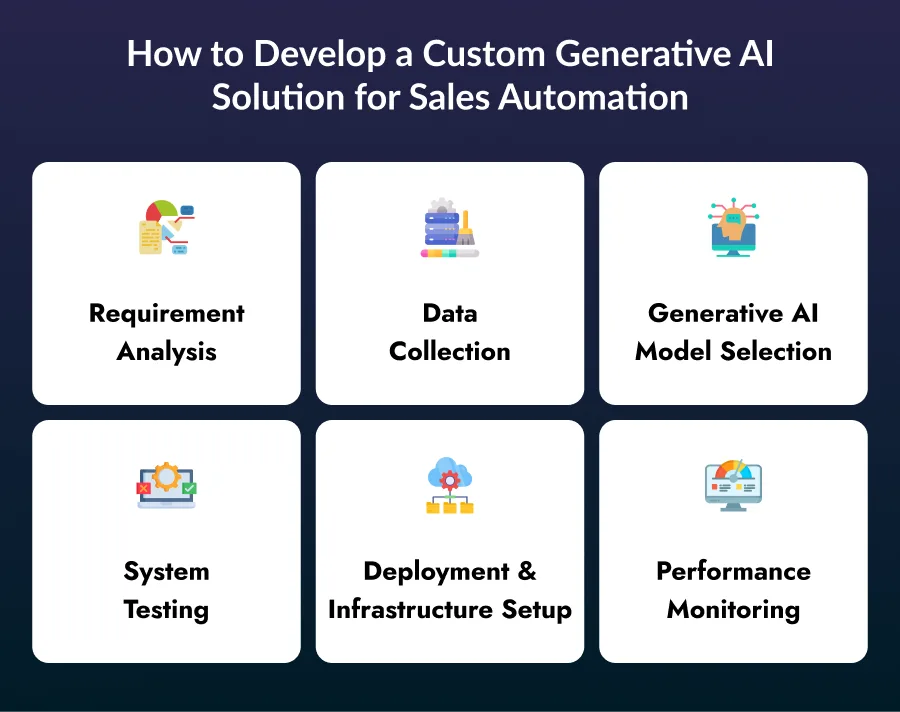
1. Requirement Analysis & Sales Workflow Mapping
The generative AI solution development process begins with identifying business objectives, sales KPIs, user roles, and workflow gaps.
You need to map the complete sales lifecycle to determine where a custom generative AI for sales solution can deliver maximum impact and measurable performance improvements.
2. Data Collection, Cleaning & Structuring
In this stage, collect data as high-quality data forms the foundation of any AI system.
Gather your historical sales records, CRM data, customer interactions, call transcripts, and performance metrics.
Then, clean it, remove inconsistencies, structure datasets properly, and ensure compliance with data privacy regulations before model development begins.
3. Generative AI Model Selection, Training & Development
Once the databases are prepared, select the appropriate LLM or hybrid AI architecture based on your use cases and scalability needs to build generative AI solutions.
Fine-tune pre-trained models or build customized pipelines using proprietary sales data.
4. System Testing & Model Validation
Before deploying the generative solution, conduct rigorous functional testing, output accuracy checks, and performance benchmarking.
Validate your genAI model’s responses for bias, hallucinations, and compliance risks.
Stress-test the system under realistic sales scenarios to ensure that it is reliable, scalable, and performs consistently for longer periods.
5. Deployment & Infrastructure Setup
Once the testing is done, deploy your sales generative AI solution on your on-premise infrastructure with proper API configurations, database connectivity, and role-based access controls. You can also choose Cloud for deployment.
Moreover, you need to ensure that it is seamlessly integrated with your CRM, sales platforms, and analytics tools.
6. Performance Monitoring & Continuous Optimization
After deployment, you need to continuously monitor KPIs such as response accuracy, lead conversion rates, and system latency.
Gather feedback from your sales teams and, based on that, retrain the AI models with updated datasets, refine prompts, and upgrade features.
This will keep your generative AI as a sales tool aligned with evolving sales strategies.
Cost to Develop Generative AI for Sales Growth
Knowing the generative AI for sales development costs is equally important when you are planning to build one such solution. So, here we have provided you with the estimated costs of building generative AI for sales teams.
| Type of Solution | Estimated Cost (EGP) |
|---|---|
| MVP (Minimum Viable Product) | $15,000 to $25,000+ |
| Full-Fledged Solution | $20,000 to $60,000+ |
| Enterprise-Grade Solution | $40,000 to $80,000+ |
Please note that these costs may vary depending on the following factors.
- Technical complexity
- Model type
- Volume and complexity of sales data
- Cloud infrastructure and hosting requirements
- Security, compliance, and governance standards
- Real-time processing capabilities
- Training, testing, and optimization cycles
- Development team

Conclusion
Sales is no longer just about persistence and persuasion. In the modern world, it has been about precision, speed, and intelligence.
Generative AI for sales empowers your teams to work smarter. Using custom genAI solutions, your sales teams can automate repetitive tasks, deliver real-time insights, and enable hyper-personalized engagement at scale.
Moreover, you can increase your sales productivity, close deals faster, make smart decisions, and increase your revenue.
Today, adopting a custom generative AI solution is no longer optional, but it is a strategic advantage that drives measurable revenue impact and sustainable success.
So, get in touch with a trusted generative AI development company and get your generative AI for sales solutions developed.
Frequently Asked Questions
Q1. What is generative AI for sales?
Generative AI for sales refers to AI-powered systems that create personalized sales content, analyze customer data, automate tasks, and provide predictive insights to improve overall sales performance.
Q2. What factors do I need to consider while opting for generative AI in sales?
You need to ensure that you have clear sales goals, data availability and quality, integration requirements, security compliance, scalability needs, and expected ROI before implementing a generative AI solution.
Q3. How long does it take to develop a generative AI solution for sales teams?
It takes around 3 to 5 months. Rest, the development time can vary depending on other factors.
Q4. Which is a reliable generative AI development company?
Developer Bazaar Technologies is a trusted generative AI development company that builds custom sales solutions and integrates genAI into existing sales processes.
Q5. Can I integrate generative AI into my existing sales systems?
Yes, generative AI can be integrated with existing CRM platforms, sales software, and tools.

Arpit Vaishnav
CTO
Developer Bazaar technologies