

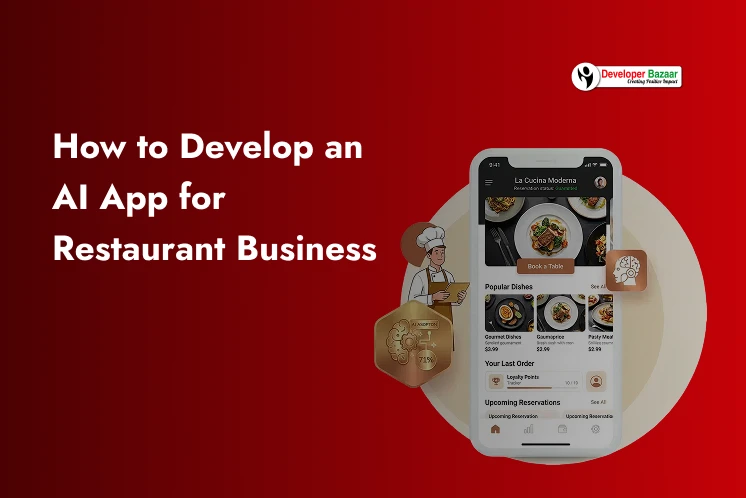
The restaurant industry is changing fast, and technology is playing a big role in this change. Today, customers expect quick service, easy food ordering, and personalized experiences. This is where an AI restaurant app becomes very useful.
An AI-powered restaurant app helps restaurant owners manage orders, understand customers better, reduce waste, and increase profits. From smart food recommendations to automatic inventory management, AI makes restaurant work easier and smarter.
In this blog, you will learn important restaurant industry statistics, understand how AI in the restaurant industry works, and explore the key features needed to develop an AI-powered restaurant app. This guide is helpful whether you want to build an AI app for a restaurant, work with an AI app development company, or plan your own restaurant mobile app.
Restaurant Industry Statistics You Should Know
Understanding the statistics helps you see why building an AI restaurant app is a smart idea.
- The food service industry is expected to reach $1 trillion in sales in 2025, showing strong growth after the pandemic.
- Restaurant jobs will grow by 200,000, making total employment 15.9 million people.
- 64% of full-service and 47% of quick-service customers care more about experience than price.
- Digital ordering and delivery have grown 300% faster than dine-in since 2014.
- Restaurants now control 56.4% of total food sales, beating grocery shopping.
- The online food delivery market may reach $429.90 billion in 2025.
- 78% of customers prefer restaurants that use locally sourced ingredients.
- 47% of restaurant owners increased prices in 2024 due to rising costs.
- 51% of QSR tasks and 27% of full-service tasks will be automated by 2025.
- Fast-casual dining spending may reach $81.5 billion in 2025.
- 81% of restaurateurs use Facebook for marketing.
- 81% of restaurant owners struggle with staff shortages.
These numbers clearly show why restaurants need AI-powered solutions to grow and survive.
Understanding the Role of AI in the Restaurant Industry
Artificial Intelligence (AI) helps restaurants work faster, smarter, and better. It does not replace people. Instead, it supports staff, reduces mistakes, and improves the overall customer experience.
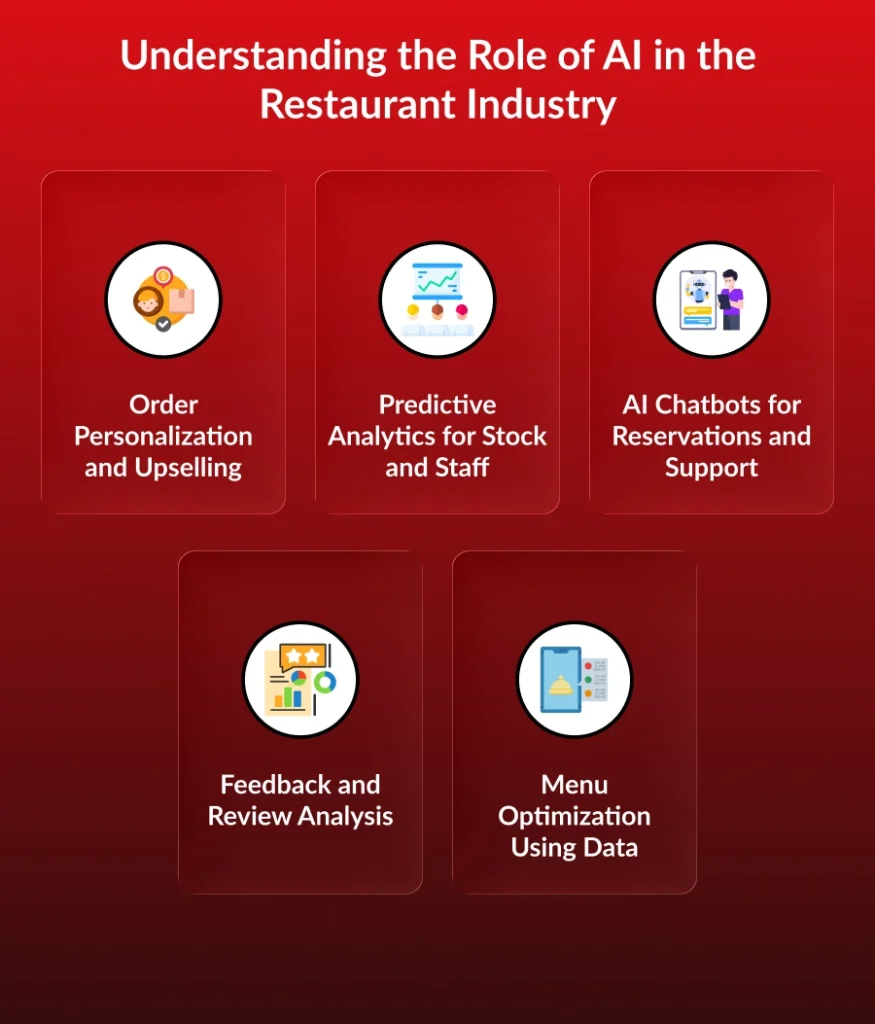
1. Order Personalization and Upselling
AI looks at a customer’s past orders and food preferences. Based on this, it suggests dishes, drinks, or add-ons that the customer is likely to enjoy. This makes customers feel valued and also increases the total order amount for the restaurant.
2. Predictive Analytics for Stock and Staff
AI studies past sales data, weather conditions, holidays, and local events. Using this information, it predicts how busy the restaurant will be on a given day. This helps owners order the right amount of ingredients and schedule the correct number of staff, reducing waste and saving money.
3. AI Chatbots for Reservations and Support
AI-powered chatbots can handle table bookings, answer common questions, and share menu details instantly. They work all day and night without breaks, even during busy hours. This reduces the workload for staff and ensures customers get quick responses.
4. Feedback and Review Analysis
AI scans customer reviews from Google, social media, and feedback forms. It finds common complaints or positive comments by analyzing patterns in the text. This helps restaurant owners quickly understand what customers like or dislike and take action to improve service.
5. Menu Optimization Using Data
AI tracks which dishes sell the most and which ones are rarely ordered. Based on this data, it suggests removing low-performing items and improving popular ones. This helps restaurants create a menu that matches customer taste and increases profits.
Key Features to Include in an AI Restaurant App
To build an AI-powered restaurant app, you need more than basic food ordering. The app should make life easier for customers and help restaurant owners manage daily work smoothly.
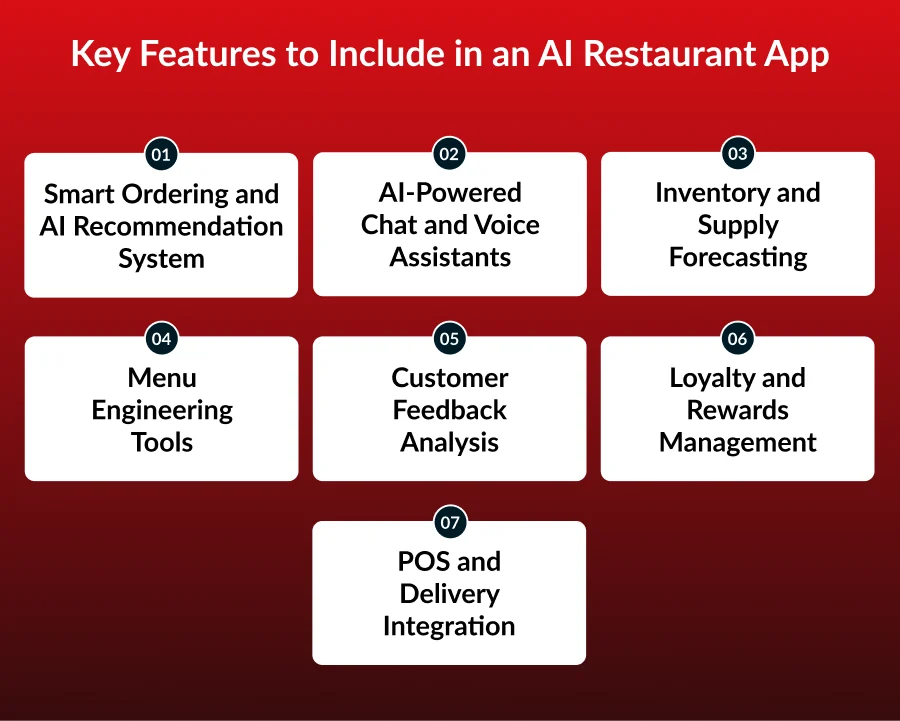
1. Smart Ordering and AI Recommendation System
The app uses AI to remember what customers order often and what they like. Based on this information, it suggests suitable items such as side dishes, drinks, or desserts. This food ordering system makes ordering easier for customers and helps restaurants increase their sales.
2. AI-Powered Chat and Voice Assistants
AI chat and voice assistants help customers by answering questions, taking table bookings, and explaining menu items. They can talk to many customers at the same time without delays. This reduces the workload of staff, especially during rush hours.
3. Inventory and Supply Forecasting
AI checks past sales data, supplier delivery times, and busy days. It predicts how much food will be needed and tells you when to restock. This helps reduce food waste and makes sure ingredients are always available.
4. Menu Engineering Tools
AI analyzes menu prices, food images, and item descriptions to see what attracts customers the most. It shows which menu items sell well and which do not. This helps restaurant owners create a menu that brings higher profits.
5. Customer Feedback Analysis
The app gathers reviews from online platforms and customer surveys. AI studies this feedback to find common complaints and positive comments. This helps restaurant owners fix issues quickly and improve customer satisfaction.
6. Loyalty and Rewards Management
AI groups customers based on how often they visit and what food they prefer. It sends personalized offers, discounts, and rewards to each group. This encourages customers to return again and builds long-term loyalty.
7. POS and Delivery Integration
The app connects smoothly with POS systems and online delivery platforms. All orders, whether dine-in, takeaway, or delivery, appear in one place. This improves kitchen coordination and speeds up order processing.
Step-by-Step: How to Build Your AI-Powered Restaurant App
Building an AI restaurant app becomes easy when you follow the right steps. Each step helps you stay focused and avoid confusion during development.
1. Define the Goal
Start by deciding why you want to develop an AI app for a restaurant. You must clearly know whether the app is for your own restaurant or for selling to other restaurants as a business product. Next, identify one main problem to solve, such as reducing food waste, increasing sales, or managing reservations better. A clear goal helps you choose the right AI features and measure success after launch.
2. Map the User Journey
Plan how customers and staff will use the app from start to finish. Think about how customers order food, how staff receive orders, and how managers track data. This step helps you decide where AI in the restaurant industry can save time, such as recommending food, predicting demand, or automating table bookings. A smooth user journey makes the app easy to use for everyone.
3. Partner with Experts
While you can try to build the app yourself, working with an experienced AI app development company saves time and avoids mistakes. Experts know how to connect AI with POS systems, delivery platforms, and inventory tools. A professional restaurant app development company ensures that data stays secure, AI works correctly, and the app performs well in real restaurant conditions.
4. Build the Core Features
Focus on the most important features first, such as an AI recommendation system, smart ordering, or inventory prediction. These features bring quick value to your restaurant. By starting small, you can launch faster, collect feedback early, and improve the app step by step. This makes it easier to build an AI-powered restaurant app without wasting resources.
5. Test the App in a Real Restaurant
Test the app in one restaurant or with a small group of users. Observe how it works during busy hours and check if AI suggestions are accurate. Ask staff and customers for feedback. Real-world testing helps you find hidden problems and improve the app before a full launch.
6. Optimize and Launch
After testing, improve AI suggestions, fix errors, and make sure the app runs smoothly on all devices. Connects well with your existing systems. Once everything works well, launch the app with confidence. A polished launch helps users trust your AI restaurant app from day one.
How Much Cost to Develop AI App for Your Restaurant Business
The cost of developing an AI-powered restaurant app varies widely based on the level of intelligence, automation, and personalization you want to introduce.
Factors such as AI model complexity, data requirements, integrations, platform choice, and customization play a crucial role in determining the final cost. Most restaurant businesses reduce risk by starting with an AI-powered MVP and scaling gradually based on real-world results.
| Cost Factor | Description | Estimated Cost Range |
|---|---|---|
| Basic AI App | AI-powered menu recommendations, basic chatbot support, order management, and payment integration | $10,000 - $20,000 |
| Mid-Level AI App | Personalized offers, AI-driven customer insights, loyalty programs, analytics dashboard, and CRM integration | $25,000 - $40,000 |
| Advanced AI App | Predictive demand forecasting, AI-driven inventory management, dynamic pricing, voice assistants, and real-time analytics | $40,000 - $80,000 |
| AI Features Complexity | Rule-based AI vs. machine learning models, personalization depth, and automation level | Impacts the total cost significantly |
Developing an AI app for your restaurant is an investment in automation, personalization, and smarter decision-making. The most cost-effective approach is to start with an AI-powered MVP around $10,000 – $20,000 that focuses on core features like smart recommendations and automated ordering.
Who Can Build AI-Powered Restaurant App
Different people and businesses can create an AI app for a restaurant business, depending on their goals and resources.
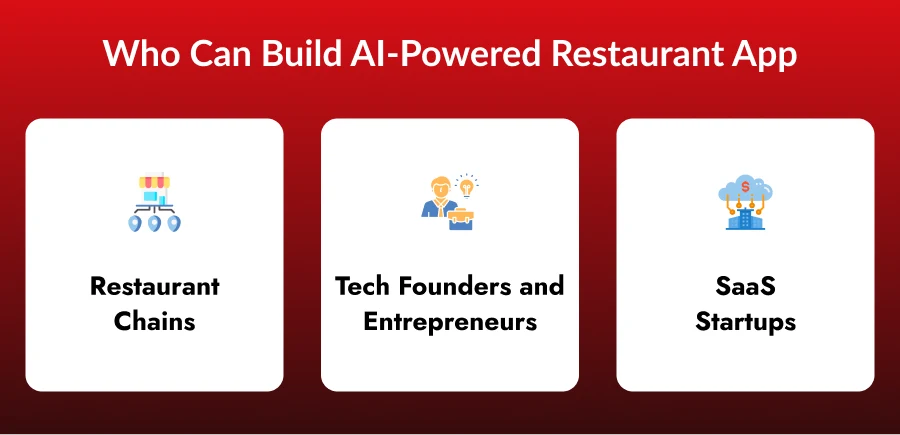
1. Restaurant Chains
Large restaurant chains often build custom AI apps that match their brand and menu. They work with a cross platform app development company to get advanced and secure solutions without building an in-house tech team.
2. Tech Founders and Entrepreneurs
Tech founders can build an artificial intelligence app for restaurants to solve common problems like long wait times or order mistakes. They can offer these apps to many restaurants and grow the business.
3. SaaS Startups
SaaS startups can develop AI-powered restaurant apps that restaurants use through monthly subscriptions. These apps are easy to install, affordable, and perfect for small and mid-sized restaurants.
Common Mistakes to Avoid When Developing an AI-Powered Restaurant App
Building an AI-driven restaurant app can significantly improve operations and customer experience, but certain missteps can lead to higher costs, low adoption, or technical setbacks. Identifying and avoiding these mistakes early helps ensure smoother development and long-term success.
1. Launching with too many features at once
Trying to include every possible feature in the initial release often slows development, increases the risk of bugs, and delays user feedback. Start with essential functionalities such as ordering, payments, and basic AI recommendations, then expand gradually based on real usage insights.
2. Training AI without real restaurant data
AI systems deliver the best results when trained on accurate, business-specific data. Relying on generic datasets can lead to irrelevant recommendations, inaccurate forecasts, and poor personalization, ultimately reducing customer satisfaction.
3. Neglecting integration with existing systems
An effective restaurant app should smoothly integrate with POS systems, inventory management tools, reservation platforms, and delivery services. Without proper integrations, staff may end up duplicating work, which reduces efficiency and increases operational errors.
4. Underestimating data and payment security
Restaurant apps handle sensitive customer information and online payments, making security non-negotiable. Failing to implement strong encryption, PCI compliance, and secure authentication can result in data breaches, legal issues, and loss of customer trust.
5. Failing to plan for scalability
An app that performs well during low traffic may struggle during peak hours. Designing with scalability using cloud infrastructure and modular architecture for your app that can handle growing order volumes, users, and AI workloads over time.
By avoiding these common mistakes, you can build a smart and competitive AI-powered restaurant app that delivers real value to both customers and staff.
Partner with Developer Bazaar Technologies to Build Your AI App for the Restaurant Business
Developer Bazaar Technologies helps restaurants build AI apps for restaurant businesses using modern, secure, and scalable technologies. We design solutions that are simple to use, fast to operate, and focused on real business results.
What makes us different is our restaurant-first approach. We do not build generic apps. We carefully understand your menu, customers, and daily operations before creating the solution.
Whether you need smart ordering, an AI recommendation system, demand forecasting, or delivery management, our experts turn your idea into a powerful AI restaurant app. As a trusted AI app development company, we ensure faster launch, smooth integrations, and long-term growth support for your restaurant business.
Conclusion
The restaurant industry is growing fast, and AI is becoming an important part of this growth. When you develop an AI app for a restaurant, you make daily work easier, faster, and more accurate. From smart ordering and AI recommendation systems to inventory planning and customer support, AI helps restaurants serve better and earn more.
Building an AI-powered restaurant app is not only for big brands. Small restaurants, startups, and SaaS businesses can also benefit by choosing the right features and development partner. By working with a trusted Mobile app development company, you can create a powerful, secure, and user-friendly solution that meets real business needs.
In the future, restaurants that use AI will stay ahead of the competition. Now is the right time to build an AI-powered restaurant app and grow your business smarter.
FAQs
1. What is an AI restaurant app?
An AI restaurant app uses artificial intelligence to help with food ordering, recommendations, inventory management, and customer support.
2. Can small restaurants build an AI-powered app?
Yes, small restaurants can easily build AI-powered restaurant apps with the help of a professional development company.
3. How does an AI recommendation system help restaurants?
It suggests food items based on customer preferences, which increases sales and improves customer satisfaction.
4. How long does it take to build an AI restaurant app?
The time depends on features, but most apps take a few months when built by an experienced restaurant app development company.
5. Is AI safe to use in restaurant apps?
Yes, when developed by experts, AI apps are secure and follow data protection standards.

RM Mishra
Co-Founder
Developer Bazaar technologies