
Building a SaaS product is not only about writing code and launching software. Today, AI is changing how businesses build, scale and deliver SaaS products. Enterprises that combine SaaS with AI can automate tasks, improve decision-making, and create smarter applications.
If you plan to build SaaS product using AI, this guide will help you understand the basics, benefits, and market trends. It will also show why combining SaaS and AI is the future of digital products.
What is a SaaS product?
A SaaS (Software as a Service) product is software that runs on the internet. Users do not need to download or install anything. Users can access it through any web browser.
For example:
- Google Docs helps you write and edit documents online
- Netflix lets users watch movies and shows anytime
When you create SaaS product, you host it on cloud servers. Users pay a subscription fee to use it.
Why Businesses Prefer SaaS
- No need for expensive hardware
- Easy to scale as users grow
- Works on any device
- Quick updates and maintenance
SaaS applications help businesses grow faster. They save time, money and effort.
SaaS Statistics for 2026: Market Insights and Key Metrics
The SaaS market is growing very fast. Let’s thoroughly understand these important numbers:
- The global SaaS market may reach $1.25 trillion by 2034, which shows that more businesses are moving towards cloud-based software solutions.
- The U.S. SaaS market could cross $412 billion by 2034, making it one of the biggest contributors to the global SaaS industry.
- North America is expected to reach $211.7 billion by 2026, showing strong adoption of SaaS platforms across enterprises in the region.
- SaaS companies serve approximately 14 billion users worldwide, underscoring the widespread adoption of SaaS across industries.
- About 81% of businesses have automated at least one process using SaaS, helping them improve efficiency and reduce manual work.
- Companies use an average of 106 SaaS applications, underscoring how heavily they rely on multiple tools for daily operations.
- Global SaaS spending may hit $300 billion by 2025, reflecting strong investment in cloud-based technologies.
- The average SaaS churn rate is 3.5%, indicating that businesses must focus on customer retention to sustain steady growth.
- Around 95% of companies will use AI-powered SaaS by 2025, proving that AI is becoming a standard feature in modern software.
- The health cloud SaaS market may reach $452.4 billion by 2029, showing rapid growth in healthcare technology solutions.
What These Stats Mean
These statistics clearly show that SaaS is growing rapidly worldwide. AI is becoming a must-have feature in modern applications. Businesses are also investing heavily in cloud software to improve efficiency and scalability.
If you are planning to build SaaS product using AI, this is the perfect time to start and stay ahead in the market.
Why Combining AI and SaaS Creates a Powerful Solution?
Today, companies don’t want smart software. This is where AI in SaaS applications plays a big role. When you develop SaaS product using AI, your product becomes more intelligent, automated and user-friendly.
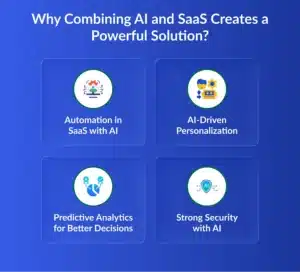
1. Automation in SaaS with AI
AI makes it easy to automate repetitive and time-consuming tasks such as data entry, customer support, scheduling, and report generation. Instead of doing these tasks manually, AI handles them quickly and accurately. This helps businesses save time and reduce operational costs. As a result, employees can focus on more important and creative work that adds real value to the business.
2. AI-Driven Personalization
AI studies user behavior, preferences, and actions to deliver a more personalized experience. It can suggest relevant products, create custom dashboards, and send smart notifications based on user needs. When you create SaaS product using AI, users feel that the platform understands them better. This improves user engagement, satisfaction, and long-term retention.
3. Predictive Analytics for Better Decisions
AI can process vast amounts of data and uncover patterns that might go unnoticed by humans. It can also predict future trends and outcomes with high accuracy. This helps businesses make smarter decisions, reduce risks, and plan better strategies. That’s why AI SaaS development is becoming very popular among enterprises that want to stay ahead in the market.
4. Strong Security with AI
AI improves security by detecting unusual activity and potential threats in real time. It can analyze different attack patterns and identify risks before they become serious problems. This helps prevent data breaches, protect sensitive information, and ensure system security. Security is very important when you develop SaaS product, especially for enterprises that handle large amounts of user data.

Main Strategies for Integrating AI into SaaS Products
Now that you understand the power of AI in SaaS applications, the next step is to choose the right way to integrate AI. There are two main approaches that businesses use when they build SaaS product using AI. Each approach has its own benefits and challenges.
1. Pre-built AI Solutions: Quick and Efficient
Pre-built AI tools are ready-made solutions that you can quickly add to your SaaS product. These tools are easy to use and help you develop SaaS product using AI faster. They also require less time and lower investment in the beginning.
However, pre-built solutions may not fully match your business needs. You may face issues while integrating them into your system. Also, you have less control over features and customization. This can limit your ability to create a unique SaaS product using AI.
2. Custom AI Development: Full Control and Flexibility
Custom AI development means building AI features from scratch. This method provides complete control over your product. You can design features exactly as your business needs and improve them over time.
When you choose this method, your AI SaaS development becomes more flexible and scalable. But it takes more time, effort, and cost. You may also need expert ai developers to build a strong product.
12 Easy Steps to Build AI-Powered SaaS Products
To build SaaS product successfully, you need a clear plan and the right process. Here are 12 detailed steps to help you develop SaaS product using AI.
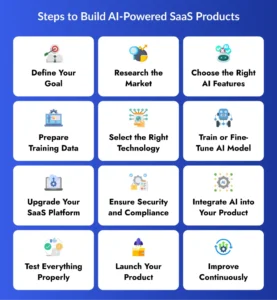
Step 1: Define Your Goal
Start by clearly understanding why you want to create SaaS product using AI. Do not follow trends blindly, focus on solving a real problem for users. Ask yourself what your product will do and why it matters. Make sure it aligns with your business goals and delivers value to customers. A strong purpose is the foundation of successful AI SaaS development.
Step 2: Research the Market
Before you build SaaS product using AI, study your target audience and competitors carefully. Talk to users to understand their needs and pain points. Analyze existing SaaS products to see what works and what doesn’t. This helps you avoid mistakes and find opportunities to improve. Market research ensures your product has real demand.
Step 3: Choose the Right AI Features
AI offers many capabilities, but you should focus only on features that bring the most value. Identify areas where users face problems and where AI can make a difference. Start small with one or two impactful features instead of adding everything at once. This approach reduces the cost of building a SaaS product and improves efficiency. You can always scale later.
Step 4: Prepare Training Data
AI models need high-quality data to perform well. Collect, clean, and organize data that matches your business needs. Poor data can lead to inaccurate results and bad user experience. Work with experts ai development company to prepare reliable datasets. Good data improves the performance and accuracy of your AI in SaaS application.
Step 5: Select the Right Technology
Choosing the right tech stack is very important for smooth AI SaaS development. You need to select suitable AI models, frameworks, and cloud platforms. Use modern tools for frontend, backend, and database management. Cloud services help you scale easily without heavy investment. The right technology ensures your product runs fast and efficiently.
Step 6: Train or Fine-Tune AI Model
Instead of building AI models from scratch, it is better to fine-tune existing ones. Pre-trained models already have basic knowledge, so they require less time and cost. You can train them using your business data to improve accuracy. This method reduces the cost to build SaaS product and speeds up development. It is a smart way to develop SaaS product using AI.
Step 7: Upgrade Your SaaS Platform
Before adding AI, make sure your SaaS system is ready to support it. Check if your current platform can handle data flow and AI integration. You may need to update or rebuild some parts of your application. A strong backend ensures smooth communication between AI and your product. This step is important when you create SaaS product using AI.
Step 8: Ensure Security and Compliance
Security is critical when you build SaaS product using AI, especially for enterprise solutions. Comply with data protection laws and relevant industry regulations such as GDPR or HIPAA when applicable. Ensure user data is safeguarded through encryption and secure storage practices. Regularly check your system for vulnerabilities. Strong security builds trust and protects your business from risks.
Step 9: Integrate AI into Your Product
Now it’s time to connect AI with your SaaS platform. Use APIs and tools to integrate AI features smoothly. Make sure the new features do not disrupt the existing user experience. Focus on simple and user-friendly design. Proper integration ensures your AI in SaaS application works effectively.
Step 10: Test Everything Properly
Testing is an important part of AI SaaS development. Check your product for performance, accuracy, and security issues. Test both the SaaS system and AI features using real-world scenarios. Fix bugs and improve functionality before launch. Good testing ensures a reliable and smooth user experience.
Step 11: Launch Your Product
Once everything is ready, release your product to users. Inform them about new AI features and how they can use them. Train your support team to handle user queries. Monitor the product closely after launch to fix any issues quickly. A successful launch helps you build SaaS product with confidence.
Step 12: Improve Continuously
After launch, keep improving your product based on user feedback and performance data. AI models need regular updates to stay accurate and useful. Fix bugs, add new features, and adapt to new trends. Continuous improvement helps you stay competitive in the market. This is key to long-term success in AI SaaS development.
Inspiring Examples of Successful AI SaaS Platforms for Your Project
Real-world examples help us understand how powerful AI SaaS development can be. Many global companies are already using AI to improve their SaaS platforms, deliver better user experiences, and scale their operations. These examples can inspire you to build SaaS product using AI and create smarter solutions for your business.
Facebook: Smarter Social Media with AI
Facebook uses AI to improve both user experience and platform safety at a massive scale. It applies AI to detect harmful content, reduce hate speech, and monitor inappropriate activities in real-time. The platform also studies user behavior to show relevant content, ads, and recommendations.
This helps Facebook create a safer, more engaging, and personalized experience for billions of users worldwide. It clearly shows how businesses can create SaaS product using AI to manage large amounts of data and users efficiently. AI also helps the company continuously improve its platform and keep users engaged.
Salesforce: AI in CRM Solutions
Salesforce is a leading example of how AI can transform SaaS products in the business world. It uses AI to automate daily tasks like data entry, customer support, and sales tracking. The platform also provides personalized customer insights and smart recommendations based on user data.
This makes it easier for businesses to understand their customers, improve communication, and increase sales. Salesforce shows how companies can develop SaaS product using AI to boost productivity and deliver better results. It is a strong example of how AI can turn traditional software into a powerful, intelligent business tool.

Conclusion
Building a SaaS product is about creating smart software that is a future-ready solution. When you build SaaS product using AI, you unlock automation, better decision-making, and improved user experiences. This helps businesses grow faster and stay competitive in a rapidly changing market.
From choosing the right approach to following the step-by-step process, every stage plays an important role in successful AI SaaS development. Whether you want to develop SaaS product from scratch or upgrade an existing platform, integrating AI can bring long-term value and higher ROI.
If you are planning to create SaaS product using AI, working with expert SaaS development company can make the journey easier and more efficient. Companies like Developer Bazaar Technologies help businesses turn ideas into powerful SaaS solutions with the right technology and strategy.
Now is the right time to invest and innovate. Start today and build a smarter SaaS future.
FAQs
1. What is the cost to build SaaS product using AI?
The cost to build SaaS product using AI depends on features, complexity, and technology used. A basic product may cost less, while advanced AI solutions can be more expensive. AI integration adds value but may increase the initial cost. However, it also improves efficiency and long-term returns.
2. How long does it take to develop SaaS product using AI?
The time required to develop SaaS product using AI usually ranges from 3 to 9 months. It depends on the features, AI complexity, and team size. Simple applications take less time, while advanced AI SaaS platforms need more development and testing. Proper planning can speed up the process.
3. Why should I build SaaS product using AI?
When you build SaaS product using AI, you can automate tasks, improve user experience, and make smarter decisions. AI helps in personalization, analytics, and security. It also gives your product a competitive advantage in the market. That’s why AI is becoming essential in modern SaaS products.
4. Do I need experts for AI SaaS development?
Yes, working with experts is highly recommended for AI SaaS development. Skilled developers understand how to integrate AI features properly and securely. They also help in choosing the right tools and technologies. Partnering with professional AI development services ensures better results and faster delivery.
5. Can small businesses create SaaS product using AI?
Yes, small businesses can also create SaaS product using AI. With cloud platforms and pre-built AI tools, it is now more affordable than before. Starting with basic features and scaling later is a smart approach. This allows businesses to manage costs and grow step by step.
6. What are the key benefits of AI in SaaS application?
AI in SaaS application helps automate tasks, provide personalized experiences, and improve decision-making. It also enhances security and reduces manual work. These benefits help businesses save time, reduce costs, and improve overall productivity.