
Key Takeaways:
- AI software delivers long-term business value by improving decision-making, automation, customer experiences, and operational efficiency.
- Successful AI projects require more than coding, they depend on quality data, the right AI model, seamless integration, and continuous optimization.
- AI development is an ongoing investment, with costs influenced by data, infrastructure, compliance, and post-launch model maintenance.
- Partnering with experienced AI developers or a trusted AI development company can reduce project risks and accelerate deployment.
- Enterprises that adopt AI strategically today are better positioned to innovate faster and gain a lasting competitive advantage.
Every big company wants to use AI today. Banks want AI that spots fraud. Hospitals want AI that helps doctors. Online stores want AI that shows the right products to the right people. But there is one big question behind all of this: how to develop AI software the right way?
This guide answers that question in simple words. We will walk through the full AI software development process, the AI software development lifecycle, the real cost, and how to hire AI developers who can turn your idea into working software. You do not need to be a tech expert to understand this guide. We kept the language simple so anyone on your team can read it and follow along.
Quick Answer: How to Develop AI Software
To develop AI software, a business must first pick a clear problem to solve, gather clean data, choose the right AI model, train and test that model, connect it to an easy-to-use app, and then launch it. After launch, the software must be watched and improved often. Most enterprises work with an AI software development company because building AI needs skilled AI developers, strong data tools, and safe cloud systems working together.
What Is AI Software?
AI software is a computer program that can learn from data and make smart choices on its own. Normal software only follows fixed rules that a person wrote. AI software is different. It looks at many examples, finds patterns, and then uses what it learned to answer questions, make predictions, or complete tasks.
For example, an AI tool can look at thousands of past loan applications and learn to guess which new applications are risky. A normal program cannot do this unless someone tells it every single rule by hand. This is why more and more enterprises want to build AI software instead of plain software.
Why Enterprises Are Investing Heavily in AI Software Development
Businesses are not building AI software just to look modern. AI software solves real problems and saves real money. Here are the biggest reasons enterprises are investing in AI software development right now.
1. Faster and Smarter Decisions
AI analyzes massive datasets in real time, helping businesses uncover insights and make smarter decisions with greater speed and accuracy.
2. Lower Operating Costs
By automating repetitive tasks such as data entry, document processing, and customer support, AI lowers costs while improving workforce productivity.
3. Better Customer Experience
AI-powered chatbots, recommendation engines, and virtual assistants provide faster support and personalized interactions that improve customer satisfaction.
4. Stronger Fraud and Risk Protection
AI continuously monitors transactions and user activity to detect unusual patterns, helping businesses prevent fraud and reduce security risks.
5. Gain a Competitive Business Advantage
Organizations that invest in AI can innovate faster, streamline operations, and respond more effectively to market changes than their competitors.
AI Software Development Market Insights & Trends
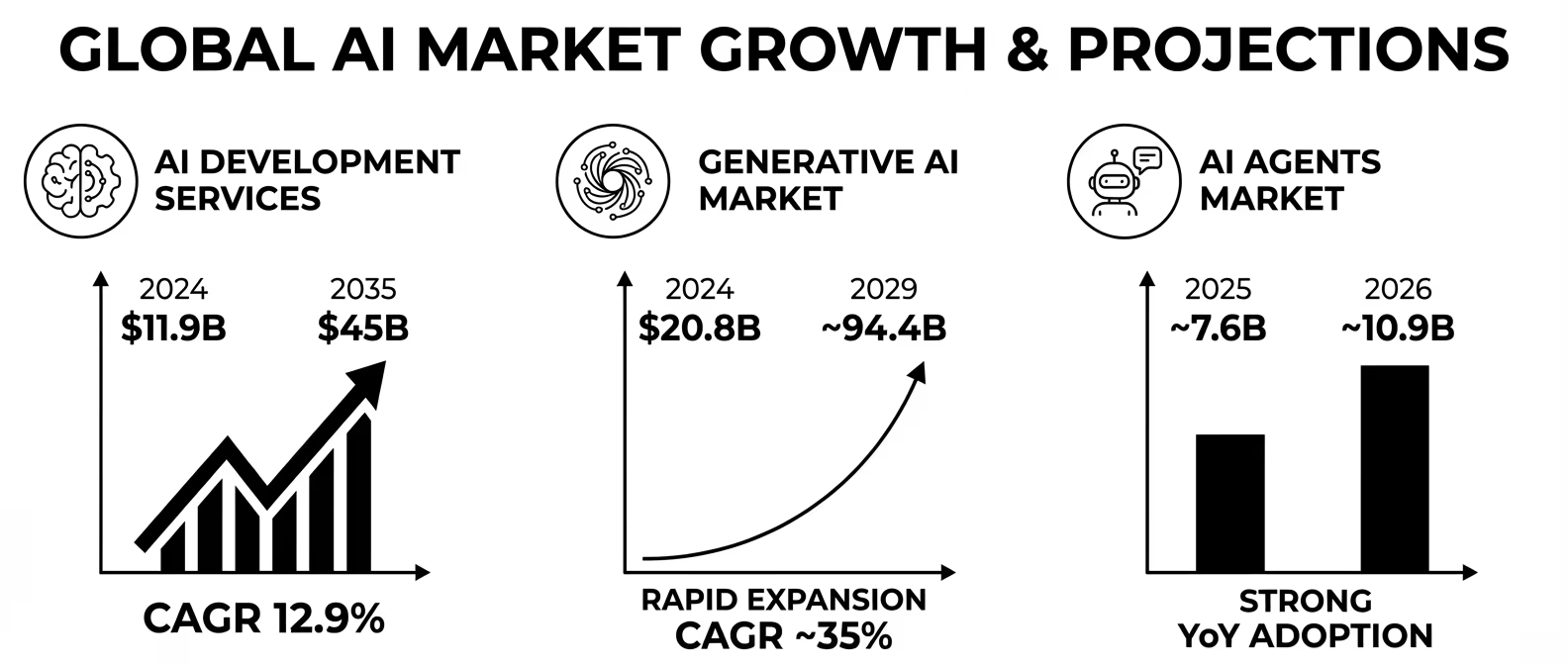
The AI software development market is growing rapidly as businesses increasingly invest in intelligent applications, automation, and AI-powered decision-making.
The global market is projected to grow from US$718.3 million in 2026 to US$9,165.4 million by 2033, expanding at a CAGR of 43.5%. This growth is fueled by the widespread adoption of AI coding assistants, automated testing tools, and intelligent software development platforms that help organizations build applications faster while improving code quality.
Key Market Highlights
- Machine Learning Holds the Largest Market Share: Machine learning is expected to account for approximately 37.4% of the market in 2026, driven by its widespread use in enterprise applications such as fraud detection, recommendation engines, and predictive analytics. Leading technology companies like Google and Amazon continue to expand machine learning across their products and services.
- IT and Software Services Remain the Biggest End Users: The IT and software services sector is projected to capture nearly 53.1% of the market in 2026. These organizations not only develop AI-powered software but also use AI internally for coding assistance, automated testing, DevOps, and cloud infrastructure management.
- North America Continues to Lead the Market: North America is expected to hold around 43.4% of the global market share in 2026, supported by strong investments in AI research, mature digital infrastructure, and close collaboration between technology companies, universities, and research institutions.
- Asia Pacific Is the Fastest-Growing Regional Market: Countries including China, Singapore, and India are accelerating AI adoption through national AI strategies, government-backed innovation programs, and increased enterprise investments, making Asia Pacific the fastest-growing region for AI software development.
- Strategic Acquisitions Are Driving AI Innovation: Major technology companies continue to strengthen their AI portfolios through acquisitions. For example, Palo Alto Networks’ planned acquisition of Chronosphere in November 2025 reflects the industry’s growing focus on combining AI observability with autonomous security and operational intelligence for enterprise applications.
AI Software Development Process: Step-by-Step
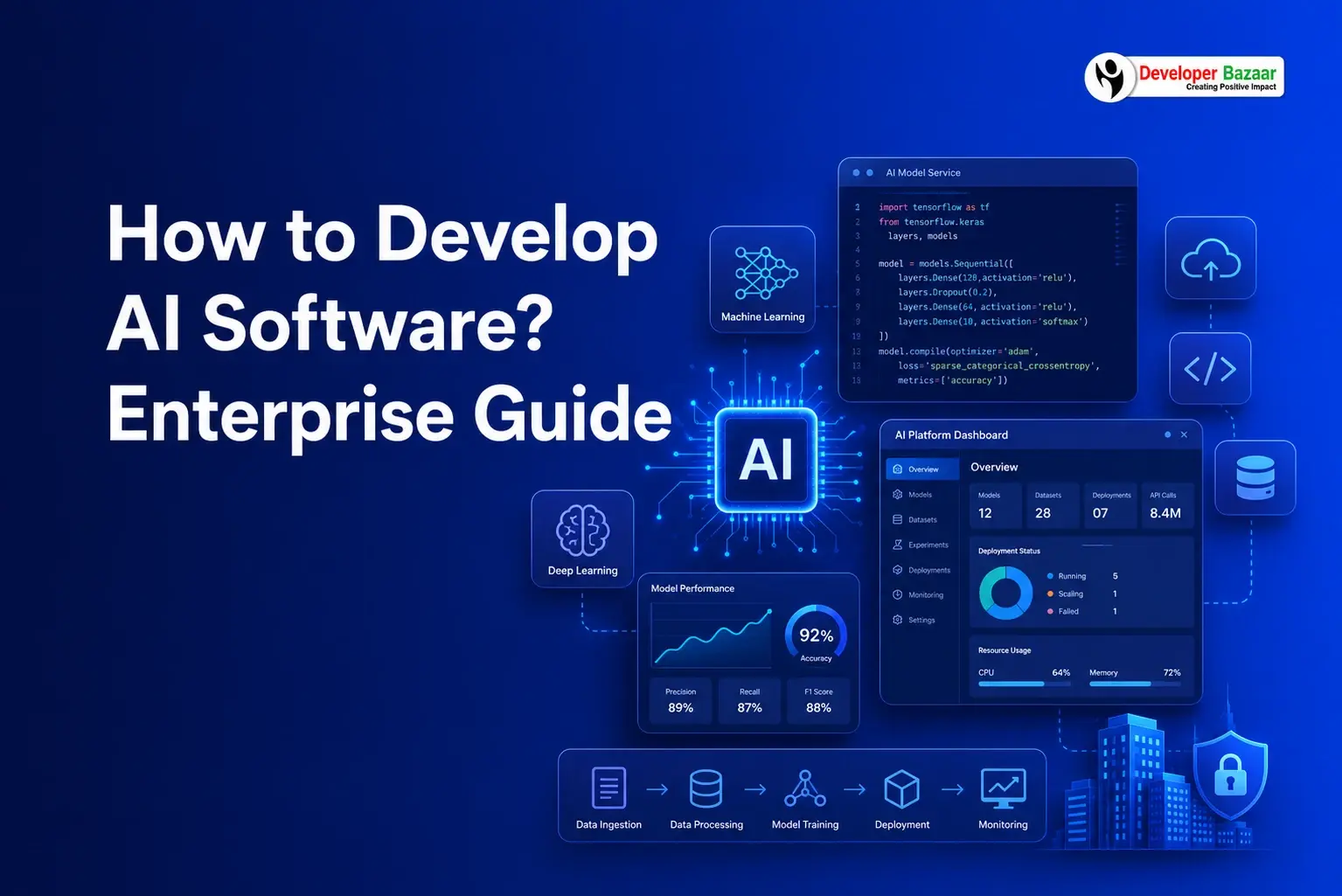
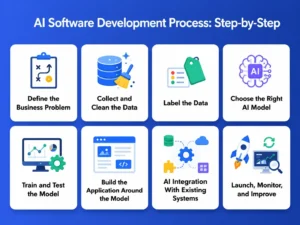
Learning how to develop AI software becomes much easier once you break it into small steps. Below is the AI software development process that most enterprise teams follow, from the very first idea to the final launch.
Step 1: Define the Business Problem
Before writing a single line of code, the team must answer one question: what problem should this AI software solve? A clear goal, such as “reduce customer support wait time” or “predict machine failure before it happens,” keeps the whole project on track.
Step 2: Collect and Clean the Data
AI software learns from data, so this step is very important. The team gathers data related to the problem, removes errors, fills in missing values, and organizes everything neatly. Clean data leads to a smarter and more reliable AI model.
Step 3: Label the Data
In many AI projects, each piece of data needs a tag or label so the AI can learn the right answer. For example, photos of products might be labeled “in stock” or “out of stock” so the AI learns to tell them apart.
Step 4: Choose the Right AI Model
Different problems need different types of AI models. A model that reads text is not the same as a model that studies images or predicts numbers. Picking the right model is one of the most important choices in the whole AI software development process.
Step 5: Train and Test the Model
The team feeds the cleaned data into the chosen AI model so it can learn patterns. Then they test the model on new data it has never seen before, to check how well it performs in real situations.
Step 6: Build the Application Around the Model
A smart AI model still needs an easy way for people to use it. This step is about building the app, website, or dashboard where employees or customers will actually interact with the AI software.
Step 7: AI Integration With Existing Systems
Most enterprises already use tools like CRMs, ERPs, or internal dashboards. AI integration means connecting the new AI software with these existing systems so data can flow smoothly between them, without extra manual work.
Step 8: Launch, Monitor, and Improve
Once the AI software goes live, the work is not over. Teams must watch how it performs, collect feedback, and retrain the model with fresh data so it keeps getting better over time.
AI-Driven Software Development Approach vs Traditional Development
Many teams ask how an AI-driven software development approach is different from regular software development. The table below breaks down the key differences in simple terms.
| Factor | Traditional Software Development | AI-Driven Software Development Approach |
|---|---|---|
| How it works | Follows fixed rules written by developers | Learns patterns from data and adjusts on its own |
| Main input | Written code and logic | Data, code, and trained AI models |
| Improves over time? | Only when developers update the code | Can improve as it learns from new data |
| Best for | Simple, rule-based tasks | Tasks with patterns, predictions, or personalization |
| Team needed | Software developers | Software developers, data scientists, and AI engineers |
AI Software Development Lifecycle
The AI software development lifecycle is the full journey an AI project goes through, from the first idea to ongoing support after launch. Understanding this lifecycle helps enterprises plan their time, budget, and team correctly.
| Lifecycle | What Happens Here |
|---|---|
| Discovery & Planning | Define the goal, study the market, and set a clear project scope |
| Data Collection | Gather data from internal systems, public sources, or partners |
| Data Preparation | Clean, label, and organize the data for training |
| Model Building | Choose and build the AI model architecture |
| Training & Validation | Train the model and test it on fresh, unseen data |
| Application Development | Build the app, dashboard, or interface around the model |
| AI Integration & Testing | Connect the AI software to existing systems and run full tests |
| Deployment | Launch the AI software for real users |
| Monitoring & Retraining | Track performance and retrain the model as new data comes in |
AI Integration: Connecting AI Software With Your Existing Systems
AI integration is often the hardest part of developing AI software for a large company. Enterprises rarely start from zero. They already have older systems, databases, and tools running the business every day. New AI software must work well with all of these.
Here are simple ways enterprises make AI integration smooth:
- Use APIs to connect the new AI software with old systems instead of rebuilding everything from scratch.
- Start with one small department or task before rolling AI software out across the whole company.
- Keep data formats consistent across all tools so the AI model can read information correctly.
- Set up strong security and access controls so only the right people can use or change the AI software.
- Test AI integration in a safe environment before switching it on for real customers or employees.
AI Software Development Cost
One of the first questions every enterprise leader asks is about AI software development cost. The honest answer is: it depends on how complex the software is. A simple AI tool costs much less than a large AI system used across many departments.
| Software Complexity | Estimated Development Cost | Estimated Timeline |
|---|---|---|
| Simple AI Software (one clear task, small data set) | $25,000 – $60,000 | 2 to 4 Months |
| Medium Complexity (multiple features, moderate data) | $60,000 – $150,000 | 4 to 8 Months |
| Highly Complex Enterprise AI Software (large data, many integrations) | $150,000 – $400,000+ | 8 to 14 Months |
Key Factors That Influence AI Software Development Cost
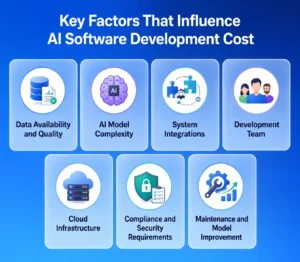
The cost of building AI software depends on several technical and business factors. Understanding these cost drivers helps enterprises plan realistic budgets and avoid unexpected expenses.
1. Data Availability and Quality
AI models require large volumes of accurate, well-structured data. Collecting, cleaning, and preparing this data can account for a significant portion of the project cost.
2. AI Model Complexity
Basic machine learning models cost less to develop than advanced generative AI or deep learning solutions, which require more expertise, training, and computing resources.
3. System Integrations
Connecting AI software with existing CRMs, ERPs, databases, or third-party platforms increases development time and implementation costs.
4. Development Team
Project costs vary based on the size, expertise, and geographic location of the AI development team, as well as whether you hire an in-house team or an external development partner.
5. Cloud Infrastructure
AI applications often rely on cloud computing, GPU processing, and scalable storage, all of which contribute to ongoing infrastructure expenses.
6. Compliance and Security Requirements
Industries such as healthcare, finance, and insurance require additional security measures, regulatory compliance, and data privacy controls, increasing overall development costs.
7. Maintenance and Model Improvement
AI software requires continuous monitoring, retraining, and performance optimization to maintain accuracy as data and business needs evolve.
Unlike traditional software, AI projects involve ongoing investments beyond initial development. While a standard application primarily incurs maintenance costs, AI software also requires continuous model updates, retraining, and infrastructure support.
For this reason, enterprises should view AI software development as a long-term strategic investment rather than a one-time implementation expense.
AI Software Development Services: In-House Team vs Outsourcing
Once a business understands the process and cost, the next choice is who will actually build the software. Enterprises usually pick from three paths for their AI development services.
| Option | Pros | Cons |
|---|---|---|
| Build an in-house team | Full control, deep company knowledge | Slow to hire, high fixed cost, hard to find skilled AI talent |
| Hire freelance AI developers | Flexible and often cheaper for small tasks | Harder to manage for large, long-term enterprise projects |
| Partner with AI software development services company | Ready team, faster delivery, proven AI software development process | Less day-to-day control compared to an in-house team |
How to Hire AI Developers the Right Way
Choosing the right AI developers can have a major impact on the success of your project. Before hiring AI developers team, evaluate their technical expertise, industry experience, and ability to deliver long-term value.
1. Look for Proven AI Development Experience
Choose developers who have successfully delivered real-world AI solutions rather than relying solely on certifications or training programs.
2. Review Their AI Project Portfolio
Ask for case studies, product demos, or examples of AI applications they have designed, built, and deployed for businesses.
3. Assess Their End-to-End AI Expertise
Ensure the team has experience with data preparation, model training, testing, deployment, and optimization, not just software development.
4. Evaluate Integration Capabilities
The developers should be able to integrate AI solutions seamlessly with your existing systems, such as CRMs, ERPs, cloud platforms, and business applications.
5. Verify Security and Compliance Knowledge
If you operate in a regulated industry, confirm that the team understands data privacy, security standards, and compliance requirements relevant to your business.
6. Discuss Post-Launch Support
AI software requires ongoing monitoring, model retraining, and performance improvements. Make sure your development partner offers long-term maintenance and optimization services.
Common Challenges in Developing AI Software
| Challenge | Simple Solution |
|---|---|
| Poor quality data | Clean and organize data before training the AI model |
| Hard to connect with old systems | Use APIs and test AI integration in small steps |
| High and unclear costs | Get a clear cost breakdown before development starts |
| Team lacks AI skills | Hire AI developers or partner with AI development services experts |
| Data privacy worries | Add encryption, access controls, and regular audits |
| Software becomes outdated | Monitor performance and retrain the model on new data often |
Build Your Enterprise AI Software With Developer Bazaar Technologies
Developer Bazaar Technologies helps enterprises develop AI software that actually works in the real world, from the first idea to full AI integration with your existing systems. Our team handles the AI software development services, so you get a solution that is reliable, secure, and built for growth.
Whether you want to build AI software from scratch, get a clear picture of AI software development cost, or simply hire AI developers you can trust, our dedicated developers are ready to help. Get in touch with Developer Bazaar Technologies today and turn your AI idea into working enterprise software.
FAQs
1. Can I start with a small AI project before investing in a full-scale solution?
Yes. Many enterprises begin with a pilot project focused on a single business problem. This approach helps validate the ROI before expanding AI across multiple departments.
2. How do I know if my business has enough data for AI development?
Not every AI solution requires massive datasets. An AI development team can assess your existing data and recommend data collection or preparation strategies if needed.
3. How can I measure the ROI of AI software?
Track metrics such as operational cost savings, faster process completion, improved accuracy, customer satisfaction, or increased revenue. Measuring these KPIs helps justify future AI investments.
4. Can AI software be upgraded as my business grows?
Yes. Modern AI solutions are built to scale, allowing you to add new features, retrain models with fresh data, and integrate additional business systems over time.
5. What should I prepare before meeting an AI development company?
Define the business problem you want to solve, identify available data sources, and outline your project goals. This helps the development team recommend the right AI solution faster.
6. How do I choose between a custom AI solution and an off-the-shelf AI tool?
Off-the-shelf tools work well for common use cases, while custom AI software is better for unique workflows, proprietary data, and specialized business requirements that require greater flexibility.