
Key Takeaways:
- AI agents go beyond traditional automation by reasoning, planning, and executing multi-step healthcare workflows with minimal human intervention.
- Agentic AI delivers value across the healthcare ecosystem, from clinical documentation and medical imaging to patient engagement, drug discovery, and hospital operations.
- Healthcare providers benefit through improved efficiency, faster clinical decision-making, reduced administrative costs, better care coordination, and enhanced patient experiences.
- Successful implementation depends on more than AI models, it requires secure data, EHR integration, regulatory compliance, governance, and human oversight.
- A phased implementation strategy helps organizations reduce risks, validate ROI, and scale AI adoption confidently across departments.
- Partnering with an experienced AI development company enables healthcare organizations to build secure, compliant, and workflow-specific AI agents that deliver measurable business and clinical outcomes.
Hospitals and clinics create huge amounts of data every day. Doctors and nurses do not always have time to read it all. This is where AI agents step in. They work in the background, read the data, and take action so care teams can focus on patients.
This guide explains what AI agents in healthcare are, how agentic AI works, and where it is already making a difference. You will also see real examples, the benefits, the challenges, and simple steps to start implementing agentic AI in your own organization.
What Are AI Agents in Healthcare?
AI agents in healthcare are software systems that use artificial intelligence to sense information, think through it, and act on it. They do this with little to no human prompting. Unlike a simple chatbot that only answers one question at a time, an AI agent can plan several steps, use tools, check its own work, and adjust when conditions change.
This newer approach is called agentic AI in healthcare. It builds on older AI tools, such as machine learning models and large language models (LLMs), but adds the ability to act independently inside clear boundaries set by the hospital or clinic.
AI Agents in Healthcare Market Statistics
The growing adoption of AI agents in healthcare reflects the industry’s increasing investment in intelligent automation, clinical decision support, and operational efficiency. Here are some key market insights from leading research firms:
- According to Grand View Research, the global Artificial Intelligence in Healthcare market was valued at USD 36.96 billion in 2025 and is expected to grow from USD 50.7 billion in 2026 to USD 613.81 billion by 2033, registering a CAGR of 42.5% during the forecast period.
- North America accounted for the largest market share of over 54% in 2025, driven by strong healthcare infrastructure, AI investments, and rapid adoption of digital health technologies.
- Software solutions represented the largest component segment of the AI healthcare market, highlighting the increasing demand for AI-powered platforms, virtual assistants, and intelligent automation solutions.
- MarketsandMarkets estimates that the global AI Agents in Healthcare market will grow from USD 538.6 million in the end of 2025 to USD 4.67 billion by 2030, registering an impressive CAGR of 54.1% during the forecast period.
- The rapid growth of AI agents is being driven by increasing adoption across clinical workflows, patient engagement, healthcare operations, medical research, and hospital administration.
- The growing adoption of Electronic Health Records (EHRs), advances in Generative AI and Large Language Models (LLMs), and rising demand for workflow automation as key factors accelerating the adoption of agentic AI in healthcare.
AI Agents vs. Traditional Healthcare Automation
Traditional healthcare automation is built on predefined rules, executing specific actions only when certain conditions are met. While effective for repetitive workflows, it lacks the ability to adapt to changing situations or make context-aware decisions. AI agents take a more intelligent approach by analyzing data, evaluating multiple possibilities, and determining the most appropriate next action. The comparison below highlights how AI agents differ from traditional healthcare automation across key capabilities.
| Feature | Traditional Automation | Agentic AI in Healthcare |
|---|---|---|
| How it works | Follows fixed, pre-set rules | Reason through data and plan steps |
| Flexibility | Breaks when conditions change | Adapts as new information arrives |
| Human input needed | High — needs constant instructions | Low — works within set boundaries |
| Best for | Simple, repeatable tasks | Multi-step clinical and admin workflows |
| Example | Auto-send appointment reminder | Reschedule, notify staff, and update EHR if a patient cancels |
How Agentic AI Works in Healthcare
Every AI agent follows a similar loop. Understanding this loop helps healthcare teams know where to trust the agent and where a human should stay in control.
- Perceive: The agent gathers data from EHRs, lab systems, wearables, or a conversation.
- Reason: It studies the data and checks it against clinical rules, guidelines, or goals.
- Plan: It breaks a goal into smaller steps and decides what to do next.
- Act: It carries out the steps, for example, updating a record, sending an alert, or booking a slot.
- Learn: It uses feedback from staff and outcomes to improve the next time.
Healthcare AI agents always operate inside guardrails. These guardrails come from clinical standards, hospital policy, and regulations such as HIPAA. This keeps the agent safe, accountable, and easy to audit.
Benefits of AI Agents in Healthcare
Agentic AI is transforming healthcare by automating complex workflows, supporting clinical decisions, and improving patient experiences.
Unlike traditional automation, AI agents can analyze information, make context-aware decisions, and coordinate multiple tasks across healthcare systems.
Below are the most common agentic AI applications in healthcare:
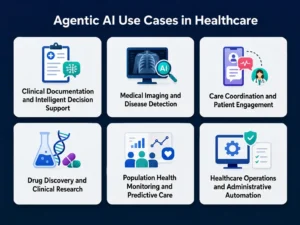
1. Clinical Documentation and Intelligent Decision Support
AI agents can capture doctor-patient conversations (with patient consent), generate structured clinical notes, update electronic health records (EHRs), and recommend relevant clinical guidelines based on patient history, lab results, and diagnostic data.
By reducing documentation time and surfacing critical insights, they allow clinicians to focus more on patient care while making informed decisions.
2. Medical Imaging and Disease Detection
Agentic AI enhances diagnostic accuracy by analyzing medical images such as X-rays, CT scans, MRIs, and pathology slides.
These systems can identify patterns associated with conditions like cancer, pneumonia, diabetic retinopathy, and neurological disorders, helping radiologists detect diseases earlier and prioritize urgent cases.
3. Care Coordination and Patient Engagement
AI agents streamline the entire patient journey by coordinating referrals, tracking lab results, scheduling follow-up appointments, and sending personalized medication or appointment reminders.
Virtual health assistants also provide 24/7 support by answering patient queries, conducting symptom assessments, and guiding patients to appropriate care, improving engagement and treatment adherence.
4. Drug Discovery and Clinical Research
Pharmaceutical companies and research organizations use AI agents to analyze biomedical data, identify promising drug candidates, predict molecular interactions, and optimize clinical trial recruitment.
By automating research-intensive tasks, agentic AI significantly accelerates drug discovery while reducing development costs.
5. Population Health Monitoring and Predictive Care
AI agents continuously analyze patient records, wearable device data, and clinical information to identify individuals at risk of chronic diseases or medical emergencies.
Early detection of conditions such as sepsis, heart failure, or kidney disease enables healthcare providers to intervene sooner, improving patient outcomes and reducing hospital admissions.
6. Healthcare Operations and Administrative Automation
Beyond clinical care, AI agents optimize hospital operations by automating medical coding, billing, insurance claims, prior authorizations, and appointment scheduling.
They also forecast patient demand, optimize staff allocation, and improve resource utilization, helping healthcare organizations reduce operational costs while delivering more efficient services.
Agentic AI Examples in Healthcare
Real organizations are already using AI agents to solve real problems. Here are a few examples that show what agentic AI applications look like in practice.
| Organization | Agentic AI Use Case | Result |
|---|---|---|
| Mayo Clinic | AI-assisted appointment scheduling | 25% drop in missed appointments |
| Kaiser Permanente | AI scribes for clinical notes | Less time on paperwork, more time with patients |
| Cleveland Clinic | AI command center for staffing and patient flow | Better real-time resource management |
| Duke Health | Sepsis Watch AI monitoring agent | Earlier detection of sepsis risk |
| Insilico Medicine | AI agents for drug molecule design | New drug candidate designed in 46 days |
Benefits of AI Agents in Healthcare
AI agents help healthcare organizations improve clinical efficiency, reduce operational costs, and deliver better patient experiences. Here are the key benefits:
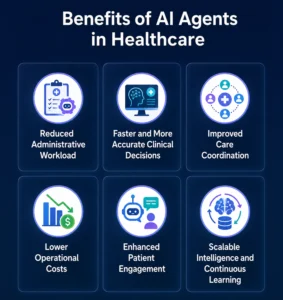
1. Reduced Administrative Workload
AI agents automate repetitive tasks such as clinical documentation, appointment scheduling, billing, and insurance processing. This minimizes administrative burden, allowing healthcare professionals to spend more time on patient care instead of paperwork.
2. Faster and More Accurate Clinical Decisions
By analyzing patient records, laboratory results, and medical images within seconds, AI agents help clinicians identify potential health risks earlier. Their ability to process large volumes of data supports quicker diagnoses while reducing the chances of overlooked findings.
3. Improved Care Coordination
AI agents continuously monitor patient journeys by tracking referrals, test results, treatment milestones, and follow-up appointments. This ensures smoother communication across care teams and helps prevent delays or missed interventions.
4. Lower Operational Costs
Automating administrative workflows reduces manual errors, claim rejections, duplicate work, and resource inefficiencies. Over time, this leads to lower operational expenses and improved financial performance for healthcare organizations.
5. Enhanced Patient Engagement
Virtual AI agents provide 24/7 support by answering common questions, scheduling appointments, sending medication reminders, and sharing personalized health information. Continuous engagement encourages better treatment adherence and improves the overall patient experience.
6. Scalable Intelligence and Continuous Learning
Unlike traditional software, AI agents can analyze millions of data points simultaneously and improve their performance through feedback and updated clinical knowledge. This enables healthcare providers to make more informed decisions as medical data continues to grow.
Challenges & Their Solutions of Implementing Agentic AI in Healthcare
While agentic AI delivers significant advantages, successful implementation requires addressing several technical, regulatory, and organizational challenges. Here’s how healthcare providers can overcome them.
1. Protecting Patient Data and Privacy
Challenge: AI agents process large volumes of sensitive patient information, making compliance with regulations such as HIPAA, GDPR, and other healthcare privacy standards essential.
Solution: Implement end-to-end encryption, strict access controls, anonymization techniques, and regular security audits. Healthcare organizations should also establish strong governance policies to ensure responsible AI usage.
2. Integrating with Existing Healthcare Systems
Challenge: Many hospitals still rely on legacy EHR platforms and disconnected software systems that make AI integration difficult.
Solution: Build AI agents using interoperable standards and APIs such as HL7 FHIR, enabling seamless communication with electronic health records, laboratory systems, and hospital management platforms.
3. Building Trust and Clinical Accountability
Challenge: Clinicians may hesitate to rely on AI recommendations if they cannot understand how decisions were made or who is responsible for the outcome.
Solution: Adopt explainable AI (XAI) models that provide transparent reasoning for recommendations while keeping healthcare professionals in control of all final clinical decisions.
4. Meeting Regulatory and Compliance Requirements
Challenge: AI systems used for diagnosis, treatment recommendations, or medical decision-making often require regulatory approval before deployment.
Solution: Involve compliance experts early in the development process, validate AI models through rigorous clinical testing, and maintain detailed documentation to support regulatory submissions.
5. Managing Implementation Costs and Workforce Adoption
Challenge: Deploying agentic AI requires investment in infrastructure, skilled talent, and organizational change, while healthcare staff may need time to adapt to new workflows.
Solution: Start with high-impact pilot projects that deliver measurable ROI, provide comprehensive staff training, and gradually expand AI adoption based on proven results and user feedback.
Implementing Agentic AI in Healthcare: A Step-by-Step Approach
Successful agentic AI in healthcare implementation requires a structured rollout rather than organization-wide deployment from day one. By starting with targeted use cases, validating performance, and expanding gradually, healthcare providers can reduce risks while maximizing ROI.
Here’s a practical step-by-step approach.
Step 1: Start with a High-Impact Use Case
Identify a workflow where AI can deliver measurable value quickly. Common starting points include clinical documentation, appointment scheduling, patient follow-ups, prior authorization, or claims processing. Focusing on a single problem makes it easier to evaluate results and gain stakeholder confidence.
Step 2: Assess Data Readiness
AI agents rely on high-quality, well-structured data to make accurate decisions. Review whether patient records, EHR data, imaging files, and operational data are complete, accessible, and compliant with healthcare privacy regulations before implementation begins.
Step 3: Choose the Right AI Integration Approach
Decide whether to build custom AI agents tailored to your organization’s workflows or adopt an existing AI integration platform that connects seamlessly with your Electronic Health Record (EHR) and other healthcare systems. The right approach depends on your budget, technical capabilities, and long-term scalability goals.
Step 4: Define Governance and Human Oversight
Establish clear rules for what AI agents can automate independently and where human approval is mandatory. Setting governance policies, audit trails, security controls, and escalation procedures helps ensure patient safety, regulatory compliance, and clinician trust.
Step 5: Launch a Pilot Program
Deploy the AI agent within a single department or workflow before expanding across the organization. Collect feedback from clinicians, administrators, and patients to identify usability issues, improve performance, and validate that the solution integrates smoothly into existing processes.
Step 6: Measure Performance and Scale Strategically
Track key performance indicators such as documentation time, diagnostic accuracy, claim processing speed, patient satisfaction, operational efficiency, and cost savings. Once the pilot demonstrates measurable success, gradually extend agentic AI to additional departments and use cases while continuously monitoring performance and refining the system.
Why Expert AI Development Matters
Implementing agentic AI in healthcare is not a plug-and-play job. It needs careful AI integration with EHR systems, strong data security, and software built to follow healthcare regulations. This is why most hospitals and clinics work with experienced healthcare software development services rather than building everything in-house from scratch.
Agentic AI Development Services for Healthcare Organizations
Building a reliable AI agent for healthcare takes more than a generic AI model. It needs custom AI development, secure data pipelines, and deep knowledge of clinical and administrative workflows.
Developer Bazaar Technologies offers Agentic AI Development Services built specifically for healthcare. Our team designs AI agents that handle real clinical and operational needs, including:
- Custom AI agents for clinical documentation, scheduling, and care coordination
- AI integration with existing EHR and hospital management systems
- Secure, HIPAA-aware healthcare software development services
- AI-powered patient engagement tools, including chatbots and virtual assistants
- End-to-end AI development, from strategy and pilot to full deployment
If your hospital, clinic, or health-tech company wants to explore how AI agents in healthcare can reduce administrative load and improve patient outcomes, Developer Bazaar Technologies can help design and build the right solution for your workflows.
Conclusion
AI agents are changing how healthcare gets done, from the exam room to the billing department. They take on routine, time-consuming tasks, support better decisions, and help care teams respond faster as conditions change. As more hospitals begin implementing agentic AI, the organizations that start with a clear plan, the right data, and a trusted AI development partner will see the biggest gains.
Ready to bring agentic AI into your healthcare organization? Developer Bazaar Technologies builds custom AI agents and healthcare software designed for real clinical and operational needs.
FAQ
1. Can AI agents integrate with legacy Electronic Health Record (EHR) systems?
Yes. Modern AI agents can integrate with legacy EHR platforms using APIs, middleware, and interoperability standards such as HL7 FHIR. The level of integration depends on the existing healthcare infrastructure and the availability of system interfaces.
2. How do AI agents reduce physician burnout in clinical practice?
AI agents automate time-consuming tasks like clinical documentation, chart reviews, coding assistance, and follow-up coordination. By reducing administrative workload, physicians can spend more time on patient care and less time on paperwork.
3. Can multiple AI agents work together within a hospital environment?
Yes. Healthcare organizations increasingly deploy multi-agent systems where specialized AI agents collaborate across workflows. For example, one agent can schedule appointments, another can monitor lab results, while a third manages billing or patient communication to streamline end-to-end operations.
4. What infrastructure is required to implement agentic AI in healthcare?
Organizations typically need secure cloud or hybrid infrastructure, access to high-quality healthcare data, EHR integration capabilities, robust cybersecurity measures, and governance frameworks to deploy AI agents successfully.
5. How is the performance of AI agents measured after deployment?
Healthcare providers evaluate AI agents using KPIs such as documentation time saved, claim processing accuracy, patient wait times, clinician productivity, operational cost reduction, and patient satisfaction scores.
6. Should healthcare organizations build custom AI agents or use pre-built AI platforms?
The choice depends on business requirements. Pre-built platforms enable faster deployment for common workflows, while custom AI agents provide greater flexibility, deeper EHR integration, and workflow-specific automation for organizations with unique clinical or operational needs.