

Key Takeaways:
- The online accommodation booking market is expanding rapidly, making this an ideal time to invest in a hotel booking app with long-term growth potential.
- Essential features such as real-time availability, secure payments, digital room keys, and loyalty programs are critical for delivering a seamless guest experience.
- AI-powered capabilities like personalized recommendations, dynamic pricing, chatbots, and predictive analytics help improve customer satisfaction while increasing bookings.
- Choosing a scalable tech stack, integrating travel APIs, and following a structured development process are key to building a reliable and future-ready platform.
- A hotel booking app can generate revenue through multiple channels, including booking commissions, premium memberships, featured listings, subscriptions, and affiliate partnerships.
- Partnering with an experienced hotel booking app development company ensures faster development, smooth third-party integrations, and ongoing support for long-term success.
Do you want to build an app like Hilton Honors? You are in the right place. In this guide, we will explain everything. We will cover what features you need, how to develop the app, how AI integration helps, and how much it costs.
The global hotel booking app market is expected to reach $25.3 billion by 2029. More and more people book hotels using their phones. If you build a great hotel booking app, you can earn a big share of this growing market!
What Is the Hilton Honors App?
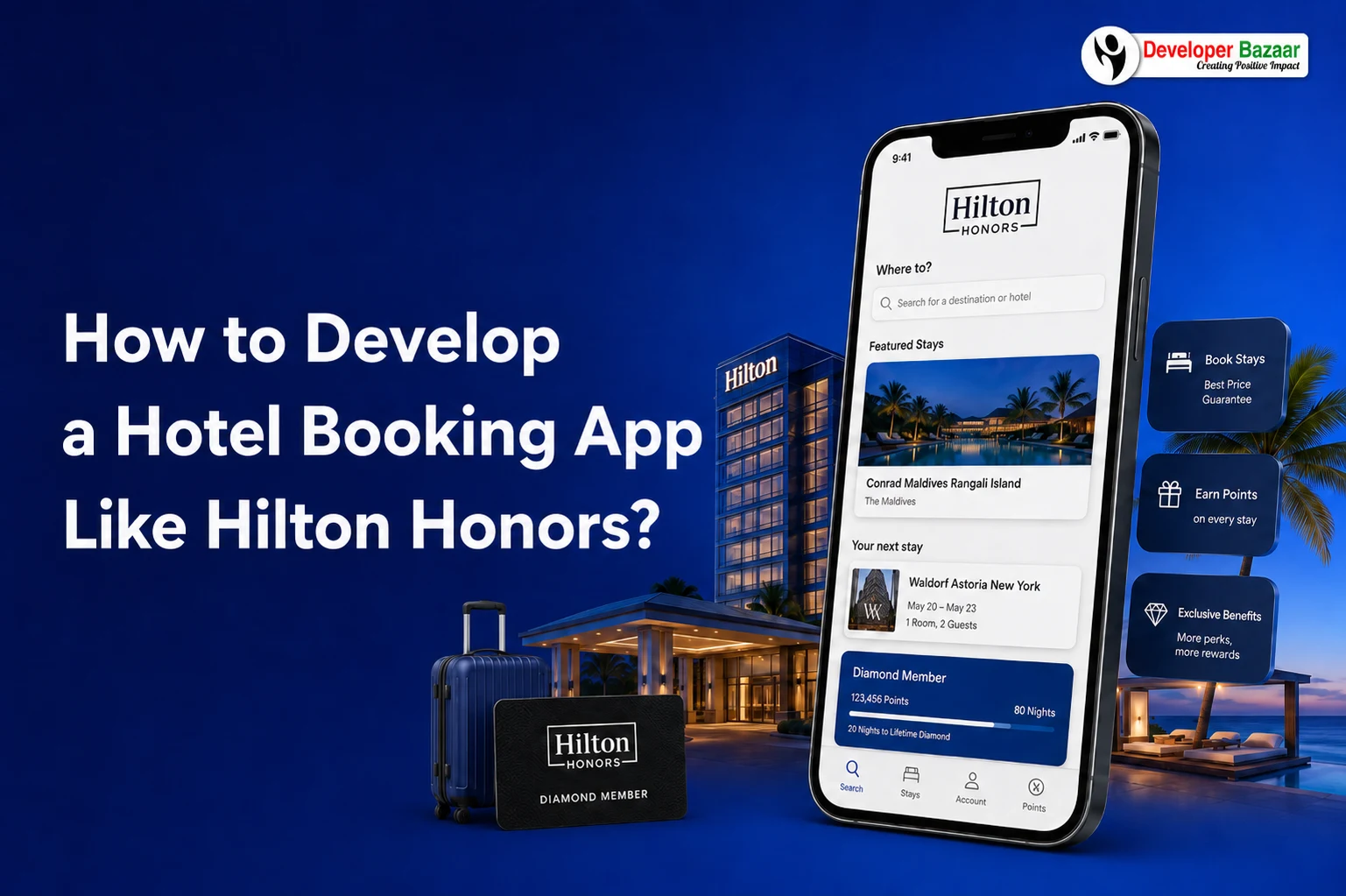
The Hilton Honors app is the official mobile application of Hilton Hotels, designed to make every stage of travel more convenient. From booking a stay to checking out, users can manage their entire hotel experience directly from their smartphones.
With the Hilton Honors app, users can:
- Search and book hotels in just a few taps
- Check in and check out without visiting the front desk
- Unlock their room using a secure digital key
- Earn, track, and redeem Hilton Honors reward points
- Communicate with hotel staff through in-app messaging
- Plan and manage travel, including hotel stays, flights, and car rentals
With more than 150 million downloads worldwide, the app has become one of the most popular hospitality apps. Its seamless user experience, loyalty rewards, and digital-first features have inspired many businesses to build apps similar to Hilton Honors for hotels, resorts, and travel brands.
Why Should You Build a Hotel Booking App?
Here are some strong reasons to build a hotel booking app right now:
The online accommodation booking industry is growing rapidly as travelers increasingly prefer booking hotels through mobile apps. Businesses that invest in a hotel booking app today can improve customer engagement, generate recurring revenue, and stay competitive in a digital-first market.
According to Fortune Business Insights, the global online accommodation booking market was valued at USD 365.50 billion in 2025, and the market is projected to grow to USD 391.85 billion in 2026. It is projected to reach USD 683.92 billion by 2034, growing at a CAGR of 7.21%. This steady growth creates a significant opportunity for businesses looking to launch a hotel booking app.
| Reason | Why It Matters |
| Expanding Market Opportunity | The global online accommodation booking market is expected to grow from USD 391.85 billion in 2026 to USD 683.92 billion by 2034, creating long-term growth opportunities for hotel booking platforms. |
| Mobile-First Consumer Behavior | Travelers now prefer booking accommodations through mobile apps because they offer convenience, faster reservations, real-time availability, and secure payments. |
| AI-Powered Personalization | Artificial intelligence and machine learning enable personalized hotel recommendations, dynamic pricing, smart search results, and AI-powered customer support, improving the overall booking experience. |
| Growing Demand for Digital Experiences | Modern users expect features like digital payments, instant confirmations, virtual property tours, and personalized travel recommendations, making feature-rich mobile apps essential. |
| Higher Customer Retention | Loyalty programs, exclusive in-app discounts, reward points, and personalized offers encourage repeat bookings and strengthen customer relationships. |
| Strong Revenue Potential | Hotel booking apps can generate revenue through booking commissions, premium memberships, featured property listings, travel partnerships, advertising, and value-added services. |
| Rising Demand for Alternative Stays | Beyond traditional hotels, users are increasingly booking vacation rentals, serviced apartments, and short-term stays, allowing businesses to serve multiple accommodation categories through a single platform. |
Key Features to Include When You Developing App Like Hilton Honors
A successful hotel booking app delivers a seamless experience for travelers while giving hotel owners complete control over bookings and operations.
To achieve this, your app should include user-centric features, a powerful admin dashboard, and AI-driven capabilities that improve personalization and operational efficiency.
Guest-Facing Features (User Panel)
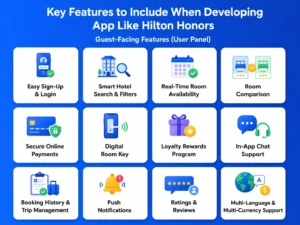
1. Easy Sign-Up & Login
Allow users to create an account using their email address, phone number, or social media accounts like Google and Facebook. A quick and secure onboarding process reduces friction and improves user retention.
2. Smart Hotel Search & Filters
Help users find the perfect accommodation by filtering hotels based on location, check-in/check-out dates, price, star ratings, amenities, guest reviews, and room type. Advanced filters make the booking process faster and more convenient.
3. Real-Time Room Availability
Display live room availability so users can instantly see which rooms are available for their selected dates. This minimizes booking conflicts and enhances user trust.
4. Room Comparison
Enable users to compare multiple rooms or hotels based on pricing, amenities, ratings, cancellation policies, and guest reviews. This helps travelers make informed booking decisions.
5. Secure Online Payments
Integrate multiple payment options, including credit/debit cards, UPI, digital wallets, net banking, and international payment gateways. Secure payment processing increases customer confidence and reduces abandoned bookings.
6. Digital Room Key
Provide guests with a secure digital key that allows them to unlock their hotel room using their smartphone. This eliminates the need for physical key cards and creates a contactless check-in experience.
7. Loyalty Rewards Program
Reward users with points for every booking, referral, or eligible purchase. Customers can redeem these points for discounts, complimentary stays, or exclusive member benefits, encouraging repeat bookings.
8. In-App Chat Support
Allow guests to communicate directly with hotel staff before, during, and after their stay. Instant messaging improves customer service by making it easy to request room service, ask questions, or resolve issues quickly.
9. Booking History & Trip Management
Give users access to all their previous and upcoming bookings in one place. They should also be able to modify reservations, cancel bookings, download invoices, and manage travel details effortlessly.
10. Push Notifications
Keep users informed with timely notifications about booking confirmations, check-in reminders, promotional offers, loyalty rewards, and important travel updates. Personalized notifications also help improve engagement.
11. Ratings & Reviews
Allow verified guests to leave ratings and detailed reviews after their stay. Authentic feedback builds trust and helps future travelers choose the right accommodation.
12. Multi-Language & Multi-Currency Support
Support multiple languages and currencies to serve international travelers. A localized user experience makes the app accessible to a global audience and improves booking conversions.
Hotel Owner / Admin Panel Features
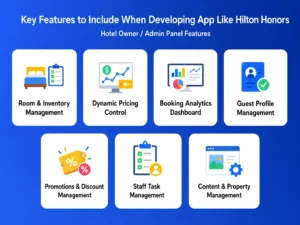
1. Room & Inventory Management
Allow hotel managers to add, edit, or remove rooms, update room availability, and manage inventory in real time. This prevents overbooking and simplifies property management.
2. Dynamic Pricing Control
Enable administrators to adjust room prices based on seasonal demand, occupancy rates, local events, and competitor pricing. Flexible pricing strategies help maximize revenue.
3. Booking Analytics Dashboard
Provide a centralized dashboard with insights into daily bookings, occupancy rates, revenue trends, cancellations, and customer behavior. These analytics support better business decisions.
4. Guest Profile Management
Store guest preferences, booking history, and loyalty information in a centralized system. Hotel staff can use this data to deliver personalized experiences and improve customer satisfaction.
5. Promotions & Discount Management
Allow administrators to create promotional campaigns, coupon codes, seasonal discounts, and exclusive member offers. These marketing tools help increase bookings during off-peak periods.
6. Staff Task Management
Assign housekeeping, maintenance, room service, and front-desk tasks through the admin panel. Real-time task tracking improves operational efficiency and guest service quality.
7. Content & Property Management
Enable hotels to update room descriptions, amenities, pricing, images, policies, and promotional content without requiring technical assistance. This keeps listings accurate and engaging.
AI-Powered Features That Make Your Hotel Booking App Stand Out
AI App Development makes hotel booking apps smarter. AI learns from user behavior and gives personalized suggestions. This increases bookings and keeps users coming back.
1. AI Chatbot
Offer instant customer support around the clock through an intelligent chatbot. It can answer frequently asked questions, assist with bookings, recommend hotels, and resolve common issues without human intervention.
2. Smart Room Recommendations
Analyze user preferences, previous bookings, search history, and travel behavior to recommend the most relevant rooms and hotels. Personalized recommendations improve user engagement and increase booking rates.
3. AI-Powered Dynamic Pricing
Use machine learning algorithms to automatically adjust room prices based on demand, occupancy, local events, competitor pricing, and seasonal trends. This helps maximize hotel revenue while remaining competitive.
4. Sentiment Analysis
Analyze guest reviews, feedback, and ratings using natural language processing (NLP). The system can identify recurring complaints or positive experiences, enabling hotel managers to improve service quality proactively.
5. Fraud Detection & Secure Payments
Monitor payment transactions in real time to identify suspicious activity, fake bookings, chargeback fraud, or unusual user behavior. AI enhances payment security and reduces financial risks.
6. Voice Search & Voice Booking
Allow users to search for hotels, check availability, or complete bookings using voice commands. Voice-enabled interactions make the app more accessible and convenient for travelers.
7. Predictive Analytics
Leverage historical booking data and market trends to forecast peak travel seasons, occupancy rates, and customer demand. Hotels can use these insights for better staffing, inventory planning, and marketing campaigns.
8. Personalized Offers & Promotions
AI can automatically generate customized discounts, loyalty rewards, and promotional campaigns based on user preferences and booking behavior. Personalized offers improve customer retention and encourage repeat bookings.
Steps to Develop a Hotel Booking App Like Hilton Honors
Building a hotel booking app involves careful planning, market research, user-focused design, development and continuous improvements.
Here’s a step-by-step guide to developing a hotel booking app like Hilton Honors.
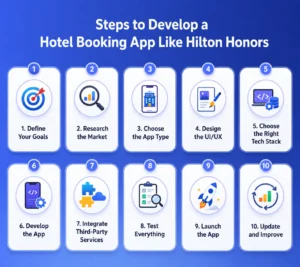
Step 1 – Define Your Goals
First, ask yourself: What do I want my app to do? Who is my target user? Which hotels will use my app? Write down all your goals clearly.
Step 2 – Research the Market
Study apps like Hilton Honors, Marriott Bonvoy, IHG One Rewards, and Booking.com. See what features they have. Find what is missing in those apps. That missing thing is your chance to be different and better.
Step 3 – Choose the App Type
Select the development approach based on your budget, timeline, and business goals.
| App Type | Best For |
| Native App | Separate apps for iOS and Android that deliver the best performance and user experience but require a larger development budget. |
| Cross-Platform App | A single codebase using Flutter or React Native that reduces development time and cost while supporting both platforms. |
| Progressive Web App (PWA) | A browser-based solution that works without installation, making it ideal for startups and businesses testing the market. |
For most businesses, cross-platform development offers the best balance between performance, scalability, and development cost.
Step 4 – Design the UI/UX
Design means how the app looks and feels. Keep it simple and clean. Users should be able to search and book a hotel in less than 3 minutes. Use big buttons, clear fonts, and bright images of rooms.
Step 5 – Choose the Right Tech Stack
Choosing the right technology stack ensures your app remains secure, scalable, and capable of handling thousands of bookings simultaneously.
| Component | Recommended Technologies | Purpose |
| Frontend | Flutter, React Native | Build cross-platform mobile apps for Android and iOS. |
| Backend | Node.js, Python, Ruby on Rails | Handle business logic, APIs, bookings, and user management. |
| Database | PostgreSQL, MongoDB | Store user profiles, hotel listings, reservations, and transactions. |
| Cloud Hosting | AWS, Google Cloud, Microsoft Azure | Provide scalable infrastructure with high availability. |
| Payment Gateway | Stripe, Razorpay, PayPal | Enable secure online payment processing. |
| AI & Machine Learning | TensorFlow, OpenAI API | Power chatbots, personalized recommendations, and dynamic pricing. |
| Push Notifications | Firebase Cloud Messaging (FCM) | Deliver booking confirmations, offers, and travel updates. |
| Maps & Location | Google Maps API | Display hotel locations, directions, and nearby attractions. |
Step 6 – Develop the App
Once planning and design are complete, the development phase begins. Most experienced development teams follow an Agile methodology, building the application in short sprints that allow continuous testing, faster feedback, and regular feature releases.
A typical development team includes:
- Project Manager to oversee timelines and delivery.
- UI/UX Designer to create user-friendly interfaces.
- Frontend Developers to build the mobile application.
- Backend Developers to develop APIs, databases, and server-side functionality.
- AI/ML Engineers to implement intelligent features.
- QA Engineers to test functionality and eliminate bugs.
- DevOps Engineers to manage deployment, cloud infrastructure, and system reliability.
Step 7 – Integrate Third-Party Services
Modern hotel booking apps rely on multiple third-party integrations to deliver a complete travel experience. These services improve functionality while reducing development time.
Common integrations include:
- Google Maps API for hotel locations and navigation.
- Stripe, Razorpay, or PayPal for secure online payments.
- Firebase Cloud Messaging or Twilio for notifications and SMS verification.
- OpenAI API for AI chatbots and personalized travel recommendations.
- Global Distribution Systems (GDS) for accessing hotel inventory across multiple providers.
- Travel APIs such as Amadeus or Sabre for flights, car rentals, and travel packages.
Step 8 – Test Everything
Before launching, thoroughly test every aspect of the application to ensure a seamless user experience. Testing helps identify bugs, improve security, and verify that the app performs reliably across different devices and operating systems.
Your QA process should include:
- Functional Testing to validate every feature.
- Performance Testing to evaluate speed and scalability.
- Security Testing to protect user accounts and payment information.
- Usability Testing to ensure the interface is intuitive.
- Cross-Platform Testing to verify compatibility across Android, iOS, tablets, and different screen sizes.
Step 9 – Launch the App
After testing, submit the app to Google Play Store and Apple App Store. Make sure your app listing has a great description, screenshots, and keywords. This helps users find your app easily in search results.
Step 10 – Update and Improve
Launching the app is not the end. Keep listening to user feedback. Fix bugs quickly. Add new features. Use analytics to see which parts of the app users love the most.
How AI Integration Transforms Hotel Booking Apps
By integrating AI, businesses can increase bookings, improve customer satisfaction, and stay ahead of the competition.
Here are the key ways AI makes a hotel booking app smarter:
| AI Feature | What It Does | Benefit |
| AI Chatbot | Answers guest questions instantly | 24/7 support, no human agents needed |
| Smart Recommendations | Suggests best rooms based on past choices | Personalized experience, more bookings |
| Dynamic Pricing | Changes room rates based on demand | Hotels earn more, users get fair prices |
| Voice Search | Users speak to search for hotels | Faster, easier user experience |
| Fraud Detection | Spots fake payments and scammers | Safer transactions for everyone |
| Predictive Analytics | Predicts peak travel seasons | Hotels prepare staff & rooms in advance |
| Sentiment Analysis | Reads reviews to find real problems | Hotels fix issues before they grow |
Cost to Develop an App Like Hilton Honors
The cost to develop an app like Hilton Honors depends on many things, how many features you want, which team you hire, and where the team is located.
| App Type | Estimated Cost (USD) | What’s Included |
| Basic App | $15,000 – $30,000 | Simple search, booking, and payments |
| Medium App | $30,000 – $80,000 | All key features + loyalty program + admin panel |
| Advanced App (Like Hilton Honors) | $80,000 – $200,000+ | AI integration, multi-property, GDS, full analytics |
How to Monetize Your Hotel Booking App?
A hotel booking app can generate revenue through multiple business models. Combining several monetization strategies helps maximize profitability while delivering value to both users and hotel partners.
- Commission on Bookings: Charge hotels a commission on every successful booking made through your platform. This is one of the most common and scalable revenue models.
- Subscription Plans: Offer monthly or annual subscription packages that provide hotels with premium tools, analytics, and increased platform visibility.
- Featured Hotel Listings: Allow hotels to pay for sponsored placements at the top of search results, helping them attract more bookings.
- In-App Advertising: Generate additional revenue by displaying relevant ads from airlines, travel agencies, car rental providers, and local tourism businesses.
- Premium Memberships: Introduce a paid membership program that offers users exclusive discounts, faster check-ins, loyalty rewards, and early access to special deals.
- Affiliate Partnerships: Partner with travel service providers to earn referral commissions on flight bookings, car rentals, travel insurance, tours, and other complementary services.
Top Hotel Booking Apps That Inspire Businesses
| App Name | Key Features | Type |
| Hilton Honors | Digital key, loyalty points, AI chat, mobile check-in | Hilton Hotels brand app |
| Marriott Bonvoy | Room upgrades, points, partner airlines rewards | Marriott brand app |
| Booking.com | Huge inventory, Genius rewards, price comparison | Third-party OTA platform |
| Airbnb | Unique stays, experiences, host-guest chat | Peer-to-peer booking |
| Hotels.com | Collect 10 nights, get 1 free rewards | OTA with loyalty twist |
| IHG One Rewards | Points pooling, milestone bonuses | IHG brand app |
Why Choose Developer Bazaar Technologies for Hotel Booking App Development?
If you want to build an app like Hilton Honors, you need an expert mobile app development company that understands both technology and the travel industry.
Developer Bazaar Technologies is a leading hotel booking app development services provider with expertise in:
- Custom Hotel Booking App Development for iOS, Android, and the web
- AI Integration for chatbots, personalized recommendations, and dynamic pricing
- Loyalty Program Development to increase customer retention
- GDS & Travel API Integration for real-time hotel inventory and bookings
- Secure Payment Gateway Integration with multiple payment options
- Cloud Deployment & Ongoing Support for scalability, performance, and maintenance
Final Thoughts
Building a hotel booking app like Hilton Honors is a big opportunity. The travel industry is growing fast, and mobile apps are the main way people book hotels today.
To develop a hotel booking app like Hilton Honors, you need:
- A clear set of features (search, booking, digital key, loyalty rewards)
- The right tech stack (Flutter, Node.js, AWS, AI tools)
- Smart AI integration for chatbots, pricing, and personalization
- A trusted mobile app development company with proven experience
- clear monetization plan to earn money from day one
Whether you want to create an app like Hilton Honors for a global hotel chain or a single boutique hotel, the process is the same. Start small, build smart, and keep improving.
FAQs
Q1. How long does it take to develop a hotel booking app like Hilton Honors?
A basic hotel booking app takes about 3 to 6 months to develop. A full-featured app with AI integration, loyalty programs, and GDS connectivity can take 9 to 18 months.
Q2. What is the cost to develop an app like Hilton Honors?
The cost to develop an app like Hilton Honors ranges from $15,000 for a basic app to $200,000+ for an advanced app with AI, multi-property management, and global GDS integration.
Q3. Which company offers the best hotel booking app development services?
Developer Bazaar Technologies is one of the top companies offering hotel booking app development services with AI integration, GDS connectivity, loyalty program development, and post-launch support at competitive pricing.
Q4. How does AI App Development help hotel apps make more money?
AI App Development helps hotel booking apps earn more by using dynamic pricing (charging more during peak season), showing personalized upsells (room upgrades, spa packages), and reducing customer support costs through AI chatbots.
Q5. How can a hotel booking app prevent overbooking across multiple properties?
A hotel booking app can prevent overbooking by integrating with a centralized Property Management System (PMS) or Global Distribution System (GDS) that synchronizes room inventory across all booking channels in real time.
Q6. What compliance standards should a hotel booking app follow?
A hotel booking app should comply with standards such as PCI DSS for secure payment processing, GDPR or local data privacy regulations for user information, and accessibility guidelines to ensure the app is usable for all travelers.
Q7. What analytics should hotel owners track after launching the app?
Hotel owners should monitor booking conversion rates, occupancy levels, cancellation rates, average booking value, customer retention, app engagement, revenue per available room (RevPAR), and AI recommendation performance to optimize both marketing and operations.