
Many businesses want to use Artificial Intelligence (AI). But approaching a full AI project directly can be risky and expensive. In this situation, an AI Proof of Concept (PoC) helps.
An AI PoC is a small test. It checks if your idea can work in the real world. It answers one important question: “Will this AI solution actually solve our problem?”
In this guide, you will learn how to build a successful AI PoC step by step, using a simple process.
Why Should Businesses Begin With a PoC Before Investing in Full-Scale AI Projects?
Without proper validation, companies risk building something that does not work or fails to deliver real value.
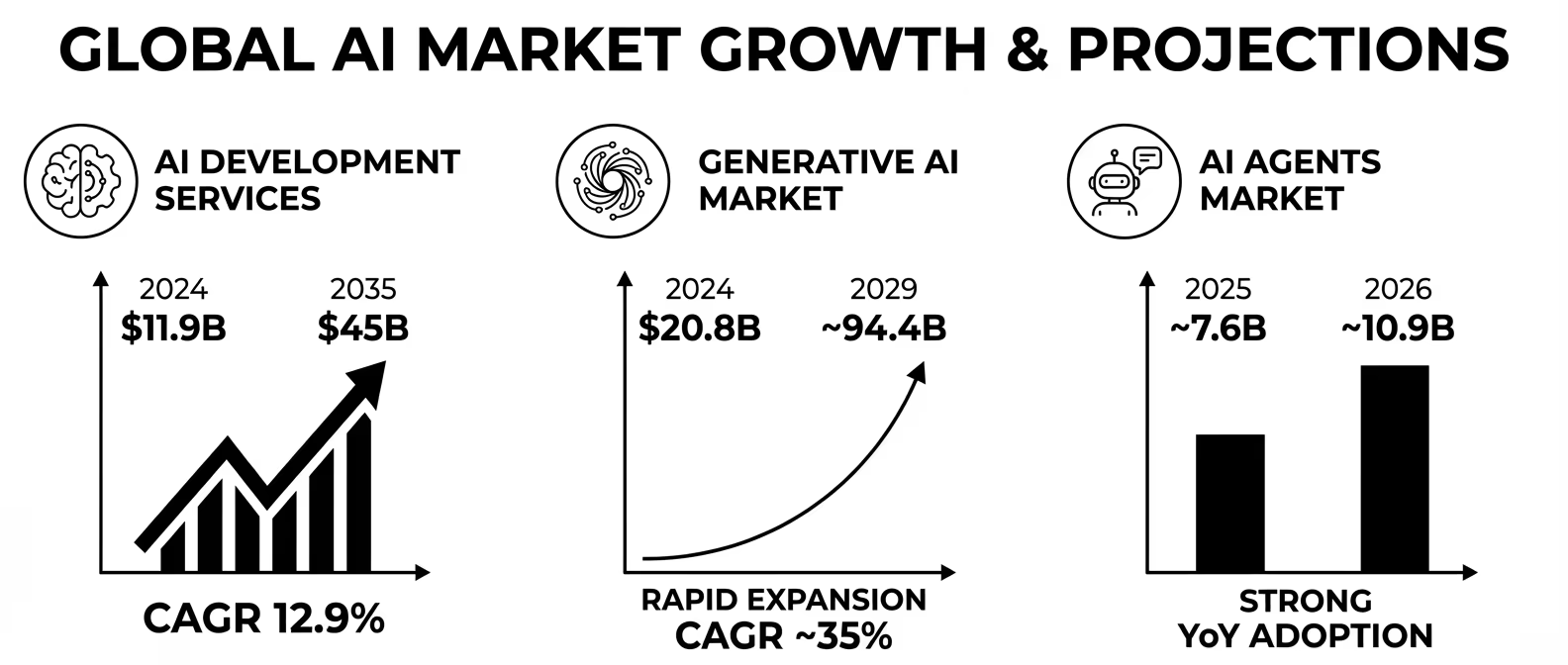
Recent research highlights why this is critical. While AI adoption has become mainstream, with 88% of organizations using AI in at least one business function. The journey from idea to impact is far from guaranteed.
In fact, around 70-85% of GenAI deployment efforts fail to achieve the expected ROI. Even more striking, only about 7% of organizations have successfully scaled AI across their entire enterprise, leaving many stuck in what experts call “pilot purgatory.”
This is where a Proof of Concept (PoC) becomes essential.
A PoC helps reduce risk by allowing businesses to test their ideas on a small scale, assess feasibility, and measure real-world impact. Instead of relying on assumptions, organizations can make informed decisions backed by actual data and performance insights.
Below are the key reasons starting with a PoC is both smart and necessary.
1. It Reduces Risk
Building a full AI system requires a big investment of time, money, and resources. If the idea fails at a later stage, the losses can be high.
A PoC works as a safety check. It tests the idea in a controlled and smaller environment. If the results are not good, the business can stop early without major losses. This approach protects the company from investing heavily in unproven ideas.
2. It Checks Feasibility
Not every AI idea is practical. Some ideas may sound good, but may not work due to technical limitations.
A PoC helps businesses check whether:
- Their existing data is useful
- Their systems can support AI integration
- The required tools and technologies are available
It answers an important question: “Can we actually build this solution with what we have?”
This step makes sure that businesses do not move forward with unrealistic expectations.
3. It Proves Real Value
AI should solve real business problems, and looks impressive. A PoC shows whether the solution can deliver actual benefits, such as:
- Saving time by automating tasks
- Reducing operational costs
- Improving decision-making with better insights
Instead of relying on theoretical benefits, businesses get clear evidence of value. This makes it easier to justify further investment.
4. It Helps Get Funding
Many government programs, innovation funds, and investors require proof before supporting a project. They want to see that the idea works in practice.
A PoC provides this proof. It shows:
- Initial results
- Technical feasibility
- Potential business impact
With this evidence, businesses can:
- Apply for funding
- Attract investors
- Justify budgets internally
This increases the chances of securing financial support for larger AI projects.
5. It Finds Problems Early
Every AI project faces challenges. If these issues are discovered too late, they can delay or even stop the project.
A PoC helps identify problems at an early stage, such as:
- Poor-quality or insufficient data
- System or infrastructure limitations
- Resistance from users or stakeholders
By discovering these issues early, businesses can fix them before moving to full-scale development. This saves both time and effort.
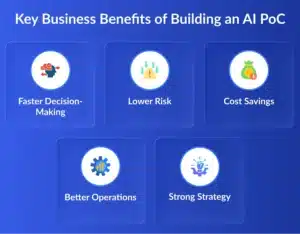
What Are the Key Business Benefits of Building an AI PoC?
An AI Proof of Concept (PoC) is a small experiment and it is a powerful tool for making better business decisions. Instead of jumping into full development, a PoC helps organizations test ideas in a controlled way and understand their real impact.
It delivers quick insights while also shaping long-term strategy. From saving money to improving operations, an AI PoC helps businesses move forward with clarity and confidence.
Below are the key benefits explained in detail.
1. Faster Decision-Making
An AI PoC allows teams to test ideas quickly without waiting for full development. This means businesses can see early results and understand what works and what does not. Instead of long planning cycles, teams get real data in a short time. This helps leaders make faster and more confident decisions based on evidence rather than assumptions.
2. Lower Risk
AI projects can be complex and expensive. Without proper testing, there is always a risk of failure. A PoC reduces this risk by validating the idea at an early stage. It checks whether the solution is technically possible and useful for the business. If the idea does not work, the company can stop early and avoid major losses.
3. Cost Savings
Developing a full AI solution requires a large investment. If the idea fails, the cost can be very high. With a PoC, businesses spend a smaller amount to test the idea first. This helps avoid wasting money on solutions that are not practical or valuable. It ensures that only the most promising ideas receive further investment.
4. Better Operations
A PoC helps businesses understand how AI can improve their daily operations. It shows where tasks can be automated and where processes can be made faster or more efficient. By testing real workflows, organizations can identify gaps and opportunities for improvement. This leads to smoother operations and better use of resources.
5. Strong Strategy
The results of a PoC provide clear direction for future steps. Leaders can see what is working and what needs improvement.
This helps in deciding:
- Which projects to scale
- Where to invest resources
- Which ideas to drop
With these insights, businesses can build a strong and focused AI strategy that aligns with their goals.
What Kind of Data is Required to Build a Reliable AI PoC?
The success of an AI Proof of Concept (PoC) depends mainly on the quality, relevance, and representativeness of the data used. High-quality data helps the AI model perform accurately, while relevant data makes sure that the results actually solve the business problem. If the data is not reliable or does not match the use case, the PoC will not deliver meaningful outcomes.
AI solutions work with different types of data depending on the problem they are trying to solve. That is why it is important to clearly understand the difference between structured and unstructured data when planning a PoC.
Structured Data: It refers to organised data that follows a fixed format, such as numerical logs, tables, or transactional records. This type of data is easy to process and is commonly used for tasks like forecasting, predictive analytics, and business optimisation. It helps in identifying patterns in numbers and trends over time.
Unstructured Data: It includes information that does not follow a fixed format, such as text, images, audio, or video. This type of data is more complex and is used in advanced AI applications like natural language processing, computer vision, and speech recognition. It helps machines understand human language, visuals, and sounds.
The dataset used in a PoC must also be large enough to uncover meaningful patterns. At the same time, it should represent real-world conditions accurately so that the model performs well not only during testing but also in actual use. If the data is too limited or unrealistic, the results of the PoC may not be dependable.
Finally, data must be properly prepared before it is used. This process includes cleaning the data to remove errors, labelling it for training, and normalising it to maintain consistency. These preprocessing steps are essential for the AI model to produce reliable and actionable results that can support business decisions and future AI adoption.
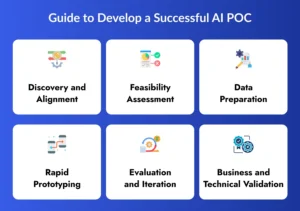
Step-by-Step Guide to Develop a Successful AI POC
Building a successful AI Proof of Concept (PoC) is to solve one clear problem. Each step in the process helps reduce uncertainty and makes sure that the final outcome is useful for the business.
Below is a clear step-by-step guide to help you build a strong AI PoC.
Step 1: Discovery and Alignment
This step focuses on clearly understanding the real problem you want to solve. Instead of starting development, teams should first identify the main challenge and define what success looks like. Asking the right questions helps bring clarity and direction to the project.
It is important to set one clear goal, such as automating a process or improving predictions. Along with this, teams should also agree on the budget, timeline, and expected outcomes. This ensures that everyone involved is aligned and working towards the same objective.
Step 2: Feasibility Assessment
In this step, the goal is to check whether your idea can actually work within your current setup. This includes reviewing your data, systems, and workflows to see if they can support the AI solution.
Teams should evaluate whether the required data is available, whether systems can integrate smoothly, and whether the solution fits existing processes. This step helps identify limitations early and avoids unexpected issues during development.
Step 3: Data Preparation
Data preparation is one of the most important steps in building an AI PoC. Raw data is often messy and cannot be used directly, so it must be cleaned and organised properly.
This includes removing errors and duplicates, standardising formats, and labelling data when needed. In some cases, adding extra data can also improve results. Proper data preparation helps that the AI model performs accurately and delivers reliable outputs.
Step 4: Rapid Prototyping
This step involves building a simple and functional version of the AI solution. The focus is on testing the core idea, not creating a complete product.
Teams select the right model, train it using prepared data, and create a basic interface or system for testing. Keeping the prototype simple allows faster development and easier changes. The goal is to quickly validate whether the idea works.
Step 5: Evaluation and Iteration
Once the prototype is ready, it must be tested carefully. This step checks how well the model performs based on factors like accuracy, speed, and reliability.
Using real-world data for testing is important to ensure realistic results. Feedback from users and stakeholders should also be collected. Based on this feedback, the model is improved step by step until it delivers useful and consistent results.
Step 6: Business and Technical Validation
This is the final step where teams decide the future of the AI project. The focus is on evaluating both technical performance and business value.
Key questions are answered, such as whether the PoC solved the problem, whether it is useful for the business, and whether it can be scaled. Based on the results, teams prepare a decision report, estimate costs, and create a roadmap for the next phase. This step is for clear and confident decision-making.
What Mistakes Must You Avoid When Creating an AI PoC?
Even well-planned AI PoCs can fail if common mistakes are ignored. Many organizations focus too much on technology and overlook basic planning and business alignment.
Avoiding these mistakes helps save time, reduce costs, and improve the chances of success. Below are the most common pitfalls and why they should be avoided.
1. Unclear Goals
Starting a PoC without a clear objective leads to confusion and poor results. If the problem is not well-defined, the team may build something that does not solve any real issue.
A clear goal helps guide the entire process and ensures that the outcome is meaningful. Without it, the PoC may become a technical experiment with no business value.
2. Poor Data Quality
Data is the foundation of any AI system. If the data is inaccurate, incomplete, or inconsistent, the results will also be unreliable.
Poor data quality can lead to wrong predictions and weak performance. This not only affects the PoC but also reduces trust in the AI solution. Cear and high-quality data is essential for success.
3. No Stakeholder Involvement
An AI PoC should not be built only by technical teams. Business leaders, domain experts, and end-users must be involved in the process.
Without their input, the solution may not meet real business needs. Stakeholder involvement for the PoC is practical, usable, and aligned with organizational goals.
4. Too Much Complexity
Trying to solve a large and complex problem in the PoC stage can slow down progress. It makes development harder and delays results.
It is better to start with a small and manageable problem. This allows teams to learn quickly and show early results. Complexity can always be added later during scaling.
5. Ignoring Real-World Use
A model may perform well in testing but fail in real-life situations. This happens when the PoC does not consider real-world conditions.
Testing with realistic data and actual user scenarios is important. This ensures that the solution works outside the lab and delivers practical value to the business.

Conclusion
An AI Proof of Concept (PoC) is the smartest way to begin your AI journey. It helps businesses test ideas, reduce risks, and understand real value before making large investments. Instead of building blindly, a PoC gives you clear, data-backed answers.
By focusing on the right problem, using quality data, and following a structured approach, organizations can turn simple ideas into powerful AI solutions. A well-executed PoC not only proves feasibility but also builds confidence for scaling AI across the business.
FAQs
1. How do I choose the right use case for an AI PoC?
Start with a problem that is clear, measurable, and has a direct impact on your business. Focus on areas where AI can save time, reduce costs, or improve decision-making. Avoid complex problems in the beginning and choose something that can show quick results.
2. Do I need a large team to build an AI PoC?
No, you do not need a large team. A small group with the right mix of skills, such as data experts, developers, and business stakeholders, is enough. The goal is to move fast and test ideas, not to build a full-scale system.
3. How do I measure the success of an AI PoC?
Success depends on both technical and business outcomes. You can measure it using metrics like accuracy, speed, and performance, along with business impact such as time saved or cost reduced. Clear success criteria should be defined at the start.
4. Can an AI PoC be reused for future development?
Yes, a well-built PoC can act as a foundation for future projects. The learnings, models, and data pipelines can be improved and scaled into a full product. It reduces effort when moving to the next stage.
5. What tools or technologies are needed to build an AI PoC?
The tools depend on your use case, but common ones include machine learning frameworks, data processing tools, and cloud platforms. Many open-source and pre-built tools are available, making it easier to start without a heavy investment.
6. How do I handle data privacy and security in an AI PoC?
Even in a PoC stage, data privacy is very important. Use secure systems, follow compliance rules, and avoid using sensitive data without proper protection. This ensures trust and reduces risks when scaling the solution.