

Accounting firms handle a huge number of client documents every day, including receipts, invoices, bank statements, tax files, and more. Managing all of this manually takes time and often leads to errors.
An AI Agent in Accounting is a smart software tool that can automatically organize, read, and process these documents. It helps accounting firms reduce manual work, improve accuracy, and save time.
In this blog, you will learn how Agentic AI in Accounting works, how to build one, and why it is becoming essential for modern accounting firms.
AI in the Accounting Market Growth
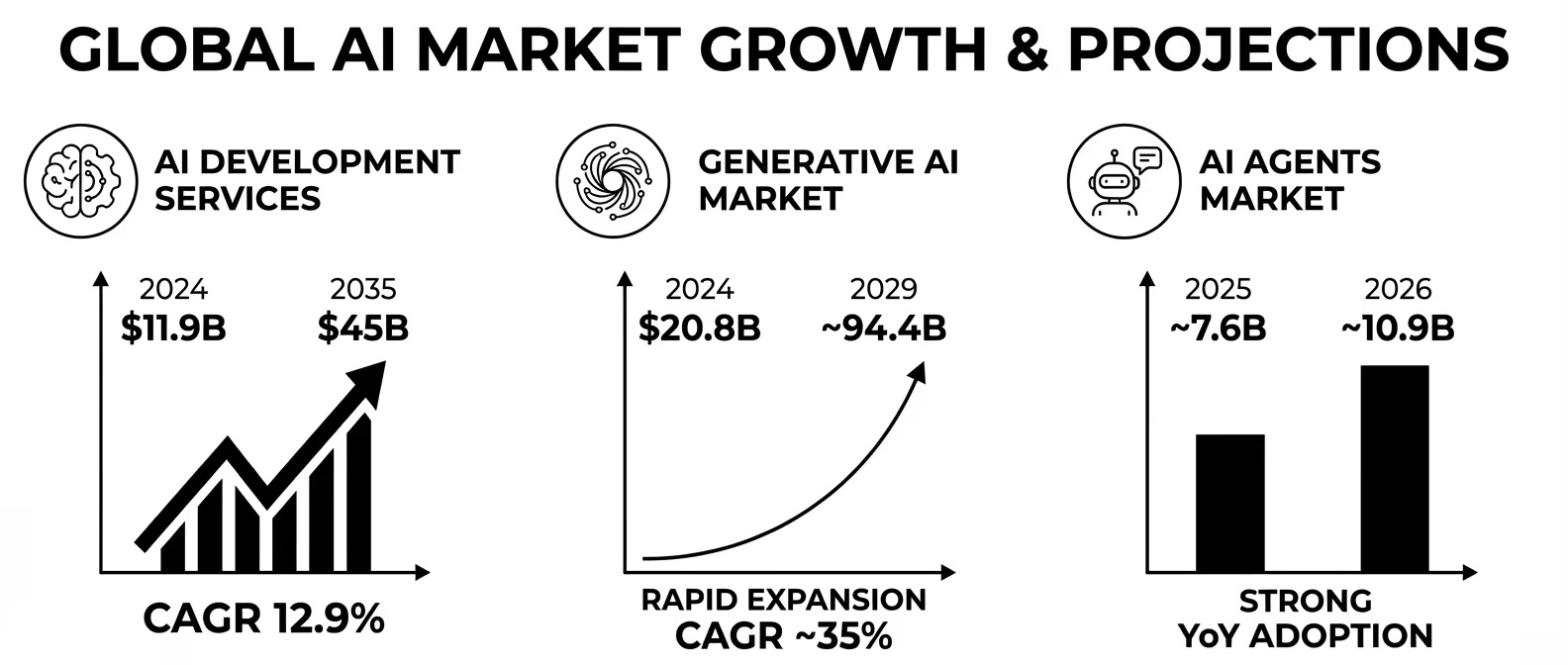
The adoption of AI in accounting is growing very rapidly. According to Mordor Intelligence, the market is expected to reach USD 10.87 billion in 2026, up from USD 7.52 billion in 2025, and is projected to grow to USD 68.75 billion by 2031 with a strong CAGR of 44.6%.
This rapid growth is driven by new technologies like generative AI, increasing digital rules for invoicing and tax systems, and the shift to cloud-based platforms. Tools powered by AI—such as OCR and advanced language models, can now convert receipts and invoices into structured data automatically.
As a result, accounting firms can complete tasks like month-end closing much faster. At the same time, AI is helping businesses move away from manual data entry and focus more on analysis, decision-making, and financial strategy.
What Makes AI Agents Different from Traditional Accounting Software?
Traditional accounting tools like QuickBooks or Xero work only when you give commands. You upload files, enter data, and click buttons to generate reports. These tools are helpful but depend heavily on human effort.
An AI Agent in an accounting firm works differently. It does not wait for instructions. Instead, it:
- Watches incoming data (emails, uploads, systems)
- Understands documents
- Takes action automatically
For example, when a client sends receipts:
- Traditional software – You upload and categorize manually
- AI agent – Reads the receipt, categorizes it, updates records, and notifies your team
This shift from manual work to smart automation is what makes Agentic AI in accounting powerful.
How AI Agents Work in Accounting Operations?
AI agents use smart technologies to handle accounting tasks simply and efficiently. Instead of relying on manual effort, they automate processes, reduce errors, and save time. Here’s how they work:
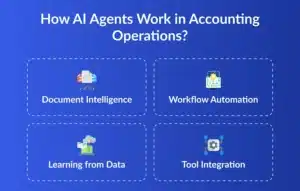
1. Document Intelligence
AI agents can read and understand documents almost like humans. They extract important details such as date, amount, and vendor from receipts, invoices, and statements. Beyond just reading, they also understand the data’s meaning and categorize it correctly, for example, automatically marking a fuel receipt as a fuel expense.
2. Workflow Automation
AI agents manage tasks step-by-step without human intervention. They check whether all required documents are submitted, update accounting systems, assign tasks to the right team members, and even send reminders. This keeps the entire workflow organized and makes sure nothing is missed.
3. Learning from Data
AI agents improve over time by learning from past data and patterns. They understand how your firm works, follow previous transaction behaviors, and adapt to your processes. This continuous learning helps increase accuracy and makes building an agentic AI system more valuable in the long run.
4. Tool Integration
AI agents easily connect with different tools like accounting software, tax platforms, and CRM systems. They automatically move data between these systems, reducing the need for manual entry. This creates a smooth and connected workflow across all tools used by the firm.
Key Types of AI Agents for Accounting Firms
Different AI agents are designed to handle specific tasks within an accounting firm. Each type plays an important role in improving efficiency and productivity.
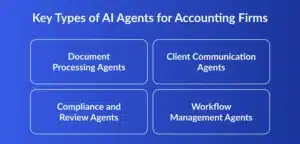
1. Document Processing Agents
Document processing agents focus on handling large volumes of documents such as receipts, invoices, and financial statements. They extract relevant data, organize it properly, and update accounting systems automatically. These agents form the backbone of any AI agent in an accounting firm by reducing manual data entry work.
2. Client Communication Agents
Client communication agents help manage regular interactions with clients. They send reminders for document submissions, answer basic queries, and provide timely updates. This not only saves time for the team but also improves the overall client experience.
3. Compliance and Review Agents
Compliance and review agents for all accounting work follows the latest tax rules and regulations. They identify errors, flag risks, and highlight important issues that need attention. These agents help firms maintain accuracy and avoid costly mistakes.
4. Workflow Management Agents
Workflow management agents are responsible for organizing tasks and tracking progress. They monitor deadlines, assign work to team members, and balance workloads efficiently. This helps in smooth operations, especially during busy periods like tax season.
How To Build An AI Agent for Accounting Firms?
If you want to build an AI Agent for accounting, you need a clear and structured approach. Below is a simple step-by-step process to help you create a smart and effective solution for your firm.
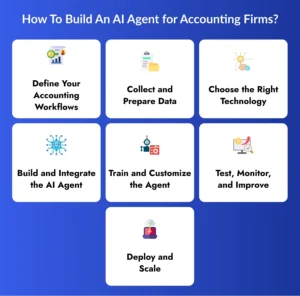
Step 1: Define Your Accounting Workflows
Start by identifying what tasks you want the AI agent to handle. This can include organizing client documents, automating bookkeeping, managing invoices, or handling client communication. Clearly defining these workflows helps you set the right goals and makes sure your AI agent solves real problems in your accounting firm.
Step 2: Collect and Prepare Data
AI agents need data to work properly. Gather both structured data (like transaction records and balance sheets) and unstructured data (like emails, scanned documents, and receipts). Clean and organize this data so the AI can understand it easily and deliver accurate results.
Step 3: Choose the Right Technology
Select the right tools and technologies to power your AI agent. This includes AI and Machine Learning models, Natural Language Processing (NLP) for understanding text, and OCR for reading documents. You can also use advanced language models to improve decision-making and automation capabilities.
Step 4: Build and Integrate the AI Agent
Develop the AI agent using modern frameworks and connect it with your existing systems. Integrate it with accounting software, CRM platforms, and tax tools so it can access and update data in real time. This step is for your AI agent works smoothly within your current workflow.
Step 5: Train and Customize the Agent
Train the AI agent using your firm’s past data, transaction patterns, and business rules. This helps it understand how your firm operates and improves its accuracy. When you create an AI agent for an accounting firm, this step is crucial to make the system reliable and aligned with your processes.
Step 6: Test, Monitor, and Improve
Start with small tasks and test the AI agent’s performance. Check for accuracy, identify errors, and make improvements. Continuously monitor how the agent performs and refine it over time to deliver the best results.
Step 7: Deploy and Scale
Once the AI agent is fully tested, deploy it across your firm. Use it to automate daily tasks, improve productivity, and handle larger workloads. Over time, you can scale its capabilities to support more complex operations.
Real-World Applications in Accounting Workflows
AI agents are not just theoretical, they are already transforming how accounting firms handle daily work. Let’s look at how they are used in real workflows:
1. Document Collection and Organization
AI agents simplify the entire process of collecting and managing client documents. They automatically send requests to clients for required files, track submissions, and organize documents in the correct folders. Once the documents are received, the agent extracts important data and stores it in the right system. This removes the hassle of messy folders, missing files, and constant follow-ups.
2. Bookkeeping Automation
Bookkeeping becomes much faster and more accurate with AI agents. They automatically categorize transactions based on past data, detect duplicate entries, and provide consistency across records. Instead of manually checking every transaction, accountants can rely on the agent to handle routine tasks, which significantly reduces workload and saves time.
3. Tax Preparation
AI agents make tax preparation smoother by pulling relevant data directly from client documents and accounting systems. They can automatically fill out tax forms and highlight any missing or incorrect information. This reduces last-minute stress during tax season and helps firms complete returns faster and with better accuracy.
4. Audit Preparation
Preparing for audits can be time-consuming, but AI agents make it easier. They organize financial records, generate required reports, and identify potential risks or unusual transactions. By doing most of the groundwork, AI agents help auditors and accountants focus on analysis rather than manual preparation, making the audit process quicker and more efficient.
Why AI Agents Matter for Accounting Firms?
AI agents are becoming essential for accounting firms because they solve common challenges and improve overall performance.
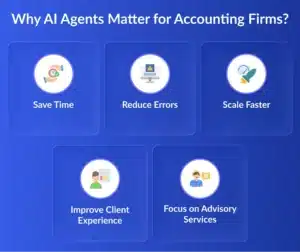
1. Save Time
AI agents handle repetitive and time-consuming tasks such as data entry, document sorting, and transaction categorization. This allows your team to focus on more important work like analysis and decision-making, improving overall productivity.
2. Reduce Errors
Since AI agents follow predefined rules and learn from past data, they perform tasks consistently. This reduces human errors, makes accurate records, and improves the overall quality of accounting work.
3. Scale Faster
With AI agents, firms can handle more clients without increasing staff. Automation takes care of routine work, making it easier to grow the business. In the long run, this also lowers the Cost to develop an AI Agent for an accounting firm compared to continuously hiring and training new employees.
4. Improve Client Experience
AI agents enable faster communication and quicker turnaround times. Clients receive timely updates, reminders, and responses, which improve their overall experience and build stronger relationships with the firm.
5. Focus on Advisory Services
When routine tasks are automated, accountants get more time to focus on high-value services like financial planning, business consulting, and strategy development. This shift helps firms grow beyond basic compliance work and unlock new revenue opportunities.
Conclusion
AI is transforming how accounting firms manage their daily operations, especially when it comes to handling large volumes of client documents. By using an AI Agent in an accounting firm, businesses can automate repetitive tasks like document organization, bookkeeping, and tax preparation with ease.
When you build an AI Agent for accounting, you are not just improving efficiency, you are creating a smarter and more scalable workflow. These agents reduce manual work, improve accuracy, and allow your team to focus on high-value tasks like client advisory and financial planning.
As technology continues to evolve, Agentic AI in an accounting firm will become a standard tool rather than an option. Firms that adopt this early will gain a strong competitive advantage, deliver better client experiences, and grow faster. Partnering with the right AI Agent Development company can help you successfully implement and scale your solution.

FAQs
1. How long does it take to develop an AI agent for an accounting firm?
The time required to develop an AI Agent for CA firms depends on the complexity of features and integrations. A basic solution may take a few weeks, while a more advanced system with automation and learning capabilities can take a few months. Proper planning and clear requirements can speed up the development process.
2. Can AI agents handle sensitive financial data securely?
Yes, AI agents can be designed with strong security measures such as data encryption, secure APIs, and role-based access control. When built correctly, they follow strict compliance standards to protect financial data and maintain client confidentiality at all times.
3. Do AI agents completely replace accountants?
No, AI agents do not replace accountants, they support them. They handle repetitive and time-consuming tasks, allowing accountants to focus on analysis, decision-making, and client advisory services. This makes the role of accountants more strategic and valuable.
4. What factors affect the cost to develop an AI agent for an accounting firm?
The cost to develop an AI Agent for an accounting firm depends on factors like features, integrations, data complexity, and level of automation. Custom-built solutions with advanced AI capabilities may cost more, but they provide better long-term value and efficiency.
5. Can AI agents be integrated with existing accounting tools?
Yes, AI agents are designed to work with existing systems like accounting software, CRM tools, and tax platforms. They integrate simply and help connect different tools, ensuring smooth data flow and reducing manual effort.
6. Is it necessary to hire an AI development company?
While it is possible to build simple solutions internally, working with an AI development company for better quality, faster deployment, and proper scalability. Experts can help design a solution that fits your firm’s exact needs.