


If you want to build an education app, you may feel confused. Should you build an LMS, an eLearning app, or a classroom app? Many schools, startups, and companies ask the same question. The truth is, each type of app solves a different problem.
This guide explains the LMS vs. e-learning app, e-learning app vs classroom app, and LMS vs. classroom app. By the end, you will know which education app you should build for your school, startup, or company.
Global Online Learning Industry Facts & Statistics for 2026
Online learning is growing very fast around the world. Schools, companies, and students now use digital platforms every day.
Here are some important 2026-era and future stats:
- Around 89-93% of organisations use an LMS, and about 55% use cloud-based systems. This shows how important structured learning tools have become.
- The global eLearning market is expected to grow beyond $740 billion by 2032 and may reach $2.28 trillion by 2035.
- A report by Mordor Intelligence says the eLearning market will grow at a 14% yearly rate until 2032.
- Research from Grand View Research shows the U.S. online learning market crossed $112 billion and keeps growing.
- North America holds the largest share of the eLearning market, but the fastest growth is in Asia Pacific.
- According to Statista, there may be 736 million online learners in Asia by 2029.
- In Europe, over 31% of people aged 16-74 already use online learning tools, based on data from Eurostat.
These numbers show one thing clearly: Digital learning is not the thing coming in the future. It is already here.
That is why many businesses and schools now ask, Should I build an LMS, an eLearning app, or a classroom app?
LMS vs eLearning Platform vs Classroom App: What’s the Difference?
Many people feel confused about LMS vs. e-learning app, e-learning app vs classroom app, and LMS vs. classroom app. All three are education apps, but they do different jobs. Let’s understand this:
Definition and Core Functions of LMS
A Learning Management System (LMS) is a software application that helps schools, colleges, and companies deliver, manage, and track learning programs. It acts like the main control room of education where administrators can manage courses, students, and performance data.
The global LMS market was valued at about $13.4 billion and continues to grow quickly as more organizations move to digital training. Many enterprises now use LMS platforms to train employees and students in a structured way.
Core functionalities typically found in LMS systems include:
| Function | Description | Statistic |
|---|---|---|
| Course Management | Helps create, manage, and deliver courses online. | About 78% of organizations use course management features. |
| Tracking and Reporting | Tracks student progress and generates performance reports. | Productivity can increase by around 25% with tracking tools. |
| Assessment and Evaluation | Allows quizzes, tests, and assignments. | Around 80% of learners prefer interactive assessments. |
| User Management | Manages students, teachers, and admin roles. | Approximately 65% of companies say user management is critical. |
| Integration Capabilities | Connects with HR tools, CRM, and other systems. | 90% of organizations require system integrations. |
An LMS supports structured learning and blended education. Studies show that about 70% of learners feel more engaged when using such systems.
Best for:
- Schools and universities
- Corporate training
- Enterprises
If you want the best education app for enterprises, an LMS is usually the right choice.
Definition and Core Functions of eLearning Platforms
An eLearning platform primarily delivers learning content. It helps learners understand topics through videos, quizzes, and interactive lessons. Unlike an LMS, it does not always include heavy management tools.
This is the key difference between LMS and elearning app.
eLearning platforms are fun, flexible, and great for self-paced learning. Startups and course creators often use them.
Core functionalities typically found in eLearning platforms include:
| Function | Description | Statistic |
|---|---|---|
| Video Lessons | Provides recorded lectures and tutorials. | Video learning improves retention by up to 60%. |
| Interactive Content | Includes quizzes, animations, and simulations. | 80% of learners prefer interactive learning. |
| Self-Paced Learning | Allows users to learn anytime. | 70% of learners prefer flexible schedules. |
| Course Library | Offers many topics in one place. | Content variety increases user retention. |
| Certificates | Provides completion certificates. | Certificates improve career opportunities. |
eLearning apps are perfect for content delivery and skill learning. Many startups choose them because they are easier to launch.
Best for:
- Course-selling startups
- Skill learning platforms
- Coaching apps
If you are thinking LMS app or an e-learning app for startups, most startups begin with an e-learning app.
Definition and Core Functions of Classroom Apps (Virtual Classroom)
A classroom app, also called a virtual classroom, allows real-time interaction between teachers and students. It recreates the feel of a physical classroom using video, chat, and live tools.
These apps focus on communication and daily teaching activities rather than full learning management.
Core functionalities typically found in classroom apps include:
| Function | Description | Statistic |
|---|---|---|
| Live Classes | Teachers can teach using video and slides. | Real-time learning can boost engagement by 37%. |
| Chat & Discussion | Students and teachers can communicate instantly. | Collaboration increases course completion by 29%. |
| Homework Sharing | Assignments can be uploaded and reviewed. | Improves student participation. |
| Attendance Tracking | Tracks student attendance in live sessions. | Helps teachers monitor activity. |
| Session Recording | Classes can be recorded for later viewing. | Supports flexible learning pace. |
Classroom apps make learning interactive and social. They are helpful for daily teaching but do not replace a full LMS.
Best for:
- Schools
- Coaching centers
- Tutors
Many schools compare classroom app vs. LMS for schools. A classroom app helps with daily teaching. An LMS manages the entire academic system.
What Are the Pros & Cons of Online Learning?
Online learning is growing fast across schools, colleges, and companies. Many businesses are investing in digital platforms because they make education flexible and easy to access. However, like any system, online learning has both advantages and challenges.
Advantages of Online Learning
1. Learn Anything, Anytime
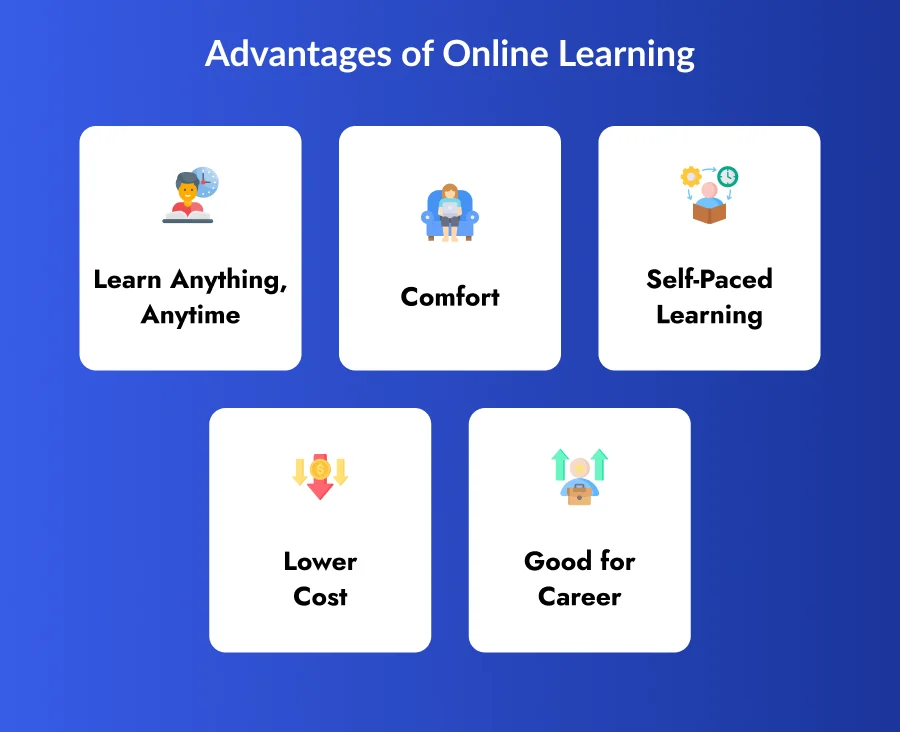
One of the biggest benefits of online learning is freedom. Students can learn almost any subject on the internet. They can study coding, languages, science, business, design, or even hobbies like music and art.
They do not need to move to another city or country. They can learn from their home using a phone, tablet, or laptop. This flexibility is why many organizations invest in eLearning app development for enterprises. Companies use online learning platforms to train employees and help them gain new skills without stopping work.
Online learning makes education available to everyone, no matter where they live.
2. Comfort
Online learning allows students to study from their own space. They do not need to travel to school or sit in classrooms for long hours. This saves time and energy.
Students can learn while sitting at home, in a library, or even while traveling. They only need a stable internet connection and a device. This comfort makes learning easier, especially for working professionals and students who have busy schedules.
However, learners should still create a proper study space so they can stay focused and avoid distractions.
3. Self-Paced Learning
Online learning gives students control over their schedule. They can learn at their own speed. If a topic feels difficult, they can pause and review it again. If it is easy, they can move faster.
This is very helpful for working people, parents, and students with busy routines. Many modern platforms also use AI recommendation systems. These smart tools analyze user progress and suggest lessons based on strengths and weaknesses. This makes learning more personal and effective.
Self-paced learning helps students feel less pressure and understand topics better.
4. Lower Cost
Online education is often cheaper than traditional classroom learning. Students do not need to pay for travel, accommodation, or physical materials. Many courses are available at low cost, and some are even free.
Companies also save money when they train employees online instead of arranging in-person training sessions. Because of these cost benefits, many businesses and schools prefer digital learning platforms.
Affordable education means more people can learn new skills and improve their careers.
5. Good for Career
Online certificates and training programs add value to resumes. They show that a person is willing to learn and improve. Many employers appreciate candidates who keep learning new skills.
Professionals can take short online courses to upgrade their knowledge. This helps them get promotions, better jobs, and new opportunities. Continuous learning has become very important in today’s fast-changing world.
Disadvantages of Online Learning
1. Less Social Interaction
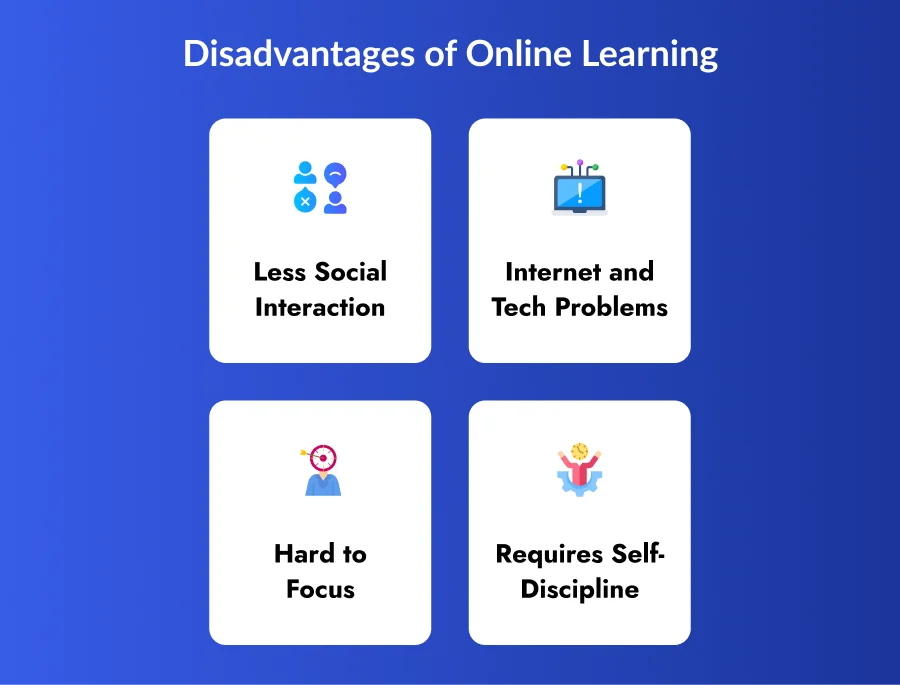
In traditional classrooms, students interact with teachers and classmates every day. They ask questions, discuss ideas, and build friendships. In online learning, this interaction is limited.
Even though platforms offer chat, video calls, and discussion boards, it is still not the same as face-to-face communication. Some students may feel lonely or less connected. This can affect motivation and learning experience.
2. Internet and Tech Problems
Online learning depends heavily on technology. Students need a stable internet connection and working devices. If the internet is slow or the system crashes, learning gets interrupted.
Some teachers and students also find it difficult to use new tools and platforms at first. They may need training to understand how to upload files, attend live classes, or create presentations.
Technical issues can slow down learning if proper support is not available.
3. Hard to Focus
Learning from home can be distracting. Students may get interrupted by noise, mobile phones, or other activities. Teachers also cannot always see if students are paying attention.
Without a physical classroom environment, it becomes harder to keep learners engaged. This is why many platforms now use quizzes, videos, and interactive tools to maintain attention.
Still, staying focused in online learning requires strong personal effort.
4. Requires Self-Discipline
Online learning works best for students who are motivated and organized. Since there is no fixed classroom schedule, learners must manage their time properly.
Some students may delay lessons or skip classes. Without discipline, they may not complete courses. That is why self-motivation and planning are very important in online education.
Students who set goals and follow a study routine benefit the most from online learning.
LMS or eLearning Platform or Classroom App: Which One Should You Choose?
This is one of the most important questions before starting development: Which type of education app should you build?
The right choice depends on your business model, audience, and long-term goals. Each type of app serves a different purpose, so understanding the differences will help you invest wisely.
Build an LMS If:
- You run a school or university: An LMS (Learning Management System) helps institutions manage courses, students, assignments, exams, and performance in one place. It acts as a complete digital education system for structured learning.
- You train employees: Companies use LMS platforms to onboard new staff, deliver compliance training, and upskill teams. Employees can access training modules anytime, while managers track completion and performance.
- You need reports and tracking: LMS platforms offer detailed analytics such as student progress, course completion rates, test scores, and engagement data. This is essential for organizations that want measurable learning outcomes.
- You manage many users: If your platform will handle hundreds or thousands of users, students, teachers, admins, or employees, an LMS provides role-based access, dashboards, and centralized control.
It supports structured programs, certifications, and long-term learning management. That’s why many companies invest in LMS development for internal training and academic systems.
Build an eLearning App If:
- You want to sell courses: If your main goal is to monetize content through paid courses, subscriptions, or memberships, an eLearning app is ideal. It focuses on content delivery, payments, and user experience.
- You are a startup: Startups usually begin with an eLearning app because it is faster and more cost-effective to launch. You can validate your idea, attract users, and start generating revenue before expanding into a full LMS.
- You focus on content: An eLearning platform is perfect when your main strength is course content, video lessons, recorded sessions, quizzes, and downloadable materials. The focus is on learning experience rather than heavy management features.
- You want global users: If you plan to reach learners worldwide, an eLearning app allows easy access, multilingual support, and online payments. You can scale quickly and build a global audience.
For most startups, the common approach is to start with an eLearning app, validate the market, and later upgrade to an LMS when you need advanced management features.
Build a Classroom App If:
- You run a school: A classroom app works best for daily academic operations like attendance, homework sharing, announcements, and communication between teachers, students, and parents.
- You need live classes: If real-time teaching is your main requirement, a classroom app supports live video sessions, chat, screen sharing, and interactive learning tools.
- You want teacher-student communication: Classroom apps make it easy for teachers and students to interact through messages, discussions, and instant updates. This improves engagement and keeps everyone connected.
A classroom app is great for day-to-day teaching and communication, while an LMS is better for complete course management, assessments, and long-term learning tracking.
What Does The Future Classroom Look Like?
The future classroom is digital, smart, and interactive. Modern trends in education apps are reshaping how students learn and engage with content.
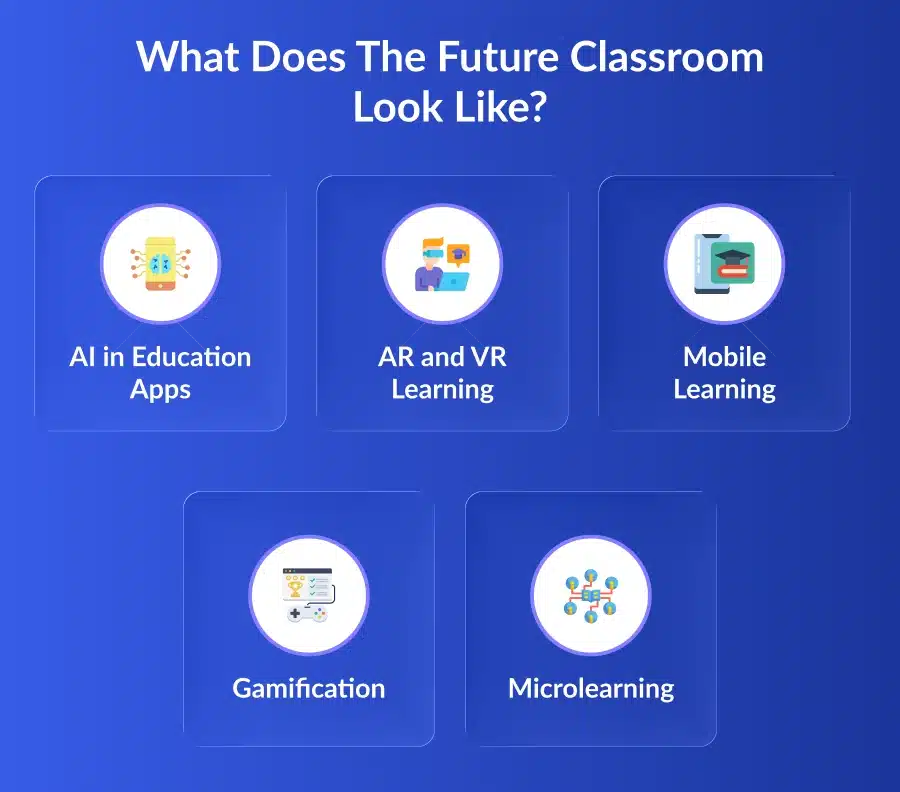
1. AI in Education Apps
AI personalizes learning by tracking student progress and suggesting lessons based on performance. Features like chatbots, smart tutors, auto-grading, and AI recommendation systems help students learn faster and more efficiently.
2. AR and VR Learning
AR and VR create immersive learning experiences through virtual labs, simulations, and 3D environments. These tools help students understand complex topics better and make learning more engaging.
3. Mobile Learning
Most students now learn through smartphones and tablets. Mobile apps allow users to attend classes, watch lessons, and complete tasks anytime and anywhere, making learning more flexible.
4. Gamification
Gamification adds elements like points, badges, levels, and rewards to make learning fun. This keeps students motivated, improves engagement, and encourages regular learning.
5. Microlearning
Microlearning delivers short lessons that take only a few minutes to complete. These quick sessions improve focus, help with better memory retention, and fit easily into busy schedules.
Conclusion
Choosing between an LMS, eLearning app, or classroom app depends on your goals, users, and long-term vision. If you need structured learning with tracking and reports, an LMS is the right choice. If your focus is on selling courses and reaching global learners, an eLearning app works best. If real-time teaching and communication are your priority, a classroom app is ideal.
As digital education continues to grow, investing in the right type of platform can help schools, startups, and enterprises scale faster and deliver better learning experiences. Whether you are building a new product or upgrading an existing system, working with the right development partner is essential.
Developer Bazaar Technologies a reputable education app development company specializes in building scalable LMS platforms, eLearning apps, and classroom solutions tailored to your business needs. Their team helps you plan, design, and launch a powerful education app that supports modern learners and future growth.

FAQs
1. What is the main difference between an LMS and an eLearning app?
An LMS focuses on managing courses, users, reports, and performance tracking, while an eLearning app mainly delivers content like videos, quizzes, and self-paced lessons.
2. Which education app is best for startups?
Most startups begin with an eLearning app because it is faster to launch and easier to monetize. As the platform grows, it can later be expanded into a full LMS.
3. Can one platform include LMS, eLearning, and classroom features together?
Yes. Many modern platforms combine all three features. For example, an LMS can include live classroom tools and eLearning content in one system.
4. How much does it cost to build an education app?
The cost depends on features, design, platform (iOS, Android, web), and development complexity. A simple app costs less, while a full LMS with advanced features requires a larger budget.
5. Which app is best for schools and coaching centers?
Schools often use classroom apps for daily teaching and communication, but larger institutions prefer LMS platforms for full course management, tracking, and reporting.

RM Mishra
Co-Founder
Developer Bazaar technologies