

Did you know how much does it really cost to build a smart queue management system in 2026? In 2026, many businesses want to reduce long waiting lines and provide faster service.
A queue management system helps achieve this by managing customers efficiently. When powered by AI, it can predict busy hours, guide customers, and save time for both staff and visitors.
In this blog, we explain what an AI-powered queue management system is, how big the market is, how much it costs to build queue management system in 2026, and what factors affect the final cost.
What Is an AI-Powered Queue Management System?
An AI-powered queue management system is a smart digital system that helps people stand in virtual lines instead of physical ones. Customers can join the queue using a mobile app, QR code, or kiosk screen.
The system uses artificial intelligence to guess waiting time, manage counters, and guide customers to the right service desk. It helps places like hospitals, banks, retail stores, restaurants, and government offices give faster and smoother service.
The Queue Management System Market is worth $0.6 billion by 2026
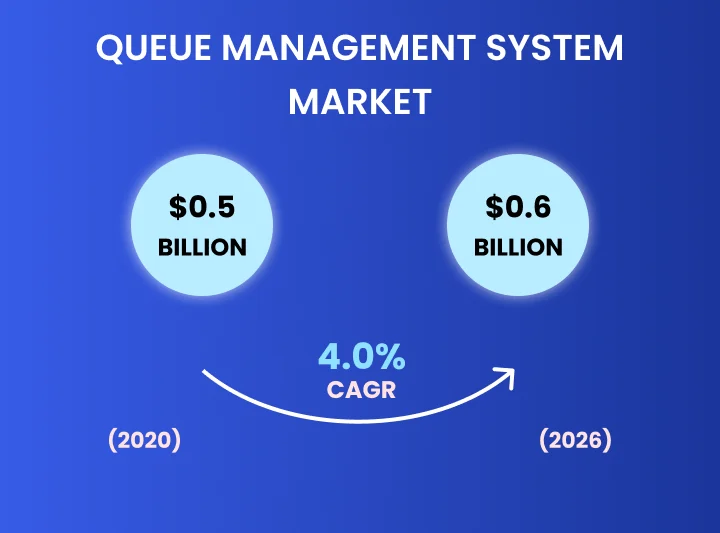
The global queue management system market is expected to be worth around $0.6 billion by 2026. More businesses are using these systems to manage large crowds and reduce waiting time.
This growth is happening because customer experience is very important today. Offices, hospitals, and shops want smart tools that improve staff efficiency and keep customers happy, especially in busy locations.
According to market reports, the queue management system market is growing steadily from $0.5 billion in 2020 to $0.6 billion by 2026, with a 4.0% CAGR during this period. The rising need to control customer traffic and improve movement inside service areas is a key reason for this growth.
Queue management systems are now widely used in places with high footfall, such as hospitals, banks, airports, government offices, and retail stores.
During and after COVID-19, businesses also started adopting QMS solutions to reduce crowding, shorten on-site waiting time, and prevent customers from leaving due to long queues.
Cost of building an AI queue management system in 2026
The cost of developing an AI queue management system in 2026 depends on the feature set, system scale, and business size.
Simple systems cost less, while advanced AI-driven platforms require a higher budget. In general, development costs fall into three clear categories: Basic, Mid-Level, and Enterprise.
Queue Management System Cost Breakdown
| System Level | Estimated Cost (USD) | Best Suited For | Key Features Included |
|---|---|---|---|
| Basic Queue Management System | $15,000 - $30,000 | Small clinics, salons, local service centers | Digital token generation, simple display screens, basic dashboards, and standard reports |
| Mid-Level Queue Management System | $30,000 - $50,000 | Banks, hospitals, restaurants, retail chains | Wait-time prediction, smart counter routing, QR-based check-ins, customer alerts, and virtual queues |
| Enterprise Queue Management System | $50,000 - $80,000+ | Airports, government offices, hospital networks | Facial recognition, advanced analytics, multi-branch control, system integrations, and high-level security |
Each level is designed to match different business needs. While basic systems help businesses shift from manual queues to digital flow, enterprise solutions support large-scale operations with advanced AI, automation, and strong data protection.
Major Factors That Influence the Cost of Queue Management System
The cost of an AI queue management system is not the same for every business. It depends on technical requirements, business size, and how the system will be used. Each design choice, feature, and deployment method directly impacts the final development cost.
1. Scope and Complexity of Features
Simple features such as token display and basic queue flow cost less to build. When advanced features like real-time predictions, smart routing, and multi-location control are added, development time increases. More complex features require additional testing and system optimization, which raises the overall cost.
2. AI and Machine Learning Capabilities
A system based on basic logic is more affordable than one powered by AI and machine learning. Features like predicting wait time, analyzing customer data, and learning from patterns need trained models and data processing. These AI capabilities require more development effort and increase project cost.
3. Custom vs Ready-Made Solution
Ready-made systems are faster to deploy and cost less because they use existing templates. However, they offer limited flexibility and customization. A custom-built solution costs more but fits your business needs better and supports long-term growth and scalability.
4. Integration Requirements
When a system connects with CRM, ERP, POS, or hospital software, development becomes more complex. Each integration needs secure APIs, testing, and performance checks. More integrations mean higher development time and added cost.
5. Deployment Model
Cloud-based systems are easier to scale and usually cost less upfront. On-premise systems require physical servers, extra security layers, and ongoing maintenance. These additional infrastructure needs increase the overall cost.
6. Compliance and Security Needs
Industries like healthcare and banking must follow strict data protection rules. Adding encryption, access control, and security checks takes extra development effort. Meeting compliance standards increases both development and testing costs.
7. UI & UX Experience
A clean and simple design improves usability for customers and staff. Multilingual screens, kiosk-friendly layouts, and smooth navigation require extra design planning. Better user experience design increases design time and overall cost.
8. Hardware Requirements
If the system includes kiosks, display screens, scanners, or biometric devices, hardware costs must be added. Hardware setup, integration, and maintenance also affect the budget. More devices mean higher overall expenses.
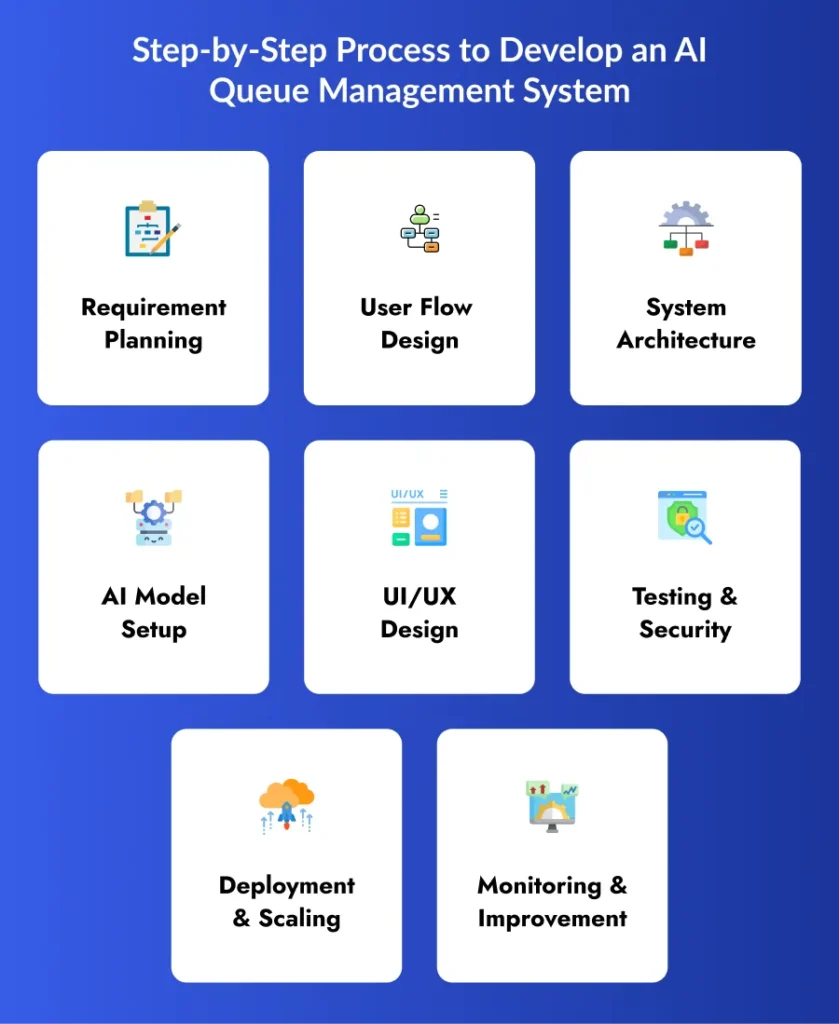
Step-by-Step Process to Develop an AI Queue Management System
To develop an AI-powered queue solution successfully, businesses must follow a simple and structured process. Each step helps the system work smoothly, stay secure, and give customers a better waiting experience.
1. Requirement Planning
The first step to develop a queue management system is to clearly understand business needs. Teams study customer flow, peak hours, service types, and common waiting issues. This step helps decide which features the AI QMS must have. Clear planning also helps control the cost to develop AI queue management system and avoid extra features.
2. User Flow Design
Designers plan how customers move through the queue system step by step. This includes walk-ins, appointments, QR check-ins, and kiosk usage. A smooth flow makes waiting less confusing and stressful. A clear user journey helps businesses create AI QMS that feels simple and user-friendly.
3. System Architecture
Developers design how all parts of the system connect and work together. This includes mobile apps, kiosks, dashboards, and databases. A scalable structure allows the system to grow easily in the future. Strong planning is important when you build AI QMS for places with heavy footfall.
4. AI Model Setup
This step adds intelligence to the system. AI predicts wait times, improves queue routing, and supports better staff planning. AI recommendation tools guide customers to the right service counter. Advanced tools like AI face recognition system also begin at this stage.
5. UI/UX Design
Designers create simple and clear screens for kiosks, mobile apps, and staff panels. Multilingual support and easy layouts help users of all ages. Good design improves adoption when businesses develop AI powered queue management system.
6. Testing & Security
Before launch, the system is tested for speed, accuracy, and security. Teams check how it performs during busy hours and ensure data safety. This step makes sure the software runs smoothly and protects user information.
7. Deployment & Scaling
The system is launched on cloud or on-premise servers based on business needs. Developers enable scaling so it can handle more users during peak times. This makes sure the AI QMS stays stable and responsive after launch.
8. Monitoring & Improvement
After launch, teams track performance and user behavior. AI models improve over time by learning from real data. Regular updates help reduce the future cost to develop queue management system again and keep the system efficient.
Benefits of an AI-Powered Queue Management System
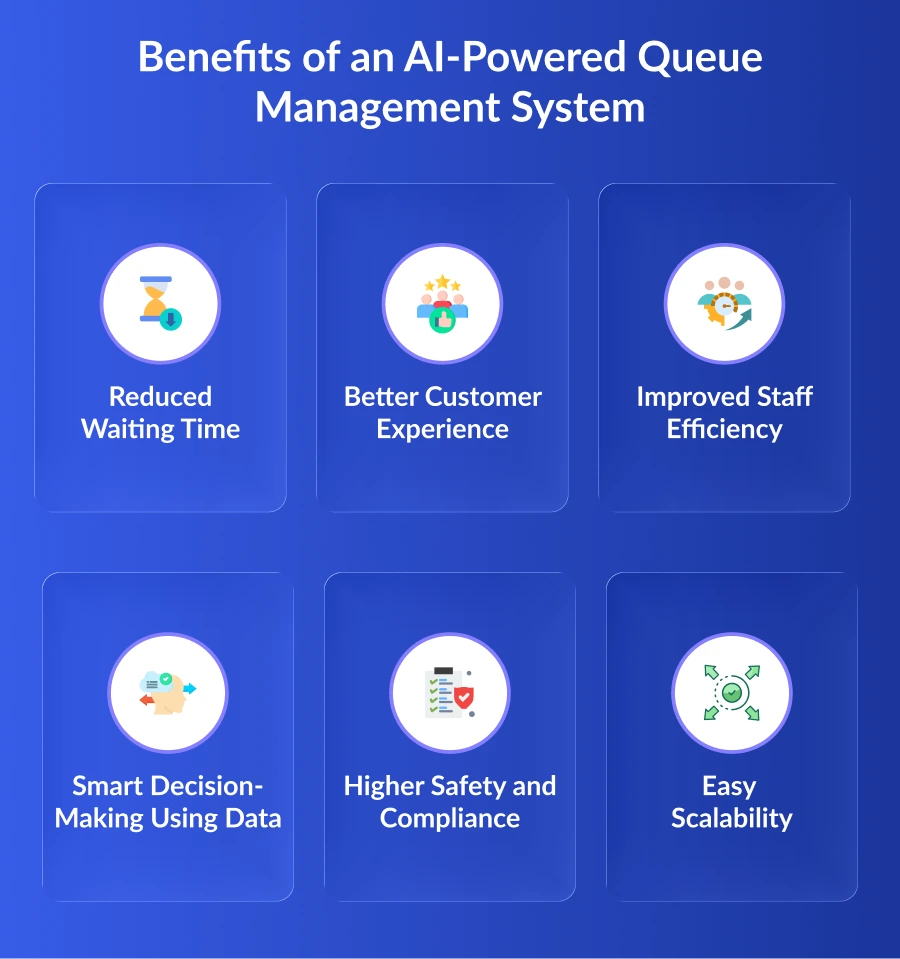
An AI-powered queue management system helps businesses manage customer flow in a smart way. It saves time, reduces pressure on staff, and improves service quality. Below are the key benefits:
1. Reduced Waiting Time
AI predicts busy hours and adjusts queues automatically. Customers get faster service and spend less time standing or waiting. This is a major reason why businesses choose to build AI QMS.
2. Better Customer Experience
Virtual queues, mobile alerts, and contactless check-ins make the process smooth. Customers clearly know when their turn is coming. A good experience increases trust in the AI queue management system.
3. Improved Staff Efficiency
AI assigns staff based on real-time demand. Teams focus on the right tasks instead of managing long lines. This helps businesses develop AI powered queue management system without hiring extra staff.
4. Smart Decision-Making Using Data
The system collects data on wait time, foot traffic, and service speed. Managers use this data to improve daily operations. These insights help reduce delays and improve planning.
5. Higher Safety and Compliance
AI controls crowd size and manages customer movement safely. Features like biometric access and secure data handling improve safety. This benefit is important for healthcare, banking, and government services using AI QMS.
6. Easy Scalability
AI queue systems grow as the business grows. New counters, kiosks, or branches can be added without problems. This makes the cost to develop AI queue management system worth it in the long run.
Future Trends in AI-Powered Queue Management Systems
AI-powered queue management systems are becoming more advanced and intelligent each year. In the future, these systems will focus on automation, smart prediction, and personalized customer service. Businesses that develop AI-powered queue management system today will stay ready for tomorrow’s needs.
1. Predictive Analytics for Forecasting
AI will study past and live data to predict busy hours in advance. Businesses can plan staff and counters before crowds arrive. This reduces long waiting lines and makes queue handling smoother.
2. Fully Automated Queue Control
Future AI systems will manage queues on their own without human support. They will move customers, open counters, and balance queues automatically. This helps businesses save time and improve accuracy when they build AI QMS.
3. Biometric and Emotion Detection
AI face recognition system will identify customers quickly and securely. Emotion detection will notice if a customer feels confused or frustrated. Staff can react faster and improve service quality using AI insights.
4. Computer Vision and IoT Integration
Cameras and smart sensors will watch crowd movement in real time. AI will take instant action when areas become too crowded. This improves safety and smooth customer flow in an AI queue management system.
5. AI Chatbots and Smart Alerts
AI chatbots will answer customer questions about wait time and service status. Smart alerts will send updates to mobile phones or kiosks. This keeps customers informed and relaxed while waiting in the queue.
Conclusion
AI-powered queue management systems are no longer optional for modern businesses. They reduce waiting time, improve customer experience, and help organizations work efficiently. As demand grows, the cost to develop an AI queue management system becomes a smart long-term investment.
Working with a trusted AI development company or software development company ensures secure, scalable, and future-ready solutions. Businesses that develop AI QMS today will stay ahead in the future competitive market with faster service and happier customers.
Developer Bazaar Technologies helps businesses design and build reliable AI-powered queue management systems tailored to their needs. With expert planning, smart AI features, and strong technical support, Developer Bazaar Technologies makes it easier to launch and scale a future-ready queue solution.
FAQs
1. What are the main types of queuing systems?
The primary types are First-In-First-Out (FIFO), Last-In-First-Out (LIFO), and Service-In-Random-Order (SIRO). Each type manages customer flow differently, so businesses should choose the system that fits their service needs best.
2. How can businesses manage queues effectively?
Effective queue management uses clear time slots, monitors wait times, and reallocates staff when needed. Using a queue management system and analyzing queue data helps reduce delays and improve customer satisfaction.
3. Why is queue management important?
Queue management prevents long waits and bottlenecks, saves labor costs, and improves safety. It also enhances customer experience by making service faster, smoother, and more predictable.
4. Can AI-powered queue management systems support multiple branches?
Yes, AI QMS can control and monitor queues across many branches from a single dashboard. This ensures consistent service and easier management for large organizations.
5. Does AI queue management work without the internet?
Some basic features work offline, but AI functions like wait-time prediction and smart routing require an internet connection. Online access ensures the AI QMS performs optimally.
6. How long does it take to develop an AI queue management system?
It typically takes 3 to 6 months, depending on system complexity and features. Large enterprise-level systems may take longer due to advanced AI, integrations, and compliance requirements.

RM Mishra
Co-Founder
Developer Bazaar technologies