

Key Takeaways:
-
- AI predictive maintenance prevents equipment failures before they happen by analyzing real-time sensor data and identifying early warning signs.
- Predictive maintenance with AI is more efficient than reactive or preventive maintenance, helping businesses reduce downtime, repair costs, and unnecessary servicing.
- AI integration is critical because it connects predictive insights with CMMS, ERP, IoT, and maintenance workflows to automate work orders and scheduling.
- Industries such as manufacturing, energy, transportation, healthcare, and facility management are already using AI-based predictive maintenance to improve asset reliability.
- Successful implementation depends on quality data, proper system integration, and scalable AI models, making experienced AI software development services an important part of deployment.
- Businesses can start small with critical assets and expand over time, reducing implementation risks while maximizing long-term ROI.
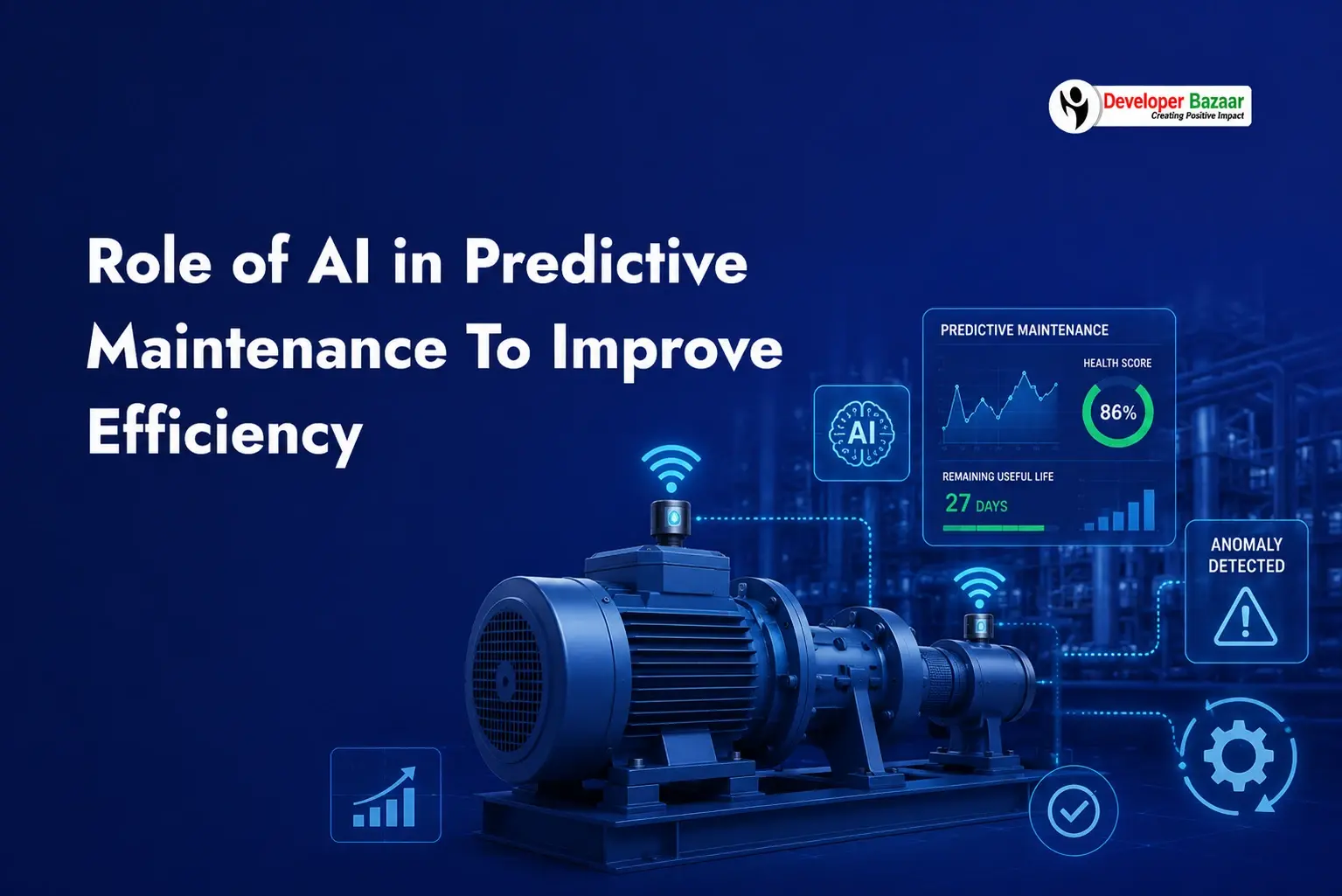
Machines break down. It happens in every factory, every plant, and every warehouse. A broken machine stops work. It costs money. It makes workers wait. But what if a machine could tell people it was about to break, days or weeks before it actually did? This is exactly what AI in predictive maintenance does.
Today, companies use AI in predictive maintenance to watch their machines every second of the day. Smart sensors collect data. AI studies that data. Then it warns the team about problems early.
This blog explains how AI-based predictive maintenance works, why it helps businesses, what challenges come with it, and how AI development services can help companies build these smart systems.
What Is Predictive Maintenance With AI?
Predictive maintenance with AI means using artificial intelligence to guess when a machine might fail. It does not wait for the machine to break. It does not follow a fixed calendar either. Instead, it watches the real condition of the machine all the time.
Think of it like a doctor checking your health. A doctor does not wait for you to get very sick. The doctor checks your blood pressure, heart rate, and temperature. If something looks wrong, the doctor acts early. AI in predictive maintenance works the same way for machines.
There are three common ways businesses maintain their equipment:
- Reactive maintenance: Fix the machine only after it breaks.
- Preventive maintenance: Fix or check the machine on a fixed schedule, whether it needs it or not.
- Predictive maintenance: Use real data and AI to fix the machine exactly when it needs help, and not before or after.
Out of these three, predictive maintenance saves the most time and money because it acts on facts, not guesses.
How AI in Predictive Maintenance Works
AI-based predictive maintenance follows a clear step-by-step process. Here is how it works:
- Sensors collect data: Small sensors sit on machines and record things like heat, sound, vibration, and pressure.
- Data moves to the cloud: This information travels to a central computer system, often through the internet.
- AI studies the data: Machine learning models look for patterns that usually happen before a machine fails.
- AI spots warning signs: The system notices small changes that a human eye might miss.
- Teams get an alert: Workers receive a warning message before the machine actually breaks down.
- Maintenance happens on time: The team fixes or replaces the part at the right moment, not too early and not too late.
This cycle repeats nonstop. The more data the AI collects, the smarter and more accurate it becomes over time.
Traditional Maintenance vs. AI-Based Predictive Maintenance
| Factor | Traditional Maintenance | AI-Based Predictive Maintenance |
|---|---|---|
| When repairs happen | After breakdown or on a fixed schedule | Exactly when the machine needs it |
| Data used | Little to no | Live sensor data and history |
| Downtime | High and unplanned | Low and planned |
| Cost over time | Higher due to emergency repairs | Lower due to early action |
| Equipment life | Shorter | Longer |
Why AI Integration Matters in Predictive Maintenance
As AI predictive maintenance adoption grows, AI integration has become essential. According to Future Market Insights, the AI-driven Predictive Maintenance Market is expected to grow from USD 2.23 billion in 2026 to USD 3.20 billion by 2036, at a 12.7% CAGR, with integrated solutions accounting for 63% of the market in 2026. This reflects the growing demand for connected maintenance platforms.
AI integration connects AI tools with existing systems like CMMS, ERP software, IoT sensors, and maintenance dashboards. Instead of only sending alerts, the system can automatically create work orders, schedule repairs, check spare parts availability, and assign technicians.
By enabling data to flow across business systems, AI integration reduces manual work, speeds up maintenance decisions, minimizes downtime, and helps organizations get the full value of their AI predictive maintenance investment.
Benefits of Predictive Maintenance AI
Companies around the world now use AI-Based Predictive Maintenance to run their operations better. Studies from firms like Deloitte and McKinsey point to strong, repeated gains once teams put AI into daily use.
Below are the biggest benefits:
| Benefit | Typical Improvement |
|---|---|
| Less unplanned downtime | 30% to 50% fewer surprise breakdowns |
| Lower maintenance costs | 18% to 30% savings compared to fixed-schedule repairs |
| Longer equipment life | 20% to 40% longer working life for machines |
| Fewer breakdowns | Up to 70% drop in sudden equipment failures |
| Faster return on investment | Many teams see payback within 8 to 18 months |
These numbers show why more manufacturing plants, hospitals, airlines, and energy companies are moving toward AI-driven maintenance in 2026.
Where AI Predictive Maintenance Is Used
AI-powered predictive maintenance is helping organizations across industries reduce equipment failures, improve operational efficiency, and lower maintenance costs.
By continuously analyzing sensor data and equipment performance, AI detects potential issues before they become costly breakdowns.
1. Manufacturing
AI-driven predictive maintenance helps manufacturers monitor production equipment, such as motors, conveyors, pumps, and assembly lines, in real time. Identifying early signs of wear, overheating, or changes in vibration helps prevent unexpected breakdowns and reduce costly production downtime.
2. Energy & Utilities
Power plants, wind farms, and utility providers use AI to monitor turbines, transformers, generators, and other critical assets. The technology detects potential failures before they occur, improving equipment reliability while reducing maintenance costs and unplanned outages.
3. Transportation & Logistics
Railway operators, fleet managers, airlines, and logistics companies rely on AI to track the condition of vehicles, tracks, engines, and infrastructure. Predictive insights help schedule maintenance proactively, improve safety, and extend the lifespan of transportation assets.
4. Healthcare
Hospitals use AI predictive maintenance to continuously monitor medical equipment such as MRI scanners, CT machines, ventilators, and patient monitoring systems. This ensures critical devices remain operational, minimizes service interruptions, and supports uninterrupted patient care.
5. Commercial Buildings & Facilities
Facility managers use AI to monitor HVAC systems, elevators, generators, lighting systems, and other building infrastructure. Predictive maintenance helps reduce unexpected equipment failures, improve energy efficiency, and ensure smooth day-to-day operations.
AI Predictive Maintenance Challenges
While AI predictive maintenance offers significant benefits, implementing it successfully requires careful planning. Organizations may face technical, operational, and organizational challenges during adoption. Understanding these obstacles helps businesses build a smoother implementation strategy and maximize long-term ROI.
1. High Initial Investment
Implementing an AI predictive maintenance system requires investment in IoT sensors, monitoring devices, cloud infrastructure, AI software, and system integration. Although the upfront costs can be substantial, the long-term savings from reduced downtime, fewer emergency repairs, and longer equipment life often outweigh the initial expense.
2. Poor Data Quality
The accuracy of AI predictive maintenance depends heavily on the quality of the data it analyzes. Incomplete, outdated, or inconsistent sensor data can lead to inaccurate predictions and missed equipment failures. Businesses must establish reliable data collection, storage, and validation processes to ensure the AI model delivers dependable insights.
3. Lack of Skilled Professionals
Successfully deploying AI-powered predictive maintenance requires expertise in AI, machine learning, data analytics, and industrial operations. Many organizations face a shortage of professionals with these specialized skills, making implementation, model training, and ongoing optimization more challenging.
4. Legacy Equipment Limitations
Many older machines were not designed with digital monitoring capabilities. Retrofitting legacy equipment with sensors and connectivity devices can be complex, time-consuming, and expensive. In some cases, organizations may need additional hardware or customized solutions to enable predictive maintenance capabilities.
5. Integration with Existing Systems
AI predictive maintenance platforms must work seamlessly with existing maintenance management systems, ERP software, IoT platforms, and operational databases. Poor integration can create data silos, disrupt workflows, and reduce the effectiveness of predictive insights, making proper system compatibility essential.
6. Building Trust in AI Recommendations
Maintenance teams often rely on years of hands-on experience when making repair decisions. As a result, some employees may initially hesitate to trust AI-generated alerts or maintenance recommendations. Building confidence requires accurate predictions, transparent reporting, employee training, and demonstrating measurable results over time.
Most of these challenges become smaller over time. Companies that start with one or two important machines, collect good data, and grow step by step usually see success.
How AI Software Development Services Help
Implementing an AI predictive maintenance solution requires more than just installing sensors or using AI software. It involves building custom AI models, integrating multiple systems, securing data, and ensuring the solution fits existing business operations. This is where AI software development services make a significant difference.
An experienced AI development services provider helps businesses:
- Assess equipment and data readiness: Evaluate existing machines, identify critical assets, and recommend the right IoT sensors and data collection strategy.
- Develop custom AI models: Build and train machine learning models using the company’s historical equipment and maintenance data for more accurate failure predictions.
- Enable seamless AI integration: Connect the predictive maintenance platform with existing CMMS, ERP systems, IoT devices, and maintenance workflows for automated operations.
- Test and deploy the solution: Validate the AI system through rigorous testing before rolling it out across production environments.
- Train maintenance teams: Help employees understand AI-generated insights, respond to alerts effectively, and adopt new maintenance processes with confidence.
- Continuously optimize performance: Monitor the AI models, retrain them with new data, and improve prediction accuracy as equipment usage evolves.
By partnering with a trusted AI software development services company, businesses can implement AI-powered predictive maintenance without building an in-house AI team.
The development partner manages the technical complexity while the organization focuses on improving equipment reliability, reducing downtime, and increasing operational efficiency.
Conclusion
AI in predictive maintenance changes how businesses care for their machines. Instead of waiting for equipment to fail or following rigid maintenance schedules, businesses can use AI in predictive maintenance to identify problems early, reduce downtime, extend asset life, and optimize maintenance spending.
While implementation requires the right data, integration, and technical expertise, the long-term benefits far outweigh the initial investment.
By partnering with Developer Bazaar Technologies, an experienced AI software development services provider, organizations build scalable AI-powered predictive maintenance solutions that integrate smoothly with existing systems and deliver measurable operational improvements.
FAQs
1. Which machines should businesses monitor first with AI predictive maintenance?
Start with high-value or business-critical equipment that causes the greatest production losses when it fails. Monitoring these assets first delivers faster ROI and provides a strong foundation for expanding the solution.
2. How much historical data is needed to train an AI predictive maintenance model?
While requirements vary by industry, AI models perform best when trained on several months of equipment sensor readings, maintenance records, and failure history. If historical data is limited, models can continue improving as new operational data is collected.
3. Can AI predictive maintenance work with existing IoT sensors?
In many cases, yes. Modern AI integration platforms can connect with existing IoT sensors, PLCs, and industrial monitoring systems. Additional sensors are usually required only when critical operating data is unavailable.
4. How often should AI models be retrained?
AI models should be reviewed and retrained whenever equipment conditions, operating environments, or production processes change significantly. Regular retraining helps maintain prediction accuracy as new data becomes available.
5. What happens if the AI predicts a failure that doesn’t occur?
Occasional false alerts are expected, especially during the early stages of deployment. As more operational data is collected and the AI model is refined, prediction accuracy improves and unnecessary alerts decrease.
6. How does AI integration improve maintenance workflows?
Instead of simply notifying maintenance teams, AI integration can automatically create work orders, schedule technicians, check spare parts inventory, and update maintenance records, reducing manual tasks and accelerating response times.
7. Should businesses replace preventive maintenance completely with AI predictive maintenance?
Not immediately. Many organizations adopt a hybrid approach where preventive maintenance continues for selected assets while AI-based predictive maintenance is gradually introduced for critical equipment and expanded over time.
8. What should businesses look for in an AI software development services partner?
Choose a provider with expertise in industrial AI, IoT integration, machine learning, cloud infrastructure, and enterprise system integration. Experience with predictive maintenance projects and ongoing model optimization is equally important.